



 Chat with AI
Exam 10: The Complete Blood Count and Peripheral Blood Smear Evaluation

Exam 1: Introduction30 Questions
Exam 2: Cellular Homeostasis40 Questions
Exam 3: Structure and Function of Hematopoietic Organs35 Questions
Exam 4: Hematopoiesis35 Questions
Exam 5: The Erythrocyte37 Questions
Exam 6: Hemoglobin40 Questions
Exam 7: Granulocytes and Monocytes30 Questions
Exam 8: Lymphocytes25 Questions
Exam 9: The Platelet16 Questions
Exam 10: The Complete Blood Count and Peripheral Blood Smear Evaluation35 Questions
Exam 11: Introduction to Anemia35 Questions
Exam 12: Anemias of Disordered Iron Metabolism and Heme Synthesis36 Questions
Exam 13: Hemoglobinopathies: Qualitative Defects33 Questions
Exam 14: Thalassemia32 Questions
Exam 15: Megaloblastic and Nonmegaloblastic Macrocytic Anemias34 Questions
Exam 16: Hypoproliferative Anemias32 Questions
Exam 17: Hemolytic Anemia: Membrane Defects36 Questions
Exam 18: Hemolytic Anemia: Enzyme Deficiencies36 Questions
Exam 19: Hemolytic Anemia: Immune Anemias30 Questions
Exam 20: Hemolytic Anemia: Nonimmune Defects30 Questions
Exam 21: Nonmalignant Disorders of Leukocytes: Granulocytes and Monocytes35 Questions
Exam 22: Nonmalignant Lymphocyte Disorders32 Questions
Exam 23: Introduction to Hematopoietic Neoplasms34 Questions
Exam 24: Myeloproliferative Neoplasms44 Questions
Exam 25: Myelodysplastic Syndromes34 Questions
Exam 26: Acute Myeloid Leukemias35 Questions
Exam 27: Precursor Lymphoid Neoplasms34 Questions
Exam 28: Mature Lymphoid Neoplasms39 Questions
Exam 29: Hematopoietic Stem Cell Transplantation41 Questions
Exam 30: Morphologic Analysis of Body Fluids in the Hematology Laboratory39 Questions
Exam 31: Primary Hemostasis35 Questions
Exam 32: Secondary Hemostasis and Fibrinolysis33 Questions
Exam 33: Disorders of Primary Hemostasis35 Questions
Exam 34: Disorders of Secondary Hemostasis34 Questions
Exam 35: Thrombophilia34 Questions
Exam 36: Hemostasis: Laboratory Testing and Instrumentation41 Questions
Exam 37: Hematology Procedures46 Questions
Exam 38: Bone Marrow Examination34 Questions
Exam 39: Automation in Hematology38 Questions
Exam 40: Flow Cytometry34 Questions
Exam 41: Chromosome Analysis of Hematopoietic and Lymphoid Disorders35 Questions
Exam 42: Molecular Analysis of Hematologic Diseases18 Questions
Select questions type


What is one of the disease states associated with the presence of target cells?

Free
(Multiple Choice)
4.8/5  (76)
(76) Correct Answer: Verified
B
Acanthocytes or spur cells have membranes with irregular distribution of spikes.What other significant feature does this cell possess?
Free
(Multiple Choice)
4.8/5 (84)
(84) Correct Answer:Verified
VerifiedD
How would you differentiate between an acanthocyte and an echinocyte?
Free
(Multiple Choice)
4.9/5 (78)
(78) Correct Answer:Verified
VerifiedA
Which RBC inclusion is characterized by diffusely staining RNA precipitate that can be seen when blood is stained with Wright's stain?
(Multiple Choice)
4.8/5 (87)
(87) What should be reported about the RBCs indicated by the arrows in the following image?
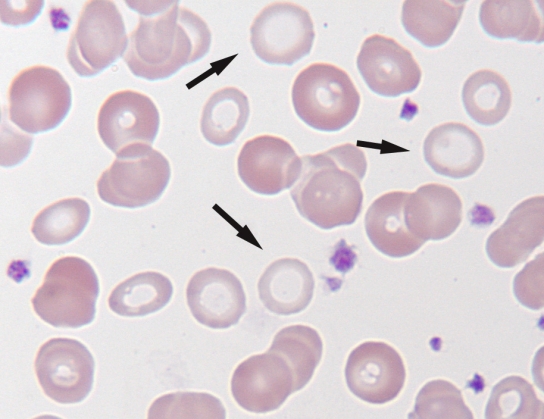
(Multiple Choice)
4.7/5 (88)
(88) Platelet estimates are usually performed on a blood smear using which microscopic magnification?
(Multiple Choice)
4.7/5 (89)
(89) Why do we see Howell-Jolly bodies in patients who have had a splenectomy?
Explain your answer.
(Essay)
4.8/5 (87)
(87) Remnants of DNA inside an RBC produce which type of inclusion?
(Multiple Choice)
4.9/5 (59)
(59) A bone marrow aspirate is hypercellular and has an M:E ratio of 1:4.What can be concluded from this? There is:
(Multiple Choice)
4.8/5 (85)
(85) The hemoglobin and hematocrit on a newborn are 18.9 g/dL and 60%.How would you interpret these data?
(Multiple Choice)
4.9/5 (94)
(94) Identify the poikilocytes in the following image and indicate a possible mechanism for their formation. 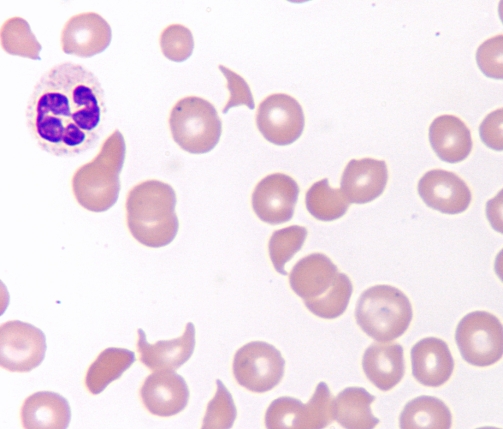
(Multiple Choice)
4.8/5 (86)
(86) Codocytes are associated with all of the following conditions except:
(Multiple Choice)
4.9/5 (71)
(71) A peripheral blood smear has an even distribution of both normocytic normochromic cells and microcytic hypochromic cells.What is this phenomenon called?
(Multiple Choice)
4.8/5 (89)
(89) The following data were reported by an instrument: RBC = 5.00 × 10₁₂ /L,hemoglobin = 8.5 g/dL and hematocrit = 32%.Calculate the MCHC.
(Multiple Choice)
4.8/5 (84)
(84) 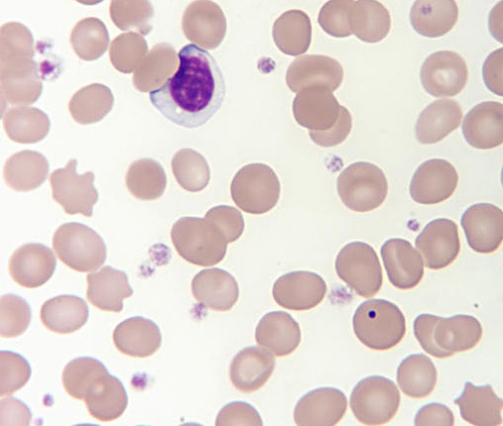
Which RBC parameter describes the variation in the volume of the RBCs in a blood sample?
(Multiple Choice)
4.8/5 (87)
(87) What staining method can be used to differentiate Pappenheimer bodies from reticulocytes?
(Multiple Choice)
4.9/5 (79)
(79) 
Filters
- Essay(0)
- Multiple Choice(0)
- Short Answer(0)
- True False(0)
- Matching(0)