



 Chat with AI
Exam 10: The Complete Blood Count and Peripheral Blood Smear Evaluation

Exam 1: Introduction30 Questions
Exam 2: Cellular Homeostasis40 Questions
Exam 3: Structure and Function of Hematopoietic Organs35 Questions
Exam 4: Hematopoiesis35 Questions
Exam 5: The Erythrocyte37 Questions
Exam 6: Hemoglobin40 Questions
Exam 7: Granulocytes and Monocytes30 Questions
Exam 8: Lymphocytes25 Questions
Exam 9: The Platelet16 Questions
Exam 10: The Complete Blood Count and Peripheral Blood Smear Evaluation35 Questions
Exam 11: Introduction to Anemia35 Questions
Exam 12: Anemias of Disordered Iron Metabolism and Heme Synthesis36 Questions
Exam 13: Hemoglobinopathies: Qualitative Defects33 Questions
Exam 14: Thalassemia32 Questions
Exam 15: Megaloblastic and Nonmegaloblastic Macrocytic Anemias34 Questions
Exam 16: Hypoproliferative Anemias32 Questions
Exam 17: Hemolytic Anemia: Membrane Defects36 Questions
Exam 18: Hemolytic Anemia: Enzyme Deficiencies36 Questions
Exam 19: Hemolytic Anemia: Immune Anemias30 Questions
Exam 20: Hemolytic Anemia: Nonimmune Defects30 Questions
Exam 21: Nonmalignant Disorders of Leukocytes: Granulocytes and Monocytes35 Questions
Exam 22: Nonmalignant Lymphocyte Disorders32 Questions
Exam 23: Introduction to Hematopoietic Neoplasms34 Questions
Exam 24: Myeloproliferative Neoplasms44 Questions
Exam 25: Myelodysplastic Syndromes34 Questions
Exam 26: Acute Myeloid Leukemias35 Questions
Exam 27: Precursor Lymphoid Neoplasms34 Questions
Exam 28: Mature Lymphoid Neoplasms39 Questions
Exam 29: Hematopoietic Stem Cell Transplantation41 Questions
Exam 30: Morphologic Analysis of Body Fluids in the Hematology Laboratory39 Questions
Exam 31: Primary Hemostasis35 Questions
Exam 32: Secondary Hemostasis and Fibrinolysis33 Questions
Exam 33: Disorders of Primary Hemostasis35 Questions
Exam 34: Disorders of Secondary Hemostasis34 Questions
Exam 35: Thrombophilia34 Questions
Exam 36: Hemostasis: Laboratory Testing and Instrumentation41 Questions
Exam 37: Hematology Procedures46 Questions
Exam 38: Bone Marrow Examination34 Questions
Exam 39: Automation in Hematology38 Questions
Exam 40: Flow Cytometry34 Questions
Exam 41: Chromosome Analysis of Hematopoietic and Lymphoid Disorders35 Questions
Exam 42: Molecular Analysis of Hematologic Diseases18 Questions
Select questions type


What should be reported about the RBCs in the following image and what affect would this have on the CBC results?
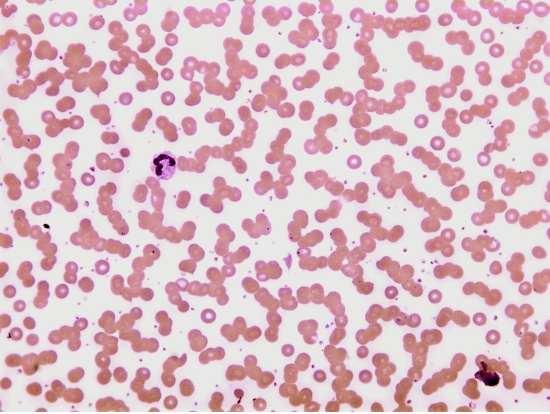
(Multiple Choice)
4.8/5  (77)
(77) Which of the following laboratory values would best correlate with moderate polychromasia on a peripheral blood smear?
(Multiple Choice)
4.7/5 (78)
(78) A patient sample has an RBC count of 4.30 × 10₁₂ /L and a reticulocyte count of 4%.What is the absolute retic count?
(Multiple Choice)
4.8/5 (78)
(78) Howell-Jolly bodies are red cell inclusions associated with what disease state?
(Multiple Choice)
4.8/5 (86)
(86) An instrument printout indicates an MCV of 63 fl and an MCHC of 26 g/dl.How will the red cells appear under the microscope?
(Multiple Choice)
4.7/5 (94)
(94) What RBC inclusions cannot be seen with Romanowsky stain but can be visualized with supravital stain?
(Multiple Choice)
4.9/5 (73)
(73) 12.Calculate the MCV from the results of a patient's CBC: RBC = 3.50 × 10¹²/L
Hemoglobin = 12.0 g/dL
Hematocrit = 40%
(Multiple Choice)
5.0/5 (78)
(78) Which of the following assays is not part of a typical complete blood count?
(Multiple Choice)
4.7/5 (80)
(80) A patient sample arrives in the laboratory with the name on the tube and no other information.What is missing?
(Essay)
4.8/5 (76)
(76) List four pre-examination precautions that must be observed to produce quality results when performing a CBC.
(Essay)
4.9/5 (75)
(75) An instrument printout reveals an RDW of 33.Which of the following would best correlate with those results?
(Multiple Choice)
4.8/5 (82)
(82) Which of the following represents the correct units for reporting an absolute reticulocyte count?
(Multiple Choice)
5.0/5 (71)
(71) An increased red cell distribution width (RDW)usually indicates what abnormality?
(Multiple Choice)
4.8/5 (65)
(65) Which poikilocyte is indicated by the arrows in the following image?
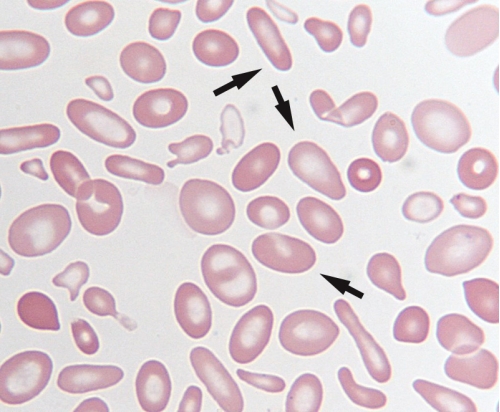
(Multiple Choice)
4.8/5 (83)
(83) Identify the poikilocytes indicated by the arrows in the following image. 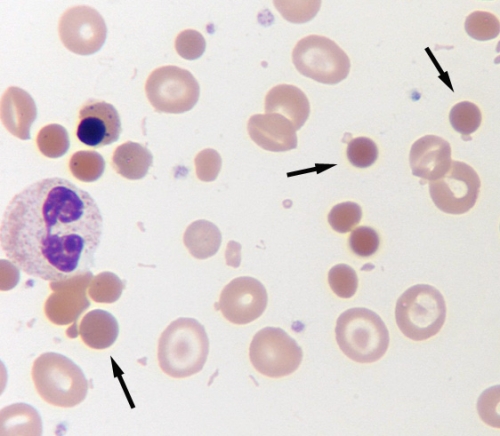
(Multiple Choice)
4.8/5 (74)
(74) 
Filters
- Essay(0)
- Multiple Choice(0)
- Short Answer(0)
- True False(0)
- Matching(0)