



 Chat with AI
Exam 34: Disorders of Secondary Hemostasis

Exam 1: Introduction30 Questions
Exam 2: Cellular Homeostasis40 Questions
Exam 3: Structure and Function of Hematopoietic Organs35 Questions
Exam 4: Hematopoiesis35 Questions
Exam 5: The Erythrocyte37 Questions
Exam 6: Hemoglobin40 Questions
Exam 7: Granulocytes and Monocytes30 Questions
Exam 8: Lymphocytes25 Questions
Exam 9: The Platelet16 Questions
Exam 10: The Complete Blood Count and Peripheral Blood Smear Evaluation35 Questions
Exam 11: Introduction to Anemia35 Questions
Exam 12: Anemias of Disordered Iron Metabolism and Heme Synthesis36 Questions
Exam 13: Hemoglobinopathies: Qualitative Defects33 Questions
Exam 14: Thalassemia32 Questions
Exam 15: Megaloblastic and Nonmegaloblastic Macrocytic Anemias34 Questions
Exam 16: Hypoproliferative Anemias32 Questions
Exam 17: Hemolytic Anemia: Membrane Defects36 Questions
Exam 18: Hemolytic Anemia: Enzyme Deficiencies36 Questions
Exam 19: Hemolytic Anemia: Immune Anemias30 Questions
Exam 20: Hemolytic Anemia: Nonimmune Defects30 Questions
Exam 21: Nonmalignant Disorders of Leukocytes: Granulocytes and Monocytes35 Questions
Exam 22: Nonmalignant Lymphocyte Disorders32 Questions
Exam 23: Introduction to Hematopoietic Neoplasms34 Questions
Exam 24: Myeloproliferative Neoplasms44 Questions
Exam 25: Myelodysplastic Syndromes34 Questions
Exam 26: Acute Myeloid Leukemias35 Questions
Exam 27: Precursor Lymphoid Neoplasms34 Questions
Exam 28: Mature Lymphoid Neoplasms39 Questions
Exam 29: Hematopoietic Stem Cell Transplantation41 Questions
Exam 30: Morphologic Analysis of Body Fluids in the Hematology Laboratory39 Questions
Exam 31: Primary Hemostasis35 Questions
Exam 32: Secondary Hemostasis and Fibrinolysis33 Questions
Exam 33: Disorders of Primary Hemostasis35 Questions
Exam 34: Disorders of Secondary Hemostasis34 Questions
Exam 35: Thrombophilia34 Questions
Exam 36: Hemostasis: Laboratory Testing and Instrumentation41 Questions
Exam 37: Hematology Procedures46 Questions
Exam 38: Bone Marrow Examination34 Questions
Exam 39: Automation in Hematology38 Questions
Exam 40: Flow Cytometry34 Questions
Exam 41: Chromosome Analysis of Hematopoietic and Lymphoid Disorders35 Questions
Exam 42: Molecular Analysis of Hematologic Diseases18 Questions
Select questions type


Which assay would assess for the presence of a circulating nonspecific inhibitor?

Free
(Multiple Choice)
4.9/5  (85)
(85) Correct Answer: Verified
C
Hemophilia A is caused by a deficiency in which of the following proteins?
Free
(Multiple Choice)
4.8/5 (86)
(86) Correct Answer:Verified
VerifiedB
George Jones is admitted to the hospital with abdominal pain.Upon physical examination,the attending physician notices a yellow ring around his green eyes.George has a significant swelling in his abdomen and has been suffering from swollen joints for the last month.The physician runs a battery of labs.The results follow: 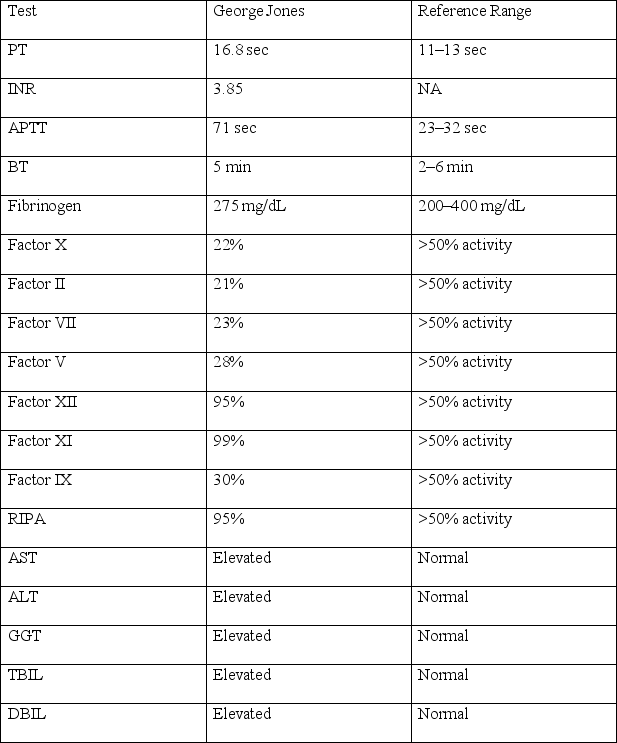 Based on this information,from what is George most likely suffering?
Free
(Multiple Choice)
4.7/5 (84)
(84) Correct Answer:Verified
VerifiedA
Deficiencies of the fibrin-forming proteins often have a delayed bleeding symptom that results from which of the following?
(Multiple Choice)
4.9/5 (73)
(73) A 5-year-old boy has his blood drawn for platelet aggregation studies.Ristocetin aggregation (RIPA)comes back abnormal with all other agonists displaying normal aggregation.VWF antigen is within normal limits.What is the most likely reason for this discrepancy?
(Multiple Choice)
4.9/5 (65)
(65) F-VIII deficiency and F-IX deficiency are classified as what category of disorder?
(Multiple Choice)
4.8/5 (82)
(82) What term describes hereditary or acquired disorders that relate to the absence of a coagulation protein or to a protein that is present in the plasma but is functionally defective?
(Multiple Choice)
4.9/5 (82)
(82) An advantage of prenatal diagnosis by genotypic analysis for hemophilia over phenotypic analysis is:
(Multiple Choice)
4.8/5 (79)
(79) Deficiency of coagulation proteins is defined as a decrease in:
(Multiple Choice)
4.9/5 (82)
(82) Interpret the following results: PT: 11.8 sec (RR: 11.2-13.8 sec)
INR: 1.07
APTT: 57 sec (RR: 23-32 sec)
BT: 12 min
Ristocetin aggregation: decreased aggregation
Based on this information,from what is the patient most likely suffering?
(Multiple Choice)
4.8/5 (95)
(95) What plasma factor levels of the deficient factor can be expected in a female carrier of FVIII or FIX deficiency?
(Multiple Choice)
4.8/5 (76)
(76) A known hemophiliac has developed an inhibitor.The physician in charge of his care wants to know how much inhibitor is present to properly treat him.What two lab tests would be ordered to assess this?
(Multiple Choice)
4.9/5 (83)
(83) Which is the most common FVIII mutation in patients with a severe phenotype (occurring in almost 50% of patients)?
(Multiple Choice)
4.7/5 (91)
(91) A patient has a prolonged PT.Which deficiency can you infer from this result?
(Multiple Choice)
4.8/5 (67)
(67) Which of the following clinical symptoms correlates with a severe form of hemophilia A or B?
(Multiple Choice)
4.8/5 (75)
(75) Which of the following is used in the identification of a secondary hemostatic pathway anomaly?
(Multiple Choice)
4.8/5 (71)
(71) Use this case to answer the following questions: ? A 5-year-old boy visits his primary care physician after an accident on his bike.It was his first accident,and he fell on his knees.His mother noticed severe swelling in his knees and elbows but thought that it was from the accident.She placed an ice pack on the affected areas and put him to rest.After a few days,the swelling had not improved,so she made an appointment to see his physician who asks him a few questions about the accident and then proceeds to perform a physical examination.The physician notes small hematomas on his elbows,knees,and his upper torso.The results from the blood draw follow.
PT: 12.2 sec (RR: 11.3-12.8 sec)
INR: 1.12
APTT: 72 sec (RR: 23-32 sec)
Platelet aggregation studies: normal aggregation with all agonists
The physician admits him to the area hospital.What should be the next course of action in investigating these results?
(Multiple Choice)
4.7/5 (83)
(83) Explain why disseminated intravascular coagulation is not a primary disease state.Correlate etiology,pathophysiology,and laboratory analysis in your response.
(Essay)
4.9/5 (85)
(85) 
Filters
- Essay(0)
- Multiple Choice(0)
- Short Answer(0)
- True False(0)
- Matching(0)