



 Chat with AI
Exam 13: Hemoglobinopathies: Qualitative Defects

Exam 1: Introduction30 Questions
Exam 2: Cellular Homeostasis40 Questions
Exam 3: Structure and Function of Hematopoietic Organs35 Questions
Exam 4: Hematopoiesis35 Questions
Exam 5: The Erythrocyte37 Questions
Exam 6: Hemoglobin40 Questions
Exam 7: Granulocytes and Monocytes30 Questions
Exam 8: Lymphocytes25 Questions
Exam 9: The Platelet16 Questions
Exam 10: The Complete Blood Count and Peripheral Blood Smear Evaluation35 Questions
Exam 11: Introduction to Anemia35 Questions
Exam 12: Anemias of Disordered Iron Metabolism and Heme Synthesis36 Questions
Exam 13: Hemoglobinopathies: Qualitative Defects33 Questions
Exam 14: Thalassemia32 Questions
Exam 15: Megaloblastic and Nonmegaloblastic Macrocytic Anemias34 Questions
Exam 16: Hypoproliferative Anemias32 Questions
Exam 17: Hemolytic Anemia: Membrane Defects36 Questions
Exam 18: Hemolytic Anemia: Enzyme Deficiencies36 Questions
Exam 19: Hemolytic Anemia: Immune Anemias30 Questions
Exam 20: Hemolytic Anemia: Nonimmune Defects30 Questions
Exam 21: Nonmalignant Disorders of Leukocytes: Granulocytes and Monocytes35 Questions
Exam 22: Nonmalignant Lymphocyte Disorders32 Questions
Exam 23: Introduction to Hematopoietic Neoplasms34 Questions
Exam 24: Myeloproliferative Neoplasms44 Questions
Exam 25: Myelodysplastic Syndromes34 Questions
Exam 26: Acute Myeloid Leukemias35 Questions
Exam 27: Precursor Lymphoid Neoplasms34 Questions
Exam 28: Mature Lymphoid Neoplasms39 Questions
Exam 29: Hematopoietic Stem Cell Transplantation41 Questions
Exam 30: Morphologic Analysis of Body Fluids in the Hematology Laboratory39 Questions
Exam 31: Primary Hemostasis35 Questions
Exam 32: Secondary Hemostasis and Fibrinolysis33 Questions
Exam 33: Disorders of Primary Hemostasis35 Questions
Exam 34: Disorders of Secondary Hemostasis34 Questions
Exam 35: Thrombophilia34 Questions
Exam 36: Hemostasis: Laboratory Testing and Instrumentation41 Questions
Exam 37: Hematology Procedures46 Questions
Exam 38: Bone Marrow Examination34 Questions
Exam 39: Automation in Hematology38 Questions
Exam 40: Flow Cytometry34 Questions
Exam 41: Chromosome Analysis of Hematopoietic and Lymphoid Disorders35 Questions
Exam 42: Molecular Analysis of Hematologic Diseases18 Questions
Select questions type


Which of the following has the highest prevalence worldwide?
(Multiple Choice)
4.9/5  (86)
(86) Use this case to answer the following questions:
During a discussion of RBC indices,a medical technologist of Cambodian origin mentioned that her own red cells had been small in a CBC performed 2 years earlier in a routine physical.A more recent CBC showed the following results. 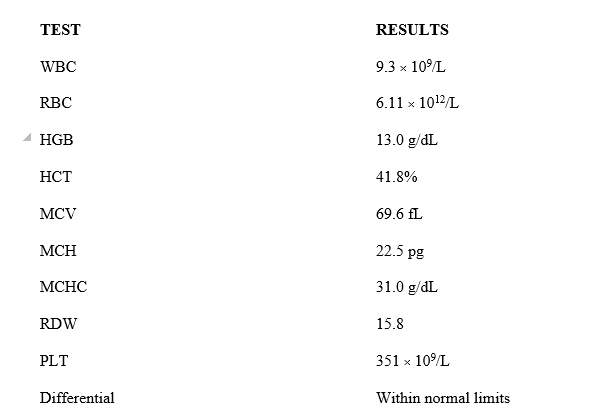 -Based on the demographics of this patient,what disorder is suspected?
 (Multiple Choice)
4.9/5 (80)
(80) A patient has a positive sickle solubility test.Further investigation reveals hemoglobin of 8.5 g/dL.What can be done to confirm these findings?
Explain your answer.
(Essay)
4.8/5 (82)
(82) The peripheral blood smear contains a normocytic,normochromic morphology with marked reticulocytosis.The hemoglobin solubility test is positive.What confirmatory test should follow?
(Multiple Choice)
4.9/5 (85)
(85) What is the purpose of treating sickle cell patients with hydroxyurea?
(Multiple Choice)
4.9/5 (78)
(78) A patient's sample is run on cellulose acetate,and two bands are found.The first band migrates to the A region on the gel.The second band migrates to the S-D-G region on the band.What is the next step to identify the second band?
(Multiple Choice)
4.9/5 (70)
(70) In hemoglobin C disease,how does the mutation affect the hemoglobin molecule?
(Multiple Choice)
4.9/5 (87)
(87) Explain how methemoglobin is formed and how its presence impacts oxygen delivery.Be sure to include oxygen affinity in your answer.
(Essay)
4.8/5 (80)
(80) Which of the following patients would have the highest percentage of hemoglobin S?
(Multiple Choice)
4.9/5 (85)
(85) Hemoglobinopathy results from a genetic abnormality of which structure within the hemoglobin molecule?
(Multiple Choice)
5.0/5 (80)
(80) Which abnormal hemoglobin is slow moving and migrates closely with hemoglobin A₂ on cellulose acetate at an alkaline pH?
(Multiple Choice)
4.8/5 (81)
(81) Use this case to answer the following questions:
During a discussion of RBC indices,a medical technologist of Cambodian origin mentioned that her own red cells had been small in a CBC performed 2 years earlier in a routine physical.A more recent CBC showed the following results.
-What reflex test is most appropriate for investigating these results?
-What reflex test is most appropriate for investigating these results? (Multiple Choice)
4.8/5 (73)
(73) 
Filters
- Essay(0)
- Multiple Choice(0)
- Short Answer(0)
- True False(0)
- Matching(0)