



 Chat with AI
Exam 19: Hemolytic Anemia: Immune Anemias

Exam 1: Introduction30 Questions
Exam 2: Cellular Homeostasis40 Questions
Exam 3: Structure and Function of Hematopoietic Organs35 Questions
Exam 4: Hematopoiesis35 Questions
Exam 5: The Erythrocyte37 Questions
Exam 6: Hemoglobin40 Questions
Exam 7: Granulocytes and Monocytes30 Questions
Exam 8: Lymphocytes25 Questions
Exam 9: The Platelet16 Questions
Exam 10: The Complete Blood Count and Peripheral Blood Smear Evaluation35 Questions
Exam 11: Introduction to Anemia35 Questions
Exam 12: Anemias of Disordered Iron Metabolism and Heme Synthesis36 Questions
Exam 13: Hemoglobinopathies: Qualitative Defects33 Questions
Exam 14: Thalassemia32 Questions
Exam 15: Megaloblastic and Nonmegaloblastic Macrocytic Anemias34 Questions
Exam 16: Hypoproliferative Anemias32 Questions
Exam 17: Hemolytic Anemia: Membrane Defects36 Questions
Exam 18: Hemolytic Anemia: Enzyme Deficiencies36 Questions
Exam 19: Hemolytic Anemia: Immune Anemias30 Questions
Exam 20: Hemolytic Anemia: Nonimmune Defects30 Questions
Exam 21: Nonmalignant Disorders of Leukocytes: Granulocytes and Monocytes35 Questions
Exam 22: Nonmalignant Lymphocyte Disorders32 Questions
Exam 23: Introduction to Hematopoietic Neoplasms34 Questions
Exam 24: Myeloproliferative Neoplasms44 Questions
Exam 25: Myelodysplastic Syndromes34 Questions
Exam 26: Acute Myeloid Leukemias35 Questions
Exam 27: Precursor Lymphoid Neoplasms34 Questions
Exam 28: Mature Lymphoid Neoplasms39 Questions
Exam 29: Hematopoietic Stem Cell Transplantation41 Questions
Exam 30: Morphologic Analysis of Body Fluids in the Hematology Laboratory39 Questions
Exam 31: Primary Hemostasis35 Questions
Exam 32: Secondary Hemostasis and Fibrinolysis33 Questions
Exam 33: Disorders of Primary Hemostasis35 Questions
Exam 34: Disorders of Secondary Hemostasis34 Questions
Exam 35: Thrombophilia34 Questions
Exam 36: Hemostasis: Laboratory Testing and Instrumentation41 Questions
Exam 37: Hematology Procedures46 Questions
Exam 38: Bone Marrow Examination34 Questions
Exam 39: Automation in Hematology38 Questions
Exam 40: Flow Cytometry34 Questions
Exam 41: Chromosome Analysis of Hematopoietic and Lymphoid Disorders35 Questions
Exam 42: Molecular Analysis of Hematologic Diseases18 Questions
Select questions type


A patient with SLE shows evidence of decreased hemoglobin and ongoing hemolysis.The DAT is negative.Which of the following is the most likely explanation for these results?
(Multiple Choice)
4.8/5  (78)
(78) Which of the following set of results is consistent with a diagnosis of WAIHA?
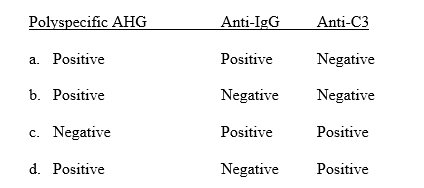
(Short Answer)
4.8/5 (84)
(84) Paroxysmal cold hemoglobinuria is associated with viral and bacterial infections in children.With what other disease(s)is it associated?
(Multiple Choice)
4.7/5 (79)
(79) Which of the following is an example of an anemia that occurs as a result of antibody development to an antigen that the individual lacks?
(Multiple Choice)
4.9/5 (77)
(77) Which of the following is consistent with a diagnosis of CAD?
(Multiple Choice)
4.9/5 (79)
(79) The absence of spherocytes on the peripheral blood smear in a case of suspected HDFN usually indicates that which of the following is the most likely cause of the condition?
(Multiple Choice)
4.8/5 (83)
(83) Which of the following has the greatest effect on the rate of hemolysis in immune hemolytic anemia?
(Multiple Choice)
4.9/5 (95)
(95) Which of the following pairs of mother and fetus shows the most likely potential for initiating HDFN in the fetus?
Mother Fetus
(Multiple Choice)
4.7/5 (75)
(75) A Group O,Rh-negative woman with no evidence of antibodies delivers her first child who shows a slightly decreased hemoglobin and the presence of spherocytes on the peripheral blood film.The DAT is positive with polyspecific AHG and anti-IgG.The baby is Group A,Rh negative and is slightly jaundiced with a bilirubin of 2.1 mg/dl.What is the most likely cause of the baby's jaundice?
(Multiple Choice)
4.9/5 (81)
(81) 
Filters
- Essay(0)
- Multiple Choice(0)
- Short Answer(0)
- True False(0)
- Matching(0)