



 Chat with AI
Exam 17: Oligopoly

Exam 1: Ten Principles of Economics455 Questions
Exam 2: Thinking Like an Economist643 Questions
Exam 3: Interdependence and the Gains From Trade547 Questions
Exam 4: The Market Forces of Supply and Demand693 Questions
Exam 5: Elasticity and Its Application626 Questions
Exam 6: Supply, Demand, and Government Policies668 Questions
Exam 7: Consumers, Producers, and the Efficiency of Markets547 Questions
Exam 8: Applications: the Costs of Taxation509 Questions
Exam 9: Application: International Trade521 Questions
Exam 10: Externalities543 Questions
Exam 11: Public Goods and Common Resources452 Questions
Exam 12: The Design of the Tax System664 Questions
Exam 13: The Costs of Production649 Questions
Exam 14: Firms in Competitive Markets604 Questions
Exam 15: Monopoly662 Questions
Exam 16: Monopolistic Competition649 Questions
Exam 17: Oligopoly522 Questions
Exam 18: The Markets for the Factors of Production592 Questions
Exam 19: Earnings and Discrimination511 Questions
Exam 20: Income Inequality and Poverty478 Questions
Exam 21: The Theory of Consumer Choice570 Questions
Exam 22: Frontiers in Microeconomics461 Questions
Exam 23: Measuring a Nation S Income547 Questions
Exam 24: Measuring the Cost of Living565 Questions
Exam 25: Production and Growth527 Questions
Exam 26: Saving, Investment, and the Financial System637 Questions
Exam 27: Tools of Finance534 Questions
Exam 28: Unemployment and Its Natural Rate701 Questions
Exam 29: The Monetary System540 Questions
Exam 30: Money Growth and Inflation504 Questions
Exam 31: Open-Economy Macroeconomics: Basic Concepts540 Questions
Exam 32: A Macroeconomic Theory of the Open Economy511 Questions
Exam 33: Aggregate Demand and Aggregate Supply572 Questions
Exam 34: The Influence of Monetary and Fiscal Policy on Aggregate Demand523 Questions
Exam 35: The Short-Run Tradeoff Between Inflation and Unemployment536 Questions
Exam 36: Six Debates Over Macroeconomic Policy354 Questions
Select questions type


Table 17-12
The table shows the town of Driveaway's demand schedule for gasoline. Assume the town's gasoline seller(s) incurs a cost of $2 for each gallon sold, with no fixed cost.  -Refer to Table 17-12. If there are exactly five sellers of gasoline in Driveaway and if they collude, then which of the following outcomes is most likely?
 (Multiple Choice)
4.9/5  (91)
(91) Table 17-25
There are just two producers of a certain product. Each is considering offering promotional discounts.  -Refer to Table 17-25. At the Nash equilibrium, how much profit will Firm A earn?
 (Multiple Choice)
4.9/5 (80)
(80) The decisions of the US and Soviet Union to build nuclear weapons is much like the prisoners' dilemma.
(True/False)
4.9/5 (77)
(77) A particular cable TV company requires a household to subscribe to its high-speed Internet service if it subscribes to cable TV, and vice versa. This practice
(Multiple Choice)
4.9/5 (80)
(80) Which strategy was the most successful in the prisoners' dilemma tournament?
(Short Answer)
4.8/5 (88)
(88) Scenario 17-2.
Imagine that two oil companies, BQ and Exxoff, own adjacent oil fields. Under the fields is a common pool of oil worth $144 million. Drilling a well to recover oil costs $5 million per well. If each company drills one well, each will get half of the oil and earn a $67 million profit ($72 million in revenue - $5 million in costs). Assume that having X percent of the total wells means that a company will collect X percent of the total revenue.
-Refer to Scenario 17-2. Exxoff's dominant strategy would lead to what sort of well-drilling behavior?
(Multiple Choice)
4.8/5 (85)
(85) Table 17-11
Only two firms, ABC and XYZ, sell a particular product. The table below shows the demand curve for their product. Each firm has the same constant marginal cost of $8 and zero fixed cost. 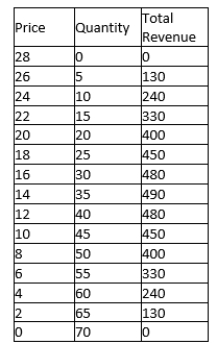 -Refer to Table 17-11. If ABC and XYZ operate to jointly maximize profits, then what is the price?
 (Multiple Choice)
5.0/5 (71)
(71) Table 17-9
The table shows the demand schedule for a particular product. 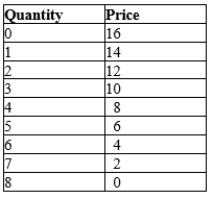 -Refer to Table 17-9. Suppose the market for this product is served by two firms that have formed a cartel. If the marginal cost of production is $4 and each firm incurs a fixed cost of $6, the combined profit of the cartel will be
 (Multiple Choice)
4.9/5 (89)
(89) Scenario 17-4.
Consider two cigarette companies, PM Inc. and Brown Inc. If neither company advertises, the two companies split the market and earn $50 million each. If they both advertise, they again split the market, but profits are lower by $10 million since each company must bear the cost of advertising. Yet if one company advertises while the other does not, the one that advertises attracts customers from the other. In this case, the company that advertises earns $60 million while the company that does not advertise earns only $30 million.
-Refer to Scenario 17-4. In 1971, Congress passed a law that banned cigarette advertising on television. If cigarette companies are profit maximizers, it is likely that
(Multiple Choice)
4.9/5 (74)
(74) The paradoxical nature of oligopoly can be demonstrated by the fact that, even though the monopoly outcome is best for the oligopolists,
(Multiple Choice)
4.7/5 (86)
(86) Who wrote, "People of the same trade seldom meet together, but the conversation ends in a conspiracy against the public, or in some diversion to raise prices."?
(Multiple Choice)
4.8/5 (76)
(76) Table 17-27
Each year the United States considers renewal of Most Favored Nation (MFN) trading status with Farland (a mythical nation). Historically, legislators have made threats of not renewing MFN status because of human rights abuses in Farland. The non-renewal of MFN trading status is likely to involve some retaliatory measures by Farland. The payoff table below shows the potential economic gains associated with a game in which Farland may impose trade sanctions against U.S. firms and the United States may not renew MFN status with Farland. The table contains the dollar value of all trade-flow benefits to the United States and Farland.  -Refer to Table 17-27. Assume that trade negotiators meet to discuss trade policy between the United States and Farland. If neither party to the negotiation is able to trust the other party, then
 (Multiple Choice)
4.8/5 (89)
(89) Table 17-30
Imagine a small town in which only two residents, Abby and Brad, own wells that produce safe drinking water. Each week Abby and Brad work together to decide how many gallons of water to pump. They bring water to town and sell it at whatever price the market will bear. To keep things simple, suppose that Abby and Brad can pump as much water as they want without cost so that the marginal cost is zero. The weekly town demand schedule and total revenue schedule for water is shown in the table below: 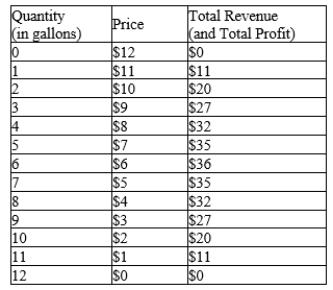 -Refer to Table 17-30. Briefly explain why each duopolist earns a lower profit at the Nash equilibrium than if they cooperated to produce the monopoly output.
 (Essay)
4.8/5 (86)
(86) Nike and Reebok (athletic shoe companies) are considering whether to advertise during the Super Bowl. Devise a simple prisoners' dilemma game to demonstrate the strategic considerations that are relevant to this decision. Does the repeated game scenario differ from a single period game? Is it possible that a repeated game (without collusive agreements) could lead to an outcome that is better than a single-period game? Explain the circumstances in which this may be true.
(Essay)
4.8/5 (83)
(83) Describe the source of tension between cooperation and self-interest in a market characterized by oligopoly. Use an example of an actual cartel arrangement to demonstrate why this tension creates instability in cartels.
(Essay)
4.9/5 (73)
(73) A Nash Equilibrium is a stable outcome for an oligopoly market situation.
(True/False)
4.8/5 (75)
(75) An agreement between two duopolists to function as a monopolist usually breaks down because
(Multiple Choice)
4.9/5 (75)
(75) Table 17-35
Suppose that two coal mining companies - Allied and Barclay - own adjacent land suitable for excavating coal mines. The profits that each firm earns depends on both the number of mines it excavates and the number of mines excavated by the other firm. The table below lists each firm's individual profits:  -Refer to Table 17-35. Does Allied have a dominant strategy? If so, describe it.
 (Essay)
4.9/5 (77)
(77) 
Filters
- Essay(0)
- Multiple Choice(0)
- Short Answer(0)
- True False(0)
- Matching(0)