



 Chat with AI
Exam 17: Oligopoly

Exam 1: Ten Principles of Economics455 Questions
Exam 2: Thinking Like an Economist643 Questions
Exam 3: Interdependence and the Gains From Trade547 Questions
Exam 4: The Market Forces of Supply and Demand693 Questions
Exam 5: Elasticity and Its Application626 Questions
Exam 6: Supply, Demand, and Government Policies668 Questions
Exam 7: Consumers, Producers, and the Efficiency of Markets547 Questions
Exam 8: Applications: the Costs of Taxation509 Questions
Exam 9: Application: International Trade521 Questions
Exam 10: Externalities543 Questions
Exam 11: Public Goods and Common Resources452 Questions
Exam 12: The Design of the Tax System664 Questions
Exam 13: The Costs of Production649 Questions
Exam 14: Firms in Competitive Markets604 Questions
Exam 15: Monopoly662 Questions
Exam 16: Monopolistic Competition649 Questions
Exam 17: Oligopoly522 Questions
Exam 18: The Markets for the Factors of Production592 Questions
Exam 19: Earnings and Discrimination511 Questions
Exam 20: Income Inequality and Poverty478 Questions
Exam 21: The Theory of Consumer Choice570 Questions
Exam 22: Frontiers in Microeconomics461 Questions
Exam 23: Measuring a Nation S Income547 Questions
Exam 24: Measuring the Cost of Living565 Questions
Exam 25: Production and Growth527 Questions
Exam 26: Saving, Investment, and the Financial System637 Questions
Exam 27: Tools of Finance534 Questions
Exam 28: Unemployment and Its Natural Rate701 Questions
Exam 29: The Monetary System540 Questions
Exam 30: Money Growth and Inflation504 Questions
Exam 31: Open-Economy Macroeconomics: Basic Concepts540 Questions
Exam 32: A Macroeconomic Theory of the Open Economy511 Questions
Exam 33: Aggregate Demand and Aggregate Supply572 Questions
Exam 34: The Influence of Monetary and Fiscal Policy on Aggregate Demand523 Questions
Exam 35: The Short-Run Tradeoff Between Inflation and Unemployment536 Questions
Exam 36: Six Debates Over Macroeconomic Policy354 Questions
Select questions type


Table 17-20
Nadia and Maddie are two college roommates who both prefer a clean common space in their dorm room, but neither enjoys cleaning. The roommates must each make a decision to either clean or not clean the dorm room's common space. The payoff table for this situation is provided below, where the higher a player's payoff number, the better off that player is. The payoffs in each cell are shown as (payoff for Nadia, payoff for Maddie).  -Refer to Table 17-20. What is Maddie's dominant strategy?
 (Multiple Choice)
4.8/5  (85)
(85) Government regulators might suspect a firm of engaging in predatory pricing if it charges prices that seem to be too __________.
(Short Answer)
5.0/5 (93)
(93) Resale price maintenance prevents retailers from competing on price.
(True/False)
4.9/5 (80)
(80) Suppose the market for home-grown peppers in the town of Smallville is comprised of two farmers. Explain why they might try to collude.
(Essay)
4.9/5 (73)
(73) Figure 17-4. Aaron and Ed are roommates. After a big snowstorm, their driveway needs to be shoveled. Each person has to decide whether to take part in shoveling the driveway. At the end of the day, either the driveway will be shoveled (if one or both roommates take part in shoveling), or it will remain unshoveled (if neither roommate shovels). With happiness measured on a scale of 1 (very unhappy) to 10 (very happy), the possible outcomes are as follows: 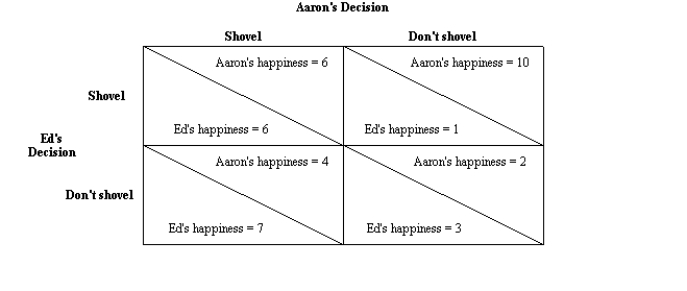 -Refer to Figure 17-4. In pursuing his own self-interest, Ed will
 (Multiple Choice)
4.9/5 (71)
(71) Table 17-37
Two restaurants with a focus on Mexican dining operate in Texama. Both Mitch's Mexican and Tim's Tacos need to decide whether to add Zesty Queso or Fresh Guacamole to their menus. The circumstances are that each firm wants to add only one of the two choices on their menu. Below you will find the profits for the stores, shown as: (1) the payoff to Mitch; (2) the payoff to Tim. 
-Refer to Table 17-37. Based upon the information from the table, you can conclude that this game is an example of
-Refer to Table 17-37. Based upon the information from the table, you can conclude that this game is an example of (Multiple Choice)
4.9/5 (80)
(80) Oligopolies can end up looking like competitive markets if the number of firms is
(Multiple Choice)
4.8/5 (84)
(84) Table 17-17
This table shows a game played between two firms, Firm A and Firm B. In this game each firm must decide how much output (Q) to produce: 2 units or 3 units. The profit for each firm is given in the table as (Profit for Firm A, Profit for Firm B).  -Refer to Table 17-17. In this game,
 (Multiple Choice)
4.9/5 (84)
(84) Table 17-25
There are just two producers of a certain product. Each is considering offering promotional discounts.  -Refer to Table 17-25. The dominant strategy
 (Multiple Choice)
4.8/5 (74)
(74) Scenario 17-1.
Assume that the countries of Irun and Urun are the only two producers of crude oil. Further assume that both countries have entered into an agreement to maintain certain production levels in order to maximize profits. In the world market for oil, the demand curve is downward sloping.
-Refer to Scenario 17-1. As long as the combined level of output is less than the Nash equilibrium level, both Irun and Urun have the individual incentive to
(Multiple Choice)
4.7/5 (92)
(92) Chrissy and Marvin are competitors in a local market and each is trying to decide if it is worthwhile to advertise. If both of them advertise, each will earn a profit of $10,000. If neither of them advertise, each will earn a profit of $20,000. If one advertises and the other doesn't, then the one who advertises will earn a profit of $30,000 and the other will earn $14,000. To earn the highest profit, Chrissy
(Multiple Choice)
4.9/5 (64)
(64) Why do economists use game theory to study the actions of firms in oligopoly markets but not in other markets?
(Essay)
4.9/5 (65)
(65) Table 17-19
Consider a small town that has two grocery stores from which residents can choose to buy a loaf of bread. The store owners each must make a decision to set a high bread price or a low bread price. The payoff table, showing profit per week, is provided below. The profit in each cell is shown as (Store 1, Store 2).  -Refer to Table 17-19. If grocery store 1 sets a high price, what price should grocery store 2 set? And what will grocery store 2's payoff equal?
 (Multiple Choice)
4.8/5 (87)
(87) Figure 17-1 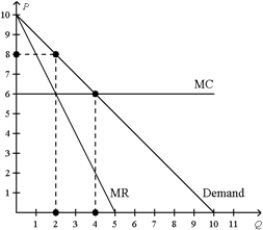 -Refer to Figure 17-1. Suppose this market is served by two firms who each face the marginal cost curve shown in the diagram and have zero fixed cost. The marginal revenue curve that a monopolist would face in this market is also shown. If the firms are able to collude successfully, each firm should earn a profit equal to
 (Multiple Choice)
4.8/5 (79)
(79) We must be knowledgeable of how people behave in strategic situations if we are to understand
(Multiple Choice)
4.8/5 (66)
(66) Table 17-14
This table shows a game played between two players, A and B. The payoffs in the table are shown as (Payoff to A, Payoff to B).  -Refer to Table 17-14. Which of the following statements about this game is true?
 (Multiple Choice)
4.8/5 (83)
(83) In which of the following markets are strategic interactions among firms most likely to occur?
(Multiple Choice)
4.9/5 (88)
(88) As the number of sellers in an oligopoly becomes very large,
(Multiple Choice)
4.8/5 (81)
(81) Table 17-10
The table shows the demand schedule for a particular product.  -Refer to Table 17-10. Suppose the market for this product is served by two firms who have formed a cartel and are colluding to set the price and quantity in this market. If the marginal cost to produce this product is constant at $40 per unit, then what price will the cartel set in this market?
 (Multiple Choice)
4.9/5 (84)
(84) 
Filters
- Essay(0)
- Multiple Choice(0)
- Short Answer(0)
- True False(0)
- Matching(0)