



 Chat with AI
Exam 17: Oligopoly

Exam 1: Ten Principles of Economics455 Questions
Exam 2: Thinking Like an Economist643 Questions
Exam 3: Interdependence and the Gains From Trade547 Questions
Exam 4: The Market Forces of Supply and Demand693 Questions
Exam 5: Elasticity and Its Application626 Questions
Exam 6: Supply, Demand, and Government Policies668 Questions
Exam 7: Consumers, Producers, and the Efficiency of Markets547 Questions
Exam 8: Applications: the Costs of Taxation509 Questions
Exam 9: Application: International Trade521 Questions
Exam 10: Externalities543 Questions
Exam 11: Public Goods and Common Resources452 Questions
Exam 12: The Design of the Tax System664 Questions
Exam 13: The Costs of Production649 Questions
Exam 14: Firms in Competitive Markets604 Questions
Exam 15: Monopoly662 Questions
Exam 16: Monopolistic Competition649 Questions
Exam 17: Oligopoly522 Questions
Exam 18: The Markets for the Factors of Production592 Questions
Exam 19: Earnings and Discrimination511 Questions
Exam 20: Income Inequality and Poverty478 Questions
Exam 21: The Theory of Consumer Choice570 Questions
Exam 22: Frontiers in Microeconomics461 Questions
Exam 23: Measuring a Nation S Income547 Questions
Exam 24: Measuring the Cost of Living565 Questions
Exam 25: Production and Growth527 Questions
Exam 26: Saving, Investment, and the Financial System637 Questions
Exam 27: Tools of Finance534 Questions
Exam 28: Unemployment and Its Natural Rate701 Questions
Exam 29: The Monetary System540 Questions
Exam 30: Money Growth and Inflation504 Questions
Exam 31: Open-Economy Macroeconomics: Basic Concepts540 Questions
Exam 32: A Macroeconomic Theory of the Open Economy511 Questions
Exam 33: Aggregate Demand and Aggregate Supply572 Questions
Exam 34: The Influence of Monetary and Fiscal Policy on Aggregate Demand523 Questions
Exam 35: The Short-Run Tradeoff Between Inflation and Unemployment536 Questions
Exam 36: Six Debates Over Macroeconomic Policy354 Questions
Select questions type


Table 17-20
Nadia and Maddie are two college roommates who both prefer a clean common space in their dorm room, but neither enjoys cleaning. The roommates must each make a decision to either clean or not clean the dorm room's common space. The payoff table for this situation is provided below, where the higher a player's payoff number, the better off that player is. The payoffs in each cell are shown as (payoff for Nadia, payoff for Maddie).  -Refer to Table 17-20. What is the Nash Equilibrium in this dorm room cleaning game?
 (Multiple Choice)
4.9/5  (86)
(86) Table 17-29
Suppose that two firms, Wild Willy's Wonderdrink (Firm W) and Hyper Hank's Hydration (Firm H), comprise the market for energy drinks. Each firm determines that it could lower its costs and increase its profits if both firms reduced their advertising budgets. But for the plan to work, each firm must agree to refrain from advertising. Each firm believes that advertising works by increasing the demand for the firm's energy drinks, but each firm also believes that if neither firm advertises, the cost savings will outweigh the lost sales. The table below lists each firm's individual profits:
Firm W
Breaks agreement Maintains agreement
and advertises and does not advertise  -Refer to Table 17-29. What is the outcome of this game?
 (Multiple Choice)
4.8/5 (81)
(81) An oligopoly would tend to restrict output and drive up price if
(Multiple Choice)
4.8/5 (68)
(68) Table 17-29
Suppose that two firms, Wild Willy's Wonderdrink (Firm W) and Hyper Hank's Hydration (Firm H), comprise the market for energy drinks. Each firm determines that it could lower its costs and increase its profits if both firms reduced their advertising budgets. But for the plan to work, each firm must agree to refrain from advertising. Each firm believes that advertising works by increasing the demand for the firm's energy drinks, but each firm also believes that if neither firm advertises, the cost savings will outweigh the lost sales. The table below lists each firm's individual profits:
Firm W
Breaks agreement Maintains agreement
and advertises and does not advertise
-Refer to Table 17-29 Does either Firm W or Firm H have a dominant strategy?
-Refer to Table 17-29 Does either Firm W or Firm H have a dominant strategy? (Multiple Choice)
4.8/5 (78)
(78) Table 17-14
This table shows a game played between two players, A and B. The payoffs in the table are shown as (Payoff to A, Payoff to B).  -Refer to Table 17-14. If player A chooses his/her best strategy, player B should
 (Multiple Choice)
4.8/5 (80)
(80) In the prisoners' dilemma game with Bonnie and Clyde as the players, the likely outcome is
(Multiple Choice)
4.8/5 (74)
(74) Table 17-11
Only two firms, ABC and XYZ, sell a particular product. The table below shows the demand curve for their product. Each firm has the same constant marginal cost of $8 and zero fixed cost. 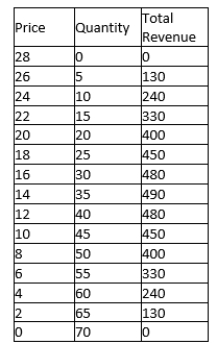 -Refer to Table 17-11. If ABC and XYZ operate to jointly maximize profits and agree to share the profit equally, then how much profit will each of them earn?
 (Multiple Choice)
4.9/5 (80)
(80) Table 17-20
Nadia and Maddie are two college roommates who both prefer a clean common space in their dorm room, but neither enjoys cleaning. The roommates must each make a decision to either clean or not clean the dorm room's common space. The payoff table for this situation is provided below, where the higher a player's payoff number, the better off that player is. The payoffs in each cell are shown as (payoff for Nadia, payoff for Maddie).
-Refer to Table 17-20. If Nadia chooses to not clean, then Maddie will
-Refer to Table 17-20. If Nadia chooses to not clean, then Maddie will (Multiple Choice)
4.8/5 (81)
(81) Table 17-19
Consider a small town that has two grocery stores from which residents can choose to buy a loaf of bread. The store owners each must make a decision to set a high bread price or a low bread price. The payoff table, showing profit per week, is provided below. The profit in each cell is shown as (Store 1, Store 2).  -Refer to Table 17-19. What is grocery store 1's dominant strategy?
 (Multiple Choice)
5.0/5 (83)
(83) Table 17-11
Only two firms, ABC and XYZ, sell a particular product. The table below shows the demand curve for their product. Each firm has the same constant marginal cost of $8 and zero fixed cost.
-Refer to Table 17-11. ABC and XYZ agree to maximize joint profits. However, while ABC produces the agreed upon amount, XYZ breaks the agreement and produces 5 more than agreed. How much profit does XYZ make?
-Refer to Table 17-11. ABC and XYZ agree to maximize joint profits. However, while ABC produces the agreed upon amount, XYZ breaks the agreement and produces 5 more than agreed. How much profit does XYZ make? (Multiple Choice)
4.9/5 (82)
(82) During the 1990s, the members of OPEC operated independently from one another, causing the world market for crude oil to become close to
(Multiple Choice)
4.9/5 (72)
(72) Table 17-2
Imagine a small town in which only two residents, Abby and Brad, own wells that produce safe drinking water. Each week Abby and Brad work together to decide how many gallons of water to pump. They bring water to town and sell it at whatever price the market will bear. To keep things simple, suppose that Abby and Brad can pump as much water as they want without cost so that the marginal cost is zero. The weekly town demand schedule and total revenue schedule for water is shown in the table below:  -Refer to Table 17-2. If this market for water were perfectly competitive instead of monopolistic, what would be the price for water?
 (Multiple Choice)
4.8/5 (75)
(75) Table 17-13
Two home-improvement stores (Lopes and HomeMax) in a growing urban area are interested in expanding their market share. Both are interested in expanding the size of their store and parking lot to accommodate potential growth in their customer base. The following game depicts the strategic outcomes that result from the game. Increases in annual profits of the two home-improvement stores are shown in the table below. 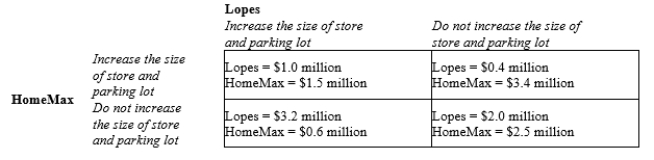 -Refer to Table 17-13. Increasing the size of its store and parking lot is a dominant strategy for
 (Multiple Choice)
5.0/5 (78)
(78) What are the three examples of controversial business practices that antitrust laws often prohibit?
(Essay)
4.7/5 (84)
(84) Table 17-8
For a certain small town, the table shows the demand schedule for water. Assume the marginal cost of supplying water is constant at $4 per bottle and there are no other costs. 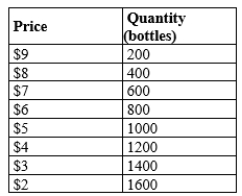 -Refer to Table 17-8. If there are two suppliers of water, Victor and Sami, and if they have successfully formed a cartel and split the market evenly, then how many bottles will Sami supply?
 (Multiple Choice)
4.8/5 (71)
(71) The oligopoly price will be greater than marginal cost but less than the monopoly price when
(Multiple Choice)
4.8/5 (74)
(74) Table 17-5
The information in the table below shows the total demand for premium-channel digital cable TV subscriptions in a small urban market. Assume that each digital cable TV operator pays a fixed cost of $200,000 (per year) to provide premium digital channels in the market area and that the marginal cost of providing the premium channel service to a household is zero. 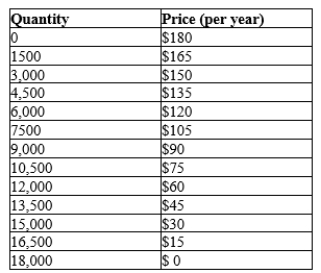 -Refer to Table 17-5. Assume there are two profit-maximizing digital cable TV companies operating in this market. Further assume that they are able to collude on the quantity of subscriptions that will be sold and on the price that will be charged for subscriptions. How much profit will each company earn, given that the two firms split the market equally?
 (Multiple Choice)
4.8/5 (89)
(89) 
Filters
- Essay(0)
- Multiple Choice(0)
- Short Answer(0)
- True False(0)
- Matching(0)