



 Chat with AI
Exam 17: Oligopoly

Exam 1: Ten Principles of Economics455 Questions
Exam 2: Thinking Like an Economist643 Questions
Exam 3: Interdependence and the Gains From Trade547 Questions
Exam 4: The Market Forces of Supply and Demand693 Questions
Exam 5: Elasticity and Its Application626 Questions
Exam 6: Supply, Demand, and Government Policies668 Questions
Exam 7: Consumers, Producers, and the Efficiency of Markets547 Questions
Exam 8: Applications: the Costs of Taxation509 Questions
Exam 9: Application: International Trade521 Questions
Exam 10: Externalities543 Questions
Exam 11: Public Goods and Common Resources452 Questions
Exam 12: The Design of the Tax System664 Questions
Exam 13: The Costs of Production649 Questions
Exam 14: Firms in Competitive Markets604 Questions
Exam 15: Monopoly662 Questions
Exam 16: Monopolistic Competition649 Questions
Exam 17: Oligopoly522 Questions
Exam 18: The Markets for the Factors of Production592 Questions
Exam 19: Earnings and Discrimination511 Questions
Exam 20: Income Inequality and Poverty478 Questions
Exam 21: The Theory of Consumer Choice570 Questions
Exam 22: Frontiers in Microeconomics461 Questions
Exam 23: Measuring a Nation S Income547 Questions
Exam 24: Measuring the Cost of Living565 Questions
Exam 25: Production and Growth527 Questions
Exam 26: Saving, Investment, and the Financial System637 Questions
Exam 27: Tools of Finance534 Questions
Exam 28: Unemployment and Its Natural Rate701 Questions
Exam 29: The Monetary System540 Questions
Exam 30: Money Growth and Inflation504 Questions
Exam 31: Open-Economy Macroeconomics: Basic Concepts540 Questions
Exam 32: A Macroeconomic Theory of the Open Economy511 Questions
Exam 33: Aggregate Demand and Aggregate Supply572 Questions
Exam 34: The Influence of Monetary and Fiscal Policy on Aggregate Demand523 Questions
Exam 35: The Short-Run Tradeoff Between Inflation and Unemployment536 Questions
Exam 36: Six Debates Over Macroeconomic Policy354 Questions
Select questions type


Table 17-15
This table shows a game played between two players, A and B. The payoffs in the table are shown as (Payoff to A, Payoff to B).  -Refer to Table 17-15. If player B chooses Right, player A should choose
 (Multiple Choice)
4.9/5  (87)
(87) Table 17-24
Two firms are considering going out of business and selling their assets. Each considers what happens if the other goes out of business. The payoff matrix below shows the net gain or loss to each firm.  -Refer to Table 17-24. Which firms have a dominant strategy?
 (Multiple Choice)
4.8/5 (72)
(72) Table 17-26
Two prescription drug manufacturers (Firm A and Firm B) are faced with lawsuits from states to recover the healthcare related expenses associated with side-effects from its drugs. Each drug manufacturer has evidence that indicates that taking its prescription drug causes liver failure. State prosecutors do not have access to the same data used by drug manufacturers and thus will have difficulty recovering full costs without the help of at least one of the drug manufacturer's studies. Each firm has been presented with an opportunity to lower its liability in the suit if it cooperates with attorneys representing the states. 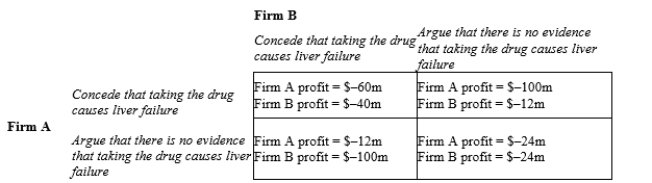 -Refer to Table 17-26. If both firms follow a dominant strategy, Firm A's profits (losses) will be
 (Multiple Choice)
4.7/5 (70)
(70) Table 17-4
The table shows the town of Mauston's demand schedule for gasoline. For simplicity, assume the town's gasoline seller(s) incur no costs in selling gasoline.  -Refer to Table 17-4. If there are exactly two sellers of gasoline in Mauston and if they collude, then which of the following outcomes is most likely?
 (Multiple Choice)
4.8/5 (90)
(90) The notion of a tit-for-tat strategy applies to a prisoners' dilemma game that is played repeatedly, but it does not apply if the game is played only once.
(True/False)
4.8/5 (88)
(88) The story of the prisoners' dilemma contains a general lesson that applies to any group trying to maintain cooperation among its members.
(True/False)
4.8/5 (89)
(89) One way that public policy encourages cooperation among oligopolists is through antitrust law.
(True/False)
4.8/5 (90)
(90) Table 17-21
The Chicken Game is named for a contest in which drivers test their courage by driving straight at each other. John and Paul have a common interest to avoid crashing into each other, but they also have a personal, competing interest to not turn first to demonstrate their courage to those observing the contest. The payoff table for this situation is provided below. The payoffs are shown as (John, Paul).  -Refer to Table 17-21. If Paul chooses Turn, what will John choose to do and what will John's payoff equal?
 (Multiple Choice)
4.7/5 (76)
(76) Table 17-7
The information in the table below shows the total demand for internet radio subscriptions in a small urban market. Assume that each company that provides these subscriptions incurs an annual fixed cost of $20,000 (per year) and that the marginal cost of providing an additional subscription is always $16. 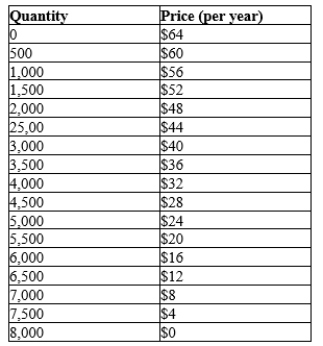 -Refer to Table 17-7. Assume there are two profit-maximizing internet radio providers operating in this market. Further assume that they are not able to collude on the price and quantity of subscriptions to sell. What price will they charge for a subscription when this market reaches a Nash equilibrium?
 (Multiple Choice)
4.7/5 (76)
(76) Table 17-11
Only two firms, ABC and XYZ, sell a particular product. The table below shows the demand curve for their product. Each firm has the same constant marginal cost of $8 and zero fixed cost. 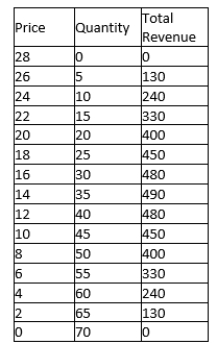 -Refer to Table 17-11. If this market were perfectly competitive instead of oligopolistic, what quantity would be produced?
 (Multiple Choice)
4.8/5 (83)
(83) Whether an oligopoly consists of 3 firms or 10 firms, the level of output likely will be the same.
(True/False)
4.8/5 (85)
(85) Table 17-18
This table shows a game played between two firms, Firm A and Firm B. In this game each firm must decide how much output (Q) to produce: 10 units or 12 units. The profit for each firm is given in the table as (Profit for Firm A, Profit for Firm B).  -Refer to Table 17-18. If these two firms agree to cooperate to maximize their joint profit, the outcome of the game will be
 (Multiple Choice)
4.9/5 (85)
(85) Table 17-1
Imagine a small town in which only two residents, Rochelle and Alec, own wells that produce safe drinking water. Each week Rochelle and Alec work together to decide how many gallons of water to pump. They bring the water to town and sell it at whatever price the market will bear. To keep things simple, suppose that Rochelle and Alec can pump as much water as they want without cost so that the marginal cost of water equals zero. The town's weekly demand schedule and total revenue schedule for water is shown in the table below: 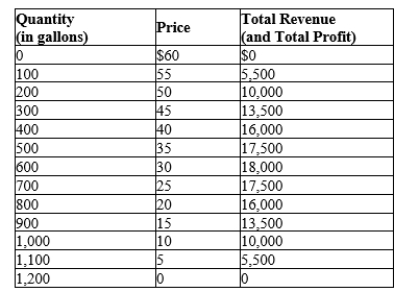 -Refer to Table 17-1. Suppose the town enacts new antitrust laws that prohibit Rochelle and Alec from operating as a monopoly. How many gallons of water will be produced and sold once Rochelle and Alec reach a Nash equilibrium?
 (Multiple Choice)
4.9/5 (89)
(89) Table 17-13
Two home-improvement stores (Lopes and HomeMax) in a growing urban area are interested in expanding their market share. Both are interested in expanding the size of their store and parking lot to accommodate potential growth in their customer base. The following game depicts the strategic outcomes that result from the game. Increases in annual profits of the two home-improvement stores are shown in the table below. 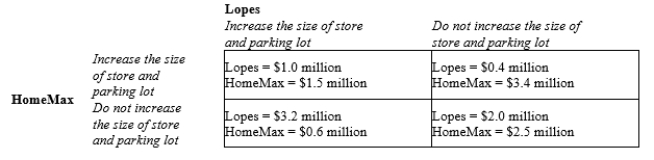 -Refer to Table 17-13. Suppose the owners of Lopes and HomeMax meet for a friendly game of golf one afternoon and happen to discuss a strategy to optimize growth related profit. They should both agree to
 (Multiple Choice)
4.9/5 (72)
(72) Table 17-34
Suppose that two oil companies - BP and Exxon - own adjacent natural gas fields. The profits that each firm earns depends on both the number of wells it drills and the number of wells drilled by the other firm. The table below lists each firm's individual profits:  -Refer to Table 17-34. Does BP have a dominant strategy? If so, describe it.
 (Essay)
4.9/5 (82)
(82) Policymakers should be aggressive in using their powers to place limits on firm behavior, because business practices that appear to reduce competition never have any legitimate purposes.
(True/False)
4.9/5 (92)
(92) Table 17-35
Suppose that two coal mining companies - Allied and Barclay - own adjacent land suitable for excavating coal mines. The profits that each firm earns depends on both the number of mines it excavates and the number of mines excavated by the other firm. The table below lists each firm's individual profits:  -Refer to Table 17-35. Does Barclay have a dominant strategy? If so, describe it.
 (Essay)
4.9/5 (67)
(67) If the output effect from increased production is larger than the price effect, then an oligopolist would increase production.
(True/False)
4.8/5 (77)
(77) 
Filters
- Essay(0)
- Multiple Choice(0)
- Short Answer(0)
- True False(0)
- Matching(0)