



 Chat with AI
Exam 17: Oligopoly

Exam 1: Ten Principles of Economics455 Questions
Exam 2: Thinking Like an Economist643 Questions
Exam 3: Interdependence and the Gains From Trade547 Questions
Exam 4: The Market Forces of Supply and Demand693 Questions
Exam 5: Elasticity and Its Application626 Questions
Exam 6: Supply, Demand, and Government Policies668 Questions
Exam 7: Consumers, Producers, and the Efficiency of Markets547 Questions
Exam 8: Applications: the Costs of Taxation509 Questions
Exam 9: Application: International Trade521 Questions
Exam 10: Externalities543 Questions
Exam 11: Public Goods and Common Resources452 Questions
Exam 12: The Design of the Tax System664 Questions
Exam 13: The Costs of Production649 Questions
Exam 14: Firms in Competitive Markets604 Questions
Exam 15: Monopoly662 Questions
Exam 16: Monopolistic Competition649 Questions
Exam 17: Oligopoly522 Questions
Exam 18: The Markets for the Factors of Production592 Questions
Exam 19: Earnings and Discrimination511 Questions
Exam 20: Income Inequality and Poverty478 Questions
Exam 21: The Theory of Consumer Choice570 Questions
Exam 22: Frontiers in Microeconomics461 Questions
Exam 23: Measuring a Nation S Income547 Questions
Exam 24: Measuring the Cost of Living565 Questions
Exam 25: Production and Growth527 Questions
Exam 26: Saving, Investment, and the Financial System637 Questions
Exam 27: Tools of Finance534 Questions
Exam 28: Unemployment and Its Natural Rate701 Questions
Exam 29: The Monetary System540 Questions
Exam 30: Money Growth and Inflation504 Questions
Exam 31: Open-Economy Macroeconomics: Basic Concepts540 Questions
Exam 32: A Macroeconomic Theory of the Open Economy511 Questions
Exam 33: Aggregate Demand and Aggregate Supply572 Questions
Exam 34: The Influence of Monetary and Fiscal Policy on Aggregate Demand523 Questions
Exam 35: The Short-Run Tradeoff Between Inflation and Unemployment536 Questions
Exam 36: Six Debates Over Macroeconomic Policy354 Questions
Select questions type


Table 17-7
The information in the table below shows the total demand for internet radio subscriptions in a small urban market. Assume that each company that provides these subscriptions incurs an annual fixed cost of $20,000 (per year) and that the marginal cost of providing an additional subscription is always $16. 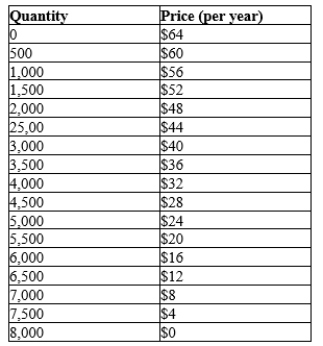 -Refer to Table 17-7. Assume there are two profit-maximizing internet radio providers operating in this market. Further assume that they are not able to collude on the price and quantity of subscriptions to sell. How many subscriptions will be sold altogether when this market reaches a Nash equilibrium?
 (Multiple Choice)
4.8/5  (74)
(74) From society's standpoint, cooperation among oligopolists is
(Multiple Choice)
4.8/5 (78)
(78) Figure 17-3. Hector and Bart are roommates. On a particular day, their apartment needs to be cleaned. Each person has to decide whether to take part in cleaning. At the end of the day, either the apartment will be completely clean (if one or both roommates take part in cleaning), or it will remain dirty (if neither roommate cleans). With happiness measured on a scale of 1 (very unhappy) to 10 (very happy), the possible outcomes are as follows: 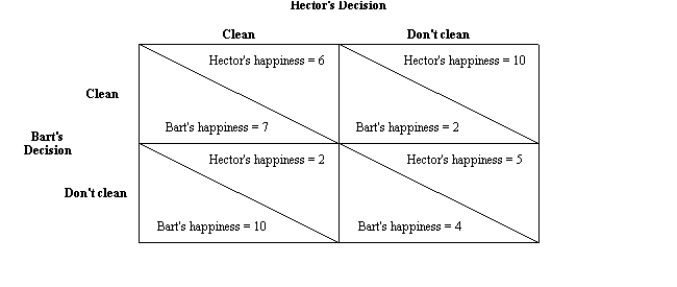 -Refer to Figure 17-3. The dominant strategy for Hector is to
 (Multiple Choice)
4.9/5 (77)
(77) Suppose three firms form a cartel and agree to charge a specific price for their output. Each individual firm has an incentive to maintain the agreement because the firm's individual profits will be the greatest under the cartel arrangement.
(True/False)
4.8/5 (80)
(80) Game theory is important for understanding which of the following market types?
(Multiple Choice)
4.9/5 (83)
(83) Figure 17-5. Two companies, ABC and QRS, are sellers in the same market. Each company decides whether to charge a high price or a low price. In the figure, the dollar amounts are payoffs and they represent annual profits for the two companies.  -Refer to Figure 17-5. Suppose the outcome of the game is one in which ABC's profit is $4 million and QRS's profit is $14 million. The most likely explanation for this outcome is that
 (Multiple Choice)
4.8/5 (67)
(67) Assume oligopoly firms are profit maximizers, they do not form a cartel, and they take other firms' production levels as given. Then in equilibrium the output effect
(Multiple Choice)
5.0/5 (73)
(73) Figure 17-3. Hector and Bart are roommates. On a particular day, their apartment needs to be cleaned. Each person has to decide whether to take part in cleaning. At the end of the day, either the apartment will be completely clean (if one or both roommates take part in cleaning), or it will remain dirty (if neither roommate cleans). With happiness measured on a scale of 1 (very unhappy) to 10 (very happy), the possible outcomes are as follows:
-Refer to Figure 17-3. If this game is played only once, then the most likely outcome is that
-Refer to Figure 17-3. If this game is played only once, then the most likely outcome is that (Multiple Choice)
4.8/5 (76)
(76) Oligopolists may well be able to reach their preferred, cooperative outcome if
(Multiple Choice)
4.9/5 (75)
(75) When price is above marginal cost, selling one more unit at the current price will increase profit. This concept is known as the
(Multiple Choice)
5.0/5 (75)
(75) Table 17-9
The table shows the demand schedule for a particular product. 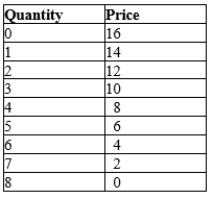 -Refer to Table 17-9. Suppose the market for this product is served by two firms that have formed a cartel. If the marginal cost of production is $0 and there is no fixed cost, the combined profit of the cartel will be
 (Multiple Choice)
4.8/5 (87)
(87) Table 17-19
Consider a small town that has two grocery stores from which residents can choose to buy a loaf of bread. The store owners each must make a decision to set a high bread price or a low bread price. The payoff table, showing profit per week, is provided below. The profit in each cell is shown as (Store 1, Store 2).  -Refer to Table 17-19. If grocery store 1 sets a low price, what price should grocery store 2 set? And what will grocery store 2's payoff equal?
 (Multiple Choice)
4.9/5 (81)
(81) Table 17-12
The table shows the town of Driveaway's demand schedule for gasoline. Assume the town's gasoline seller(s) incurs a cost of $2 for each gallon sold, with no fixed cost.  -Refer to Table 17-12. If the market for gasoline in Driveaway is a monopoly, then the profit-maximizing monopolist will charge a price of
 (Multiple Choice)
4.9/5 (77)
(77) Table 17-9
The table shows the demand schedule for a particular product.
-Refer to Table 17-9. If the marginal cost of production in this market is $4, what is the socially efficient quantity of output?
-Refer to Table 17-9. If the marginal cost of production in this market is $4, what is the socially efficient quantity of output? (Multiple Choice)
5.0/5 (65)
(65) Table 17-27
Each year the United States considers renewal of Most Favored Nation (MFN) trading status with Farland (a mythical nation). Historically, legislators have made threats of not renewing MFN status because of human rights abuses in Farland. The non-renewal of MFN trading status is likely to involve some retaliatory measures by Farland. The payoff table below shows the potential economic gains associated with a game in which Farland may impose trade sanctions against U.S. firms and the United States may not renew MFN status with Farland. The table contains the dollar value of all trade-flow benefits to the United States and Farland.  -Refer to Table 17-27. If both countries follow a dominant strategy, the value of trade flow benefits for the United States will be
 (Multiple Choice)
4.8/5 (81)
(81) 
Filters
- Essay(0)
- Multiple Choice(0)
- Short Answer(0)
- True False(0)
- Matching(0)