



 Chat with AI
Exam 17: Oligopoly

Exam 1: Ten Principles of Economics455 Questions
Exam 2: Thinking Like an Economist643 Questions
Exam 3: Interdependence and the Gains From Trade547 Questions
Exam 4: The Market Forces of Supply and Demand693 Questions
Exam 5: Elasticity and Its Application626 Questions
Exam 6: Supply, Demand, and Government Policies668 Questions
Exam 7: Consumers, Producers, and the Efficiency of Markets547 Questions
Exam 8: Applications: the Costs of Taxation509 Questions
Exam 9: Application: International Trade521 Questions
Exam 10: Externalities543 Questions
Exam 11: Public Goods and Common Resources452 Questions
Exam 12: The Design of the Tax System664 Questions
Exam 13: The Costs of Production649 Questions
Exam 14: Firms in Competitive Markets604 Questions
Exam 15: Monopoly662 Questions
Exam 16: Monopolistic Competition649 Questions
Exam 17: Oligopoly522 Questions
Exam 18: The Markets for the Factors of Production592 Questions
Exam 19: Earnings and Discrimination511 Questions
Exam 20: Income Inequality and Poverty478 Questions
Exam 21: The Theory of Consumer Choice570 Questions
Exam 22: Frontiers in Microeconomics461 Questions
Exam 23: Measuring a Nation S Income547 Questions
Exam 24: Measuring the Cost of Living565 Questions
Exam 25: Production and Growth527 Questions
Exam 26: Saving, Investment, and the Financial System637 Questions
Exam 27: Tools of Finance534 Questions
Exam 28: Unemployment and Its Natural Rate701 Questions
Exam 29: The Monetary System540 Questions
Exam 30: Money Growth and Inflation504 Questions
Exam 31: Open-Economy Macroeconomics: Basic Concepts540 Questions
Exam 32: A Macroeconomic Theory of the Open Economy511 Questions
Exam 33: Aggregate Demand and Aggregate Supply572 Questions
Exam 34: The Influence of Monetary and Fiscal Policy on Aggregate Demand523 Questions
Exam 35: The Short-Run Tradeoff Between Inflation and Unemployment536 Questions
Exam 36: Six Debates Over Macroeconomic Policy354 Questions
Select questions type


A tit-for-tat strategy, in a repeated game, is one in which a player starts by cooperating and then does whatever the other player did last time.
(True/False)
4.8/5  (63)
(63) Assume that Samorola has entered into an enforceable resale price maintenance agreement with Trint and U-Mobile. Which of the following will always be true?
(Multiple Choice)
4.8/5 (82)
(82) A cooperative agreement among oligopolists is less likely to be maintained,
(Multiple Choice)
4.9/5 (99)
(99) Suppose that antitrust laws were successful in moving the allocation of resources in the computer software industry closer to the social optimum. This situation would illustrate which of the following Ten Principles of Economics?
(Multiple Choice)
4.7/5 (71)
(71) Table 17-3
Imagine a small town in a remote area where only two residents, Maria and Miguel, own dairies that produce milk that is safe to drink. Each week Maria and Miguel work together to decide how many gallons of milk to produce. They bring milk to town and sell it at whatever price the market will bear. To keep things simple, suppose that Maria and Miguel can produce as much milk as they want without cost so that the marginal cost is zero. The weekly town demand schedule and total revenue schedule for milk is shown in the table below: 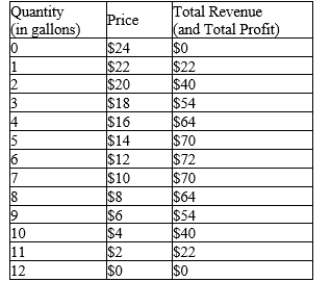 -Refer to Table 17-3. Suppose the town enacts new antitrust laws that prohibit Maria and Miguel from operating as a monopoly. How much profit will Miguel and Maria each earn once they reach a Nash equilibrium?
 (Multiple Choice)
4.9/5 (80)
(80) Table 17-12
The table shows the town of Driveaway's demand schedule for gasoline. Assume the town's gasoline seller(s) incurs a cost of $2 for each gallon sold, with no fixed cost.  -Refer to Table 17-12. If the market for gasoline in Driveaway is a monopoly, then the monopolist's maximum profit is
 (Multiple Choice)
4.8/5 (82)
(82) In the language of game theory, a situation in which each person must consider how others might respond to his or her own actions is called a
(Multiple Choice)
4.7/5 (69)
(69) Scenario 17-5
Assume that a local restaurant sells two items, salads and steaks. The restaurant's only two customers on a particular day are Mr. Carnivore and Ms. Leafygreens. Mr. Carnivore is willing to pay $20 for a steak and $7 for a salad. Ms. Leafygreens is willing to pay only $8 for a steak, but is willing to pay $12 for a salad. Assume that the restaurant can provide each of these items at zero marginal cost.
-Refer to Scenario 17-5. If the restaurant is unable to use tying, what is the profit-maximizing price to charge for a steak?
(Multiple Choice)
4.8/5 (73)
(73) Table 17-9
The table shows the demand schedule for a particular product. 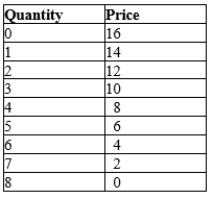 -Refer to Table 17-9. Suppose the market for this product is served by two firms that have formed a cartel. What price will the cartel charge in this market if the marginal cost of production is $0?
 (Multiple Choice)
4.7/5 (74)
(74) As a group, oligopolists would always earn the highest profit if they would
(Multiple Choice)
4.7/5 (79)
(79) Briefly describe the two arguments that economists make to defend the practice of resale price maintenance.
(Essay)
4.7/5 (77)
(77) Table 17-27
Each year the United States considers renewal of Most Favored Nation (MFN) trading status with Farland (a mythical nation). Historically, legislators have made threats of not renewing MFN status because of human rights abuses in Farland. The non-renewal of MFN trading status is likely to involve some retaliatory measures by Farland. The payoff table below shows the potential economic gains associated with a game in which Farland may impose trade sanctions against U.S. firms and the United States may not renew MFN status with Farland. The table contains the dollar value of all trade-flow benefits to the United States and Farland.  -Refer to Table 17-27. This particular game
 (Multiple Choice)
4.8/5 (78)
(78) Scenario 17-4.
Consider two cigarette companies, PM Inc. and Brown Inc. If neither company advertises, the two companies split the market and earn $50 million each. If they both advertise, they again split the market, but profits are lower by $10 million since each company must bear the cost of advertising. Yet if one company advertises while the other does not, the one that advertises attracts customers from the other. In this case, the company that advertises earns $60 million while the company that does not advertise earns only $30 million.
-Refer to Scenario 17-4. PM Inc.'s dominant strategy is to
(Multiple Choice)
4.7/5 (75)
(75) If two players engaged in a prisoner's dilemma game are likely to repeat the game, they are more likely to cooperate than if they play the game only once.
(True/False)
4.7/5 (84)
(84) If a market is a duopoly and additional firms enter and do not cooperate, then
(Multiple Choice)
5.0/5 (81)
(81) Table 17-29
Suppose that two firms, Wild Willy's Wonderdrink (Firm W) and Hyper Hank's Hydration (Firm H), comprise the market for energy drinks. Each firm determines that it could lower its costs and increase its profits if both firms reduced their advertising budgets. But for the plan to work, each firm must agree to refrain from advertising. Each firm believes that advertising works by increasing the demand for the firm's energy drinks, but each firm also believes that if neither firm advertises, the cost savings will outweigh the lost sales. The table below lists each firm's individual profits:
Firm W
Breaks agreement Maintains agreement
and advertises and does not advertise  -Refer to Table 17-29. Which of the following statement(s) correctly characterizes the outcome of this game?
 (Multiple Choice)
4.9/5 (80)
(80) The likely outcome of the standard prisoners' dilemma game is that
(Multiple Choice)
4.9/5 (93)
(93) In cartels, the reason that the monopoly output is unstable is due to the factors that are present in a prisoner's dilemma.
(True/False)
4.8/5 (78)
(78) 
Filters
- Essay(0)
- Multiple Choice(0)
- Short Answer(0)
- True False(0)
- Matching(0)