



 Chat with AI
Exam 17: Oligopoly

Exam 1: Ten Principles of Economics455 Questions
Exam 2: Thinking Like an Economist643 Questions
Exam 3: Interdependence and the Gains From Trade547 Questions
Exam 4: The Market Forces of Supply and Demand693 Questions
Exam 5: Elasticity and Its Application626 Questions
Exam 6: Supply, Demand, and Government Policies668 Questions
Exam 7: Consumers, Producers, and the Efficiency of Markets547 Questions
Exam 8: Applications: the Costs of Taxation509 Questions
Exam 9: Application: International Trade521 Questions
Exam 10: Externalities543 Questions
Exam 11: Public Goods and Common Resources452 Questions
Exam 12: The Design of the Tax System664 Questions
Exam 13: The Costs of Production649 Questions
Exam 14: Firms in Competitive Markets604 Questions
Exam 15: Monopoly662 Questions
Exam 16: Monopolistic Competition649 Questions
Exam 17: Oligopoly522 Questions
Exam 18: The Markets for the Factors of Production592 Questions
Exam 19: Earnings and Discrimination511 Questions
Exam 20: Income Inequality and Poverty478 Questions
Exam 21: The Theory of Consumer Choice570 Questions
Exam 22: Frontiers in Microeconomics461 Questions
Exam 23: Measuring a Nation S Income547 Questions
Exam 24: Measuring the Cost of Living565 Questions
Exam 25: Production and Growth527 Questions
Exam 26: Saving, Investment, and the Financial System637 Questions
Exam 27: Tools of Finance534 Questions
Exam 28: Unemployment and Its Natural Rate701 Questions
Exam 29: The Monetary System540 Questions
Exam 30: Money Growth and Inflation504 Questions
Exam 31: Open-Economy Macroeconomics: Basic Concepts540 Questions
Exam 32: A Macroeconomic Theory of the Open Economy511 Questions
Exam 33: Aggregate Demand and Aggregate Supply572 Questions
Exam 34: The Influence of Monetary and Fiscal Policy on Aggregate Demand523 Questions
Exam 35: The Short-Run Tradeoff Between Inflation and Unemployment536 Questions
Exam 36: Six Debates Over Macroeconomic Policy354 Questions
Select questions type


Table 17-8
For a certain small town, the table shows the demand schedule for water. Assume the marginal cost of supplying water is constant at $4 per bottle and there are no other costs. 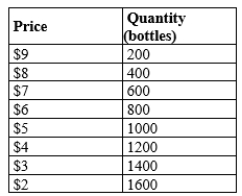 -Refer to Table 17-8. If there were many suppliers of bottled water, what would be the price and quantity?
 (Multiple Choice)
4.8/5  (89)
(89) Game theory is necessary to understand which kinds of markets?
(Multiple Choice)
4.9/5 (74)
(74) In the case of oligopolistic markets, self-interest makes cooperation difficult and it often leads to an undesirable outcome for the firms that are involved.
(True/False)
4.8/5 (67)
(67) Table 17-34
Suppose that two oil companies - BP and Exxon - own adjacent natural gas fields. The profits that each firm earns depends on both the number of wells it drills and the number of wells drilled by the other firm. The table below lists each firm's individual profits:  -Refer to Table 17-34. Is there a Nash equilibrium? If so, describe it.
 (Essay)
5.0/5 (77)
(77) After initial success, the OPEC cartel saw the price of oil and the revenues of its members decline due, in part, to
(Multiple Choice)
4.9/5 (80)
(80) In the U.S. government's 1998 suit against the Microsoft Corporation, a central issue was whether Microsoft should be allowed to integrate its Internet browser into its Windows operating system. Microsoft responded that
(Multiple Choice)
4.9/5 (74)
(74) Table 17-4
The table shows the town of Mauston's demand schedule for gasoline. For simplicity, assume the town's gasoline seller(s) incur no costs in selling gasoline.  -Refer to Table 17-4. If the market for gasoline in Mauston is a monopoly, then the profit-maximizing monopolist will charge a price of
 (Multiple Choice)
4.8/5 (72)
(72) Table 17-33
Suppose that Robert and Howard own the only two movie studios in California. Each producer must choose between a low budget and a high budget strategy for his next film. The economic profit from each strategy is indicated in the table below:  -Refer to Table 17-33. Does Robert have a dominant strategy? If so, describe it.
 (Essay)
4.7/5 (80)
(80) Figure 17-5. Two companies, ABC and QRS, are sellers in the same market. Each company decides whether to charge a high price or a low price. In the figure, the dollar amounts are payoffs and they represent annual profits for the two companies.  -Refer to Figure 17-5. Suppose we observe that the outcome of the game is one in which each company earns a profit of $10 million. This outcome
 (Multiple Choice)
4.9/5 (76)
(76) Scenario 17-3.
Consider two countries, Kinglandia and Rovinastan, that are engaged in an arms race. Each country must decide whether to build new weapons or to disarm existing weapons. Each country prefers to have more arms than the other because a large arsenal gives it more influence in world affairs. But each country also prefers to live in a world safe from the other country's weapons. The following table shows the possible outcomes for each decision combination. The numbers in each cell represent the country's ranking of the outcome (10 = best outcome, 1 = worst outcome).  -Refer to Scenario 17-3. Which of these statements is correct?
(i)Kinglandia is better off building new weapons if Rovinastan builds new weapons.
(ii)Kinglandia is better off building new weapons if Rovinastan disarms existing weapons.
(iii)Rovinastan is only better off building new weapons if Kinglandia builds new weapons.
-Refer to Scenario 17-3. Which of these statements is correct?
(i)Kinglandia is better off building new weapons if Rovinastan builds new weapons.
(ii)Kinglandia is better off building new weapons if Rovinastan disarms existing weapons.
(iii)Rovinastan is only better off building new weapons if Kinglandia builds new weapons. (Multiple Choice)
4.8/5 (88)
(88) Table 17-5
The information in the table below shows the total demand for premium-channel digital cable TV subscriptions in a small urban market. Assume that each digital cable TV operator pays a fixed cost of $200,000 (per year) to provide premium digital channels in the market area and that the marginal cost of providing the premium channel service to a household is zero. 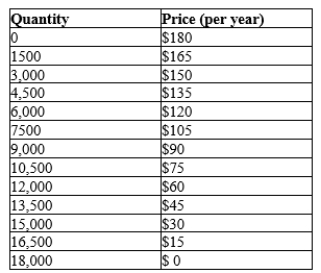 -Refer to Table 17-5. Assume there are two profit-maximizing digital cable TV companies operating in this market. Further assume that they are not able to collude on the price and quantity of premium digital channel subscriptions to sell. How many premium digital channel cable TV subscriptions will be sold altogether when this market reaches a Nash equilibrium?
 (Multiple Choice)
4.8/5 (92)
(92) Table 17-15
This table shows a game played between two players, A and B. The payoffs in the table are shown as (Payoff to A, Payoff to B).  -Refer to Table 17-15. Which of the following outcomes represents a Nash equilibrium in the game?
 (Multiple Choice)
4.9/5 (80)
(80) Suppose a market is initially perfectly competitive with many firms selling an identical product. Over time, however, suppose the merging of firms results in the market being served by only three or four firms selling this same product. As a result, we would expect
(Multiple Choice)
4.7/5 (80)
(80) When a group of firms acts in unison to maximize profits as if they were a monopoly, they form a __________.
(Short Answer)
4.9/5 (74)
(74) Figure 17-2. Two companies, Acme and Pinnacle, each decide whether to produce a good quality product or a poor quality product. In the figure, the dollar amounts are payoffs and they represent annual profits for the two companies. 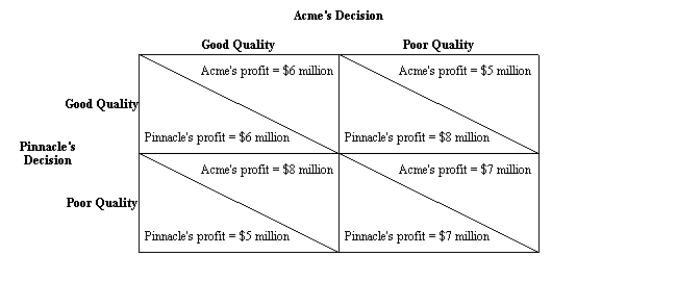 -Refer to Figure 17-2. The more frequently this game is played, the more likely it is that
 (Multiple Choice)
4.8/5 (100)
(100) Table 17-4
The table shows the town of Mauston's demand schedule for gasoline. For simplicity, assume the town's gasoline seller(s) incur no costs in selling gasoline.
-Refer to Table 17-4. If the market for gasoline in Mauston is perfectly competitive, then the equilibrium price of gasoline is
-Refer to Table 17-4. If the market for gasoline in Mauston is perfectly competitive, then the equilibrium price of gasoline is (Multiple Choice)
4.8/5 (74)
(74) A central issue in the Microsoft antitrust lawsuit involved Microsoft's integration of its Internet browser into its Windows operating system, to be sold as one unit. This practice is known as
(Multiple Choice)
4.9/5 (76)
(76) 
Filters
- Essay(0)
- Multiple Choice(0)
- Short Answer(0)
- True False(0)
- Matching(0)