



 Chat with AI
Exam 17: Oligopoly

Exam 1: Ten Principles of Economics455 Questions
Exam 2: Thinking Like an Economist643 Questions
Exam 3: Interdependence and the Gains From Trade547 Questions
Exam 4: The Market Forces of Supply and Demand693 Questions
Exam 5: Elasticity and Its Application626 Questions
Exam 6: Supply, Demand, and Government Policies668 Questions
Exam 7: Consumers, Producers, and the Efficiency of Markets547 Questions
Exam 8: Applications: the Costs of Taxation509 Questions
Exam 9: Application: International Trade521 Questions
Exam 10: Externalities543 Questions
Exam 11: Public Goods and Common Resources452 Questions
Exam 12: The Design of the Tax System664 Questions
Exam 13: The Costs of Production649 Questions
Exam 14: Firms in Competitive Markets604 Questions
Exam 15: Monopoly662 Questions
Exam 16: Monopolistic Competition649 Questions
Exam 17: Oligopoly522 Questions
Exam 18: The Markets for the Factors of Production592 Questions
Exam 19: Earnings and Discrimination511 Questions
Exam 20: Income Inequality and Poverty478 Questions
Exam 21: The Theory of Consumer Choice570 Questions
Exam 22: Frontiers in Microeconomics461 Questions
Exam 23: Measuring a Nation S Income547 Questions
Exam 24: Measuring the Cost of Living565 Questions
Exam 25: Production and Growth527 Questions
Exam 26: Saving, Investment, and the Financial System637 Questions
Exam 27: Tools of Finance534 Questions
Exam 28: Unemployment and Its Natural Rate701 Questions
Exam 29: The Monetary System540 Questions
Exam 30: Money Growth and Inflation504 Questions
Exam 31: Open-Economy Macroeconomics: Basic Concepts540 Questions
Exam 32: A Macroeconomic Theory of the Open Economy511 Questions
Exam 33: Aggregate Demand and Aggregate Supply572 Questions
Exam 34: The Influence of Monetary and Fiscal Policy on Aggregate Demand523 Questions
Exam 35: The Short-Run Tradeoff Between Inflation and Unemployment536 Questions
Exam 36: Six Debates Over Macroeconomic Policy354 Questions
Select questions type


Scenario 17-3.
Consider two countries, Kinglandia and Rovinastan, that are engaged in an arms race. Each country must decide whether to build new weapons or to disarm existing weapons. Each country prefers to have more arms than the other because a large arsenal gives it more influence in world affairs. But each country also prefers to live in a world safe from the other country's weapons. The following table shows the possible outcomes for each decision combination. The numbers in each cell represent the country's ranking of the outcome (10 = best outcome, 1 = worst outcome).  -Refer to Scenario 17-3. If each country only makes a choice of whether to build or disarm one time and Rovinastan chooses to build new weapons, then Kinglandia will
 (Multiple Choice)
4.8/5  (89)
(89) If two firms comprise the entire soft drink market, the market would be a(n)
(Multiple Choice)
4.8/5 (75)
(75) Once a cartel is formed, the market is in effect served by
(Multiple Choice)
4.9/5 (83)
(83) The argument that consumers will not be willing to pay any more for two items sold as one than they would for the two items sold separately is used to justify the legality of which of the following?
(Multiple Choice)
4.9/5 (74)
(74) The prisoners' dilemma is an important game to study because
(Multiple Choice)
4.9/5 (80)
(80) We know that people tend to overuse common resources. This problem can be viewed as an example of
(Multiple Choice)
4.9/5 (84)
(84) Assume that two firms in an oligopoly market are unable to collude. Once the Nash Equilibrium is reached
(Multiple Choice)
4.9/5 (87)
(87) Table 17-19
Consider a small town that has two grocery stores from which residents can choose to buy a loaf of bread. The store owners each must make a decision to set a high bread price or a low bread price. The payoff table, showing profit per week, is provided below. The profit in each cell is shown as (Store 1, Store 2).  -Refer to Table 17-19. If grocery store 2 sets a high price, what price should grocery store 1 set? And what will grocery store 1's payoff equal?
 (Multiple Choice)
4.8/5 (80)
(80) Table 17-32
Suppose that Angelina and Brad own the only two professional photography stores in town. Each must choose between a low price and a high price for senior photo packages. The annual economic profit from each strategy is indicated in the table below:  -Refer to Table 17-32. Does Brad have a dominant strategy? If so, describe it.
 (Essay)
4.9/5 (74)
(74) Table 17-3
Imagine a small town in a remote area where only two residents, Maria and Miguel, own dairies that produce milk that is safe to drink. Each week Maria and Miguel work together to decide how many gallons of milk to produce. They bring milk to town and sell it at whatever price the market will bear. To keep things simple, suppose that Maria and Miguel can produce as much milk as they want without cost so that the marginal cost is zero. The weekly town demand schedule and total revenue schedule for milk is shown in the table below: 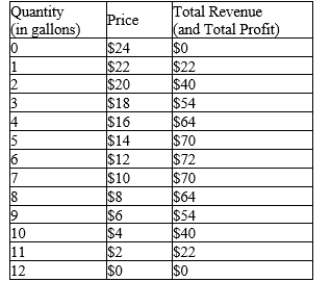 -Refer to Table 17-3. Suppose the town enacts new antitrust laws that prohibit Maria and Miguel from operating as a monopoly. What will be the price of milk once Maria and Miguel reach a Nash equilibrium?
 (Multiple Choice)
4.9/5 (80)
(80) Because oligopoly markets have only a few sellers, the actions of any one seller
(Multiple Choice)
4.9/5 (77)
(77) Table 17-28
Suppose that two firms determine that each could lower its costs and increase its profits if both reduced their advertising budgets. But in order for the plan to work, each firm must agree to refrain from advertising. Each firm believes that advertising works by increasing the demand for the firm's product, but each firm also believes that if neither firm advertises, the cost savings will outweigh the lost sales. The table below lists each firm's individual profits:
Firm A
Breaks agreement Maintains agreement
and advertises and does not advertise  -Refer to Table 17-28. Which of the following statement(s) correctly characterizes the outcome of this game?
 (Multiple Choice)
4.8/5 (79)
(79) Table 17-26
Two prescription drug manufacturers (Firm A and Firm B) are faced with lawsuits from states to recover the healthcare related expenses associated with side-effects from its drugs. Each drug manufacturer has evidence that indicates that taking its prescription drug causes liver failure. State prosecutors do not have access to the same data used by drug manufacturers and thus will have difficulty recovering full costs without the help of at least one of the drug manufacturer's studies. Each firm has been presented with an opportunity to lower its liability in the suit if it cooperates with attorneys representing the states. 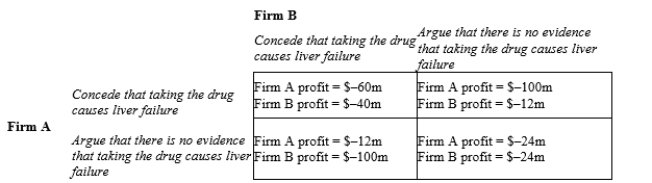 -Refer to Table 17-26. When this game reaches a Nash equilibrium, profits for Firm A and Firm B will be
 (Multiple Choice)
5.0/5 (88)
(88) Suppose that two poker players believe that they are superior players to the rest of the people at their table. Further suppose that the two players make an agreement to concede hands to each other in order to drive the other players from the game first. Economists would model such behavior as
(Multiple Choice)
4.9/5 (82)
(82) If nations such as Germany, Japan, and the United States prohibited international trade in automobiles, a likely effect would be that
(Multiple Choice)
5.0/5 (64)
(64) Very often, the reason that players can solve the prisoners' dilemma and reach the most profitable outcome is that
(Multiple Choice)
4.7/5 (73)
(73) 
Filters
- Essay(0)
- Multiple Choice(0)
- Short Answer(0)
- True False(0)
- Matching(0)