



 Chat with AI
Exam 17: Oligopoly

Exam 1: Ten Principles of Economics455 Questions
Exam 2: Thinking Like an Economist643 Questions
Exam 3: Interdependence and the Gains From Trade547 Questions
Exam 4: The Market Forces of Supply and Demand693 Questions
Exam 5: Elasticity and Its Application626 Questions
Exam 6: Supply, Demand, and Government Policies668 Questions
Exam 7: Consumers, Producers, and the Efficiency of Markets547 Questions
Exam 8: Applications: the Costs of Taxation509 Questions
Exam 9: Application: International Trade521 Questions
Exam 10: Externalities543 Questions
Exam 11: Public Goods and Common Resources452 Questions
Exam 12: The Design of the Tax System664 Questions
Exam 13: The Costs of Production649 Questions
Exam 14: Firms in Competitive Markets604 Questions
Exam 15: Monopoly662 Questions
Exam 16: Monopolistic Competition649 Questions
Exam 17: Oligopoly522 Questions
Exam 18: The Markets for the Factors of Production592 Questions
Exam 19: Earnings and Discrimination511 Questions
Exam 20: Income Inequality and Poverty478 Questions
Exam 21: The Theory of Consumer Choice570 Questions
Exam 22: Frontiers in Microeconomics461 Questions
Exam 23: Measuring a Nation S Income547 Questions
Exam 24: Measuring the Cost of Living565 Questions
Exam 25: Production and Growth527 Questions
Exam 26: Saving, Investment, and the Financial System637 Questions
Exam 27: Tools of Finance534 Questions
Exam 28: Unemployment and Its Natural Rate701 Questions
Exam 29: The Monetary System540 Questions
Exam 30: Money Growth and Inflation504 Questions
Exam 31: Open-Economy Macroeconomics: Basic Concepts540 Questions
Exam 32: A Macroeconomic Theory of the Open Economy511 Questions
Exam 33: Aggregate Demand and Aggregate Supply572 Questions
Exam 34: The Influence of Monetary and Fiscal Policy on Aggregate Demand523 Questions
Exam 35: The Short-Run Tradeoff Between Inflation and Unemployment536 Questions
Exam 36: Six Debates Over Macroeconomic Policy354 Questions
Select questions type


Table 17-13
Two home-improvement stores (Lopes and HomeMax) in a growing urban area are interested in expanding their market share. Both are interested in expanding the size of their store and parking lot to accommodate potential growth in their customer base. The following game depicts the strategic outcomes that result from the game. Increases in annual profits of the two home-improvement stores are shown in the table below. 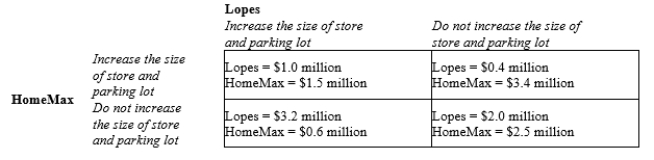 -Refer to Table 17-13. Pursuing its own best interest, Lopes will
 (Multiple Choice)
4.9/5  (72)
(72) It is always the case that players in a prisoner's dilemma situation will choose the Nash Equilibrium.
(True/False)
4.8/5 (74)
(74) The Sherman Antitrust Act prohibits competing firms from even talking about fixing prices.
(True/False)
4.8/5 (83)
(83) Table 17-20
Nadia and Maddie are two college roommates who both prefer a clean common space in their dorm room, but neither enjoys cleaning. The roommates must each make a decision to either clean or not clean the dorm room's common space. The payoff table for this situation is provided below, where the higher a player's payoff number, the better off that player is. The payoffs in each cell are shown as (payoff for Nadia, payoff for Maddie).  -Refer to Table 17-20. If Nadia chooses to clean, then Maddie will
 (Multiple Choice)
4.9/5 (89)
(89) Table 17-7
The information in the table below shows the total demand for internet radio subscriptions in a small urban market. Assume that each company that provides these subscriptions incurs an annual fixed cost of $20,000 (per year) and that the marginal cost of providing an additional subscription is always $16. 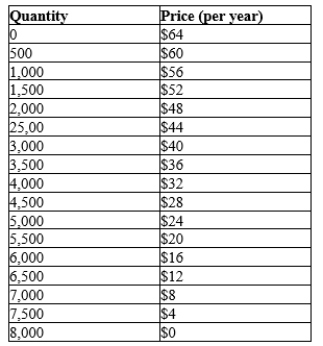 -Refer to Table 17-7. Assume there are two internet radio providers that operate in this market. If they are able to collude on the quantity of subscriptions that will be sold and on the price that will be charged for subscriptions, then their agreement will stipulate that
 (Multiple Choice)
4.9/5 (91)
(91) When firms have agreements among themselves on the quantity to produce and the price at which to sell output, we refer to their form of organization as a
(Multiple Choice)
4.7/5 (87)
(87) Which potentially anti-competitive business practice is often justified on the grounds that it corrects for the free rider problem?
(Short Answer)
4.9/5 (65)
(65) In a particular town, Comvision and Veriview are the only two providers of cable TV service. Comvision and Veriview constitute a
(Multiple Choice)
4.8/5 (85)
(85) The Sherman Antitrust Act states that if a person can prove that he was damaged by an illegal arrangement to restrain trade, he could sue and recover three times the damages he sustained.
(True/False)
4.7/5 (76)
(76) Why would lack of cooperation between criminal suspects be desirable for society as a whole?
(Multiple Choice)
4.9/5 (65)
(65) A lack of cooperation by oligopolists trying to maintain monopoly profits
(Multiple Choice)
4.9/5 (77)
(77) Table 17-37
Two restaurants with a focus on Mexican dining operate in Texama. Both Mitch's Mexican and Tim's Tacos need to decide whether to add Zesty Queso or Fresh Guacamole to their menus. The circumstances are that each firm wants to add only one of the two choices on their menu. Below you will find the profits for the stores, shown as: (1) the payoff to Mitch; (2) the payoff to Tim. 
-Refer to Table 17-37. Based upon the information from the table, which firm has a dominant strategy?
-Refer to Table 17-37. Based upon the information from the table, which firm has a dominant strategy? (Multiple Choice)
5.0/5 (79)
(79) Ford and General Motors are considering expanding into the Vietnamese automobile market. Devise a simple prisoners' dilemma game to demonstrate the strategic considerations that are relevant to this decision.
(Essay)
4.8/5 (80)
(80) Suppose that Thierry and Abdul are duopolists. Thierry is producing 700 units of output, and Abdul is producing 500 units of output. When Abdul produces 500 units, Thierry maximizes profit by producing 700 units. When Thierry produces 700 units of output, Abdul maximizes profit by producing 500 units. Thierry and Abdul are
(Multiple Choice)
4.9/5 (86)
(86) Because each oligopolist cares about its own profit rather than the collective profit of all the oligopolists together,
(Multiple Choice)
4.9/5 (76)
(76) Figure 17-5. Two companies, ABC and QRS, are sellers in the same market. Each company decides whether to charge a high price or a low price. In the figure, the dollar amounts are payoffs and they represent annual profits for the two companies.  -Refer to Figure 17-5. The situation faced by ABC and QRS is
 (Multiple Choice)
4.8/5 (79)
(79) Table 17-36
The information in the table shows the total demand for water service in Takoma. Assume that there are two companies operating in Takoma. Each company that provides these services incurs an annual fixed cost of $400 and that the marginal cost of providing the service to each customer is exactly $2.00. Figures listed are for an annual service contract.
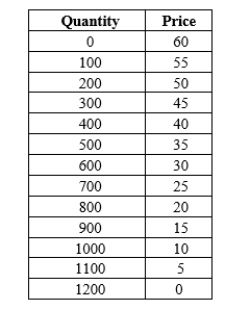 -Refer to Table 17-36. Suppose that this is a perfectly competitive market. What would total output be?
 (Multiple Choice)
4.8/5 (93)
(93) Describe the output and price effects that influence the profit-maximizing decision faced by a firm in an oligopoly market. How does this differ from output and price effects in a monopoly market?
(Essay)
4.9/5 (81)
(81) Table 17-7
The information in the table below shows the total demand for internet radio subscriptions in a small urban market. Assume that each company that provides these subscriptions incurs an annual fixed cost of $20,000 (per year) and that the marginal cost of providing an additional subscription is always $16.
-Refer to Table 17-7. Assume there are two profit-maximizing internet radio providers operating in this market. Further assume that they are able to collude on the quantity of subscriptions that will be sold and on the price that will be charged for subscriptions. If the firms divide the market evenly, how much profit will each company earn?
-Refer to Table 17-7. Assume there are two profit-maximizing internet radio providers operating in this market. Further assume that they are able to collude on the quantity of subscriptions that will be sold and on the price that will be charged for subscriptions. If the firms divide the market evenly, how much profit will each company earn? (Multiple Choice)
4.9/5 (86)
(86) 
Filters
- Essay(0)
- Multiple Choice(0)
- Short Answer(0)
- True False(0)
- Matching(0)