



 Chat with AI
Exam 17: Oligopoly

Exam 1: Ten Principles of Economics455 Questions
Exam 2: Thinking Like an Economist643 Questions
Exam 3: Interdependence and the Gains From Trade547 Questions
Exam 4: The Market Forces of Supply and Demand693 Questions
Exam 5: Elasticity and Its Application626 Questions
Exam 6: Supply, Demand, and Government Policies668 Questions
Exam 7: Consumers, Producers, and the Efficiency of Markets547 Questions
Exam 8: Applications: the Costs of Taxation509 Questions
Exam 9: Application: International Trade521 Questions
Exam 10: Externalities543 Questions
Exam 11: Public Goods and Common Resources452 Questions
Exam 12: The Design of the Tax System664 Questions
Exam 13: The Costs of Production649 Questions
Exam 14: Firms in Competitive Markets604 Questions
Exam 15: Monopoly662 Questions
Exam 16: Monopolistic Competition649 Questions
Exam 17: Oligopoly522 Questions
Exam 18: The Markets for the Factors of Production592 Questions
Exam 19: Earnings and Discrimination511 Questions
Exam 20: Income Inequality and Poverty478 Questions
Exam 21: The Theory of Consumer Choice570 Questions
Exam 22: Frontiers in Microeconomics461 Questions
Exam 23: Measuring a Nation S Income547 Questions
Exam 24: Measuring the Cost of Living565 Questions
Exam 25: Production and Growth527 Questions
Exam 26: Saving, Investment, and the Financial System637 Questions
Exam 27: Tools of Finance534 Questions
Exam 28: Unemployment and Its Natural Rate701 Questions
Exam 29: The Monetary System540 Questions
Exam 30: Money Growth and Inflation504 Questions
Exam 31: Open-Economy Macroeconomics: Basic Concepts540 Questions
Exam 32: A Macroeconomic Theory of the Open Economy511 Questions
Exam 33: Aggregate Demand and Aggregate Supply572 Questions
Exam 34: The Influence of Monetary and Fiscal Policy on Aggregate Demand523 Questions
Exam 35: The Short-Run Tradeoff Between Inflation and Unemployment536 Questions
Exam 36: Six Debates Over Macroeconomic Policy354 Questions
Select questions type


There are two types of markets in which firms face some competition yet are still able to have some control over the prices of their products. Those two types of market are
(Multiple Choice)
5.0/5  (74)
(74) The game that oligopolists play in trying to reach the oligopoly outcome is similar to the game that the two prisoners play in the prisoners' dilemma.
(True/False)
4.7/5 (73)
(73) An agreement among firms in a market about quantities to produce or prices to charge is called
(Multiple Choice)
4.9/5 (65)
(65) The manufacturer of South Face sells jackets to retail stores for $120 each, and it requires the retail stores to charge customers $150 per jacket. Any retailer that charges less than $150 would violate its contract with South Face. What do economists call this business practice?
(Multiple Choice)
4.9/5 (70)
(70) An oligopolist will increase production if the output effect is
(Multiple Choice)
4.8/5 (68)
(68) What happens when the prisoners' dilemma game is repeated numerous times in an oligopoly market?
(i)The firms may well reach the monopoly outcome.
(ii)The firms may well reach the competitive outcome.
(iii)Buyers of the oligopolists' product will likely be worse off as a result.
(Multiple Choice)
4.7/5 (71)
(71) Table 17-7
The information in the table below shows the total demand for internet radio subscriptions in a small urban market. Assume that each company that provides these subscriptions incurs an annual fixed cost of $20,000 (per year) and that the marginal cost of providing an additional subscription is always $16. 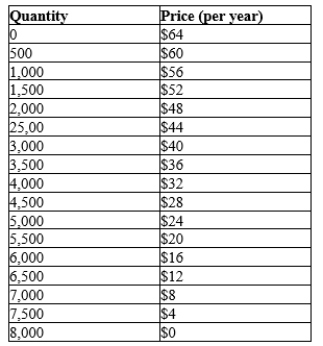 -Refer to Table 17-7. The socially efficient level of output supplied to this market is
 (Multiple Choice)
4.7/5 (74)
(74) Table 17-12
The table shows the town of Driveaway's demand schedule for gasoline. Assume the town's gasoline seller(s) incurs a cost of $2 for each gallon sold, with no fixed cost.  -Refer to Table 17-12. If there are exactly five sellers of gasoline in Driveaway and if they collude, then which of the following outcomes is most likely?
 (Multiple Choice)
4.7/5 (69)
(69) In some games, the noncooperative equilibrium is bad for the players and bad for society.
(True/False)
4.9/5 (70)
(70) Table 17-6
Imagine a small town in which only two residents, Kunal and Naj, own wells that produce safe drinking water. Each week Kunal and Naj work together to decide how many gallons of water to pump, to bring the water to town, and to sell it at whatever price the market will bear. Assume Kunal and Naj can pump as much water as they want without cost so that the marginal cost of water equals zero.
The weekly town demand schedule and total revenue schedule for water are shown in the table below. 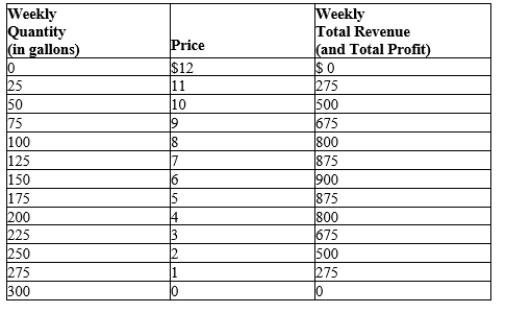 -Refer to Table 17-6. Suppose the town enacts new antitrust laws that prohibit Kunal and Naj from operating as a monopolist. Once the Nash equilibrium is reached, how much profit will each producer earn?
 (Multiple Choice)
4.8/5 (67)
(67) In a two-person repeated game, a tit-for-tat strategy starts with
(Multiple Choice)
4.9/5 (89)
(89) Table 17-11
Only two firms, ABC and XYZ, sell a particular product. The table below shows the demand curve for their product. Each firm has the same constant marginal cost of $8 and zero fixed cost. 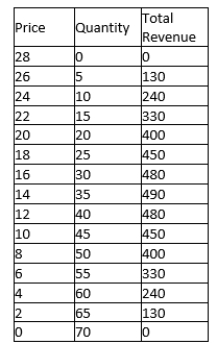 -Refer to Table 17-11. If ABC and XYZ operate to jointly maximize profits, then what quantity is sold?
 (Multiple Choice)
4.9/5 (89)
(89) Figure 17-1 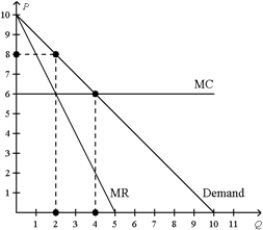 -Refer to Figure 17-1. Suppose this market is served by two firms who each face the marginal cost curve shown in the diagram. The marginal revenue curve that a monopolist would face in this market is also shown. If the firms are able to collude successfully,
 (Multiple Choice)
4.8/5 (68)
(68) As a group, oligopolists would always be better off if they would act collectively
(Multiple Choice)
4.9/5 (83)
(83) Table 17-6
Imagine a small town in which only two residents, Kunal and Naj, own wells that produce safe drinking water. Each week Kunal and Naj work together to decide how many gallons of water to pump, to bring the water to town, and to sell it at whatever price the market will bear. Assume Kunal and Naj can pump as much water as they want without cost so that the marginal cost of water equals zero.
The weekly town demand schedule and total revenue schedule for water are shown in the table below.
-Refer to Table 17-6. The socially efficient level of water supplied to the market would be
-Refer to Table 17-6. The socially efficient level of water supplied to the market would be (Multiple Choice)
4.8/5 (69)
(69) Table 17-19
Consider a small town that has two grocery stores from which residents can choose to buy a loaf of bread. The store owners each must make a decision to set a high bread price or a low bread price. The payoff table, showing profit per week, is provided below. The profit in each cell is shown as (Store 1, Store 2).  -Refer to Table 17-19. What is the Nash Equilibrium of this price-setting game?
 (Multiple Choice)
4.8/5 (81)
(81) The Sherman Antitrust Act prohibits price-fixing in the sense that
(Multiple Choice)
4.8/5 (74)
(74) Table 17-27
Each year the United States considers renewal of Most Favored Nation (MFN) trading status with Farland (a mythical nation). Historically, legislators have made threats of not renewing MFN status because of human rights abuses in Farland. The non-renewal of MFN trading status is likely to involve some retaliatory measures by Farland. The payoff table below shows the potential economic gains associated with a game in which Farland may impose trade sanctions against U.S. firms and the United States may not renew MFN status with Farland. The table contains the dollar value of all trade-flow benefits to the United States and Farland.  -Refer to Table 17-27. If trade negotiators are able to communicate effectively about the consequences of various trade policies (i.e., enter into an agreement about the policy they should adopt), then we would expect the countries to agree to which outcome?
 (Multiple Choice)
4.8/5 (80)
(80) Table 17-21
The Chicken Game is named for a contest in which drivers test their courage by driving straight at each other. John and Paul have a common interest to avoid crashing into each other, but they also have a personal, competing interest to not turn first to demonstrate their courage to those observing the contest. The payoff table for this situation is provided below. The payoffs are shown as (John, Paul).  -Refer to Table 17-21. What is Paul's dominant strategy?
 (Multiple Choice)
4.9/5 (81)
(81) 
Filters
- Essay(0)
- Multiple Choice(0)
- Short Answer(0)
- True False(0)
- Matching(0)