



 Chat with AI
Exam 17: Oligopoly

Exam 1: Ten Principles of Economics455 Questions
Exam 2: Thinking Like an Economist643 Questions
Exam 3: Interdependence and the Gains From Trade547 Questions
Exam 4: The Market Forces of Supply and Demand693 Questions
Exam 5: Elasticity and Its Application626 Questions
Exam 6: Supply, Demand, and Government Policies668 Questions
Exam 7: Consumers, Producers, and the Efficiency of Markets547 Questions
Exam 8: Applications: the Costs of Taxation509 Questions
Exam 9: Application: International Trade521 Questions
Exam 10: Externalities543 Questions
Exam 11: Public Goods and Common Resources452 Questions
Exam 12: The Design of the Tax System664 Questions
Exam 13: The Costs of Production649 Questions
Exam 14: Firms in Competitive Markets604 Questions
Exam 15: Monopoly662 Questions
Exam 16: Monopolistic Competition649 Questions
Exam 17: Oligopoly522 Questions
Exam 18: The Markets for the Factors of Production592 Questions
Exam 19: Earnings and Discrimination511 Questions
Exam 20: Income Inequality and Poverty478 Questions
Exam 21: The Theory of Consumer Choice570 Questions
Exam 22: Frontiers in Microeconomics461 Questions
Exam 23: Measuring a Nation S Income547 Questions
Exam 24: Measuring the Cost of Living565 Questions
Exam 25: Production and Growth527 Questions
Exam 26: Saving, Investment, and the Financial System637 Questions
Exam 27: Tools of Finance534 Questions
Exam 28: Unemployment and Its Natural Rate701 Questions
Exam 29: The Monetary System540 Questions
Exam 30: Money Growth and Inflation504 Questions
Exam 31: Open-Economy Macroeconomics: Basic Concepts540 Questions
Exam 32: A Macroeconomic Theory of the Open Economy511 Questions
Exam 33: Aggregate Demand and Aggregate Supply572 Questions
Exam 34: The Influence of Monetary and Fiscal Policy on Aggregate Demand523 Questions
Exam 35: The Short-Run Tradeoff Between Inflation and Unemployment536 Questions
Exam 36: Six Debates Over Macroeconomic Policy354 Questions
Select questions type


Which of the following questions about predatory pricing remains unresolved?
(Multiple Choice)
4.7/5  (73)
(73) To increase their individual profits, members of a cartel have an incentive to
(Multiple Choice)
4.7/5 (77)
(77) Table 17-22
Brian and Matt own the only two bicycle repair shops in town. Each must choose between a low price for repair work and a high price. The annual economic profit from each strategy is indicated in the table. The profits are shown as (Matt, Brian) in each cell.  -Refer to Table 17-22. Which of the following statements is correct if Brian and Matt will play this game only once?
 (Multiple Choice)
4.8/5 (81)
(81) Table 17-20
Nadia and Maddie are two college roommates who both prefer a clean common space in their dorm room, but neither enjoys cleaning. The roommates must each make a decision to either clean or not clean the dorm room's common space. The payoff table for this situation is provided below, where the higher a player's payoff number, the better off that player is. The payoffs in each cell are shown as (payoff for Nadia, payoff for Maddie).  -Refer to Table 17-20. If Maddie chooses not to clean, then Nadia will
 (Multiple Choice)
5.0/5 (83)
(83) To move the allocation of resources closer to the social optimum, policymakers should typically try to induce firms in an oligopoly to
(Multiple Choice)
4.8/5 (81)
(81) As the number of firms in an oligopoly becomes very large, the price effect disappears.
(True/False)
4.9/5 (75)
(75) A manufacturer of light bulbs sells its products to retail stores and requires the stores to sell the bulbs to customers for $2 per bulb. This practice is known as tying.
(True/False)
4.9/5 (98)
(98) Which of the following statements about oligopolies is not correct?
(Multiple Choice)
4.7/5 (77)
(77) Why are the actions of firms interdependent in an oligopoly market but not in a monopolistically competitive market?
(Essay)
4.9/5 (84)
(84) Table 17-15
This table shows a game played between two players, A and B. The payoffs in the table are shown as (Payoff to A, Payoff to B).  -Refer to Table 17-15. Which of the following statements regarding this game is true?
 (Multiple Choice)
4.9/5 (84)
(84) Scenario 17-2.
Imagine that two oil companies, BQ and Exxoff, own adjacent oil fields. Under the fields is a common pool of oil worth $144 million. Drilling a well to recover oil costs $5 million per well. If each company drills one well, each will get half of the oil and earn a $67 million profit ($72 million in revenue - $5 million in costs). Assume that having X percent of the total wells means that a company will collect X percent of the total revenue.
-Refer to Scenario 17-2. If BQ and Exxoff are able to successfully cooperate to maximize their joint profits, BQ will earn
(Multiple Choice)
4.9/5 (74)
(74) Scenario 17-3.
Consider two countries, Kinglandia and Rovinastan, that are engaged in an arms race. Each country must decide whether to build new weapons or to disarm existing weapons. Each country prefers to have more arms than the other because a large arsenal gives it more influence in world affairs. But each country also prefers to live in a world safe from the other country's weapons. The following table shows the possible outcomes for each decision combination. The numbers in each cell represent the country's ranking of the outcome (10 = best outcome, 1 = worst outcome).  -Refer to Scenario 17-3. If Rovinastan chooses to disarm its existing weapons, then Kinglandia will
 (Multiple Choice)
4.9/5 (65)
(65) Juan Pablo and Zak are competitors in a local market. Each is trying to decide if it is better to advertise on TV, on radio, or not at all. If they both advertise on TV, each will earn a profit of $8,000. If they both advertise on radio, each will earn a profit of $14,000. If neither advertises at all, each will earn a profit of $20,000. If one advertises on TV and other advertises on radio, then the one advertising on TV will earn $12,000 and the other will earn $10,000. If one advertises on TV and the other does not advertise, then the one advertising on TV will earn $22,000 and the other will earn $4,000. If one advertises on radio and the other does not advertise, then the one advertising on radio will earn $24,000 and the other will earn $8,000. If both follow their dominant strategy, then Juan Pablo will
(Multiple Choice)
4.9/5 (79)
(79) Table 17-12
The table shows the town of Driveaway's demand schedule for gasoline. Assume the town's gasoline seller(s) incurs a cost of $2 for each gallon sold, with no fixed cost. 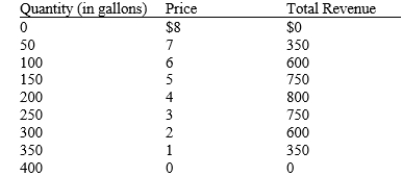 -Refer to Table 17-12. If the market for gasoline in Driveaway is perfectly competitive, then the equilibrium price of gasoline is
 (Multiple Choice)
4.9/5 (75)
(75) To function as a monopoly, OPEC and other cartels rely on __________ among members.
(Short Answer)
4.9/5 (82)
(82) Figure 17-5. Two companies, ABC and QRS, are sellers in the same market. Each company decides whether to charge a high price or a low price. In the figure, the dollar amounts are payoffs and they represent annual profits for the two companies. 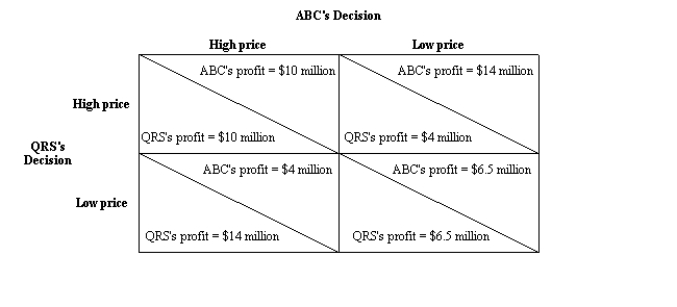 -Refer to Figure 17-5. If this game is played only once, then the most likely outcome is that
 (Multiple Choice)
5.0/5 (75)
(75) Table 17-28
Suppose that two firms determine that each could lower its costs and increase its profits if both reduced their advertising budgets. But in order for the plan to work, each firm must agree to refrain from advertising. Each firm believes that advertising works by increasing the demand for the firm's product, but each firm also believes that if neither firm advertises, the cost savings will outweigh the lost sales. The table below lists each firm's individual profits:
Firm A
Breaks agreement Maintains agreement
and advertises and does not advertise  -Refer to Table 17-28. Does either Firm A or Firm B have a dominant strategy?
 (Multiple Choice)
4.9/5 (79)
(79) 
Filters
- Essay(0)
- Multiple Choice(0)
- Short Answer(0)
- True False(0)
- Matching(0)