



 Chat with AI
Exam 17: Oligopoly

Exam 1: Ten Principles of Economics455 Questions
Exam 2: Thinking Like an Economist643 Questions
Exam 3: Interdependence and the Gains From Trade547 Questions
Exam 4: The Market Forces of Supply and Demand693 Questions
Exam 5: Elasticity and Its Application626 Questions
Exam 6: Supply, Demand, and Government Policies668 Questions
Exam 7: Consumers, Producers, and the Efficiency of Markets547 Questions
Exam 8: Applications: the Costs of Taxation509 Questions
Exam 9: Application: International Trade521 Questions
Exam 10: Externalities543 Questions
Exam 11: Public Goods and Common Resources452 Questions
Exam 12: The Design of the Tax System664 Questions
Exam 13: The Costs of Production649 Questions
Exam 14: Firms in Competitive Markets604 Questions
Exam 15: Monopoly662 Questions
Exam 16: Monopolistic Competition649 Questions
Exam 17: Oligopoly522 Questions
Exam 18: The Markets for the Factors of Production592 Questions
Exam 19: Earnings and Discrimination511 Questions
Exam 20: Income Inequality and Poverty478 Questions
Exam 21: The Theory of Consumer Choice570 Questions
Exam 22: Frontiers in Microeconomics461 Questions
Exam 23: Measuring a Nation S Income547 Questions
Exam 24: Measuring the Cost of Living565 Questions
Exam 25: Production and Growth527 Questions
Exam 26: Saving, Investment, and the Financial System637 Questions
Exam 27: Tools of Finance534 Questions
Exam 28: Unemployment and Its Natural Rate701 Questions
Exam 29: The Monetary System540 Questions
Exam 30: Money Growth and Inflation504 Questions
Exam 31: Open-Economy Macroeconomics: Basic Concepts540 Questions
Exam 32: A Macroeconomic Theory of the Open Economy511 Questions
Exam 33: Aggregate Demand and Aggregate Supply572 Questions
Exam 34: The Influence of Monetary and Fiscal Policy on Aggregate Demand523 Questions
Exam 35: The Short-Run Tradeoff Between Inflation and Unemployment536 Questions
Exam 36: Six Debates Over Macroeconomic Policy354 Questions
Select questions type


Assume that Bart's Batteries has entered into a resale price maintenance agreement with Radio Shanty but not with Prime Purchase. In this case,
(Multiple Choice)
4.8/5  (75)
(75) Table 17-33
Suppose that Robert and Howard own the only two movie studios in California. Each producer must choose between a low budget and a high budget strategy for his next film. The economic profit from each strategy is indicated in the table below:  -Refer to Table 17-33. Does Howard have a dominant strategy? If so, describe it.
 (Essay)
4.9/5 (87)
(87) Oligopolies produce more when they collude then when they do not.
(True/False)
4.9/5 (80)
(80) Table 17-7
The information in the table below shows the total demand for internet radio subscriptions in a small urban market. Assume that each company that provides these subscriptions incurs an annual fixed cost of $20,000 (per year) and that the marginal cost of providing an additional subscription is always $16. 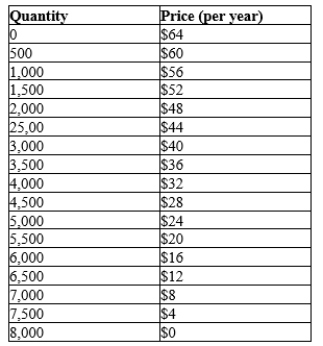 -Refer to Table 17-7. Assume that there are two profit-maximizing internet radio providers operating in this market. Further assume that they are not able to collude on the price and quantity of subscriptions to sell. How much profit will each firm earn when this market reaches a Nash equilibrium?
 (Multiple Choice)
4.8/5 (62)
(62) Figure 17-3. Hector and Bart are roommates. On a particular day, their apartment needs to be cleaned. Each person has to decide whether to take part in cleaning. At the end of the day, either the apartment will be completely clean (if one or both roommates take part in cleaning), or it will remain dirty (if neither roommate cleans). With happiness measured on a scale of 1 (very unhappy) to 10 (very happy), the possible outcomes are as follows: 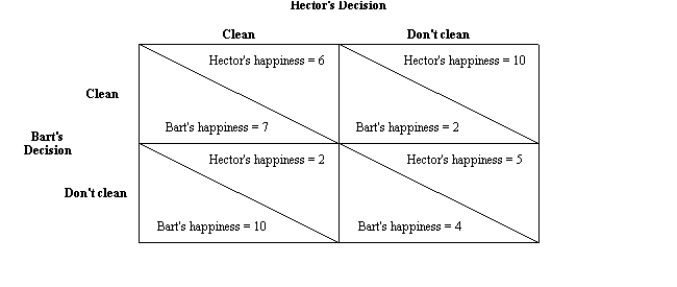 -Refer to Figure 17-3. In pursuing his own self-interest, Hector will
 (Multiple Choice)
4.8/5 (81)
(81) The equilibrium price in a market characterized by oligopoly is
(Multiple Choice)
4.9/5 (72)
(72) The practice of selling a product to retailers and requiring the retailers to charge a specific price for the product is called
(Multiple Choice)
4.9/5 (93)
(93) If the output effect is larger than the price effect, an individual firm will __________ production.
(Short Answer)
4.9/5 (81)
(81) As the number of firms in an oligopoly industry decreases, the market moves closer to a __________ market.
(Short Answer)
4.8/5 (75)
(75) The theory of oligopoly provides another reason that free trade can benefit all countries because
(Multiple Choice)
4.9/5 (84)
(84) Table 17-1
Imagine a small town in which only two residents, Rochelle and Alec, own wells that produce safe drinking water. Each week Rochelle and Alec work together to decide how many gallons of water to pump. They bring the water to town and sell it at whatever price the market will bear. To keep things simple, suppose that Rochelle and Alec can pump as much water as they want without cost so that the marginal cost of water equals zero. The town's weekly demand schedule and total revenue schedule for water is shown in the table below: 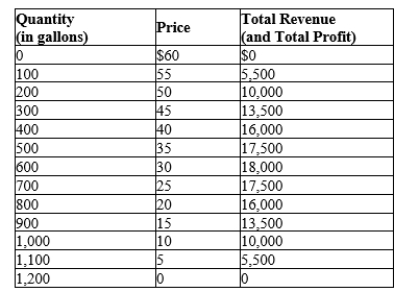 -Refer to Table 17-1. Suppose the town enacts new antitrust laws that prohibit Rochelle and Alec from operating as a monopoly. What will be the price of water once Rochelle and Alec reach a Nash equilibrium?
 (Multiple Choice)
4.9/5 (79)
(79) Table 17-6
Imagine a small town in which only two residents, Kunal and Naj, own wells that produce safe drinking water. Each week Kunal and Naj work together to decide how many gallons of water to pump, to bring the water to town, and to sell it at whatever price the market will bear. Assume Kunal and Naj can pump as much water as they want without cost so that the marginal cost of water equals zero.
The weekly town demand schedule and total revenue schedule for water are shown in the table below. 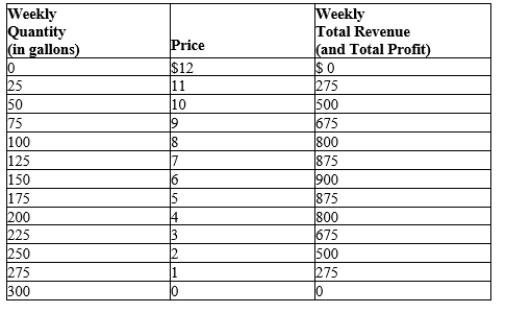 -Refer to Table 17-6. As long as Kunal and Naj operate as a profit-maximizing monopoly, what will their combined weekly revenue amount to?
 (Multiple Choice)
4.9/5 (84)
(84) Table 17-21
The Chicken Game is named for a contest in which drivers test their courage by driving straight at each other. John and Paul have a common interest to avoid crashing into each other, but they also have a personal, competing interest to not turn first to demonstrate their courage to those observing the contest. The payoff table for this situation is provided below. The payoffs are shown as (John, Paul).  -Refer to Table 17-21. If Paul chooses Drive Straight, what will John choose to do and what will John's payoff equal?
 (Multiple Choice)
4.7/5 (85)
(85) Which of these situations produces the largest profits for oligopolists?
(Multiple Choice)
4.8/5 (85)
(85) Consider a market served by a monopolist, Firm A. A new firm, Firm B, enters the market and, as a result, Firm A lowers its price to try to drive Firm B out of the market. This practice is known as
(Multiple Choice)
4.8/5 (89)
(89) Scenario 17-3.
Consider two countries, Kinglandia and Rovinastan, that are engaged in an arms race. Each country must decide whether to build new weapons or to disarm existing weapons. Each country prefers to have more arms than the other because a large arsenal gives it more influence in world affairs. But each country also prefers to live in a world safe from the other country's weapons. The following table shows the possible outcomes for each decision combination. The numbers in each cell represent the country's ranking of the outcome (10 = best outcome, 1 = worst outcome).  -Refer to Scenario 17-3. Suppose the two countries agreed to disarm existing weapons. In reality these two countries may have a hard time keeping this agreement due to which of the following reasons?
(i)Even though Kinglandia has no incentive to cheat on the agreement, Rovinastan has an incentive to cheat on the agreement.
(ii)Much like the prisoners' dilemma, both countries are better off reneging on the agreement and building new weapons.
(iii)Both countries want to increase their world power by building new weapons.
-Refer to Scenario 17-3. Suppose the two countries agreed to disarm existing weapons. In reality these two countries may have a hard time keeping this agreement due to which of the following reasons?
(i)Even though Kinglandia has no incentive to cheat on the agreement, Rovinastan has an incentive to cheat on the agreement.
(ii)Much like the prisoners' dilemma, both countries are better off reneging on the agreement and building new weapons.
(iii)Both countries want to increase their world power by building new weapons. (Multiple Choice)
4.9/5 (73)
(73) A distinguishing feature of an oligopolistic industry is the tension between
(Multiple Choice)
4.9/5 (83)
(83) 
Filters
- Essay(0)
- Multiple Choice(0)
- Short Answer(0)
- True False(0)
- Matching(0)