



 Chat with AI
Exam 17: Oligopoly

Exam 1: Ten Principles of Economics455 Questions
Exam 2: Thinking Like an Economist643 Questions
Exam 3: Interdependence and the Gains From Trade547 Questions
Exam 4: The Market Forces of Supply and Demand693 Questions
Exam 5: Elasticity and Its Application626 Questions
Exam 6: Supply, Demand, and Government Policies668 Questions
Exam 7: Consumers, Producers, and the Efficiency of Markets547 Questions
Exam 8: Applications: the Costs of Taxation509 Questions
Exam 9: Application: International Trade521 Questions
Exam 10: Externalities543 Questions
Exam 11: Public Goods and Common Resources452 Questions
Exam 12: The Design of the Tax System664 Questions
Exam 13: The Costs of Production649 Questions
Exam 14: Firms in Competitive Markets604 Questions
Exam 15: Monopoly662 Questions
Exam 16: Monopolistic Competition649 Questions
Exam 17: Oligopoly522 Questions
Exam 18: The Markets for the Factors of Production592 Questions
Exam 19: Earnings and Discrimination511 Questions
Exam 20: Income Inequality and Poverty478 Questions
Exam 21: The Theory of Consumer Choice570 Questions
Exam 22: Frontiers in Microeconomics461 Questions
Exam 23: Measuring a Nation S Income547 Questions
Exam 24: Measuring the Cost of Living565 Questions
Exam 25: Production and Growth527 Questions
Exam 26: Saving, Investment, and the Financial System637 Questions
Exam 27: Tools of Finance534 Questions
Exam 28: Unemployment and Its Natural Rate701 Questions
Exam 29: The Monetary System540 Questions
Exam 30: Money Growth and Inflation504 Questions
Exam 31: Open-Economy Macroeconomics: Basic Concepts540 Questions
Exam 32: A Macroeconomic Theory of the Open Economy511 Questions
Exam 33: Aggregate Demand and Aggregate Supply572 Questions
Exam 34: The Influence of Monetary and Fiscal Policy on Aggregate Demand523 Questions
Exam 35: The Short-Run Tradeoff Between Inflation and Unemployment536 Questions
Exam 36: Six Debates Over Macroeconomic Policy354 Questions
Select questions type


Table 17-1
Imagine a small town in which only two residents, Rochelle and Alec, own wells that produce safe drinking water. Each week Rochelle and Alec work together to decide how many gallons of water to pump. They bring the water to town and sell it at whatever price the market will bear. To keep things simple, suppose that Rochelle and Alec can pump as much water as they want without cost so that the marginal cost of water equals zero. The town's weekly demand schedule and total revenue schedule for water is shown in the table below: 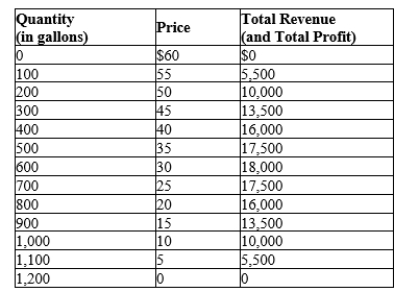 -Refer to Table 17-1. If Rochelle and Alec operate as a profit-maximizing monopoly in the market for water, how much profit will each of them earn, assuming that the two producers split the market equally?
 (Multiple Choice)
4.8/5  (75)
(75) Figure 17-1 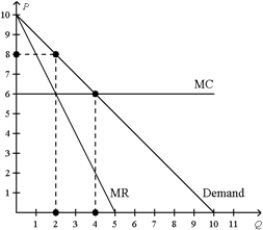 -Refer to Figure 17-1. Suppose this market is served by a duopoly in which each firm faces the marginal cost curve shown in the diagram. The marginal revenue curve that a monopolist would face in this market is also shown. Which of the following statements is true?
 (Multiple Choice)
4.9/5 (86)
(86) Table 17-35
Suppose that two coal mining companies - Allied and Barclay - own adjacent land suitable for excavating coal mines. The profits that each firm earns depends on both the number of mines it excavates and the number of mines excavated by the other firm. The table below lists each firm's individual profits:  -Refer to Table 17-35. Is there a Nash equilibrium? If so, describe it.
 (Essay)
4.8/5 (74)
(74) Table 17-30
Imagine a small town in which only two residents, Abby and Brad, own wells that produce safe drinking water. Each week Abby and Brad work together to decide how many gallons of water to pump. They bring water to town and sell it at whatever price the market will bear. To keep things simple, suppose that Abby and Brad can pump as much water as they want without cost so that the marginal cost is zero. The weekly town demand schedule and total revenue schedule for water is shown in the table below: 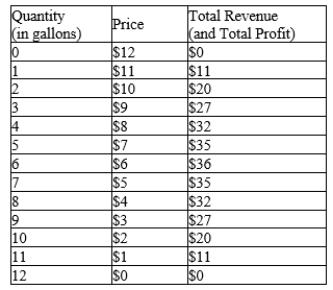 -Refer to Table 17-30. Discuss the difference between the monopoly outcome and the Nash equilibrium.
 (Essay)
4.8/5 (78)
(78) Table 17-12
The table shows the town of Driveaway's demand schedule for gasoline. Assume the town's gasoline seller(s) incurs a cost of $2 for each gallon sold, with no fixed cost.  -Refer to Table 17-12. If there are exactly two sellers of gasoline in Driveaway and if they collude, then which of the following outcomes is most likely?
 (Multiple Choice)
4.8/5 (82)
(82) Figure 17-3. Hector and Bart are roommates. On a particular day, their apartment needs to be cleaned. Each person has to decide whether to take part in cleaning. At the end of the day, either the apartment will be completely clean (if one or both roommates take part in cleaning), or it will remain dirty (if neither roommate cleans). With happiness measured on a scale of 1 (very unhappy) to 10 (very happy), the possible outcomes are as follows: 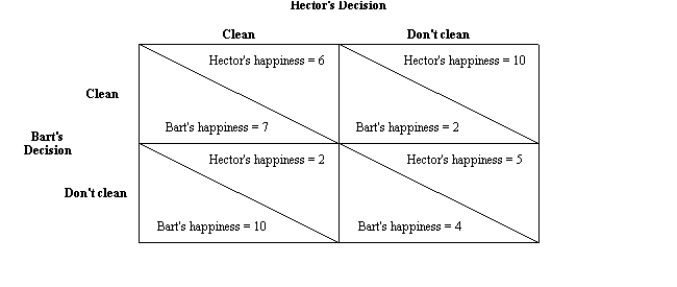 -Refer to Figure 17-3. In pursuing his own self-interest, Bart will
 (Multiple Choice)
4.9/5 (78)
(78) Scenario 17-4.
Consider two cigarette companies, PM Inc. and Brown Inc. If neither company advertises, the two companies split the market and earn $50 million each. If they both advertise, they again split the market, but profits are lower by $10 million since each company must bear the cost of advertising. Yet if one company advertises while the other does not, the one that advertises attracts customers from the other. In this case, the company that advertises earns $60 million while the company that does not advertise earns only $30 million.
-Refer to Scenario 17-4. The likely outcome of this game is that PM Inc. earns
(Multiple Choice)
4.7/5 (91)
(91) Table 17-21
The Chicken Game is named for a contest in which drivers test their courage by driving straight at each other. John and Paul have a common interest to avoid crashing into each other, but they also have a personal, competing interest to not turn first to demonstrate their courage to those observing the contest. The payoff table for this situation is provided below. The payoffs are shown as (John, Paul).  -Refer to Table 17-21. How many Nash equilibria are there in this Chicken game?
 (Multiple Choice)
4.8/5 (72)
(72) Table 17-14
This table shows a game played between two players, A and B. The payoffs in the table are shown as (Payoff to A, Payoff to B).  -Refer to Table 17-14. If both players choose their best strategies, player A will earn a payoff of
 (Multiple Choice)
4.7/5 (73)
(73) Table 17-23
Two bottled beverage manufacturers (Firm A and Firm B) determine that they could lower their costs, and thus increase their profits, if they reduced their advertising budgets. But for the plan to work, each firm must agree to refrain from advertising. Each firm believes that advertising works by increasing the demand for the firm's product, but each firm also believes that if neither firm advertises, the costs savings will outweigh the lost sales. Listed in the table below are the individual profits for each firm.  -Refer to Table 17-23. Suppose that the two firms, A and B, make an agreement to withhold any advertising for one month to lower each firm's costs and raise each firm's profits. If the firms reach the Nash equilibrium,
 (Multiple Choice)
4.7/5 (89)
(89) Scenario 17-1.
Assume that the countries of Irun and Urun are the only two producers of crude oil. Further assume that both countries have entered into an agreement to maintain certain production levels in order to maximize profits. In the world market for oil, the demand curve is downward sloping.
-Refer to Scenario 17-1. The fact that both countries have colluded to earn higher profit shows their desire to keep their combined level of output
(Multiple Choice)
4.8/5 (80)
(80) A situation in which firms choose their best strategy given the strategies chosen by the other firms in the market is called
(Multiple Choice)
4.8/5 (76)
(76) Scenario 17-2.
Imagine that two oil companies, BQ and Exxoff, own adjacent oil fields. Under the fields is a common pool of oil worth $144 million. Drilling a well to recover oil costs $5 million per well. If each company drills one well, each will get half of the oil and earn a $67 million profit ($72 million in revenue - $5 million in costs). Assume that having X percent of the total wells means that a company will collect X percent of the total revenue.
-Refer to Scenario 17-2. If each firm is permitted to drill two wells at most, the firms are in a Nash equilibrium when
(Multiple Choice)
4.8/5 (84)
(84) Scenario 17-5
Assume that a local restaurant sells two items, salads and steaks. The restaurant's only two customers on a particular day are Mr. Carnivore and Ms. Leafygreens. Mr. Carnivore is willing to pay $20 for a steak and $7 for a salad. Ms. Leafygreens is willing to pay only $8 for a steak, but is willing to pay $12 for a salad. Assume that the restaurant can provide each of these items at zero marginal cost.
-Refer to Scenario 17-5. If the restaurant is unable to use tying, what is the profit-maximizing price to charge for a salad?
(Multiple Choice)
4.8/5 (84)
(84) Scenario 17-2.
Imagine that two oil companies, BQ and Exxoff, own adjacent oil fields. Under the fields is a common pool of oil worth $144 million. Drilling a well to recover oil costs $5 million per well. If each company drills one well, each will get half of the oil and earn a $67 million profit ($72 million in revenue - $5 million in costs). Assume that having X percent of the total wells means that a company will collect X percent of the total revenue.
-Refer to Scenario 17-2. If BQ were to drill a second well, what would its profit be if Exxoff did not drill a second well?
(Multiple Choice)
4.9/5 (72)
(72) Table 17-5
The information in the table below shows the total demand for premium-channel digital cable TV subscriptions in a small urban market. Assume that each digital cable TV operator pays a fixed cost of $200,000 (per year) to provide premium digital channels in the market area and that the marginal cost of providing the premium channel service to a household is zero. 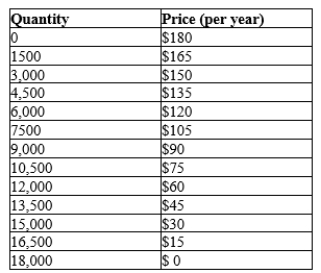 -Refer to Table 17-5. Assume there are two profit-maximizing digital cable TV companies operating in this market. Further assume that they are not able to collude on the price and quantity of premium digital channel subscriptions to sell. What price will premium digital channel cable TV subscriptions be sold at when this market reaches a Nash equilibrium?
 (Multiple Choice)
4.7/5 (80)
(80) 
Filters
- Essay(0)
- Multiple Choice(0)
- Short Answer(0)
- True False(0)
- Matching(0)