



 Chat with AI
Exam 17: Oligopoly

Exam 1: Ten Principles of Economics455 Questions
Exam 2: Thinking Like an Economist643 Questions
Exam 3: Interdependence and the Gains From Trade547 Questions
Exam 4: The Market Forces of Supply and Demand693 Questions
Exam 5: Elasticity and Its Application626 Questions
Exam 6: Supply, Demand, and Government Policies668 Questions
Exam 7: Consumers, Producers, and the Efficiency of Markets547 Questions
Exam 8: Applications: the Costs of Taxation509 Questions
Exam 9: Application: International Trade521 Questions
Exam 10: Externalities543 Questions
Exam 11: Public Goods and Common Resources452 Questions
Exam 12: The Design of the Tax System664 Questions
Exam 13: The Costs of Production649 Questions
Exam 14: Firms in Competitive Markets604 Questions
Exam 15: Monopoly662 Questions
Exam 16: Monopolistic Competition649 Questions
Exam 17: Oligopoly522 Questions
Exam 18: The Markets for the Factors of Production592 Questions
Exam 19: Earnings and Discrimination511 Questions
Exam 20: Income Inequality and Poverty478 Questions
Exam 21: The Theory of Consumer Choice570 Questions
Exam 22: Frontiers in Microeconomics461 Questions
Exam 23: Measuring a Nation S Income547 Questions
Exam 24: Measuring the Cost of Living565 Questions
Exam 25: Production and Growth527 Questions
Exam 26: Saving, Investment, and the Financial System637 Questions
Exam 27: Tools of Finance534 Questions
Exam 28: Unemployment and Its Natural Rate701 Questions
Exam 29: The Monetary System540 Questions
Exam 30: Money Growth and Inflation504 Questions
Exam 31: Open-Economy Macroeconomics: Basic Concepts540 Questions
Exam 32: A Macroeconomic Theory of the Open Economy511 Questions
Exam 33: Aggregate Demand and Aggregate Supply572 Questions
Exam 34: The Influence of Monetary and Fiscal Policy on Aggregate Demand523 Questions
Exam 35: The Short-Run Tradeoff Between Inflation and Unemployment536 Questions
Exam 36: Six Debates Over Macroeconomic Policy354 Questions
Select questions type


The Sherman Antitrust Act prohibits executives of competing companies from
(Multiple Choice)
4.9/5  (78)
(78) Table 17-31
Imagine a small town in a remote area where only two residents, Maria and Miguel, own dairies that produce milk that is safe to drink. Each week Maria and Miguel work together to decide how many gallons of milk to produce. They bring milk to town and sell it at whatever price the market will bear. To keep things simple, suppose that Maria and Miguel can produce as much milk as they want without cost so that the marginal cost is zero. The weekly town demand schedule and total revenue schedule for milk is shown in the table below: 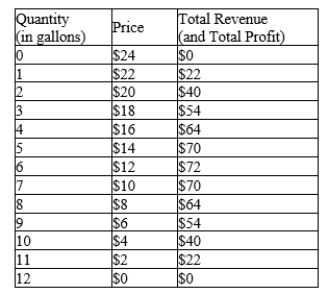 -Refer to Table 17-31. Briefly explain why each duopolist earns a lower profit at the Nash equilibrium than if they cooperated to produce the monopoly output.
 (Essay)
4.9/5 (71)
(71) A law that encourages market competition by prohibiting firms from gaining or exercising excessive market power is
(Multiple Choice)
4.8/5 (73)
(73) If all of the firms in an oligopoly successfully collude and form a cartel, then total profit for the cartel is equal to what it would be if the market were a monopoly.
(True/False)
4.9/5 (76)
(76) What effect does the number of firms in an oligopoly have on the characteristics of the market?
(Essay)
5.0/5 (73)
(73) Which of the following examples illustrates an oligopoly market?
(Multiple Choice)
4.8/5 (80)
(80) Table 17-36
The information in the table shows the total demand for water service in Takoma. Assume that there are two companies operating in Takoma. Each company that provides these services incurs an annual fixed cost of $400 and that the marginal cost of providing the service to each customer is exactly $2.00. Figures listed are for an annual service contract.
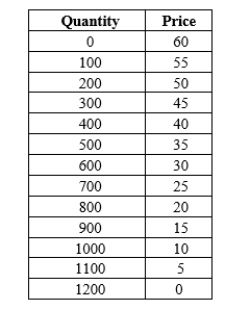 -Refer to Table 17-36. If there were only one water service provide in this market, and this single firm maximizes profits, the company will
 (Multiple Choice)
4.8/5 (79)
(79) Table 17-18
This table shows a game played between two firms, Firm A and Firm B. In this game each firm must decide how much output (Q) to produce: 10 units or 12 units. The profit for each firm is given in the table as (Profit for Firm A, Profit for Firm B).  -Refer to Table 17-18. The dominant strategy For Firm A is to produce
 (Multiple Choice)
4.9/5 (77)
(77) Like monopolists, oligopolists are aware that an increase in the quantity of output always
(Multiple Choice)
4.8/5 (88)
(88) As the number of firms in an oligopoly increases, the magnitude of the price effect increases.
(True/False)
4.8/5 (74)
(74) Consider a game of the "Jack and Jill" type in which a market is a duopoly and each firm decides to produce either a "high" quantity of output or a "low" quantity of output. If the two firms successfully reach and maintain the cooperative outcome of the game, then
(Multiple Choice)
4.8/5 (86)
(86) If a person can prove that she was damaged by an illegal arrangement to restrain trade, that person can sue and recover
(Multiple Choice)
4.9/5 (82)
(82) If an oligopolist is part of a cartel that is collectively producing the monopoly level of output, then that oligopolist has the incentive to increase production with the aim of
(Multiple Choice)
4.8/5 (84)
(84) In a duopoly if the firms have agreed to jointly maximize profits, then each firm can increase its current individual profits by producing more.
(True/False)
4.9/5 (75)
(75) Table 17-11
Only two firms, ABC and XYZ, sell a particular product. The table below shows the demand curve for their product. Each firm has the same constant marginal cost of $8 and zero fixed cost. 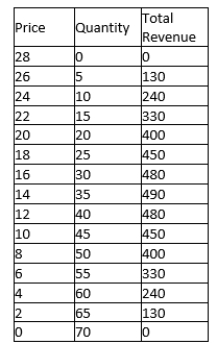 -Refer to Table 17-11. How much less do each of these firms earn in the Nash equilibrium than if they jointly maximize profits?
 (Multiple Choice)
4.9/5 (85)
(85) When firms are faced with making strategic choices to maximize profit, economists typically use
(Multiple Choice)
4.8/5 (76)
(76) Scenario 17-6
Assume that a local telecommunications company sells high speed internet access and cable television. The company's only two customers are Taylor and Tim. Taylor is willing to pay $50 per month for high speed internet access and $50 per month for cable television. Tim is willing to pay only $20 per month for high speed internet access, but is willing to pay $70 per month for cable television. Assume that the telecommunications company can provide each of these products at zero marginal cost.
-Refer to Scenario 17-6. If the telecommunications company is unable to use tying, what is the profit-maximizing price to charge for high speed internet access?
(Short Answer)
4.8/5 (72)
(72) 
Filters
- Essay(0)
- Multiple Choice(0)
- Short Answer(0)
- True False(0)
- Matching(0)