



 Chat with AI
Exam 17: Oligopoly

Exam 1: Ten Principles of Economics455 Questions
Exam 2: Thinking Like an Economist643 Questions
Exam 3: Interdependence and the Gains From Trade547 Questions
Exam 4: The Market Forces of Supply and Demand693 Questions
Exam 5: Elasticity and Its Application626 Questions
Exam 6: Supply, Demand, and Government Policies668 Questions
Exam 7: Consumers, Producers, and the Efficiency of Markets547 Questions
Exam 8: Applications: the Costs of Taxation509 Questions
Exam 9: Application: International Trade521 Questions
Exam 10: Externalities543 Questions
Exam 11: Public Goods and Common Resources452 Questions
Exam 12: The Design of the Tax System664 Questions
Exam 13: The Costs of Production649 Questions
Exam 14: Firms in Competitive Markets604 Questions
Exam 15: Monopoly662 Questions
Exam 16: Monopolistic Competition649 Questions
Exam 17: Oligopoly522 Questions
Exam 18: The Markets for the Factors of Production592 Questions
Exam 19: Earnings and Discrimination511 Questions
Exam 20: Income Inequality and Poverty478 Questions
Exam 21: The Theory of Consumer Choice570 Questions
Exam 22: Frontiers in Microeconomics461 Questions
Exam 23: Measuring a Nation S Income547 Questions
Exam 24: Measuring the Cost of Living565 Questions
Exam 25: Production and Growth527 Questions
Exam 26: Saving, Investment, and the Financial System637 Questions
Exam 27: Tools of Finance534 Questions
Exam 28: Unemployment and Its Natural Rate701 Questions
Exam 29: The Monetary System540 Questions
Exam 30: Money Growth and Inflation504 Questions
Exam 31: Open-Economy Macroeconomics: Basic Concepts540 Questions
Exam 32: A Macroeconomic Theory of the Open Economy511 Questions
Exam 33: Aggregate Demand and Aggregate Supply572 Questions
Exam 34: The Influence of Monetary and Fiscal Policy on Aggregate Demand523 Questions
Exam 35: The Short-Run Tradeoff Between Inflation and Unemployment536 Questions
Exam 36: Six Debates Over Macroeconomic Policy354 Questions
Select questions type


In imperfectly competitive markets, increasing production will decrease the price of all units sold. This concept is known as the
(Multiple Choice)
4.8/5  (80)
(80) Table 17-26
Two prescription drug manufacturers (Firm A and Firm B) are faced with lawsuits from states to recover the healthcare related expenses associated with side-effects from its drugs. Each drug manufacturer has evidence that indicates that taking its prescription drug causes liver failure. State prosecutors do not have access to the same data used by drug manufacturers and thus will have difficulty recovering full costs without the help of at least one of the drug manufacturer's studies. Each firm has been presented with an opportunity to lower its liability in the suit if it cooperates with attorneys representing the states. 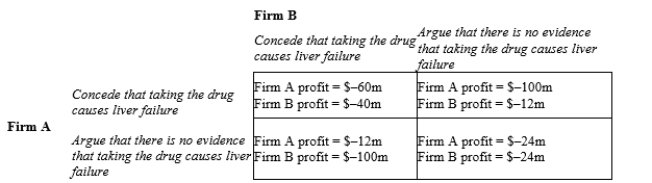 -Refer to Table 17-26. If both firms follow a dominant strategy, Firm B's profits (losses) will be
 (Multiple Choice)
4.7/5 (75)
(75) A special kind of imperfectly competitive market that has only two firms is called
(Multiple Choice)
4.9/5 (75)
(75) Table 17-11
Only two firms, ABC and XYZ, sell a particular product. The table below shows the demand curve for their product. Each firm has the same constant marginal cost of $8 and zero fixed cost. 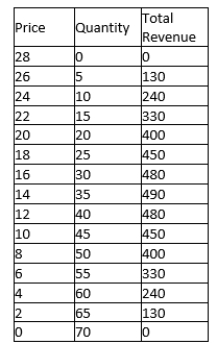 -Refer to Table 17-11. What is the socially efficient quantity of the product?
 (Multiple Choice)
4.9/5 (86)
(86) Table 17-6
Imagine a small town in which only two residents, Kunal and Naj, own wells that produce safe drinking water. Each week Kunal and Naj work together to decide how many gallons of water to pump, to bring the water to town, and to sell it at whatever price the market will bear. Assume Kunal and Naj can pump as much water as they want without cost so that the marginal cost of water equals zero.
The weekly town demand schedule and total revenue schedule for water are shown in the table below. 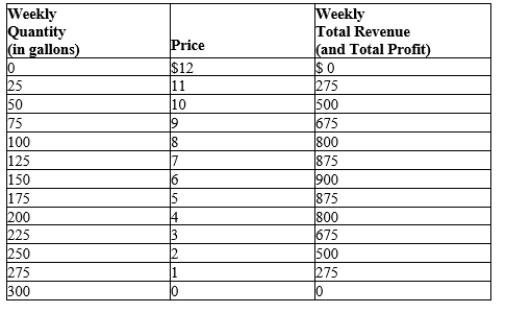 -Refer to Table 17-6. Suppose the town enacts new antitrust laws that prohibit Kunal and Naj from operating as a monopolist. What will quantity of water will each of them produce once the Nash equilibrium is reached?
 (Multiple Choice)
4.8/5 (81)
(81) Scenario 17-2.
Imagine that two oil companies, BQ and Exxoff, own adjacent oil fields. Under the fields is a common pool of oil worth $144 million. Drilling a well to recover oil costs $5 million per well. If each company drills one well, each will get half of the oil and earn a $67 million profit ($72 million in revenue - $5 million in costs). Assume that having X percent of the total wells means that a company will collect X percent of the total revenue.
-Refer to Scenario 17-2. If BQ and Exxoff are able to successfully cooperate to maximize their joint profits, BQ will
(Multiple Choice)
4.8/5 (70)
(70) Which government entity is charged with investigating and enforcing antitrust laws?
(Multiple Choice)
4.8/5 (71)
(71) The practice of requiring someone to buy two or more items together, rather than separately, is called
(Multiple Choice)
4.8/5 (72)
(72) Table 17-18
This table shows a game played between two firms, Firm A and Firm B. In this game each firm must decide how much output (Q) to produce: 10 units or 12 units. The profit for each firm is given in the table as (Profit for Firm A, Profit for Firm B).  -Refer to Table 17-18. The Nash equilibrium for this game is
 (Multiple Choice)
4.8/5 (75)
(75) Suppose that Barack and Michelle are duopolists. Barack is producing 300 units of output, and Michelle is producing 400 units of output. When Michelle produces 400 units, Barack maximizes profit by producing 300 units. When Barack produces 300 units of output, Michelle maximizes profit by producing 400 units. Barack and Michelle are
(Multiple Choice)
4.7/5 (74)
(74) The equilibrium quantity in markets characterized by oligopoly is
(Multiple Choice)
4.7/5 (82)
(82) Figure 17-4. Aaron and Ed are roommates. After a big snowstorm, their driveway needs to be shoveled. Each person has to decide whether to take part in shoveling the driveway. At the end of the day, either the driveway will be shoveled (if one or both roommates take part in shoveling), or it will remain unshoveled (if neither roommate shovels). With happiness measured on a scale of 1 (very unhappy) to 10 (very happy), the possible outcomes are as follows: 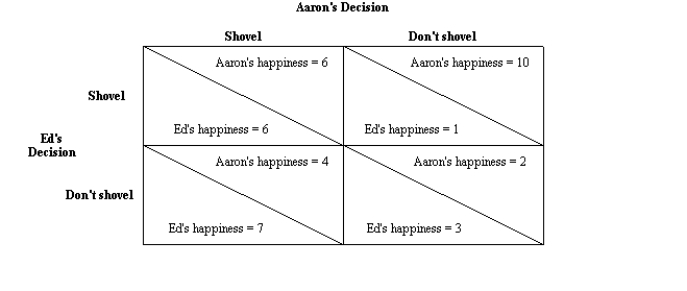 -Refer to Figure 17-4. In pursuing his own self-interest, Aaron will
 (Multiple Choice)
4.8/5 (74)
(74) Which of the controversial business practices, resale price maintenance, predatory pricing, or tying, was a part of a long-running antitrust lawsuit against Microsoft and why?
(Essay)
4.7/5 (78)
(78) Suppose that Bieber and Rihanna are duopolists in the music industry. In May, they agree to work together as a monopolist, charging the monopoly price for their music and producing the monopoly quantity of songs. By June, each singer is considering breaking the agreement. What would you expect to happen next?
(Multiple Choice)
4.7/5 (79)
(79) Table 17-21
The Chicken Game is named for a contest in which drivers test their courage by driving straight at each other. John and Paul have a common interest to avoid crashing into each other, but they also have a personal, competing interest to not turn first to demonstrate their courage to those observing the contest. The payoff table for this situation is provided below. The payoffs are shown as (John, Paul).  -Refer to Table 17-21. What is John's dominant strategy?
 (Multiple Choice)
4.8/5 (82)
(82) Table 17-11
Only two firms, ABC and XYZ, sell a particular product. The table below shows the demand curve for their product. Each firm has the same constant marginal cost of $8 and zero fixed cost.
-Refer to Table 17-11. ABC and XYZ agree to jointly maximize profits. If ABC and XYZ each break the agreement and each produce 5 more than agreed upon, how much less profit does each make, compared to the profit at to the cartel output?
-Refer to Table 17-11. ABC and XYZ agree to jointly maximize profits. If ABC and XYZ each break the agreement and each produce 5 more than agreed upon, how much less profit does each make, compared to the profit at to the cartel output? (Multiple Choice)
4.7/5 (67)
(67) For cartels, as the number of firms (members of the cartel) increases,
(Multiple Choice)
4.8/5 (86)
(86) Individual profit earned by Dave, the oligopolist, depends on which of the following?
(i)The quantity of output that Dave produces
(ii)The quantities of output that the other firms in the market produce
(iii)The extent of collusion between Dave and the other firms in the market
(Multiple Choice)
4.9/5 (83)
(83) 
Filters
- Essay(0)
- Multiple Choice(0)
- Short Answer(0)
- True False(0)
- Matching(0)