



 Chat with AI
Exam 17: Oligopoly

Exam 1: Ten Principles of Economics455 Questions
Exam 2: Thinking Like an Economist643 Questions
Exam 3: Interdependence and the Gains From Trade547 Questions
Exam 4: The Market Forces of Supply and Demand693 Questions
Exam 5: Elasticity and Its Application626 Questions
Exam 6: Supply, Demand, and Government Policies668 Questions
Exam 7: Consumers, Producers, and the Efficiency of Markets547 Questions
Exam 8: Applications: the Costs of Taxation509 Questions
Exam 9: Application: International Trade521 Questions
Exam 10: Externalities543 Questions
Exam 11: Public Goods and Common Resources452 Questions
Exam 12: The Design of the Tax System664 Questions
Exam 13: The Costs of Production649 Questions
Exam 14: Firms in Competitive Markets604 Questions
Exam 15: Monopoly662 Questions
Exam 16: Monopolistic Competition649 Questions
Exam 17: Oligopoly522 Questions
Exam 18: The Markets for the Factors of Production592 Questions
Exam 19: Earnings and Discrimination511 Questions
Exam 20: Income Inequality and Poverty478 Questions
Exam 21: The Theory of Consumer Choice570 Questions
Exam 22: Frontiers in Microeconomics461 Questions
Exam 23: Measuring a Nation S Income547 Questions
Exam 24: Measuring the Cost of Living565 Questions
Exam 25: Production and Growth527 Questions
Exam 26: Saving, Investment, and the Financial System637 Questions
Exam 27: Tools of Finance534 Questions
Exam 28: Unemployment and Its Natural Rate701 Questions
Exam 29: The Monetary System540 Questions
Exam 30: Money Growth and Inflation504 Questions
Exam 31: Open-Economy Macroeconomics: Basic Concepts540 Questions
Exam 32: A Macroeconomic Theory of the Open Economy511 Questions
Exam 33: Aggregate Demand and Aggregate Supply572 Questions
Exam 34: The Influence of Monetary and Fiscal Policy on Aggregate Demand523 Questions
Exam 35: The Short-Run Tradeoff Between Inflation and Unemployment536 Questions
Exam 36: Six Debates Over Macroeconomic Policy354 Questions
Select questions type


Other things the same, in which case is the quantity produced the highest?
(Multiple Choice)
4.9/5  (88)
(88) Explain the practice of resale price maintenance and discuss why it is controversial.
(Essay)
4.9/5 (88)
(88) Scenario 17-6
Assume that a local telecommunications company sells high speed internet access and cable television. The company's only two customers are Taylor and Tim. Taylor is willing to pay $50 per month for high speed internet access and $50 per month for cable television. Tim is willing to pay only $20 per month for high speed internet access, but is willing to pay $70 per month for cable television. Assume that the telecommunications company can provide each of these products at zero marginal cost.
-Refer to Scenario 17-6. How much additional profit can the telecommunications company earn by switching to the use of a tying strategy to price high speed internet access and cable television rather than pricing these goods separately?
(Short Answer)
4.8/5 (75)
(75) Table 17-2
Imagine a small town in which only two residents, Abby and Brad, own wells that produce safe drinking water. Each week Abby and Brad work together to decide how many gallons of water to pump. They bring water to town and sell it at whatever price the market will bear. To keep things simple, suppose that Abby and Brad can pump as much water as they want without cost so that the marginal cost is zero. The weekly town demand schedule and total revenue schedule for water is shown in the table below:  -Refer to Table 17-2. Suppose that Abby and Brad work together to operate as a profit-maximizing monopolist. How many gallons of water will be produced and sold?
 (Multiple Choice)
4.8/5 (71)
(71) Game theory is just as necessary for understanding competitive or monopoly markets as it is for understanding oligopolistic markets.
(True/False)
4.9/5 (69)
(69) The Clayton Act of 1914 allowed a person who successfully sued a company for damages caused by an illegal arrangement to restrain trade to recover __________ damages.
(Short Answer)
4.7/5 (81)
(81) Which of the following prohibits executives of competing firms from even talking about fixing prices?
(Multiple Choice)
4.7/5 (92)
(92) Table 17-1
Imagine a small town in which only two residents, Rochelle and Alec, own wells that produce safe drinking water. Each week Rochelle and Alec work together to decide how many gallons of water to pump. They bring the water to town and sell it at whatever price the market will bear. To keep things simple, suppose that Rochelle and Alec can pump as much water as they want without cost so that the marginal cost of water equals zero. The town's weekly demand schedule and total revenue schedule for water is shown in the table below: 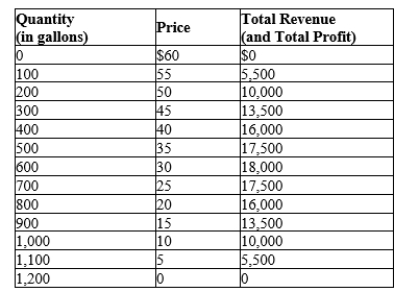 -Refer to Table 17-1. If Rochelle and Alec operate as a profit-maximizing monopoly in the market for water, what price will they charge?
 (Multiple Choice)
4.9/5 (78)
(78) Table 17-11
Only two firms, ABC and XYZ, sell a particular product. The table below shows the demand curve for their product. Each firm has the same constant marginal cost of $8 and zero fixed cost. 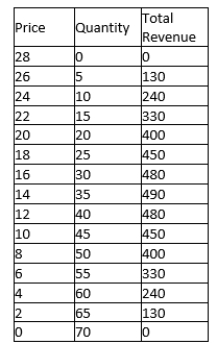 -Refer to Table 17-11. If this market were perfectly competitive instead of oligopolistic, what would the price be?
 (Multiple Choice)
4.9/5 (85)
(85) Table 17-24
Two firms are considering going out of business and selling their assets. Each considers what happens if the other goes out of business. The payoff matrix below shows the net gain or loss to each firm.  -Refer to Table 17-24. What is the Nash equilibrium?
 (Multiple Choice)
4.9/5 (72)
(72) Laurel and Janet are competitors in a local market and each is trying to decide if it is worthwhile to advertise. If both of them advertise, each will earn a profit of $5,000. If neither of them advertise, each will earn a profit of $10,000. If one advertises and the other doesn't, then the one who advertises will earn a profit of $12,000 and the other will earn $2,000. In this version of the prisoners' dilemma, if the game is played only once, Laurel should
(Multiple Choice)
4.8/5 (88)
(88) Figure 17-5. Two companies, ABC and QRS, are sellers in the same market. Each company decides whether to charge a high price or a low price. In the figure, the dollar amounts are payoffs and they represent annual profits for the two companies.  -Refer to Figure 17-5. If the two companies make their pricing decisions independently, then it is likely that ABC will
 (Multiple Choice)
4.7/5 (81)
(81) Table 17-18
This table shows a game played between two firms, Firm A and Firm B. In this game each firm must decide how much output (Q) to produce: 10 units or 12 units. The profit for each firm is given in the table as (Profit for Firm A, Profit for Firm B).  -Refer to Table 17-18. If these two firms play this game repeatedly, the likely outcome will be
 (Multiple Choice)
4.8/5 (76)
(76) Scenario 17-5
Assume that a local restaurant sells two items, salads and steaks. The restaurant's only two customers on a particular day are Mr. Carnivore and Ms. Leafygreens. Mr. Carnivore is willing to pay $20 for a steak and $7 for a salad. Ms. Leafygreens is willing to pay only $8 for a steak, but is willing to pay $12 for a salad. Assume that the restaurant can provide each of these items at zero marginal cost.
-Refer to Scenario 17-5. How much additional profit can the restaurant earn by switching to the use of a tying strategy to price salads and steaks rather than pricing these goods separately?
(Multiple Choice)
4.9/5 (67)
(67) Scenario 17-4.
Consider two cigarette companies, PM Inc. and Brown Inc. If neither company advertises, the two companies split the market and earn $50 million each. If they both advertise, they again split the market, but profits are lower by $10 million since each company must bear the cost of advertising. Yet if one company advertises while the other does not, the one that advertises attracts customers from the other. In this case, the company that advertises earns $60 million while the company that does not advertise earns only $30 million.
-Refer to Scenario 17-4. If these two companies collude and agree upon the best joint strategy,
(Multiple Choice)
4.7/5 (77)
(77) In a typical cartel agreement, the cartel maximizes profit when it
(Multiple Choice)
4.8/5 (80)
(80) 
Filters
- Essay(0)
- Multiple Choice(0)
- Short Answer(0)
- True False(0)
- Matching(0)