



 Chat with AI
Exam 17: Oligopoly

Exam 1: Ten Principles of Economics455 Questions
Exam 2: Thinking Like an Economist643 Questions
Exam 3: Interdependence and the Gains From Trade547 Questions
Exam 4: The Market Forces of Supply and Demand693 Questions
Exam 5: Elasticity and Its Application626 Questions
Exam 6: Supply, Demand, and Government Policies668 Questions
Exam 7: Consumers, Producers, and the Efficiency of Markets547 Questions
Exam 8: Applications: the Costs of Taxation509 Questions
Exam 9: Application: International Trade521 Questions
Exam 10: Externalities543 Questions
Exam 11: Public Goods and Common Resources452 Questions
Exam 12: The Design of the Tax System664 Questions
Exam 13: The Costs of Production649 Questions
Exam 14: Firms in Competitive Markets604 Questions
Exam 15: Monopoly662 Questions
Exam 16: Monopolistic Competition649 Questions
Exam 17: Oligopoly522 Questions
Exam 18: The Markets for the Factors of Production592 Questions
Exam 19: Earnings and Discrimination511 Questions
Exam 20: Income Inequality and Poverty478 Questions
Exam 21: The Theory of Consumer Choice570 Questions
Exam 22: Frontiers in Microeconomics461 Questions
Exam 23: Measuring a Nation S Income547 Questions
Exam 24: Measuring the Cost of Living565 Questions
Exam 25: Production and Growth527 Questions
Exam 26: Saving, Investment, and the Financial System637 Questions
Exam 27: Tools of Finance534 Questions
Exam 28: Unemployment and Its Natural Rate701 Questions
Exam 29: The Monetary System540 Questions
Exam 30: Money Growth and Inflation504 Questions
Exam 31: Open-Economy Macroeconomics: Basic Concepts540 Questions
Exam 32: A Macroeconomic Theory of the Open Economy511 Questions
Exam 33: Aggregate Demand and Aggregate Supply572 Questions
Exam 34: The Influence of Monetary and Fiscal Policy on Aggregate Demand523 Questions
Exam 35: The Short-Run Tradeoff Between Inflation and Unemployment536 Questions
Exam 36: Six Debates Over Macroeconomic Policy354 Questions
Select questions type


Table 17-6
Imagine a small town in which only two residents, Kunal and Naj, own wells that produce safe drinking water. Each week Kunal and Naj work together to decide how many gallons of water to pump, to bring the water to town, and to sell it at whatever price the market will bear. Assume Kunal and Naj can pump as much water as they want without cost so that the marginal cost of water equals zero.
The weekly town demand schedule and total revenue schedule for water are shown in the table below. 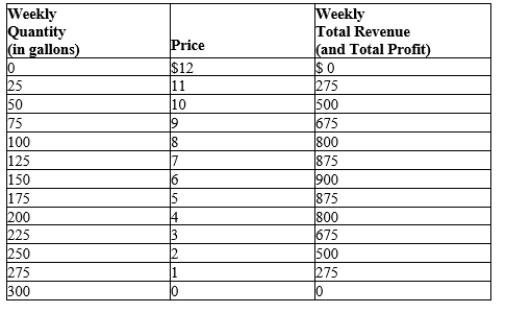 -Refer to Table 17-6. If the market for water were perfectly competitive instead of monopolistic, how many gallons of water would be produced and sold?
 (Multiple Choice)
4.9/5  (92)
(92) George and Jerry are competitors in a local market. Each is trying to decide if it is better to advertise on TV, on radio, or not at all. If they both advertise on TV, each will earn a profit of $3,000. If they both advertise on radio, each will earn a profit of $5,000. If neither advertises at all, each will earn a profit of $10,000. If one advertises on TV and the other advertises on radio, then the one advertising on TV will earn $4,000 and the other will earn $2,000. If one advertises on TV and the other does not advertise, then the one advertising on TV will earn $8,000 and the other will earn $5,000. If one advertises on radio and the other does not advertise, then the one advertising on radio will earn $9,000 and the other will earn $6,000. If both follow their dominant strategy, then George will
(Multiple Choice)
4.8/5 (69)
(69) Table 17-23
Two bottled beverage manufacturers (Firm A and Firm B) determine that they could lower their costs, and thus increase their profits, if they reduced their advertising budgets. But for the plan to work, each firm must agree to refrain from advertising. Each firm believes that advertising works by increasing the demand for the firm's product, but each firm also believes that if neither firm advertises, the costs savings will outweigh the lost sales. Listed in the table below are the individual profits for each firm.  -Refer to Table 17-23. At the Nash equilibrium, how much profit will Firm B earn?
 (Multiple Choice)
4.9/5 (72)
(72) Table 17-12
The table shows the town of Driveaway's demand schedule for gasoline. Assume the town's gasoline seller(s) incurs a cost of $2 for each gallon sold, with no fixed cost.  -Refer to Table 17-12. Suppose there are exactly two sellers of gasoline in Driveaway: Amogo and Spilmerica. If Amogo sells 150 gallons and Spilmerica sells 100 gallons, then
 (Multiple Choice)
4.7/5 (79)
(79) Scenario 17-3.
Consider two countries, Kinglandia and Rovinastan, that are engaged in an arms race. Each country must decide whether to build new weapons or to disarm existing weapons. Each country prefers to have more arms than the other because a large arsenal gives it more influence in world affairs. But each country also prefers to live in a world safe from the other country's weapons. The following table shows the possible outcomes for each decision combination. The numbers in each cell represent the country's ranking of the outcome (10 = best outcome, 1 = worst outcome).  -Refer to Scenario 17-3. Building new weapons is a dominant strategy for
 (Multiple Choice)
4.9/5 (92)
(92) Table 17-21
The Chicken Game is named for a contest in which drivers test their courage by driving straight at each other. John and Paul have a common interest to avoid crashing into each other, but they also have a personal, competing interest to not turn first to demonstrate their courage to those observing the contest. The payoff table for this situation is provided below. The payoffs are shown as (John, Paul).  -Refer to Table 17-21. If John chooses Turn, what will Paul choose to do and what will Paul's payoff equal?
 (Multiple Choice)
4.9/5 (66)
(66) In the prisoners' dilemma game with Bonnie and Clyde as the players, the likely outcome is one
(Multiple Choice)
4.9/5 (89)
(89) Table 17-13
Two home-improvement stores (Lopes and HomeMax) in a growing urban area are interested in expanding their market share. Both are interested in expanding the size of their store and parking lot to accommodate potential growth in their customer base. The following game depicts the strategic outcomes that result from the game. Increases in annual profits of the two home-improvement stores are shown in the table below. 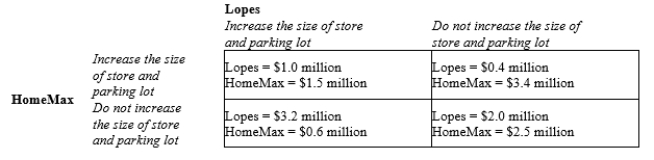 -Refer to Table 17-13. If both stores follow a dominant strategy, HomeMax's annual profit will grow by
 (Multiple Choice)
4.9/5 (76)
(76) Antitrust laws tend to target restraint of trade as characterized by __________.
(Essay)
4.7/5 (81)
(81) Table 17-27
Each year the United States considers renewal of Most Favored Nation (MFN) trading status with Farland (a mythical nation). Historically, legislators have made threats of not renewing MFN status because of human rights abuses in Farland. The non-renewal of MFN trading status is likely to involve some retaliatory measures by Farland. The payoff table below shows the potential economic gains associated with a game in which Farland may impose trade sanctions against U.S. firms and the United States may not renew MFN status with Farland. The table contains the dollar value of all trade-flow benefits to the United States and Farland.  -Refer to Table 17-27. When this game reaches a Nash equilibrium, the value of trade flow benefits will be
 (Multiple Choice)
4.9/5 (81)
(81) As the number of firms in the oligopoly grows very large, the
(Multiple Choice)
4.9/5 (83)
(83) OPEC (Organization of Petroleum Exporting Countries) is an example of a cartel in the output market for petroleum. Major League Baseball could be considered a cartel in the __________ market for baseball players.
(Short Answer)
4.8/5 (73)
(73) An agreement among firms regarding price and/or production levels is called
(Multiple Choice)
4.9/5 (72)
(72) Figure 17-3. Hector and Bart are roommates. On a particular day, their apartment needs to be cleaned. Each person has to decide whether to take part in cleaning. At the end of the day, either the apartment will be completely clean (if one or both roommates take part in cleaning), or it will remain dirty (if neither roommate cleans). With happiness measured on a scale of 1 (very unhappy) to 10 (very happy), the possible outcomes are as follows: 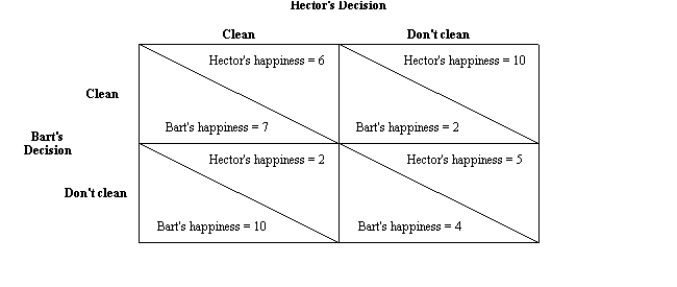 -Refer to Figure 17-3. The possible outcome in which both Hector and Bart clean is analogous to which of the following outcomes of the duopoly game?
 (Multiple Choice)
4.8/5 (71)
(71) If one firm left a duopoly market where the firms did not cooperate then
(Multiple Choice)
4.8/5 (71)
(71) When oligopolistic firms interacting with one another each choose their best strategy given the strategies chosen by other firms in the market, we have
(Multiple Choice)
4.8/5 (91)
(91) In which of the following games is it clearly the case that the cooperative outcome of the game is good for the two players and bad for society?
(Multiple Choice)
4.8/5 (65)
(65) Table 17-21
The Chicken Game is named for a contest in which drivers test their courage by driving straight at each other. John and Paul have a common interest to avoid crashing into each other, but they also have a personal, competing interest to not turn first to demonstrate their courage to those observing the contest. The payoff table for this situation is provided below. The payoffs are shown as (John, Paul).
-Refer to Table 17-21. If John chooses Drive Straight, what will Paul choose to do and what will Paul's payoff equal?
-Refer to Table 17-21. If John chooses Drive Straight, what will Paul choose to do and what will Paul's payoff equal? (Multiple Choice)
5.0/5 (91)
(91) 
Filters
- Essay(0)
- Multiple Choice(0)
- Short Answer(0)
- True False(0)
- Matching(0)