



 Chat with AI
Exam 17: Oligopoly

Exam 1: Ten Principles of Economics455 Questions
Exam 2: Thinking Like an Economist643 Questions
Exam 3: Interdependence and the Gains From Trade547 Questions
Exam 4: The Market Forces of Supply and Demand693 Questions
Exam 5: Elasticity and Its Application626 Questions
Exam 6: Supply, Demand, and Government Policies668 Questions
Exam 7: Consumers, Producers, and the Efficiency of Markets547 Questions
Exam 8: Applications: the Costs of Taxation509 Questions
Exam 9: Application: International Trade521 Questions
Exam 10: Externalities543 Questions
Exam 11: Public Goods and Common Resources452 Questions
Exam 12: The Design of the Tax System664 Questions
Exam 13: The Costs of Production649 Questions
Exam 14: Firms in Competitive Markets604 Questions
Exam 15: Monopoly662 Questions
Exam 16: Monopolistic Competition649 Questions
Exam 17: Oligopoly522 Questions
Exam 18: The Markets for the Factors of Production592 Questions
Exam 19: Earnings and Discrimination511 Questions
Exam 20: Income Inequality and Poverty478 Questions
Exam 21: The Theory of Consumer Choice570 Questions
Exam 22: Frontiers in Microeconomics461 Questions
Exam 23: Measuring a Nation S Income547 Questions
Exam 24: Measuring the Cost of Living565 Questions
Exam 25: Production and Growth527 Questions
Exam 26: Saving, Investment, and the Financial System637 Questions
Exam 27: Tools of Finance534 Questions
Exam 28: Unemployment and Its Natural Rate701 Questions
Exam 29: The Monetary System540 Questions
Exam 30: Money Growth and Inflation504 Questions
Exam 31: Open-Economy Macroeconomics: Basic Concepts540 Questions
Exam 32: A Macroeconomic Theory of the Open Economy511 Questions
Exam 33: Aggregate Demand and Aggregate Supply572 Questions
Exam 34: The Influence of Monetary and Fiscal Policy on Aggregate Demand523 Questions
Exam 35: The Short-Run Tradeoff Between Inflation and Unemployment536 Questions
Exam 36: Six Debates Over Macroeconomic Policy354 Questions
Select questions type


Which of the following is correct? When oligopolies collude
(Multiple Choice)
4.8/5  (87)
(87) Table 17-2
Imagine a small town in which only two residents, Abby and Brad, own wells that produce safe drinking water. Each week Abby and Brad work together to decide how many gallons of water to pump. They bring water to town and sell it at whatever price the market will bear. To keep things simple, suppose that Abby and Brad can pump as much water as they want without cost so that the marginal cost is zero. The weekly town demand schedule and total revenue schedule for water is shown in the table below:  -Refer to Table 17-2. Suppose that Abby and Brad work together to operate as a profit-maximizing monopolist. What price will they charge for water?
 (Multiple Choice)
4.8/5 (82)
(82) Table 17-9
The table shows the demand schedule for a particular product. 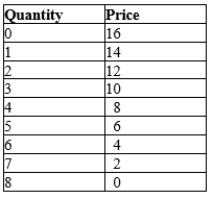 -Refer to Table 17-9. Suppose the market for this product is served by two firms that have formed a cartel. What price will the cartel charge in this market if the marginal cost of production is $4?
 (Multiple Choice)
4.9/5 (87)
(87) In the game in which two oil companies own adjacent oil fields, the companies will not use the oil efficiently because
(Multiple Choice)
4.9/5 (86)
(86) A group of firms that act in unison to maximize collective profits is called a
(Multiple Choice)
4.9/5 (95)
(95) As the number of firms in an oligopoly increases, the price approaches
(Multiple Choice)
4.8/5 (76)
(76) In a prisoner's dilemma situation where firms are setting prices, the dominant strategy is always to charge the price that leads to maximum profits for all firms.
(True/False)
4.9/5 (95)
(95) Table 17-17
This table shows a game played between two firms, Firm A and Firm B. In this game each firm must decide how much output (Q) to produce: 2 units or 3 units. The profit for each firm is given in the table as (Profit for Firm A, Profit for Firm B).  -Refer to Table 17-17. Which of the following outcomes represent the Nash equilibrium in this game?
 (Multiple Choice)
4.9/5 (71)
(71) Table 17-26
Two prescription drug manufacturers (Firm A and Firm B) are faced with lawsuits from states to recover the healthcare related expenses associated with side-effects from its drugs. Each drug manufacturer has evidence that indicates that taking its prescription drug causes liver failure. State prosecutors do not have access to the same data used by drug manufacturers and thus will have difficulty recovering full costs without the help of at least one of the drug manufacturer's studies. Each firm has been presented with an opportunity to lower its liability in the suit if it cooperates with attorneys representing the states. 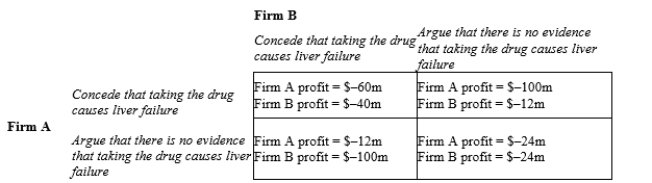 -Refer to Table 17-26. Pursuing its own best interests, Firm B will concede that taking its drug causes liver failure
 (Multiple Choice)
4.8/5 (69)
(69) Table 17-27
Each year the United States considers renewal of Most Favored Nation (MFN) trading status with Farland (a mythical nation). Historically, legislators have made threats of not renewing MFN status because of human rights abuses in Farland. The non-renewal of MFN trading status is likely to involve some retaliatory measures by Farland. The payoff table below shows the potential economic gains associated with a game in which Farland may impose trade sanctions against U.S. firms and the United States may not renew MFN status with Farland. The table contains the dollar value of all trade-flow benefits to the United States and Farland.  -Refer to Table 17-27. If both countries follow a dominant strategy, the value of trade flow benefits for Farland will be
 (Multiple Choice)
4.9/5 (84)
(84) Scenario 17-4.
Consider two cigarette companies, PM Inc. and Brown Inc. If neither company advertises, the two companies split the market and earn $50 million each. If they both advertise, they again split the market, but profits are lower by $10 million since each company must bear the cost of advertising. Yet if one company advertises while the other does not, the one that advertises attracts customers from the other. In this case, the company that advertises earns $60 million while the company that does not advertise earns only $30 million.
-Refer to Scenario 17-4. What will these two companies do if they behave as individual profit maximizers?
(Multiple Choice)
4.8/5 (66)
(66) Table 17-21
The Chicken Game is named for a contest in which drivers test their courage by driving straight at each other. John and Paul have a common interest to avoid crashing into each other, but they also have a personal, competing interest to not turn first to demonstrate their courage to those observing the contest. The payoff table for this situation is provided below. The payoffs are shown as (John, Paul).  -Refer to Table 17-21. What is (are) the Nash equilibrium (equilibria) in this Chicken game?
 (Multiple Choice)
4.8/5 (72)
(72) In a prisoner's dilemma, only one firm has a dominant strategy.
(True/False)
4.9/5 (83)
(83) A dominant strategy is a strategy that is best for a player in a game regardless of the strategies chosen by the other players.
(True/False)
4.9/5 (80)
(80) When the prisoners' dilemma game is generalized to describe situations other than those that literally involve two prisoners, we see that cooperation between the players of the game
(Multiple Choice)
4.8/5 (86)
(86) 
Filters
- Essay(0)
- Multiple Choice(0)
- Short Answer(0)
- True False(0)
- Matching(0)