



 Chat with AI
Exam 10: The Complete Blood Count and Peripheral Blood Smear Evaluation

Exam 1: Introduction32 Questions
Exam 2: Cellular Homeostasis40 Questions
Exam 3: Structure and Function of Hematopoietic Organs35 Questions
Exam 4: Hematopoiesis35 Questions
Exam 5: The Erythrocyte37 Questions
Exam 6: Hemoglobin40 Questions
Exam 7: Granulocytes and Monocytes30 Questions
Exam 8: Lymphocytes25 Questions
Exam 9: The Platelet18 Questions
Exam 10: The Complete Blood Count and Peripheral Blood Smear Evaluation40 Questions
Exam 11: Introduction to Anemia34 Questions
Exam 12: Anemias of Disordered Iron Metabolism and Heme Synthesis40 Questions
Exam 13: Hemoglobinopathies: Qualitative Defects33 Questions
Exam 14: Thalassemia32 Questions
Exam 15: Megaloblastic and Nonmegaloblastic Macrocytic Anemias33 Questions
Exam 16: Hypoproliferative Anemias31 Questions
Exam 17: Hemolytic Anemia: Membrane Defects36 Questions
Exam 18: Hemolytic Anemia: Enzyme Deficiencies36 Questions
Exam 19: Hemolytic Anemia: Immune Anemias32 Questions
Exam 20: Hemolytic Anemia: Nonimmune Defects30 Questions
Exam 21: Nonmalignant Disorders of Leukocytes: Granulocytes and Monocytes36 Questions
Exam 22: Nonmalignant Lymphocyte Disorders35 Questions
Exam 23: Introduction to Hematopoietic Neoplasms33 Questions
Exam 24: Myeloproliferative Neoplasms43 Questions
Exam 25: Myelodysplastic Syndromes34 Questions
Exam 26: Acute Myeloid Leukemias36 Questions
Exam 27: Precursor Lymphoid Neoplasms33 Questions
Exam 28: Mature Lymphoid Neoplasms41 Questions
Exam 29: Hematopoietic Stem Cell Transplantation41 Questions
Exam 30: Morphologic Analysis of Body Fluids in the Hematology42 Questions
Exam 31: Primary Hemostasis32 Questions
Exam 32: Secondary Hemostasis and Fibrinolysis35 Questions
Exam 33: Disorders of Primary Hemostasis36 Questions
Exam 34: Disorders of Secondary Hemostasis31 Questions
Exam 35: Thrombophilia38 Questions
Exam 36: Hemostasis: Laboratory Testing and Instrumentation50 Questions
Exam 37: Hematology Procedures44 Questions
Exam 38: Bone Marrow Examination33 Questions
Exam 39: Automation in Hematology27 Questions
Exam 40: Flow Cytometry33 Questions
Exam 41: Chromosome Analysis of Hematopoietic and Lymphoid Disorders34 Questions
Exam 42: Molecular Analysis of Hematologic Diseases17 Questions
Exam 43: Quality Assessment in the Hematology Laboratory29 Questions
Select questions type


Which RBC inclusion is characterized by diffusely staining RNA precipitate that can be seen when blood is stained with Wright's stain?
(Multiple Choice)
4.8/5  (67)
(67) A patient sample has an RBC count of 4.30 × 10¹²/L and a reticulocyte count of 4%. What is the absolute retic count?
(Multiple Choice)
4.9/5 (80)
(80) List four pre-examination precautions that must be observed to produce quality results when performing a CBC.
(Essay)
4.8/5 (87)
(87) Platelet estimates are usually performed on a blood smear using which microscopic magnification?
(Multiple Choice)
4.9/5 (77)
(77) A patient sample arrives in the laboratory with the name on the tube and no other information. What is missing?
(Essay)
4.8/5 (82)
(82) Which of the following test results would indicate a positive bone marrow response to anemia?
(Multiple Choice)
4.9/5 (82)
(82) Which of the following represents the correct units for reporting an absolute reticulocyte count?
(Multiple Choice)
4.7/5 (84)
(84) An increased red cell distribution width (RDW) usually indicates what abnormality?
(Multiple Choice)
4.9/5 (86)
(86) Identify the poikilocytes indicated by the arrows in the following image. 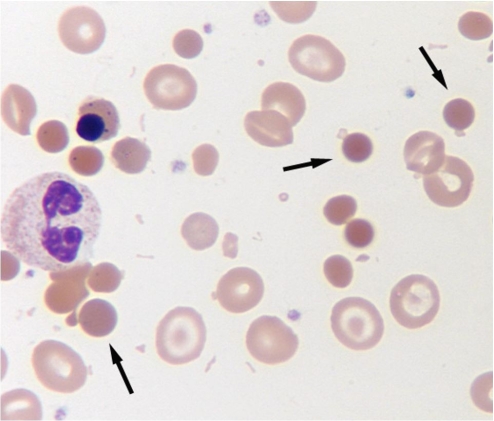
(Multiple Choice)
4.8/5 (82)
(82) What RBC inclusions cannot be seen with Romanowsky stain but can be visualized with supravital stain?
(Multiple Choice)
4.8/5 (97)
(97) 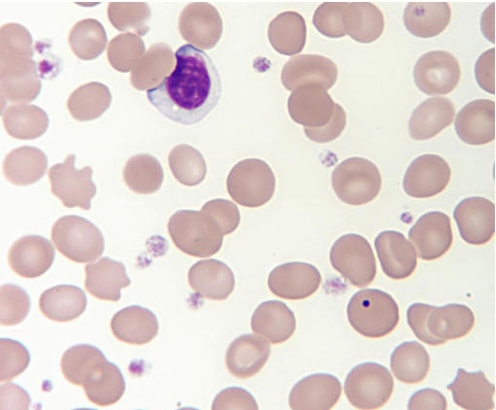
Which of the following laboratory values would best correlate with moderate polychromasia on a peripheral blood smear?
(Multiple Choice)
4.9/5 (84)
(84) Acanthocytes or spur cells have membranes with irregular distribution of spikes. What other significant feature does this cell possess?
(Multiple Choice)
4.8/5 (83)
(83) Codocytes are associated with all of the following conditions except:
(Multiple Choice)
4.9/5 (80)
(80) A peripheral blood smear exhibits heterogeneity in RBC size distribution throughout the smear. Which of the RBC indices would be most indicative of this?
(Multiple Choice)
4.8/5 (80)
(80) An instrument printout reveals an RDW of 33. Which of the following would best correlate with those results?
(Multiple Choice)
4.8/5 (83)
(83) While performing a 100-cell manual WBC differential, the laboratory professional observes Dohle bodies, toxic granulation and vacuoles in many neutrophils. This would suggest:
(Multiple Choice)
4.8/5 (78)
(78) Which parameter provides the best estimate of bone marrow megakaryocytopoiesis?
(Multiple Choice)
4.9/5 (80)
(80) What is one of the disease states associated with the presence of target cells?
(Multiple Choice)
4.9/5 (75)
(75) 
Filters
- Essay(0)
- Multiple Choice(0)
- Short Answer(0)
- True False(0)
- Matching(0)