



 Chat with AI
Exam 10: The Complete Blood Count and Peripheral Blood Smear Evaluation

Exam 1: Introduction32 Questions
Exam 2: Cellular Homeostasis40 Questions
Exam 3: Structure and Function of Hematopoietic Organs35 Questions
Exam 4: Hematopoiesis35 Questions
Exam 5: The Erythrocyte37 Questions
Exam 6: Hemoglobin40 Questions
Exam 7: Granulocytes and Monocytes30 Questions
Exam 8: Lymphocytes25 Questions
Exam 9: The Platelet18 Questions
Exam 10: The Complete Blood Count and Peripheral Blood Smear Evaluation40 Questions
Exam 11: Introduction to Anemia34 Questions
Exam 12: Anemias of Disordered Iron Metabolism and Heme Synthesis40 Questions
Exam 13: Hemoglobinopathies: Qualitative Defects33 Questions
Exam 14: Thalassemia32 Questions
Exam 15: Megaloblastic and Nonmegaloblastic Macrocytic Anemias33 Questions
Exam 16: Hypoproliferative Anemias31 Questions
Exam 17: Hemolytic Anemia: Membrane Defects36 Questions
Exam 18: Hemolytic Anemia: Enzyme Deficiencies36 Questions
Exam 19: Hemolytic Anemia: Immune Anemias32 Questions
Exam 20: Hemolytic Anemia: Nonimmune Defects30 Questions
Exam 21: Nonmalignant Disorders of Leukocytes: Granulocytes and Monocytes36 Questions
Exam 22: Nonmalignant Lymphocyte Disorders35 Questions
Exam 23: Introduction to Hematopoietic Neoplasms33 Questions
Exam 24: Myeloproliferative Neoplasms43 Questions
Exam 25: Myelodysplastic Syndromes34 Questions
Exam 26: Acute Myeloid Leukemias36 Questions
Exam 27: Precursor Lymphoid Neoplasms33 Questions
Exam 28: Mature Lymphoid Neoplasms41 Questions
Exam 29: Hematopoietic Stem Cell Transplantation41 Questions
Exam 30: Morphologic Analysis of Body Fluids in the Hematology42 Questions
Exam 31: Primary Hemostasis32 Questions
Exam 32: Secondary Hemostasis and Fibrinolysis35 Questions
Exam 33: Disorders of Primary Hemostasis36 Questions
Exam 34: Disorders of Secondary Hemostasis31 Questions
Exam 35: Thrombophilia38 Questions
Exam 36: Hemostasis: Laboratory Testing and Instrumentation50 Questions
Exam 37: Hematology Procedures44 Questions
Exam 38: Bone Marrow Examination33 Questions
Exam 39: Automation in Hematology27 Questions
Exam 40: Flow Cytometry33 Questions
Exam 41: Chromosome Analysis of Hematopoietic and Lymphoid Disorders34 Questions
Exam 42: Molecular Analysis of Hematologic Diseases17 Questions
Exam 43: Quality Assessment in the Hematology Laboratory29 Questions
Select questions type


A CBC shows decreased RBC, HGB, and HCT. The manual reticulocyte count result was 12%. Which of the following would you expect to see on the peripheral smear?

Free
(Multiple Choice)
4.9/5  (83)
(83) Correct Answer: Verified
C
Remnants of DNA inside an RBC produce which type of inclusion?
Free
(Multiple Choice)
5.0/5 (82)
(82) Correct Answer:Verified
VerifiedA
How would you differentiate between an acanthocyte and an echinocyte?
Free
(Multiple Choice)
4.9/5 (89)
(89) Correct Answer:Verified
VerifiedA
The hemoglobin and hematocrit on a newborn are 18.9 g/dL and 60%. How would you interpret these data?
(Multiple Choice)
4.8/5 (77)
(77) Which poikilocyte is indicated by the arrows in the following image? 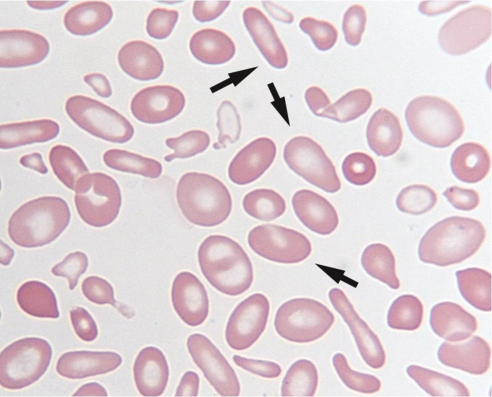
(Multiple Choice)
4.7/5 (80)
(80) Howell-Jolly bodies are red cell inclusions associated with what disease state?
(Multiple Choice)
4.8/5 (92)
(92) What should be reported about the RBCs in the following image and what affect would this have on the CBC results? 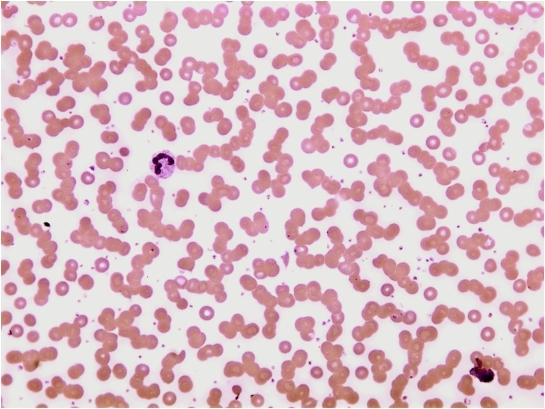
(Multiple Choice)
4.8/5 (71)
(71) Calculate the MCV from the results of a patient's CBC: RBC = 3.50 × 10¹²/L
Hemoglobin = 12.0 g/dL
Hematocrit = 40%
(Multiple Choice)
4.9/5 (81)
(81) Why do we see Howell-Jolly bodies in patients who have had a splenectomy? Explain your answer.
(Essay)
4.7/5 (70)
(70) Describe the purpose of and the way to calculate the "rule of three."
(Essay)
4.9/5 (94)
(94) Which of the following assays is not part of a typical complete blood count?
(Multiple Choice)
4.8/5 (84)
(84) The following data were reported by an instrument: RBC = 5.00 × 10¹²/L, hemoglobin = 8.5 g/dL and hematocrit = 32%. Calculate the MCHC.
(Multiple Choice)
4.9/5 (91)
(91) What staining method can be used to differentiate Pappenheimer bodies from reticulocytes?
(Multiple Choice)
4.9/5 (70)
(70) An instrument printout indicates an MCV of 63 fl and an MCHC of 26 g/dl. How will the red cells appear under the microscope?
(Multiple Choice)
4.8/5 (87)
(87) Which of the following values would be considered normal in a healthy 1-day old newborn?
(Multiple Choice)
4.8/5 (73)
(73) Which of the following is the proper order for reporting a CBC with one or more critical values:
(Multiple Choice)
4.9/5 (88)
(88) What should be reported about the RBCs indicated by the arrows in the following image? 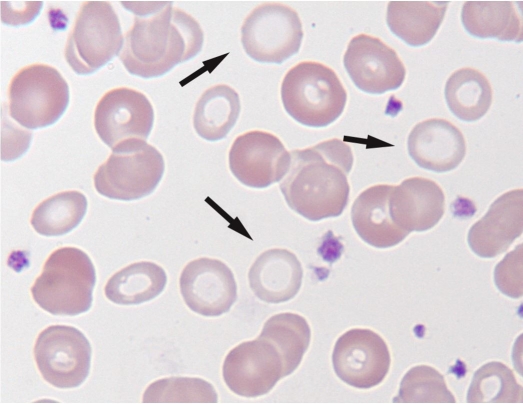
(Multiple Choice)
4.9/5 (88)
(88) Which RBC parameter describes the average volume of the RBCs in a blood sample?
(Multiple Choice)
4.8/5 (78)
(78) Identify the poikilocytes in the following image and indicate a possible mechanism for their formation. 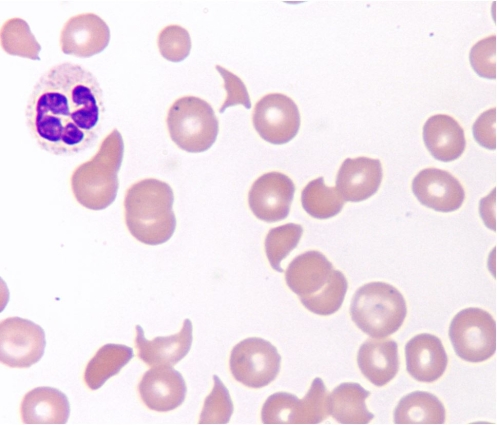
(Multiple Choice)
4.8/5 (64)
(64) 
Filters
- Essay(0)
- Multiple Choice(0)
- Short Answer(0)
- True False(0)
- Matching(0)