



 Chat with AI
Exam 34: Disorders of Secondary Hemostasis

Exam 1: Introduction32 Questions
Exam 2: Cellular Homeostasis40 Questions
Exam 3: Structure and Function of Hematopoietic Organs35 Questions
Exam 4: Hematopoiesis35 Questions
Exam 5: The Erythrocyte37 Questions
Exam 6: Hemoglobin40 Questions
Exam 7: Granulocytes and Monocytes30 Questions
Exam 8: Lymphocytes25 Questions
Exam 9: The Platelet18 Questions
Exam 10: The Complete Blood Count and Peripheral Blood Smear Evaluation40 Questions
Exam 11: Introduction to Anemia34 Questions
Exam 12: Anemias of Disordered Iron Metabolism and Heme Synthesis40 Questions
Exam 13: Hemoglobinopathies: Qualitative Defects33 Questions
Exam 14: Thalassemia32 Questions
Exam 15: Megaloblastic and Nonmegaloblastic Macrocytic Anemias33 Questions
Exam 16: Hypoproliferative Anemias31 Questions
Exam 17: Hemolytic Anemia: Membrane Defects36 Questions
Exam 18: Hemolytic Anemia: Enzyme Deficiencies36 Questions
Exam 19: Hemolytic Anemia: Immune Anemias32 Questions
Exam 20: Hemolytic Anemia: Nonimmune Defects30 Questions
Exam 21: Nonmalignant Disorders of Leukocytes: Granulocytes and Monocytes36 Questions
Exam 22: Nonmalignant Lymphocyte Disorders35 Questions
Exam 23: Introduction to Hematopoietic Neoplasms33 Questions
Exam 24: Myeloproliferative Neoplasms43 Questions
Exam 25: Myelodysplastic Syndromes34 Questions
Exam 26: Acute Myeloid Leukemias36 Questions
Exam 27: Precursor Lymphoid Neoplasms33 Questions
Exam 28: Mature Lymphoid Neoplasms41 Questions
Exam 29: Hematopoietic Stem Cell Transplantation41 Questions
Exam 30: Morphologic Analysis of Body Fluids in the Hematology42 Questions
Exam 31: Primary Hemostasis32 Questions
Exam 32: Secondary Hemostasis and Fibrinolysis35 Questions
Exam 33: Disorders of Primary Hemostasis36 Questions
Exam 34: Disorders of Secondary Hemostasis31 Questions
Exam 35: Thrombophilia38 Questions
Exam 36: Hemostasis: Laboratory Testing and Instrumentation50 Questions
Exam 37: Hematology Procedures44 Questions
Exam 38: Bone Marrow Examination33 Questions
Exam 39: Automation in Hematology27 Questions
Exam 40: Flow Cytometry33 Questions
Exam 41: Chromosome Analysis of Hematopoietic and Lymphoid Disorders34 Questions
Exam 42: Molecular Analysis of Hematologic Diseases17 Questions
Exam 43: Quality Assessment in the Hematology Laboratory29 Questions
Select questions type


George Jones is admitted to the hospital with abdominal pain. Upon physical examination, the attending physician notices a yellow ring around his green eyes. George has a significant swelling in his abdomen and has been suffering from swollen joints for the last month. The physician runs a battery of labs. The results follow: 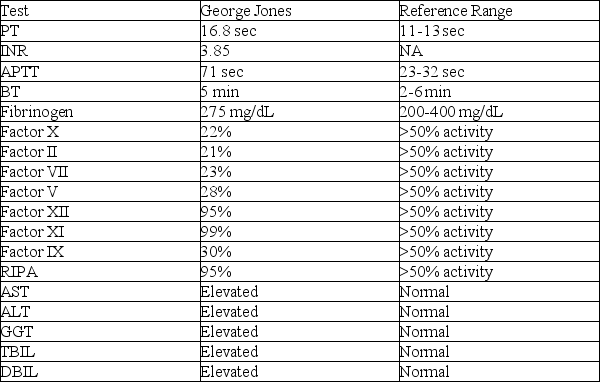 Based on this information, from what is George most likely suffering?
Free
(Multiple Choice)
4.8/5  (82)
(82) Correct Answer: Verified
A
A 5-year-old boy has his blood drawn for platelet aggregation studies. Ristocetin aggregation (RIPA) comes back abnormal with all other agonists displaying normal aggregation. VWF antigen is within normal limits. What is the most likely reason for this discrepancy?
Free
(Multiple Choice)
4.8/5 (93)
(93) Correct Answer:Verified
VerifiedB
Which of the following clinical symptoms correlates with a severe form of hemophilia A or B?
Free
(Multiple Choice)
4.8/5 (81)
(81) Correct Answer:Verified
VerifiedC
Deficiencies of the fibrin-forming proteins often have a delayed bleeding symptom that results from which of the following?
(Multiple Choice)
4.8/5 (84)
(84) Deficiency of coagulation proteins is defined as a decrease in:
(Multiple Choice)
4.9/5 (78)
(78) Which of the following laboratory assays would be useful in identifying the presence of primary fibrinolysis?
(Multiple Choice)
5.0/5 (58)
(58) A known hemophiliac has developed an inhibitor. The physician in charge of his care wants to know how much inhibitor is present to properly treat him. What two lab tests would be ordered to assess this?
(Multiple Choice)
4.8/5 (75)
(75) What should be the next course of action in investigating these results?
(Multiple Choice)
4.8/5 (70)
(70) Screening tests for the evaluation of VWD include the platelet count, APTT, PT, bleeding time, and/or PFA-100. Which of the following results would be evident in most cases of VWD?
(Multiple Choice)
4.9/5 (78)
(78) Hemophilia A is caused by a deficiency in which of the following proteins?
(Multiple Choice)
4.9/5 (68)
(68) Which congenital deficiency(ies) is(are) suspected with a normal platelet count, an abnormal PT and APTT, and normal PFA-100 and thrombin time?
(Multiple Choice)
4.8/5 (82)
(82) F-VIII deficiency and F-IX deficiency are classified as what category of disorder?
(Multiple Choice)
4.8/5 (86)
(86) A physician has confirmed von Willebrand's disease in a patient. Further testing is needed to determine which subtype the patient has. Multimer analysis is performed and comes back normal. What is the most probable explanation for this?
(Multiple Choice)
4.8/5 (87)
(87) Explain how liver disease can be differentiated from DIC through laboratory test analysis.
(Essay)
4.9/5 (80)
(80) What type of VWD is the only type to have a decreased platelet count?
(Multiple Choice)
4.7/5 (91)
(91) Interpret the following results: PT: 11.8 sec (RR: 11.2-13.8 sec)
INR: 1.07
APTT: 57 sec (RR: 23-32 sec)
Closure time: increased
Ristocetin aggregation: decreased aggregation
Based on this information, what is the most likely disorder?
(Multiple Choice)
4.9/5 (81)
(81) How does von Willebrand's disease (VWD) differ from Bernard-Soulier syndrome? Correlate the pathophysiology of both disorders in your response. Name at least two laboratory tests that differentiate each.
(Essay)
5.0/5 (90)
(90) Explain the inheritance pattern of the following disorders and how it contributes to the clinical manifestations of each:
a. Hemophilia A
b. Hemophilia B
c. von Willebrand's disease
d. Bernard-Soulier syndrome
(Essay)
4.8/5 (87)
(87) 
Filters
- Essay(0)
- Multiple Choice(0)
- Short Answer(0)
- True False(0)
- Matching(0)