



 Chat with AI
Exam 20: Hemolytic Anemia: Nonimmune Defects

Exam 1: Introduction32 Questions
Exam 2: Cellular Homeostasis40 Questions
Exam 3: Structure and Function of Hematopoietic Organs35 Questions
Exam 4: Hematopoiesis35 Questions
Exam 5: The Erythrocyte37 Questions
Exam 6: Hemoglobin40 Questions
Exam 7: Granulocytes and Monocytes30 Questions
Exam 8: Lymphocytes25 Questions
Exam 9: The Platelet18 Questions
Exam 10: The Complete Blood Count and Peripheral Blood Smear Evaluation40 Questions
Exam 11: Introduction to Anemia34 Questions
Exam 12: Anemias of Disordered Iron Metabolism and Heme Synthesis40 Questions
Exam 13: Hemoglobinopathies: Qualitative Defects33 Questions
Exam 14: Thalassemia32 Questions
Exam 15: Megaloblastic and Nonmegaloblastic Macrocytic Anemias33 Questions
Exam 16: Hypoproliferative Anemias31 Questions
Exam 17: Hemolytic Anemia: Membrane Defects36 Questions
Exam 18: Hemolytic Anemia: Enzyme Deficiencies36 Questions
Exam 19: Hemolytic Anemia: Immune Anemias32 Questions
Exam 20: Hemolytic Anemia: Nonimmune Defects30 Questions
Exam 21: Nonmalignant Disorders of Leukocytes: Granulocytes and Monocytes36 Questions
Exam 22: Nonmalignant Lymphocyte Disorders35 Questions
Exam 23: Introduction to Hematopoietic Neoplasms33 Questions
Exam 24: Myeloproliferative Neoplasms43 Questions
Exam 25: Myelodysplastic Syndromes34 Questions
Exam 26: Acute Myeloid Leukemias36 Questions
Exam 27: Precursor Lymphoid Neoplasms33 Questions
Exam 28: Mature Lymphoid Neoplasms41 Questions
Exam 29: Hematopoietic Stem Cell Transplantation41 Questions
Exam 30: Morphologic Analysis of Body Fluids in the Hematology42 Questions
Exam 31: Primary Hemostasis32 Questions
Exam 32: Secondary Hemostasis and Fibrinolysis35 Questions
Exam 33: Disorders of Primary Hemostasis36 Questions
Exam 34: Disorders of Secondary Hemostasis31 Questions
Exam 35: Thrombophilia38 Questions
Exam 36: Hemostasis: Laboratory Testing and Instrumentation50 Questions
Exam 37: Hematology Procedures44 Questions
Exam 38: Bone Marrow Examination33 Questions
Exam 39: Automation in Hematology27 Questions
Exam 40: Flow Cytometry33 Questions
Exam 41: Chromosome Analysis of Hematopoietic and Lymphoid Disorders34 Questions
Exam 42: Molecular Analysis of Hematologic Diseases17 Questions
Exam 43: Quality Assessment in the Hematology Laboratory29 Questions
Select questions type


Explain why infections with Clostridium perfringens lead to hemolysis of the RBCs.
(Essay)
4.9/5  (79)
(79) Which of the following analytes would be increased in MAHA?
(Multiple Choice)
4.8/5 (93)
(93) What features are identified on the peripheral blood smear in TTP?
(Multiple Choice)
4.8/5 (87)
(87) Laboratory testing in DIC helps distinguish this condition from others. Which of the following results would be expected in DIC?
(Multiple Choice)
4.8/5 (87)
(87) A 7-year-old girl is brought to a physician because she has a swollen hand with an ischemic lesion. The physician suspects a brown recluse spider bite. What is the suspected mechanism of erythrocyte damage caused by venom of this spider?
(Multiple Choice)
4.8/5 (73)
(73) Describe the mechanism that causes the production of schistocytes in microangiopathic hemolytic anemia.
(Essay)
4.9/5 (82)
(82) A mother brings her 3-year-old daughter to the emergency department because she is having trouble urinating. The child is not feverish. She has otherwise been healthy except for a bout of diarrhea about 10 days ago. Laboratory test results are as follows: 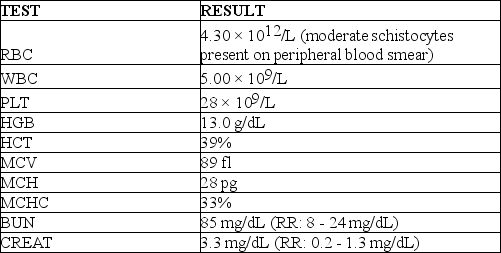 Based on the history and the laboratory results, what is the most likely diagnosis?
 (Multiple Choice)
4.9/5 (72)
(72) A runner is in training for the Chicago Marathon. After his most recent 26 mile run, he notices that his urine was reddish-brown. The next morning, his urine is clear and yellow, but he decided to see his primary care physician. All of the hematology and chemistry results are within the reference range. What is the most likely reason for this scenario?
(Multiple Choice)
4.8/5 (67)
(67) 
Filters
- Essay(0)
- Multiple Choice(0)
- Short Answer(0)
- True False(0)
- Matching(0)