



 Chat with AI
Exam 8: An Introduction to Metabolism

Exam 1: Evolution, the Themes of Biology, and Scientific Inquiry51 Questions
Exam 2: The Chemical Context of Life61 Questions
Exam 3: Water and Life55 Questions
Exam 4: Carbon and the Molecular Diversity of Life58 Questions
Exam 5: The Structure and Function of Large Biological Molecules70 Questions
Exam 6: A Tour of the Cell66 Questions
Exam 7: Membrane Structure and Function68 Questions
Exam 8: An Introduction to Metabolism67 Questions
Exam 9: Cellular Respiration and Fermentation68 Questions
Exam 10: Photosynthesis65 Questions
Exam 11: Cell Communication65 Questions
Exam 12: The Cell Cycle66 Questions
Exam 13: Meiosis and Sexual Life Cycles64 Questions
Exam 14: Mendel and the Gene Idea62 Questions
Exam 15: The Chromosomal Basis of Inheritance58 Questions
Exam 16: The Molecular Basis of Inheritance65 Questions
Exam 17: Gene Expression: From Gene to Protein67 Questions
Exam 18: Regulation of Gene Expression66 Questions
Exam 19: Viruses54 Questions
Exam 20: Dna Tools and Biotechnology57 Questions
Exam 21: Genomes and Their Evolution44 Questions
Exam 22: Descent With Modification: a Darwinian View of Life60 Questions
Exam 23: The Evolution of Populations64 Questions
Exam 24: The Origin of Species67 Questions
Exam 25: The History of Life on Earth59 Questions
Exam 26: Phylogeny and the Tree of Life75 Questions
Exam 27: Bacteria and Archaea75 Questions
Exam 28: Protists79 Questions
Exam 29: Plant Diversity I: How Plants Colonised Land82 Questions
Exam 30: Plant Diversity Ii: the Evolution of Seed Plants80 Questions
Exam 31: Fungi70 Questions
Exam 32: An Overview of Animal Diversity67 Questions
Exam 33: An Introduction to Invertebrates83 Questions
Exam 34: The Origin and Evolution of Vertebrates82 Questions
Exam 35: Vascular Plant Structure, Growth, and Development65 Questions
Exam 36: Resource Acquisition and Transport in Vascular Plants74 Questions
Exam 37: Soil and Plant Nutrition52 Questions
Exam 38: Angiosperm Reproduction and Biotechnology60 Questions
Exam 39: Plant Responses to Internal and External Signals61 Questions
Exam 40: Basic Principles of Animal Form and Function68 Questions
Exam 41: Animal Nutrition64 Questions
Exam 42: Circulation and Gas Exchange67 Questions
Exam 43: The Immune System69 Questions
Exam 44: Osmoregulation and Excretion64 Questions
Exam 45: Hormones and the Endocrine System66 Questions
Exam 46: Animal Reproduction68 Questions
Exam 47: Animal Development70 Questions
Exam 48: Neurons, Synapses, and Signalling68 Questions
Exam 49: Nervous Systems65 Questions
Exam 50: Sensory and Motor Mechanisms67 Questions
Select questions type


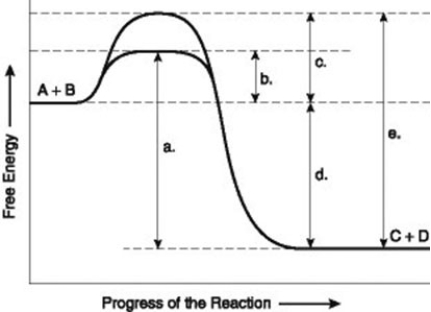 - The figure illustrates the energy states associated with the reaction A + B ↔ C + D. Which of the following in the figure would be the same in either an enzyme-catalysed or a noncatalysed reaction?
 (Multiple Choice)
4.8/5  (88)
(88) How might a change of one amino acid at a site, distant from the active site of an enzyme, alter the substrate specificity of an enzyme?
(Multiple Choice)
4.8/5 (74)
(74)  Rate of an enzyme-catalysed reaction as a function of varying reactant concentration, with the concentration of enzyme constant
In the figure, why does the reaction rate plateau at higher reactant concentrations?
Rate of an enzyme-catalysed reaction as a function of varying reactant concentration, with the concentration of enzyme constant
In the figure, why does the reaction rate plateau at higher reactant concentrations? (Multiple Choice)
4.7/5 (64)
(64) When chemical, transport, or mechanical work is done by an organism, what happens to the heat generated?
(Multiple Choice)
4.9/5 (76)
(76) Which of the following statements is true of metabolism in its entirety in all organisms?
(Multiple Choice)
4.8/5 (76)
(76) Which of the following statements describes a common characteristic of catabolic pathways?
(Multiple Choice)
4.9/5 (68)
(68) A number of systems for pumping ions across membranes are powered by ATP. Such ATP-powered pumps are often called ATPases, although they do not often hydrolyse ATP unless they are simultaneously transporting ions. Because small increases in calcium ions in the cytosol can trigger a number of different intracellular reactions, cells keep the cytosolic calcium concentration quite low under normal conditions, using ATP-powered calcium pumps. For example, muscle cells transport calcium from the cytosol into the membranous system called the sarcoplasmic reticulum (SR). If a resting muscle cell's cytosol has a free calcium ion concentration of 10-7 while the concentration in the SR is 10-2, then how is the ATPase acting?
(Multiple Choice)
4.8/5 (84)
(84)  Rate of an enzyme-catalysed reaction as a function of varying reactant concentration, with the concentration of enzyme constant.
For the enzyme-catalysed reaction shown in the figure, if the initial reactant concentration is 1.0 micromolar, which of these treatments will cause the greatest increase in the rate of the reaction?
Rate of an enzyme-catalysed reaction as a function of varying reactant concentration, with the concentration of enzyme constant.
For the enzyme-catalysed reaction shown in the figure, if the initial reactant concentration is 1.0 micromolar, which of these treatments will cause the greatest increase in the rate of the reaction? (Multiple Choice)
4.8/5 (83)
(83) Which of the following statements is true for all exergonic reactions?
(Multiple Choice)
4.9/5 (86)
(86) ________ is a regulatory mechanism in which the end product of a metabolic pathway inhibits an enzyme that catalyses an early step in the pathway.
(Multiple Choice)
4.7/5 (73)
(73) Which of the following characteristics is most likely to be associated with an enzyme that catalyses two different chemical reactions?
(Multiple Choice)
4.8/5 (87)
(87) Which of the following statements is an important consequence of the first law of thermodynamics for a living organism?
(Multiple Choice)
4.8/5 (77)
(77) Which of the following statements about anabolic pathways is true?
(Multiple Choice)
4.8/5 (80)
(80) Zinc, an essential trace element for most organisms, is present in the active site of the enzyme carboxypeptidase. The zinc most likely functions as ________.
(Multiple Choice)
4.8/5 (68)
(68)  -Activity of various enzymes at various temperatures (a) and at various pH (b)
Which curves on the graphs may represent the temperature and pH profiles of an enzyme taken from a bacterium that lives in a mildly alkaline hot springs at temperatures of 70°C or higher?
-Activity of various enzymes at various temperatures (a) and at various pH (b)
Which curves on the graphs may represent the temperature and pH profiles of an enzyme taken from a bacterium that lives in a mildly alkaline hot springs at temperatures of 70°C or higher? (Multiple Choice)
4.9/5 (86)
(86) The relationship between catabolism and anabolism is most similar to the relationship between which of the following pairs of terms?
(Multiple Choice)
4.8/5 (76)
(76) In a metabolic pathway, succinate dehydrogenase catalyses the conversion of succinate to fumarate. The reaction is inhibited by malonic acid, a substance that resembles succinate but cannot be acted upon by succinate dehydrogenase. Increasing the amount of succinate molecules to those of malonic acid reduces the inhibitory effect of malonic acid. Which of the following statements correctly describes the role played by molecules described in the reaction?
(Multiple Choice)
4.8/5 (72)
(72)
- The figure illustrates the energy states associated with the reaction A + B ↔ C + D. Which of the following represents the activation energy required for the enzyme-catalysed reaction in the figure?
- The figure illustrates the energy states associated with the reaction A + B ↔ C + D. Which of the following represents the activation energy required for the enzyme-catalysed reaction in the figure? (Multiple Choice)
4.8/5 (84)
(84) Why is the ΔG of ATP hydrolysis in the cell about twice as great as the ΔG of ATP hydrolysis in a test tube under standard conditions?
(Multiple Choice)
4.9/5 (92)
(92) Which of the following aspects of enzyme structure is best described by a clasping handshake analogy?
(Multiple Choice)
4.8/5 (96)
(96) 
Filters
- Essay(0)
- Multiple Choice(0)
- Short Answer(0)
- True False(0)
- Matching(0)