



 Chat with AI
Exam 9: Cellular Respiration and Fermentation

Exam 1: Evolution, the Themes of Biology, and Scientific Inquiry51 Questions
Exam 2: The Chemical Context of Life61 Questions
Exam 3: Water and Life55 Questions
Exam 4: Carbon and the Molecular Diversity of Life58 Questions
Exam 5: The Structure and Function of Large Biological Molecules70 Questions
Exam 6: A Tour of the Cell66 Questions
Exam 7: Membrane Structure and Function68 Questions
Exam 8: An Introduction to Metabolism67 Questions
Exam 9: Cellular Respiration and Fermentation68 Questions
Exam 10: Photosynthesis65 Questions
Exam 11: Cell Communication65 Questions
Exam 12: The Cell Cycle66 Questions
Exam 13: Meiosis and Sexual Life Cycles64 Questions
Exam 14: Mendel and the Gene Idea62 Questions
Exam 15: The Chromosomal Basis of Inheritance58 Questions
Exam 16: The Molecular Basis of Inheritance65 Questions
Exam 17: Gene Expression: From Gene to Protein67 Questions
Exam 18: Regulation of Gene Expression66 Questions
Exam 19: Viruses54 Questions
Exam 20: Dna Tools and Biotechnology57 Questions
Exam 21: Genomes and Their Evolution44 Questions
Exam 22: Descent With Modification: a Darwinian View of Life60 Questions
Exam 23: The Evolution of Populations64 Questions
Exam 24: The Origin of Species67 Questions
Exam 25: The History of Life on Earth59 Questions
Exam 26: Phylogeny and the Tree of Life75 Questions
Exam 27: Bacteria and Archaea75 Questions
Exam 28: Protists79 Questions
Exam 29: Plant Diversity I: How Plants Colonised Land82 Questions
Exam 30: Plant Diversity Ii: the Evolution of Seed Plants80 Questions
Exam 31: Fungi70 Questions
Exam 32: An Overview of Animal Diversity67 Questions
Exam 33: An Introduction to Invertebrates83 Questions
Exam 34: The Origin and Evolution of Vertebrates82 Questions
Exam 35: Vascular Plant Structure, Growth, and Development65 Questions
Exam 36: Resource Acquisition and Transport in Vascular Plants74 Questions
Exam 37: Soil and Plant Nutrition52 Questions
Exam 38: Angiosperm Reproduction and Biotechnology60 Questions
Exam 39: Plant Responses to Internal and External Signals61 Questions
Exam 40: Basic Principles of Animal Form and Function68 Questions
Exam 41: Animal Nutrition64 Questions
Exam 42: Circulation and Gas Exchange67 Questions
Exam 43: The Immune System69 Questions
Exam 44: Osmoregulation and Excretion64 Questions
Exam 45: Hormones and the Endocrine System66 Questions
Exam 46: Animal Reproduction68 Questions
Exam 47: Animal Development70 Questions
Exam 48: Neurons, Synapses, and Signalling68 Questions
Exam 49: Nervous Systems65 Questions
Exam 50: Sensory and Motor Mechanisms67 Questions
Select questions type


Which electron carrier(s) function in the citric acid cycle?
(Multiple Choice)
4.7/5  (83)
(83) Which of the following processes is driven by chemiosmosis?
(Multiple Choice)
4.8/5 (73)
(73) Which metabolic pathway is common to both fermentation and cellular respiration of a glucose molecule?
(Multiple Choice)
4.9/5 (78)
(78) Where are the proteins of the electron transport chain located?
(Multiple Choice)
4.8/5 (77)
(77) A person on a strict diet and exercise regimen lost 7 kg (about 15 pounds) of body fat in just two weeks. What is the most likely way that the lost fat left the body?
(Multiple Choice)
4.8/5 (67)
(67) Carbon dioxide (CO₂) is released during which of the following stages of cellular respiration?
(Multiple Choice)
4.8/5 (85)
(85) New biosensors, applied like a temporary tattoo to the skin, can alert serious athletes that they are about to "hit the wall" and will find it difficult to continue exercising. These biosensors monitor lactate, a form of lactic acid, released in sweat during strenuous exercise. Which of the statements below is the best explanation of why athletes would need to monitor lactate levels?
(Multiple Choice)
4.8/5 (77)
(77) In which reactions of cellular respiration and fermentation does substrate-level phosphorylation occur?
(Multiple Choice)
4.9/5 (73)
(73) Water is one of the end products of aerobic respiration. What is the source of the oxygen atom used in formation of the water?
(Multiple Choice)
4.8/5 (94)
(94) Which of the following statements about the electron transport chain is true?
(Multiple Choice)
4.8/5 (90)
(90) 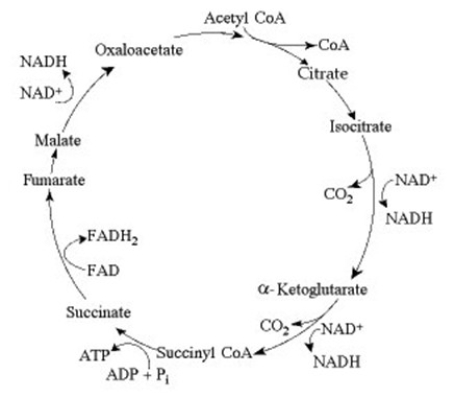 The citric acid cycle.
If you were to add one of the eight citric acid cycle intermediates to the culture medium of yeast growing in the laboratory, what do you think would happen to the rates of ATP and carbon dioxide production?
The citric acid cycle.
If you were to add one of the eight citric acid cycle intermediates to the culture medium of yeast growing in the laboratory, what do you think would happen to the rates of ATP and carbon dioxide production? (Multiple Choice)
4.9/5 (77)
(77) A young dog has never had much energy. He is brought to a veterinarian for help, and she decides to conduct several diagnostic tests. She discovers that the dog's mitochondria can use only fatty acids and amino acids for respiration, and his cells produce more lactate than normal. Of the following, which is the best explanation of the dog's condition?
(Multiple Choice)
4.8/5 (72)
(72) High levels of citric acid inhibit the enzyme phosphofructokinase, a key enzyme in glycolysis. Citric acid binds to the enzyme at a different location from the active site. This is an example of ________.
(Multiple Choice)
4.9/5 (84)
(84) The immediate energy source that drives ATP synthesis by ATP synthase during oxidative phosphorylation is the
(Multiple Choice)
4.7/5 (88)
(88) Yeast cells that have defective mitochondria incapable of respiration will be able to grow by catabolising which of the following carbon sources for energy?
(Multiple Choice)
5.0/5 (90)
(90) What happens to a glucose molecule when it loses a hydrogen atom as the result of an oxidation-reduction reaction?
(Multiple Choice)
4.7/5 (80)
(80) What happens when electrons are passed from one atom to a more electronegative atom?
(Multiple Choice)
4.8/5 (78)
(78) What kinds of cells carry out ATP synthesis by chemiosmosis?
(Multiple Choice)
4.8/5 (73)
(73) 
Filters
- Essay(0)
- Multiple Choice(0)
- Short Answer(0)
- True False(0)
- Matching(0)