



 Chat with AI
Exam 21: Genomes and Their Evolution

Exam 1: Evolution, the Themes of Biology, and Scientific Inquiry51 Questions
Exam 2: The Chemical Context of Life61 Questions
Exam 3: Water and Life55 Questions
Exam 4: Carbon and the Molecular Diversity of Life58 Questions
Exam 5: The Structure and Function of Large Biological Molecules70 Questions
Exam 6: A Tour of the Cell66 Questions
Exam 7: Membrane Structure and Function68 Questions
Exam 8: An Introduction to Metabolism67 Questions
Exam 9: Cellular Respiration and Fermentation68 Questions
Exam 10: Photosynthesis65 Questions
Exam 11: Cell Communication65 Questions
Exam 12: The Cell Cycle66 Questions
Exam 13: Meiosis and Sexual Life Cycles64 Questions
Exam 14: Mendel and the Gene Idea62 Questions
Exam 15: The Chromosomal Basis of Inheritance58 Questions
Exam 16: The Molecular Basis of Inheritance65 Questions
Exam 17: Gene Expression: From Gene to Protein67 Questions
Exam 18: Regulation of Gene Expression66 Questions
Exam 19: Viruses54 Questions
Exam 20: Dna Tools and Biotechnology57 Questions
Exam 21: Genomes and Their Evolution44 Questions
Exam 22: Descent With Modification: a Darwinian View of Life60 Questions
Exam 23: The Evolution of Populations64 Questions
Exam 24: The Origin of Species67 Questions
Exam 25: The History of Life on Earth59 Questions
Exam 26: Phylogeny and the Tree of Life75 Questions
Exam 27: Bacteria and Archaea75 Questions
Exam 28: Protists79 Questions
Exam 29: Plant Diversity I: How Plants Colonised Land82 Questions
Exam 30: Plant Diversity Ii: the Evolution of Seed Plants80 Questions
Exam 31: Fungi70 Questions
Exam 32: An Overview of Animal Diversity67 Questions
Exam 33: An Introduction to Invertebrates83 Questions
Exam 34: The Origin and Evolution of Vertebrates82 Questions
Exam 35: Vascular Plant Structure, Growth, and Development65 Questions
Exam 36: Resource Acquisition and Transport in Vascular Plants74 Questions
Exam 37: Soil and Plant Nutrition52 Questions
Exam 38: Angiosperm Reproduction and Biotechnology60 Questions
Exam 39: Plant Responses to Internal and External Signals61 Questions
Exam 40: Basic Principles of Animal Form and Function68 Questions
Exam 41: Animal Nutrition64 Questions
Exam 42: Circulation and Gas Exchange67 Questions
Exam 43: The Immune System69 Questions
Exam 44: Osmoregulation and Excretion64 Questions
Exam 45: Hormones and the Endocrine System66 Questions
Exam 46: Animal Reproduction68 Questions
Exam 47: Animal Development70 Questions
Exam 48: Neurons, Synapses, and Signalling68 Questions
Exam 49: Nervous Systems65 Questions
Exam 50: Sensory and Motor Mechanisms67 Questions
Select questions type


Which of the following statements correctly describes one characteristic of a multigene family?
(Multiple Choice)
4.8/5  (81)
(81) Which of the following processes is an early step in the whole-genome shotgun approach to sequencing?
(Multiple Choice)
4.9/5 (70)
(70) Using modern techniques of sequencing by synthesis and the shotgun approach, sequences are assembled into chromosomes by ________.
(Multiple Choice)
4.9/5 (77)
(77) Fragments of DNA have been extracted from the remnants of extinct woolly mammoths, amplified, and sequenced. How can these fragments of DNA now be used?
(Multiple Choice)
4.8/5 (85)
(85) Biologists now routinely test for homology between genes in different species. If genes are determined to be homologous, how are they related to each other?
(Multiple Choice)
4.8/5 (86)
(86) During which of the following processes does exon shuffling occur?
(Multiple Choice)
4.9/5 (87)
(87) Which of the following types of genes or gene families may be created by mutations that occur in one member of a gene pair that arose from gene duplication?
(Multiple Choice)
4.9/5 (70)
(70) If the sequence of a cDNA has matches with DNA sequences in the genome, then this genomic DNA could be described by which of the following statements?
(Multiple Choice)
4.7/5 (75)
(75) Two eukaryotic proteins have one domain in common but are otherwise very different. Which of the following processes is most likely to have contributed to this similarity?
(Multiple Choice)
5.0/5 (89)
(89) Bioinformatics includes ________.
I. using computer programs to align DNA sequences
II. creating recombinant DNA from separate species
III. developing computer-based tools for genome analysis
IV. using mathematical tools to make sense of biological systems
(Multiple Choice)
4.8/5 (72)
(72) Why is it more difficult to identify eukaryotic genes than prokaryotic genes using genomic techniques?
(Multiple Choice)
4.8/5 (73)
(73) After finding a new medicinal plant, a pharmaceutical company decides to determine if the plant has genes similar to those of other known medicinal plants. What would annotation of the genome of this plant allow the company to determine?
(Multiple Choice)
4.8/5 (84)
(84) 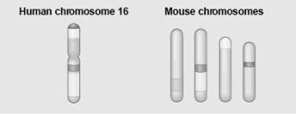 The figure shows a diagram of blocks of genes on human chromosome 16 and the locations of blocks of similar genes on four chromosomes of the mouse.
Which of the following statements describes the result of the movement of these blocks?
The figure shows a diagram of blocks of genes on human chromosome 16 and the locations of blocks of similar genes on four chromosomes of the mouse.
Which of the following statements describes the result of the movement of these blocks? (Multiple Choice)
4.8/5 (92)
(92) In humans, the embryonic and foetal forms of haemoglobin have a higher affinity for oxygen than that of adults. Why is this the case?
(Multiple Choice)
4.7/5 (67)
(67) Bioinformatics can be used to scan for short sequences that specify known mRNAs, called ________.
(Multiple Choice)
4.8/5 (93)
(93) Which of the following conclusions has led to the comparison between the number of human genes and those of other animal species?
(Multiple Choice)
4.9/5 (83)
(83) 
Filters
- Essay(0)
- Multiple Choice(0)
- Short Answer(0)
- True False(0)
- Matching(0)