



 Chat with AI
Exam 25: The History of Life on Earth

Exam 1: Evolution, the Themes of Biology, and Scientific Inquiry51 Questions
Exam 2: The Chemical Context of Life61 Questions
Exam 3: Water and Life55 Questions
Exam 4: Carbon and the Molecular Diversity of Life58 Questions
Exam 5: The Structure and Function of Large Biological Molecules70 Questions
Exam 6: A Tour of the Cell66 Questions
Exam 7: Membrane Structure and Function68 Questions
Exam 8: An Introduction to Metabolism67 Questions
Exam 9: Cellular Respiration and Fermentation68 Questions
Exam 10: Photosynthesis65 Questions
Exam 11: Cell Communication65 Questions
Exam 12: The Cell Cycle66 Questions
Exam 13: Meiosis and Sexual Life Cycles64 Questions
Exam 14: Mendel and the Gene Idea62 Questions
Exam 15: The Chromosomal Basis of Inheritance58 Questions
Exam 16: The Molecular Basis of Inheritance65 Questions
Exam 17: Gene Expression: From Gene to Protein67 Questions
Exam 18: Regulation of Gene Expression66 Questions
Exam 19: Viruses54 Questions
Exam 20: Dna Tools and Biotechnology57 Questions
Exam 21: Genomes and Their Evolution44 Questions
Exam 22: Descent With Modification: a Darwinian View of Life60 Questions
Exam 23: The Evolution of Populations64 Questions
Exam 24: The Origin of Species67 Questions
Exam 25: The History of Life on Earth59 Questions
Exam 26: Phylogeny and the Tree of Life75 Questions
Exam 27: Bacteria and Archaea75 Questions
Exam 28: Protists79 Questions
Exam 29: Plant Diversity I: How Plants Colonised Land82 Questions
Exam 30: Plant Diversity Ii: the Evolution of Seed Plants80 Questions
Exam 31: Fungi70 Questions
Exam 32: An Overview of Animal Diversity67 Questions
Exam 33: An Introduction to Invertebrates83 Questions
Exam 34: The Origin and Evolution of Vertebrates82 Questions
Exam 35: Vascular Plant Structure, Growth, and Development65 Questions
Exam 36: Resource Acquisition and Transport in Vascular Plants74 Questions
Exam 37: Soil and Plant Nutrition52 Questions
Exam 38: Angiosperm Reproduction and Biotechnology60 Questions
Exam 39: Plant Responses to Internal and External Signals61 Questions
Exam 40: Basic Principles of Animal Form and Function68 Questions
Exam 41: Animal Nutrition64 Questions
Exam 42: Circulation and Gas Exchange67 Questions
Exam 43: The Immune System69 Questions
Exam 44: Osmoregulation and Excretion64 Questions
Exam 45: Hormones and the Endocrine System66 Questions
Exam 46: Animal Reproduction68 Questions
Exam 47: Animal Development70 Questions
Exam 48: Neurons, Synapses, and Signalling68 Questions
Exam 49: Nervous Systems65 Questions
Exam 50: Sensory and Motor Mechanisms67 Questions
Select questions type


Upon being formed, oceanic islands, such as the Hawaiian Islands, should feature what characteristic, leading to which phenomenon?
(Multiple Choice)
4.9/5  (74)
(74) How did the Cretaceous and Permian extinctions affect the numbers of prey organisms?
(Multiple Choice)
4.9/5 (74)
(74) A female fly, full of fertilised eggs, is swept by high winds to an island far out to sea. She is the first fly to arrive on this island and the only fly to arrive in this way. Thousands of years later, her numerous offspring occupy the island, but none of them resembles her. There are, instead, several species, each of which eats only a certain type of food. None of the species can fly and their balancing organs (halteres) are now used in courtship displays. The male members of each species bear modified halteres that are unique in appearance to their species. Females bear vestigial halteres. The ranges of all of the daughter species overlap.
Which of these fly organs, as they exist in the description, best illustrates an exaptation?
(Multiple Choice)
4.9/5 (59)
(59) Which of the following steps has not yet been accomplished by scientists studying the origin of life?
(Multiple Choice)
4.8/5 (68)
(68) Which of the following organisms would be most likely to form a fossil?
(Multiple Choice)
4.8/5 (86)
(86) The following question is based on the observation that several dozen different proteins comprise the prokaryotic flagellum and its attachment to the prokaryotic cell, producing a highly complex structure.
-Certain proteins of the complex motor that drives bacterial flagella are modified versions of proteins that had previously belonged to plasma membrane pumps. This evidence supports the claim that ________.
(Multiple Choice)
4.8/5 (95)
(95) Which factor most likely caused animals and plants in India to differ greatly from species in nearby southeast Asia?
(Multiple Choice)
4.9/5 (69)
(69) What adaptions by mammals helped their adaptive radiation after extinction of terrestrial dinosaurs?
(Multiple Choice)
4.8/5 (74)
(74) A female fly, full of fertilised eggs, is swept by high winds to an island far out to sea. She is the first fly to arrive on this island and the only fly to arrive in this way. Thousands of years later, her numerous offspring occupy the island, but none of them resembles her. There are, instead, several species, each of which eats only a certain type of food. None of the species can fly, and their balancing organs (halteres) are now used in courtship displays. The male members of each species bear modified halteres that are unique in appearance to their species. Females bear vestigial halteres. The ranges of all of the daughter species overlap.
In each fly species, the entire body segment that gave rise to the original flight wings is missing. The mutation(s) that led to the flightless condition could have ________.
(Multiple Choice)
4.9/5 (82)
(82) What is the most accurate method used to measure the age of a fossil?
(Multiple Choice)
4.8/5 (79)
(79) A sediment core is removed from the floor of an inland sea. The sea has been in existence, off and on, throughout the entire time that terrestrial life has existed. Researchers wish to locate and study the terrestrial organisms fossilised in this core. The core is illustrated as a vertical column, with the top of the column representing the most recent strata and the bottom representing the time when land was first colonised by life. 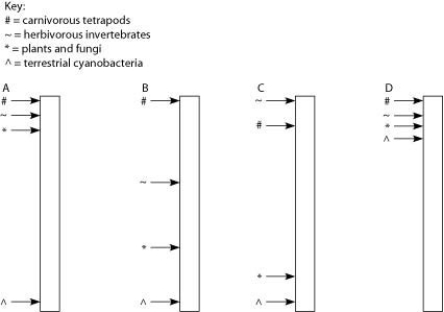 If arrows indicate locations in the column where fossils of a particular type (see key) first appear, then which core in the figure above has the most accurate arrangement of fossils?
 (Multiple Choice)
4.8/5 (79)
(79) Which factor most likely caused animals and plants in India to differ greatly from species in nearby south-east Asia?
(Multiple Choice)
4.9/5 (80)
(80) The duplication of homeotic (Hox) genes has been significant in the evolution of animals because it ________.
(Multiple Choice)
4.9/5 (84)
(84) Endosymbiosis is an evolutionary theory that explains the origin of eukaryotes and suggests a specific order in which this might have occurred. Ancestral cells engulfed and then began to use the metabolic processes of the smaller cells. Based on shared-core processes and features, which statement most accurately describes the order, the theory, and the evolutionary implications for all organisms within domain Eukarya?
(Multiple Choice)
5.0/5 (70)
(70) Which of the following showed their greatest diversity during the Mesozoic era but were a small, less diverse group during the Paleozoic era?
(Multiple Choice)
4.8/5 (84)
(84) A swim bladder is a gas-filled sac that helps fish maintain buoyancy. The evolution of the swim bladder from lungs of an ancestral fish is an example of ________.
(Multiple Choice)
4.9/5 (75)
(75) A sediment core is removed from the floor of an inland sea. The sea has been in existence, off and on, throughout the entire time that terrestrial life has existed. Researchers wish to locate and study the terrestrial organisms fossilised in this core. The core is illustrated as a vertical column, with the top of the column representing the most recent strata and the bottom representing the time when land was first colonised by life. 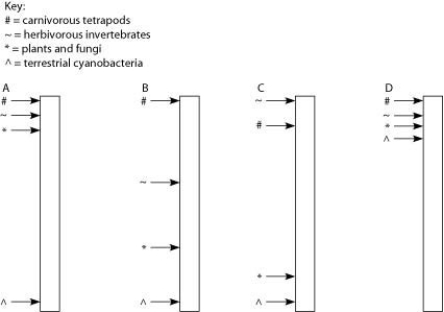 To assign absolute dates to fossils in this sediment core, it would be most helpful if ________.
 (Multiple Choice)
4.8/5 (71)
(71) The Permian period ended and then rapid speciation occurred as new animal and plant forms evolved. The most likely explanation for this is ________.
I. adaptive radiation
II. ecological opportunity
III. lack of competition
IV. morphological innovation
(Multiple Choice)
4.8/5 (85)
(85) 
Filters
- Essay(0)
- Multiple Choice(0)
- Short Answer(0)
- True False(0)
- Matching(0)