



 Chat with AI
Exam 40: Basic Principles of Animal Form and Function

Exam 1: Evolution, the Themes of Biology, and Scientific Inquiry51 Questions
Exam 2: The Chemical Context of Life61 Questions
Exam 3: Water and Life55 Questions
Exam 4: Carbon and the Molecular Diversity of Life58 Questions
Exam 5: The Structure and Function of Large Biological Molecules70 Questions
Exam 6: A Tour of the Cell66 Questions
Exam 7: Membrane Structure and Function68 Questions
Exam 8: An Introduction to Metabolism67 Questions
Exam 9: Cellular Respiration and Fermentation68 Questions
Exam 10: Photosynthesis65 Questions
Exam 11: Cell Communication65 Questions
Exam 12: The Cell Cycle66 Questions
Exam 13: Meiosis and Sexual Life Cycles64 Questions
Exam 14: Mendel and the Gene Idea62 Questions
Exam 15: The Chromosomal Basis of Inheritance58 Questions
Exam 16: The Molecular Basis of Inheritance65 Questions
Exam 17: Gene Expression: From Gene to Protein67 Questions
Exam 18: Regulation of Gene Expression66 Questions
Exam 19: Viruses54 Questions
Exam 20: Dna Tools and Biotechnology57 Questions
Exam 21: Genomes and Their Evolution44 Questions
Exam 22: Descent With Modification: a Darwinian View of Life60 Questions
Exam 23: The Evolution of Populations64 Questions
Exam 24: The Origin of Species67 Questions
Exam 25: The History of Life on Earth59 Questions
Exam 26: Phylogeny and the Tree of Life75 Questions
Exam 27: Bacteria and Archaea75 Questions
Exam 28: Protists79 Questions
Exam 29: Plant Diversity I: How Plants Colonised Land82 Questions
Exam 30: Plant Diversity Ii: the Evolution of Seed Plants80 Questions
Exam 31: Fungi70 Questions
Exam 32: An Overview of Animal Diversity67 Questions
Exam 33: An Introduction to Invertebrates83 Questions
Exam 34: The Origin and Evolution of Vertebrates82 Questions
Exam 35: Vascular Plant Structure, Growth, and Development65 Questions
Exam 36: Resource Acquisition and Transport in Vascular Plants74 Questions
Exam 37: Soil and Plant Nutrition52 Questions
Exam 38: Angiosperm Reproduction and Biotechnology60 Questions
Exam 39: Plant Responses to Internal and External Signals61 Questions
Exam 40: Basic Principles of Animal Form and Function68 Questions
Exam 41: Animal Nutrition64 Questions
Exam 42: Circulation and Gas Exchange67 Questions
Exam 43: The Immune System69 Questions
Exam 44: Osmoregulation and Excretion64 Questions
Exam 45: Hormones and the Endocrine System66 Questions
Exam 46: Animal Reproduction68 Questions
Exam 47: Animal Development70 Questions
Exam 48: Neurons, Synapses, and Signalling68 Questions
Exam 49: Nervous Systems65 Questions
Exam 50: Sensory and Motor Mechanisms67 Questions
Select questions type


Hummingbirds are small birds that require a regular food supply. When hummingbirds are faced with a situation that decreases their food supply, such as a storm, which of the following adaptations would be most useful for the bird to survive such an unpredictable and short-term absence of food resources?
(Multiple Choice)
4.8/5  (74)
(74) You are studying a large tropical reptile that has a high and relatively stable body temperature. How do you determine whether this animal is an endotherm or an ectotherm?
(Multiple Choice)
4.8/5 (83)
(83) Much of the coordination of vertebrate body functions via chemical signals is accomplished by the ________.
(Multiple Choice)
4.7/5 (77)
(77) Both the endocrine and nervous systems transmit information around an animal's body. Which of the following is a characteristic of nervous system signals?
(Multiple Choice)
4.9/5 (81)
(81) Which of the following is a true statement about body size and physiology?
(Multiple Choice)
5.0/5 (87)
(87) 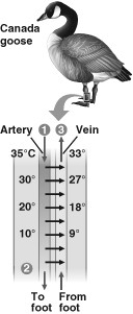 - The countercurrent arrangement of blood vessels is an adaptation that allows the goose to ________.
 (Multiple Choice)
4.9/5 (77)
(77) The temperature-regulating centre of vertebrate animals is located in the ________.
(Multiple Choice)
4.8/5 (75)
(75) An example of an ectothermic organism that has few or no behavioural options when it comes to its ability to adjust its body temperature is a ________.
(Multiple Choice)
4.8/5 (68)
(68) Standard metabolic rate (SMR) and basal metabolic rate (BMR) are ________.
(Multiple Choice)
4.8/5 (79)
(79) Which of the following would increase the rate of heat exchange between an animal and its environment?
(Multiple Choice)
4.7/5 (82)
(82) You are studying a large tropical reptile that has a high and relatively stable body temperature. How would you determine whether this animal is an endotherm or an ectotherm?
(Multiple Choice)
4.8/5 (91)
(91) You discover a new species of bacteria that grows in aquatic environments with high salt levels. While studying these bacteria, you note that their internal environment is similar to the salt concentrations in their surroundings. You also discover that the internal salt concentrations of the bacteria change as the salt concentration in their environment changes. The new species can tolerate small changes in this way, but dies from large changes because it has no mechanism for altering its own internal salt levels. What type of homeostatic mechanism is this species using to regulate its internal salt levels?
(Multiple Choice)
4.7/5 (78)
(78) In a cool environment, an ectotherm is more likely to survive an extended period of food deprivation than would an equally sized endotherm because the ectotherm ________.
(Multiple Choice)
4.8/5 (77)
(77) An animal's inputs of energy and materials would exceed its outputs
(Multiple Choice)
5.0/5 (70)
(70) Chum salmon (Oncorhynchus keta) are born in freshwater environments and then migrate to the sea. Near the end of their lives, they return to the freshwater stream where they were born to spawn. In fresh water, water constantly diffuses into the body and ions are lost from the body. In salt water, body water diffuses out of the body and excess ions are gained from the water. A salmon's gills have special cells to pump salt in or out of the body to maintain homeostasis. In response to the salmon's moves between fresh water and salt water, some cells in the gills are produced and others are destroyed. These changes made in the cells of the gills during the lifetime of an individual salmon are an example of which of the following?
(Multiple Choice)
4.9/5 (81)
(81) An elephant and a mouse are running in full sunlight, and both overheat by the same amount above their normal body temperatures. When they move into the shade and rest, which animal will cool down faster?
(Multiple Choice)
4.8/5 (71)
(71) Consider the energy budgets for a human, an elephant, a penguin, a mouse, and a snake. The ________ would have the highest total annual energy expenditure, and the ________ would have the highest energy expenditure per unit mass.
(Multiple Choice)
4.7/5 (81)
(81) You have a cube of modelling clay in your hands. Which of the following changes to the shape of this cube of clay will decrease its surface area relative to its volume?
(Multiple Choice)
4.8/5 (76)
(76) The panting responses observed in overheated birds and mammals dissipate excess heat by ________.
(Multiple Choice)
4.8/5 (80)
(80) The metabolic rate of an animal is most accurately determined by ________.
(Multiple Choice)
4.7/5 (76)
(76) 
Filters
- Essay(0)
- Multiple Choice(0)
- Short Answer(0)
- True False(0)
- Matching(0)