



 Chat with AI
Exam 43: The Immune System

Exam 1: Evolution, the Themes of Biology, and Scientific Inquiry51 Questions
Exam 2: The Chemical Context of Life61 Questions
Exam 3: Water and Life55 Questions
Exam 4: Carbon and the Molecular Diversity of Life58 Questions
Exam 5: The Structure and Function of Large Biological Molecules70 Questions
Exam 6: A Tour of the Cell66 Questions
Exam 7: Membrane Structure and Function68 Questions
Exam 8: An Introduction to Metabolism67 Questions
Exam 9: Cellular Respiration and Fermentation68 Questions
Exam 10: Photosynthesis65 Questions
Exam 11: Cell Communication65 Questions
Exam 12: The Cell Cycle66 Questions
Exam 13: Meiosis and Sexual Life Cycles64 Questions
Exam 14: Mendel and the Gene Idea62 Questions
Exam 15: The Chromosomal Basis of Inheritance58 Questions
Exam 16: The Molecular Basis of Inheritance65 Questions
Exam 17: Gene Expression: From Gene to Protein67 Questions
Exam 18: Regulation of Gene Expression66 Questions
Exam 19: Viruses54 Questions
Exam 20: Dna Tools and Biotechnology57 Questions
Exam 21: Genomes and Their Evolution44 Questions
Exam 22: Descent With Modification: a Darwinian View of Life60 Questions
Exam 23: The Evolution of Populations64 Questions
Exam 24: The Origin of Species67 Questions
Exam 25: The History of Life on Earth59 Questions
Exam 26: Phylogeny and the Tree of Life75 Questions
Exam 27: Bacteria and Archaea75 Questions
Exam 28: Protists79 Questions
Exam 29: Plant Diversity I: How Plants Colonised Land82 Questions
Exam 30: Plant Diversity Ii: the Evolution of Seed Plants80 Questions
Exam 31: Fungi70 Questions
Exam 32: An Overview of Animal Diversity67 Questions
Exam 33: An Introduction to Invertebrates83 Questions
Exam 34: The Origin and Evolution of Vertebrates82 Questions
Exam 35: Vascular Plant Structure, Growth, and Development65 Questions
Exam 36: Resource Acquisition and Transport in Vascular Plants74 Questions
Exam 37: Soil and Plant Nutrition52 Questions
Exam 38: Angiosperm Reproduction and Biotechnology60 Questions
Exam 39: Plant Responses to Internal and External Signals61 Questions
Exam 40: Basic Principles of Animal Form and Function68 Questions
Exam 41: Animal Nutrition64 Questions
Exam 42: Circulation and Gas Exchange67 Questions
Exam 43: The Immune System69 Questions
Exam 44: Osmoregulation and Excretion64 Questions
Exam 45: Hormones and the Endocrine System66 Questions
Exam 46: Animal Reproduction68 Questions
Exam 47: Animal Development70 Questions
Exam 48: Neurons, Synapses, and Signalling68 Questions
Exam 49: Nervous Systems65 Questions
Exam 50: Sensory and Motor Mechanisms67 Questions
Select questions type


Mutant fruit flies that make only one antimicrobial peptide were tested for survival after infection with Neurospora crassa fungi or with Micrococcus luteus bacteria. 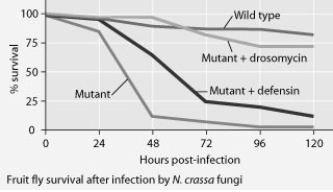
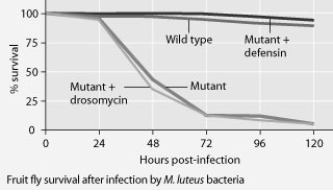 The results shown in the graphs support the hypothesis that ________.
 (Multiple Choice)
4.8/5  (75)
(75) A patient complaining of watery, itchy eyes and sneezing after being given a flower bouquet as a birthday gift should first be treated with ________.
(Multiple Choice)
4.9/5 (89)
(89) Which of the following statements about epitopes are correct?
I. B cell receptors bind to epitopes.
II. T cell receptors bind to epitopes.
III. There can be 10 or more different epitopes on each antigen.
IV. There is a one-to-one correspondence between antigen and epitope.
(Multiple Choice)
5.0/5 (70)
(70) Within a differentiated B cell, the rearrangement of DNA sequences between variable regions and joining regions is accomplished by a(n)________.
(Multiple Choice)
4.8/5 (86)
(86) Clonal selection and differentiation of B cells activated by antigen exposure leads to the production of ________.
(Multiple Choice)
4.9/5 (86)
(86) An immunoglobulin (Ig) molecule, of any class, with regions symbolised as C or V, H or L, has a light chain made up of ________.
(Multiple Choice)
4.8/5 (74)
(74) A nonfunctional CD4 protein on a helper T cell would result in the helper T cell being unable to ________.
(Multiple Choice)
4.7/5 (75)
(75) B cells interacting with helper T cells are stimulated to differentiate when ________.
(Multiple Choice)
4.9/5 (84)
(84) Septic shock, a systemic response including high fever and low blood pressure, is a response to ________.
(Multiple Choice)
4.8/5 (83)
(83) An immune response to a tissue graft will differ from an immune response to a bacterium because ________.
(Multiple Choice)
4.8/5 (72)
(72) Which of the following components of the immune system destroys cancerous cells by punching holes in plasma membranes and triggering apoptosis?
(Multiple Choice)
4.7/5 (78)
(78) Which of the following should be the same in identical twins?
(Multiple Choice)
4.9/5 (74)
(74) Mucus occurs in both the respiratory and digestive tracts. What is its main immunological function?
(Multiple Choice)
4.8/5 (64)
(64) In a humoral or antibody-mediated immune response, specific B cells are stimulated by helper T cells to transform into plasma cells that secrete antibodies. What would be an important feature added to the plasma cells during this transition process that allows them to better perform their function?
(Multiple Choice)
4.9/5 (82)
(82) Which of the following statements are fundamental to the clonal selection theory of how the adaptive immune system functions?
I. Each lymphocyte has a unique membrane receptor that recognises one antigen.
II. When the lymphocyte binds an antigen, it is activated and begins dividing to form many identical copies of itself.
III. Cloned lymphocytes have slight differences and are selected by the spleen for removal if they do not bind an antigen.
IV. Cloned cells descend from an activated lymphocyte and persist even after the pathogen is eliminated.
(Multiple Choice)
4.8/5 (78)
(78) What major advantage is conveyed by having a system of adaptive immunity?
(Multiple Choice)
4.9/5 (73)
(73) Bacteria entering the body through a small cut in the skin ________.
(Multiple Choice)
4.9/5 (91)
(91) An individual who has been bitten by a poisonous snake that has a fast-acting toxin would likely benefit from ________.
(Multiple Choice)
4.9/5 (82)
(82) 
Filters
- Essay(0)
- Multiple Choice(0)
- Short Answer(0)
- True False(0)
- Matching(0)