



 Chat with AI
Exam 45: Hormones and the Endocrine System

Exam 1: Evolution, the Themes of Biology, and Scientific Inquiry51 Questions
Exam 2: The Chemical Context of Life61 Questions
Exam 3: Water and Life55 Questions
Exam 4: Carbon and the Molecular Diversity of Life58 Questions
Exam 5: The Structure and Function of Large Biological Molecules70 Questions
Exam 6: A Tour of the Cell66 Questions
Exam 7: Membrane Structure and Function68 Questions
Exam 8: An Introduction to Metabolism67 Questions
Exam 9: Cellular Respiration and Fermentation68 Questions
Exam 10: Photosynthesis65 Questions
Exam 11: Cell Communication65 Questions
Exam 12: The Cell Cycle66 Questions
Exam 13: Meiosis and Sexual Life Cycles64 Questions
Exam 14: Mendel and the Gene Idea62 Questions
Exam 15: The Chromosomal Basis of Inheritance58 Questions
Exam 16: The Molecular Basis of Inheritance65 Questions
Exam 17: Gene Expression: From Gene to Protein67 Questions
Exam 18: Regulation of Gene Expression66 Questions
Exam 19: Viruses54 Questions
Exam 20: Dna Tools and Biotechnology57 Questions
Exam 21: Genomes and Their Evolution44 Questions
Exam 22: Descent With Modification: a Darwinian View of Life60 Questions
Exam 23: The Evolution of Populations64 Questions
Exam 24: The Origin of Species67 Questions
Exam 25: The History of Life on Earth59 Questions
Exam 26: Phylogeny and the Tree of Life75 Questions
Exam 27: Bacteria and Archaea75 Questions
Exam 28: Protists79 Questions
Exam 29: Plant Diversity I: How Plants Colonised Land82 Questions
Exam 30: Plant Diversity Ii: the Evolution of Seed Plants80 Questions
Exam 31: Fungi70 Questions
Exam 32: An Overview of Animal Diversity67 Questions
Exam 33: An Introduction to Invertebrates83 Questions
Exam 34: The Origin and Evolution of Vertebrates82 Questions
Exam 35: Vascular Plant Structure, Growth, and Development65 Questions
Exam 36: Resource Acquisition and Transport in Vascular Plants74 Questions
Exam 37: Soil and Plant Nutrition52 Questions
Exam 38: Angiosperm Reproduction and Biotechnology60 Questions
Exam 39: Plant Responses to Internal and External Signals61 Questions
Exam 40: Basic Principles of Animal Form and Function68 Questions
Exam 41: Animal Nutrition64 Questions
Exam 42: Circulation and Gas Exchange67 Questions
Exam 43: The Immune System69 Questions
Exam 44: Osmoregulation and Excretion64 Questions
Exam 45: Hormones and the Endocrine System66 Questions
Exam 46: Animal Reproduction68 Questions
Exam 47: Animal Development70 Questions
Exam 48: Neurons, Synapses, and Signalling68 Questions
Exam 49: Nervous Systems65 Questions
Exam 50: Sensory and Motor Mechanisms67 Questions
Select questions type


Testosterone is an example of a chemical signal that affects the very cells that synthesise it, the neighbouring cells in the testis, along with distant cells outside the gonads. Thus, testosterone is an example of ________.
I. an autocrine signal
II. a paracrine signal
III. an endocrine signal
(Multiple Choice)
5.0/5  (79)
(79) Which of the following are properties of steroid hormones?
I. Steroid hormones are lipid-soluble and easily cross the phospholipid bilayer.
II. Steroid hormones usually exert their effects on target cells through membrane receptor proteins.
III. Steroid hormones act on cells close to where they were produced.
IV. Steroid hormones regulate gene transcription by binding to intracellular receptor proteins.
(Multiple Choice)
4.8/5 (75)
(75) Removing which of the following glands would have the most wide-reaching effect on bodily functions of an adult human?
(Multiple Choice)
4.9/5 (75)
(75) 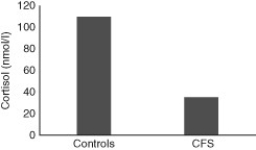 People who suffer from chronic fatigue syndrome (CFS) experience ongoing, debilitating fatigue. In one study, cortisol levels in the saliva during the first hour after waking were measured and compared between CFS patients and people without CFS (controls). The data is summarised in the graph. What can you infer from the data?
 (Multiple Choice)
4.8/5 (85)
(85) The steroid hormone that coordinates moulting in arthropods is ________.
(Multiple Choice)
4.8/5 (80)
(80) The relationship between the insect hormones ecdysteroid and PTTH is an example of
(Multiple Choice)
4.8/5 (97)
(97) Prostaglandins are local regulators whose chemical structure is derived from ________.
(Multiple Choice)
4.9/5 (71)
(71) During mammalian labour and delivery, the contraction of uterine muscles is enhanced by oxytocin. This is an example of ________.
(Multiple Choice)
4.9/5 (87)
(87) People experiencing chronic stress may be more likely to become sick because ________.
(Multiple Choice)
4.9/5 (72)
(72) You are dissecting a fish in your biology laboratory section. Your teaching assistant points out a long oval structure and tells you it is an endocrine gland. Which of the following would you then know is a true statement about this structure?
(Multiple Choice)
4.8/5 (87)
(87) Which of the following has both endocrine and exocrine activity?
(Multiple Choice)
4.9/5 (69)
(69) If a biochemist discovers a new molecule, which of the following pieces of data would allow her to draw the conclusion that the molecule is a steroid hormone?
I. The molecule is lipid-soluble.
II. The molecule is derived from a series of steps beginning with cholesterol.
III. The molecule acts at a target tissue some distance from where it is produced.
IV. The molecule uses a transport protein when in an aqueous solution such as blood.
(Multiple Choice)
4.9/5 (74)
(74) Analysis of a blood sample from a fasting individual who had not eaten for 24 hours would be expected to reveal high levels of ________.
(Multiple Choice)
4.9/5 (84)
(84) If a portion of the pancreas is surgically removed from a rat and the rat subsequently loses its appetite, one explanation is that the removed portion contains cells that secrete a chemical signal that somehow stimulates appetite. Given this scenario, what type of chemical signalling is occurring?
(Multiple Choice)
4.8/5 (72)
(72) A cluster of tumour cells that produces and secretes growth factors to induce surrounding cells to grow and divide is showing which type of cell-to-cell signalling?
(Multiple Choice)
4.8/5 (82)
(82) When a steroid hormone and a polypeptide hormone exert similar effects on a population of target cells, then ________.
(Multiple Choice)
5.0/5 (84)
(84) 
Filters
- Essay(0)
- Multiple Choice(0)
- Short Answer(0)
- True False(0)
- Matching(0)