



 Chat with AI
Exam 33: Deuterostome Animals

Exam 1: Studying Life 97 Questions
Exam 2: Small Molecules and the Chemistry of Life145 Questions
Exam 3: Proteins, Carbohydrates, and Lipids145 Questions
Exam 4: Nucleic Acids and the Origin of Life117 Questions
Exam 5: Cells: the Working Units of Life153 Questions
Exam 6: Cell Membranes136 Questions
Exam 7: Cell Signaling and Communication150 Questions
Exam 8: Energy, Enzymes, and Metabolism153 Questions
Exam 9: Pathways That Harvest Chemical Energy154 Questions
Exam 10: Photosynthesis: Energy From Sunlight158 Questions
Exam 11: The Cell Cycle and Cell Division176 Questions
Exam 12: Inheritance, Genes, and Chromosomes150 Questions
Exam 13: Dna and Its Role in Heredity155 Questions
Exam 14: From Dna to Protein: Gene Expression151 Questions
Exam 15: Gene Mutation and Molecular Medicine141 Questions
Exam 16: Regulation of Gene Expression151 Questions
Exam 17: Genomes145 Questions
Exam 18: Recombinent Dna and Biotechnology141 Questions
Exam 19: Differential Gene Expression in Development147 Questions
Exam 20: Development and Evolutionary Change120 Questions
Exam 21: Evidence and Mechanisms of Evolution151 Questions
Exam 22: Reconstructing and Using Phylogenies137 Questions
Exam 23: Species and Their Formation140 Questions
Exam 24: Evolution of Genes and Genomes141 Questions
Exam 25: The History of Life on Earth145 Questions
Exam 26: Bacteria and Archaea: the Prokaryotic Domains156 Questions
Exam 27: The Origin and Diversification of Eukaryotes148 Questions
Exam 28: Plants Without Seeds: From Water to Land144 Questions
Exam 29: The Evolution of Seed Plants141 Questions
Exam 30: Fungi: Recyclers, Pathogens, Parasites, and Plant Partners144 Questions
Exam 31: Animal Origins and the Evolution of Body Plans122 Questions
Exam 32: Protostome Animals146 Questions
Exam 33: Deuterostome Animals150 Questions
Exam 34: The Plant Body132 Questions
Exam 35: Transport in Plants133 Questions
Exam 36: Plant Nutrition134 Questions
Exam 37: Regulation of Plant Growth137 Questions
Exam 38: Reproduction in Flowering Plants140 Questions
Exam 39: Plant Responses to Environmental Challenges131 Questions
Exam 40: Physiology, Homeostasis, and Temperature Regulation146 Questions
Exam 41: Animal Hormones147 Questions
Exam 42: Immunology: Animal Defense Systems150 Questions
Exam 43: Animal Reproduction150 Questions
Exam 44: Animal Development147 Questions
Exam 45: Neurons and Nervous Systems145 Questions
Exam 46: Sensory Systems150 Questions
Exam 47: The Mammalian Nervous System: Structure and Higher Function150 Questions
Exam 48: Musculoskeletal Systems150 Questions
Exam 49: Gas Exchange in Animals149 Questions
Exam 50: Circulatory Systems150 Questions
Exam 51: Nutrition, Digestion, and Absorption149 Questions
Exam 52: Salt and Water Balance and Nitrogen145 Questions
Exam 53: Animal Behavior149 Questions
Exam 54: Ecology and the Distribution of Life150 Questions
Exam 55: Population Ecology123 Questions
Exam 56: Species Interaction and Coevolution131 Questions
Exam 57: Community Ecology133 Questions
Exam 58: Ecosystems and Global Ecology142 Questions
Exam 59: Conservation Biology116 Questions
Select questions type


Which of the following statements about protostome and deuterostome evolution is false?
(Multiple Choice)
4.8/5  (66)
(66) Which of the following is not one of the traits shared by birds and the theropods from which they are thought to have emerged?
(Multiple Choice)
4.9/5 (84)
(84) Which of the following was not a change that accompanied the transition from the australopithecines to Homo habilis?
(Multiple Choice)
4.8/5 (75)
(75) Use the following to answer questions:
Refer to the diagram below. 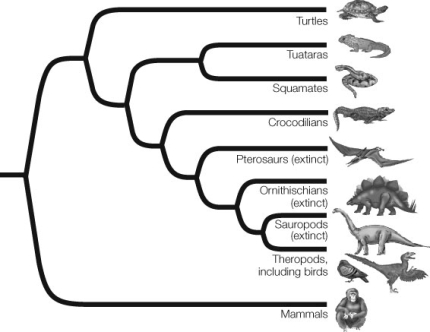 -List all of the groups included in the archosaurs, dinosaurs, lepidosaurs, and reptiles.
 (Short Answer)
4.9/5 (75)
(75) When a starfish, a type of echinoderm, is resting on the seafloor, its _______ face(s) the seafloor, whereas the ______ is on the upper surface of the animal.
(Multiple Choice)
4.8/5 (76)
(76) Use the following to answer questions:
Match the correct group of organisms from the list below with the evolutionary innovations specified in the questions that follow.
-Swim bladders
A) Reptiles
B) Birds
C) Ray-finned fishes
D) Chondrichthyans
E) Echinoderms
(Short Answer)
4.7/5 (73)
(73) The hominids-the evolutionary lineage that led to humans-separated from the other ape lineages about _______ million years ago in Africa.
(Multiple Choice)
4.7/5 (86)
(86) The chondrichthyans, including sharks, skates, and rays, and chimaeras,
(Multiple Choice)
4.8/5 (75)
(75) Which of the following is a major difference between the chondrichthyans and the ray-finned fishes?
(Multiple Choice)
4.9/5 (71)
(71) Which of the following vertebrate groups is a living representative of the dinosaur lineage?
(Multiple Choice)
4.7/5 (74)
(74) The brain of Homo sapiens reached its modern size approximately _______ years ago.
(Multiple Choice)
4.7/5 (86)
(86) Living deuterostomes comprise three clades, the echinoderms, the chordates, and the
(Multiple Choice)
4.9/5 (80)
(80) The evolution of a hinged jaw resulted in an extensive radiation of the fishes into the many modern jawed forms. What was the main advantage and significance of hinged jaws in this radiation?
(Essay)
4.9/5 (84)
(84) During the Devonian, the partly terrestrial _______ arose from an ancestor they shared with lungfishes.
(Short Answer)
4.8/5 (88)
(88) Which of the following represents the probable order in which human ancestors made their appearance?
(Multiple Choice)
4.8/5 (80)
(80) _______ are bilaterally symmetrical animals that possess a dorsal hollow nerve cord, a tail that extends beyond the anus, and a notochord at some stage of their life cycle.
(Short Answer)
4.8/5 (78)
(78) Which of the following statements relating to archosaurs is false?
(Multiple Choice)
4.9/5 (88)
(88) 
Filters
- Essay(0)
- Multiple Choice(0)
- Short Answer(0)
- True False(0)
- Matching(0)