



 Chat with AI
Exam 41: Animal Hormones

Exam 1: Studying Life 97 Questions
Exam 2: Small Molecules and the Chemistry of Life145 Questions
Exam 3: Proteins, Carbohydrates, and Lipids145 Questions
Exam 4: Nucleic Acids and the Origin of Life117 Questions
Exam 5: Cells: the Working Units of Life153 Questions
Exam 6: Cell Membranes136 Questions
Exam 7: Cell Signaling and Communication150 Questions
Exam 8: Energy, Enzymes, and Metabolism153 Questions
Exam 9: Pathways That Harvest Chemical Energy154 Questions
Exam 10: Photosynthesis: Energy From Sunlight158 Questions
Exam 11: The Cell Cycle and Cell Division176 Questions
Exam 12: Inheritance, Genes, and Chromosomes150 Questions
Exam 13: Dna and Its Role in Heredity155 Questions
Exam 14: From Dna to Protein: Gene Expression151 Questions
Exam 15: Gene Mutation and Molecular Medicine141 Questions
Exam 16: Regulation of Gene Expression151 Questions
Exam 17: Genomes145 Questions
Exam 18: Recombinent Dna and Biotechnology141 Questions
Exam 19: Differential Gene Expression in Development147 Questions
Exam 20: Development and Evolutionary Change120 Questions
Exam 21: Evidence and Mechanisms of Evolution151 Questions
Exam 22: Reconstructing and Using Phylogenies137 Questions
Exam 23: Species and Their Formation140 Questions
Exam 24: Evolution of Genes and Genomes141 Questions
Exam 25: The History of Life on Earth145 Questions
Exam 26: Bacteria and Archaea: the Prokaryotic Domains156 Questions
Exam 27: The Origin and Diversification of Eukaryotes148 Questions
Exam 28: Plants Without Seeds: From Water to Land144 Questions
Exam 29: The Evolution of Seed Plants141 Questions
Exam 30: Fungi: Recyclers, Pathogens, Parasites, and Plant Partners144 Questions
Exam 31: Animal Origins and the Evolution of Body Plans122 Questions
Exam 32: Protostome Animals146 Questions
Exam 33: Deuterostome Animals150 Questions
Exam 34: The Plant Body132 Questions
Exam 35: Transport in Plants133 Questions
Exam 36: Plant Nutrition134 Questions
Exam 37: Regulation of Plant Growth137 Questions
Exam 38: Reproduction in Flowering Plants140 Questions
Exam 39: Plant Responses to Environmental Challenges131 Questions
Exam 40: Physiology, Homeostasis, and Temperature Regulation146 Questions
Exam 41: Animal Hormones147 Questions
Exam 42: Immunology: Animal Defense Systems150 Questions
Exam 43: Animal Reproduction150 Questions
Exam 44: Animal Development147 Questions
Exam 45: Neurons and Nervous Systems145 Questions
Exam 46: Sensory Systems150 Questions
Exam 47: The Mammalian Nervous System: Structure and Higher Function150 Questions
Exam 48: Musculoskeletal Systems150 Questions
Exam 49: Gas Exchange in Animals149 Questions
Exam 50: Circulatory Systems150 Questions
Exam 51: Nutrition, Digestion, and Absorption149 Questions
Exam 52: Salt and Water Balance and Nitrogen145 Questions
Exam 53: Animal Behavior149 Questions
Exam 54: Ecology and the Distribution of Life150 Questions
Exam 55: Population Ecology123 Questions
Exam 56: Species Interaction and Coevolution131 Questions
Exam 57: Community Ecology133 Questions
Exam 58: Ecosystems and Global Ecology142 Questions
Exam 59: Conservation Biology116 Questions
Select questions type


If a person had a tumor that caused over-secretion of the posterior pituitary hormones, which of the following hormones would you expect to see at elevated levels?
(Multiple Choice)
4.7/5  (81)
(81) Which of the following statements about hormones, hormone-producing cells, and target cells is false?
(Multiple Choice)
4.8/5 (93)
(93) Use the following to answer questions:
Refer to the diagram below. 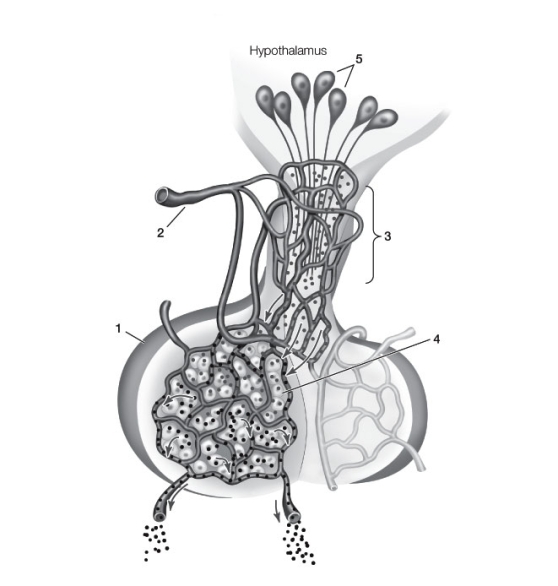 -Which of the following labels is not correct?
 (Multiple Choice)
5.0/5 (77)
(77) A lobed gland located around the front of the windpipe is called the _______.
(Short Answer)
4.9/5 (88)
(88) Which of the following glands is controlled by thyrotropin and secretes thyroxine?
(Multiple Choice)
4.8/5 (72)
(72) Which of the following is not secreted by the adrenal cortex?
(Multiple Choice)
4.7/5 (86)
(86) The pituitary hormone that stimulates the production of milk is _______.
(Short Answer)
4.9/5 (84)
(84) Which of the following glands has one part that develops from the embryonic mouth cavity and a second part that develops from the floor of the developing brain?
(Multiple Choice)
4.8/5 (81)
(81) Which of the following glands produces epinephrine and norepinephrine?
(Multiple Choice)
4.9/5 (84)
(84) Why would breast-feeding an infant soon after birth help a mother's uterus return to its prepregnancy size?
(Essay)
4.7/5 (75)
(75) Malfunctioning of the thyroid gland in the human adult can result in
(Multiple Choice)
4.8/5 (85)
(85) Use the following to answer questions:
Match the description of a gland, target organ, function, or action specified in the questions that follow with the correct hormone from the list below.
-Secreted by the pineal gland
(Multiple Choice)
4.9/5 (79)
(79) Refer to the diagram below. Which of the following events in the secretion of thyroxine is paired correctly with the location in the thyroid gland where it occurs? 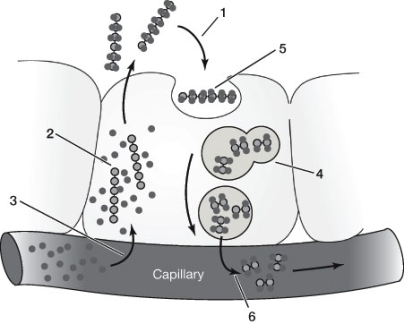
(Multiple Choice)
4.9/5 (90)
(90) Protein hormones do not cross the cell membrane, but _______ hormones do.
(Short Answer)
4.8/5 (82)
(82) In an emergency, the adrenal glands produce _______ within seconds. Within minutes, these glands then produce _______ for prolonged response to stress.
(Short Answer)
4.8/5 (77)
(77) 
Filters
- Essay(0)
- Multiple Choice(0)
- Short Answer(0)
- True False(0)
- Matching(0)