



 Chat with AI
Exam 54: Ecology and the Distribution of Life

Exam 1: Studying Life 97 Questions
Exam 2: Small Molecules and the Chemistry of Life145 Questions
Exam 3: Proteins, Carbohydrates, and Lipids145 Questions
Exam 4: Nucleic Acids and the Origin of Life117 Questions
Exam 5: Cells: the Working Units of Life153 Questions
Exam 6: Cell Membranes136 Questions
Exam 7: Cell Signaling and Communication150 Questions
Exam 8: Energy, Enzymes, and Metabolism153 Questions
Exam 9: Pathways That Harvest Chemical Energy154 Questions
Exam 10: Photosynthesis: Energy From Sunlight158 Questions
Exam 11: The Cell Cycle and Cell Division176 Questions
Exam 12: Inheritance, Genes, and Chromosomes150 Questions
Exam 13: Dna and Its Role in Heredity155 Questions
Exam 14: From Dna to Protein: Gene Expression151 Questions
Exam 15: Gene Mutation and Molecular Medicine141 Questions
Exam 16: Regulation of Gene Expression151 Questions
Exam 17: Genomes145 Questions
Exam 18: Recombinent Dna and Biotechnology141 Questions
Exam 19: Differential Gene Expression in Development147 Questions
Exam 20: Development and Evolutionary Change120 Questions
Exam 21: Evidence and Mechanisms of Evolution151 Questions
Exam 22: Reconstructing and Using Phylogenies137 Questions
Exam 23: Species and Their Formation140 Questions
Exam 24: Evolution of Genes and Genomes141 Questions
Exam 25: The History of Life on Earth145 Questions
Exam 26: Bacteria and Archaea: the Prokaryotic Domains156 Questions
Exam 27: The Origin and Diversification of Eukaryotes148 Questions
Exam 28: Plants Without Seeds: From Water to Land144 Questions
Exam 29: The Evolution of Seed Plants141 Questions
Exam 30: Fungi: Recyclers, Pathogens, Parasites, and Plant Partners144 Questions
Exam 31: Animal Origins and the Evolution of Body Plans122 Questions
Exam 32: Protostome Animals146 Questions
Exam 33: Deuterostome Animals150 Questions
Exam 34: The Plant Body132 Questions
Exam 35: Transport in Plants133 Questions
Exam 36: Plant Nutrition134 Questions
Exam 37: Regulation of Plant Growth137 Questions
Exam 38: Reproduction in Flowering Plants140 Questions
Exam 39: Plant Responses to Environmental Challenges131 Questions
Exam 40: Physiology, Homeostasis, and Temperature Regulation146 Questions
Exam 41: Animal Hormones147 Questions
Exam 42: Immunology: Animal Defense Systems150 Questions
Exam 43: Animal Reproduction150 Questions
Exam 44: Animal Development147 Questions
Exam 45: Neurons and Nervous Systems145 Questions
Exam 46: Sensory Systems150 Questions
Exam 47: The Mammalian Nervous System: Structure and Higher Function150 Questions
Exam 48: Musculoskeletal Systems150 Questions
Exam 49: Gas Exchange in Animals149 Questions
Exam 50: Circulatory Systems150 Questions
Exam 51: Nutrition, Digestion, and Absorption149 Questions
Exam 52: Salt and Water Balance and Nitrogen145 Questions
Exam 53: Animal Behavior149 Questions
Exam 54: Ecology and the Distribution of Life150 Questions
Exam 55: Population Ecology123 Questions
Exam 56: Species Interaction and Coevolution131 Questions
Exam 57: Community Ecology133 Questions
Exam 58: Ecosystems and Global Ecology142 Questions
Exam 59: Conservation Biology116 Questions
Select questions type


Wet and warm most of the year, the _______ is the biome with the highest overall species richness.
(Short Answer)
4.9/5  (74)
(74) The long-term average atmospheric conditions of a region is referred to as its
(Multiple Choice)
4.7/5 (91)
(91) A(n) _______ is a terrestrial environment defined by the growth forms of its plants.
(Multiple Choice)
4.9/5 (80)
(80) By replacing the names of the taxa on a phylogenetic tree with the regions in which those taxa live, biogeographers can transform the tree into _______.
(Short Answer)
4.7/5 (83)
(83) The latitude of Washington, D.C., is 39°N. The latitude of Boston, Massachusetts, is 42°N. If the only difference in their temperature regimes is connected to their latitude difference, about how much warmer should Washington, D.C. be compared to Boston?
(Multiple Choice)
4.9/5 (78)
(78) In which of the following groups is species richness high in cold deserts?
(Multiple Choice)
4.9/5 (78)
(78) Which of the following is not a characteristic of tropical alpine tundra?
(Multiple Choice)
4.7/5 (77)
(77) Species that are found only within a certain region are said to be
(Multiple Choice)
4.9/5 (80)
(80) Use the following to answer questions:
Refer to the map below. The map depicts a large continent of an imaginary world. The 20°, 30°, and 40°N latitudes are labeled. 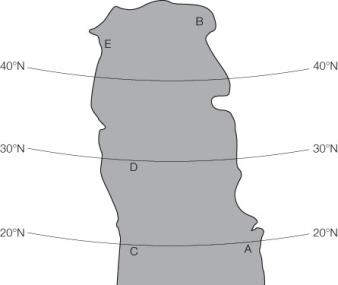 -What is the most likely biome for site C?
 (Multiple Choice)
4.8/5 (68)
(68) Suppose you are visiting a natural history museum and come across skeletons of a population of voles that have a more compact body and shorter appendages than normal. Even without looking at their tags, you would infer that the habitat of this population had been
(Multiple Choice)
4.9/5 (85)
(85) Tropical evergreen forests have greater overall productivity and species richness than tropical deciduous forests, yet the latter are more easily converted to productive agricultural land than the former. Why?
(Essay)
4.8/5 (77)
(77) When more than one hypothesis can explain a pattern, scientists typically prefer the most _______ one-the explanation that requires the smallest number of unobserved events to account for it.
(Short Answer)
4.8/5 (92)
(92) The level of moisture found in an area is an example of _______ factors in the environment.
(Short Answer)
4.7/5 (91)
(91) In situations in which both vicariance and dispersal can explain biogeographic patterns, biologists prefer
(Multiple Choice)
4.9/5 (80)
(80) Many organisms move from place to place in an effort to locate and occupy the environment to which they are best adapted. Compare the movement of a bird flying back and forth between its tropical wintering area and its temperate breeding range with the movement of a lizard as it shifts between its burrow and the surface and between shaded and sunny areas on the surface. Is the term "migration" properly applied to both types of movement?
(Essay)
4.8/5 (79)
(79) 
Filters
- Essay(0)
- Multiple Choice(0)
- Short Answer(0)
- True False(0)
- Matching(0)