



 Chat with AI
Exam 1: Behavioral Sciences

Exam 1: Behavioral Sciences343 Questions
Exam 2: Biochemistry307 Questions
Exam 3: Biology319 Questions
Exam 4: Critical Analysis & Reasoning Skills358 Questions
Exam 5: General Chemistry317 Questions
Exam 6: Organic Chemistry191 Questions
Exam 7: Physics200 Questions
Select questions type


To assess the relationship between chronic disease and spatial inequality in a given area, researchers systematically observe and interview individuals in their communities. This is best described as which of the following?
(Multiple Choice)
5.0/5  (80)
(80) Passage
On the way home from a routine visit to the pediatrician, Sarah stops with her infant son at the local convenience store. As she is waiting in line, a man squeezes in closely behind them and sneezes. As Sarah walks home, she finds that her heart is racing, she feels nauseous, and she is terrified that her child will become severely ill.Soon after, she becomes obsessed with disease and contamination. She begins to take extensive measures to "decontaminate" herself and her home, including washing her hands dozens of times daily. These cleaning rituals have the immediate effect of lessening Sarah's anxiety, so she soon spends most of her day performing them. She seeks treatment from a therapist, who instructs her to gradually expose herself to "contamination" but refrain from her cleaning rituals. The therapist also teaches Sarah how to recognize and modify her maladaptive thoughts about illness prevention. Within several weeks, Sarah finds that she can manage her thoughts about disease and contamination without resorting to ritualistic cleaning.A researcher hypothesized that individuals with obsessive-compulsive disorder (OCD), such as Sarah, would show a more generalized fear response to safe stimuli compared to controls. Generalized conditioned fear responses occur when individuals react with fear to stimuli that resemble the original conditioned stimulus (eg, someone injured in an accident with a red truck fears all red vehicles). The researcher conditioned 100 individuals (50 with OCD and 50 controls) to associate a shock with a visual stimulus. In phase 1, participants viewed a computer screen that alternated between images of a small ring (1 cm) and a large ring (20 cm). The small ring and large ring were displayed for 1 second each, with a blank screen in between for 5 seconds. A mild electric shock was paired with the large ring, and no shock was paired with the small ring. This was repeated for 10 trials. In phase 2, shocks were discontinued, and three intermediate-sized rings were added to the series and presented in increasing size (ie, 1 cm, 5 cm, 10 cm, 15 cm, 20 cm) while the participants' startle response to each ring was measured. This was repeated for 10 trials.
ncbi.nlm.nih.gov/pmc/articles/PMC3932061/
-A researcher replicates the study but continues to occasionally pair the 20-cm ring with an electric shock in phase 2. Which phenomenon is the researcher most likely trying to avoid?
(Multiple Choice)
4.9/5 (94)
(94) Passage
Although the terms sex, sex category, and gender are commonly used interchangeably by most people, sociologists distinguish between them. Sex refers to the biological distinction between bodies (eg, male, female). Sex category (eg, male, female) is based on the visible secondary sex characteristics people use to attribute sex to others. Gender (eg, masculine, feminine) specifically refers to the behaviors and behavioral expectations people attribute to others on the basis of the individual's perceived sex category. Sex category and gender have recently been conceptualized as continua, with male and female as the extremes for sex category perception and masculine and feminine as the extremes for gender. Despite this, sex category and gender are usually perceived by humans categorically instead of continuously.Researchers conducted a study to assess how sex category interpretation is related to implicit bias and cortical activity. For the first phase, researchers tested sex category interpretation using 12 highly realistic computer-generated "facial morphs" varying along a continuum of apparent sex category from extremely male (1) to extremely female (12). The sexually dimorphic content of the faces was manipulated, but all other aspects were unchanged. For example, eyes and noses remained constant, but brow lines and eyebrows were thickened for male faces. Participants viewed the 12 faces in random order, rating each face on a scale of 1 (extremely male) to 10 (extremely female). Despite the uniform increments in the sexually dimorphic content of the facial morphs, responses demonstrated dichotomous sex category classification, as expected.For the second phase, which assessed the relationship between sex category interpretation and implicit bias, participants completed an implicit association test (IAT), in which they were shown the facial morphs with a pair of word attributes, one positive and one negative (eg, hard-working, lazy), and were asked to quickly pick the word they most associated with the face. Participants demonstrated shorter response times for facial morphs at the end points of the sex category continuum.For the third phase, researchers assessed the relationship between face-sensitive regions in the occipitotemporal cortex, particularly the fusiform face area (FFA), and sex category interpretation. Participants were injected with a glucose analog containing a radioactive tracer an hour before brain activity was measured while participants viewed the facial morphs. Results suggest that FFA activity was strongest when the faces were at the end points of the sex category continuum, regardless of whether a face was perceived as male or female.
-According to the first paragraph, the way people perceive gender is most analogous to the way people perceive which of the following?
(Multiple Choice)
4.8/5 (73)
(73) Passage
Psychotic disorders are characterized by a loss of contact with reality. The most common psychotic disorder is schizophrenia, which has a typical onset of psychotic symptoms in early adulthood. Schizophrenia displays considerable inter-individual variation throughout the course of the disorder; many factors appear to influence its progression. Comorbid (co-occurring) conditions, common in schizophrenia, may lead to poorer prognoses. For example, research suggests that fewer depressive symptoms are moderately associated with higher rates of medication compliance, whereas more depressive symptoms are associated with increased future relapses. The early detection of psychosis also appears to have a significant impact on long-term outcomes in schizophrenia. A first psychotic episode that goes untreated for a longer period is associated with more future hospitalizations and a diminished response to future therapeutic interventions.Researchers conducted a study to determine which was better at predicting the development of psychosis, a major component of schizophrenia, in high-risk young adults: the presence of certain speech pattern features or a standard clinical symptom inventory. The participant sample was restricted to 50 younger adults (age 18-30) who either met criteria for prodromal syndrome (preclinical signs of psychosis) or had a first-degree relative with schizophrenia.Every three months for three years, participants were interviewed and given the Symptoms of Psychosis Inventory (SPI), a standardized clinical assessment designed to measure psychosis and related symptoms. The SPI contains two subscales based on the major symptoms of schizophrenia: the Positive Symptom Scale (PSS) and the Negative Symptom Scale (NSS), which are summed to provide a total SPI score. Transcribed interview data were analyzed with software designed to assess the following speech pattern features: semantic coherence (the relatedness of phrases to one another), the number of determiners (eg, "that," "which," "what") used in a phrase (determiner density), and phrase length.Experienced clinicians diagnosed 11 participants with active psychosis by the end of the study. A computer program generated two models that predicted the development of active psychosis based on the data collected. One model based the prediction solely on a combination of the three speech pattern features ("Speech Model") and the other model based the prediction solely on SPI symptoms data ("SPI Model") (Table 1).Table 1 Comparison of Predictive Models
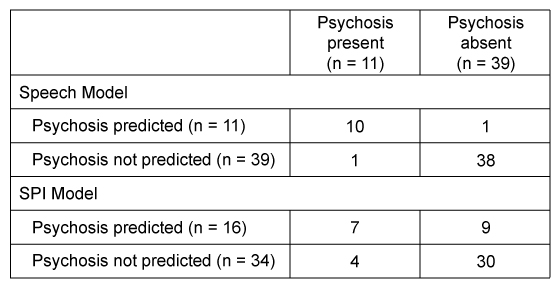 -Which of the following is accurate regarding the design of the study described in the passage?
 (Multiple Choice)
4.8/5 (79)
(79) Passage
During the 19th century, the industrial revolution led to advances in health care in the United States that resulted in declines in the death rate followed by population growth. Around 1860, the U.S. birth rate also began to steadily decline until reaching its current plateau of about two births per woman during her lifetime. Since 1860, the U.S. birth rate has significantly increased during only one period: the post-World War II era known as the baby boom."Baby boomers," the generation of Americans born roughly between 1946 and 1964, are living longer than any prior generation, and their aging has evolving social and historical significance. By 2030, it is estimated that there will be about 61 million baby boomers in their eighties. In 1950, there were approximately seven times more producers (people age 15-64) than elderly (people age 65 and over); by 2030 there are projected to be less than three times more producers than elderly. Providing medical and social care to this aging cohort will have a major negative impact on the American economy due to the costs associated with health care and basic social services.Also impacting the U.S. population distribution is the fact that younger Americans (referred to as "millennials," born roughly between 1982 and 2004) are delaying marriage and children more so than any preceding generation, resulting in declining U.S. fertility rates. Figure 1 compares the U.S. population pyramid in 2000 to a projected population pyramid in 2030.
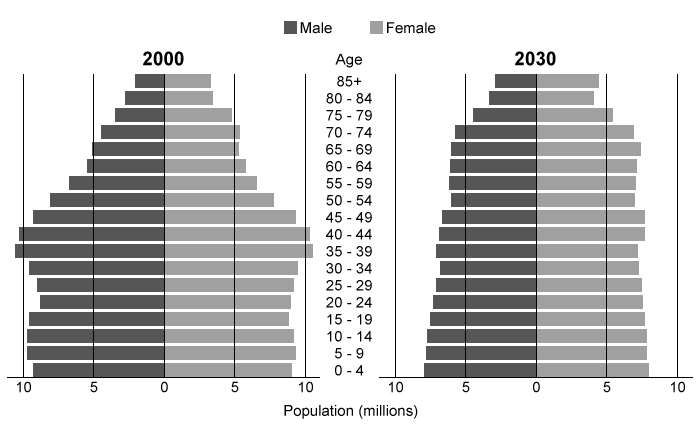 Figure 1 United States population pyramid from 2000 and a projected population pyramid for 2030
-Which of the following would increase the dependency ratio in 2030?
Figure 1 United States population pyramid from 2000 and a projected population pyramid for 2030
-Which of the following would increase the dependency ratio in 2030? (Multiple Choice)
4.8/5 (87)
(87) To study how online communication can coalesce into long-term sustained action toward a collective social goal, a researcher analyzed and coded all the social media text surrounding a single topic. This can best be described as:
(Multiple Choice)
4.8/5 (88)
(88) Passage
Psychophysiology examines the relationship between the properties of a physical stimulus (eg, amplitude of sound waves) and how we perceive that stimulus (eg, loudness). However, this relationship is often accompanied by a degree of uncertainty as the stimulus of interest, or signal, can be confounded by various sources of noise. Noise can be either external (arising from the environment) or internal (arising from physiological sources).To investigate the effect of distraction on auditory perception, researchers tested the ability of subjects to detect auditory tones presented during a visual-memory task. The study included 90 participants age 18-65, and each participant completed 10 trials. Trials consisted of five 800-Hz tones presented randomly while participants viewed a set of 15 sequential pictures of common objects on a computer screen. The objects fell into one of three categories: animals, vehicles, or things that make noise. Half the participants were asked to memorize as many objects as they could (objects group), and half were asked to remember only the categories of objects they saw (categories group). Tones were presented bilaterally within a range of 0-20 dB. Participants noted when they detected a tone during the trial by pressing a button. Results of the study are shown in Figure 1.
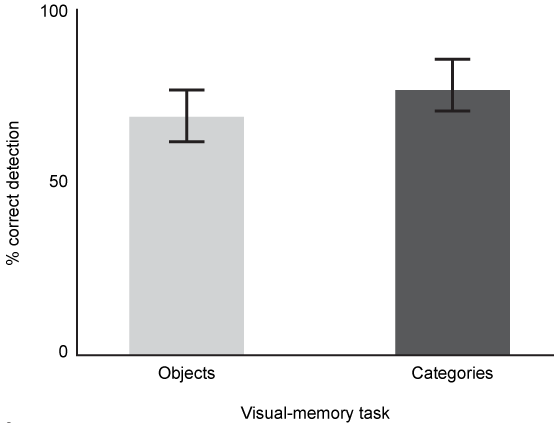 Figure 1 Mean percentage of tones correctly identified in each visual-memory task group (Note: Error bars indicate 95% confidence intervals.)
W. Yost ©2007 Academic Press.
-Researchers noticed that participants were more likely to erroneously report hearing a tone when viewing a picture of an object that produces a tone-like sound, such as a telephone or a bell. What type of processing best explains why this mistake might occur?
Figure 1 Mean percentage of tones correctly identified in each visual-memory task group (Note: Error bars indicate 95% confidence intervals.)
W. Yost ©2007 Academic Press.
-Researchers noticed that participants were more likely to erroneously report hearing a tone when viewing a picture of an object that produces a tone-like sound, such as a telephone or a bell. What type of processing best explains why this mistake might occur? (Multiple Choice)
4.7/5 (70)
(70) A successful business owner has a motor vehicle collision, leaving him paralyzed and in a wheelchair. He perceives that his colleagues and clients begin to treat him as though he is less capable. He starts to doubt his ability to successfully run his business. This reaction is best explained by which of the following?
(Multiple Choice)
5.0/5 (83)
(83) Passage
Religion establishes the beliefs and rituals surrounding the sacred and provides meaning and significance to individuals' lives. The tenets of any given religion can have a far-reaching impact on the individuals within its faith community. For example, certain religions promote faith-based lifestyle directives (FBLDs), which urge believers to follow specific guidelines regarding their own behavior (eg, restrictions on diet and substance use) and their treatment of others (eg, mission work). Because these practices typically reflect the religious group's values, FBLDs are often an important expression of faith for the deeply religious.One religious group with health-related FBLDs is the Seventh Day Adventist Church, which formed in the 1860s after early leaders broke away from established Protestant churches. Since its formal establishment, Seventh Day Adventist Church membership has grown from 3,500 to over 20 million worldwide. The Seventh Day Adventist Church advocates conservative religious teachings and a holistic approach to health and wellness; members are encouraged to pursue vegetarianism, exercise regularly, and avoid alcohol and tobacco.Although FBLDs impact believers' personal choices and behaviors, they are also often meant to have an impact on others through the creation of social institutions such as schools and hospitals. For example, early Adventist leaders developed a health care system to serve the needs of the larger community, and members of the modern Adventist Church have continued to try to reduce health disparities worldwide by creating hospitals, clinics, and universities that provide health care and education services to underserved and developing communities.Researchers from a variety of fields have examined health-related religious values and FBLDs. Epidemiological research has shown that believers from different religions who follow certain FBLDs (eg, abstaining from smoking and alcohol) experience lower rates of chronic illnesses (eg, heart disease and many types of cancer) than the general population. Sociologists have suggested that as a society increasingly relies on medical professionals, rather than clergy, as legitimate sources of guidance on lifestyle behaviors, membership in religious groups with values that are compatible with medicalization will continue to rise. Some hypothesize that this phenomenon accounts for the seemingly contradictory increase in membership in certain conservative religious groups with strict FBLDs, despite mainstream society becoming less religious.
-Which concept is most relevant to the hypothesis described at the end of the fourth paragraph?
(Multiple Choice)
4.9/5 (87)
(87) Passage
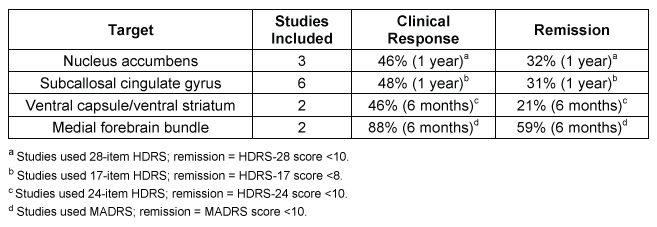
Major depression is a mood disorder that affects nearly 7% of the American population and is the most common cause of disability worldwide. Standard treatment typically involves antidepressant medication alone, although a combination of antidepressant medication and psychological treatment, such as psychotherapy or cognitive-behavioral therapy, is often more effective. However, because depression has genetic, environmental, and psychological contributing factors, treatment can be challenging. Approximately 10% of those suffering from depression have treatment-resistant depression (TRD) that does not respond to standard treatment.A number of treatment options for those with TRD target the functioning of the nervous system. Deep-brain stimulation (DBS), which is used to treat Parkinson disease, has also been investigated as a treatment for TRD. DBS involves implanting a device in the brain that sends electrical impulses to a specific area. Although the mechanism by which DBS alleviates depressive symptoms is unclear, neurostimulation provided by DBS is thought to disrupt dysfunctional patterns of electrical activity in local areas and connected brain regions.A meta-analysis reviewed the data from several studies that used different brain regions as DBS targets in the treatment of TRD. Table 1 shows the percentage of TRD patients who underwent DBS and showed clinical responsiveness and remission of depression. Clinical response was defined as a 50% reduction in scores on a measure of depression. Various scales were used in the studies, including different versions of the Hamilton Depression Rating Scale (HDRS) and Montgomery-Asberg Depression Rating Scale (MADRS). Remission of depression was defined as a score that fell below a predetermined threshold.Table 1 Percentage of TRD Patients Who Showed Clinical Response and Remission With DBS Treatment
 -Which of the following is true regarding two classes of drugs commonly used to treat depression, selective serotonin reuptake inhibitors (SSRIs) and monoamine oxidase inhibitors (MAOIs)?
 (Multiple Choice)
4.9/5 (91)
(91) Passage
Poverty may be the most foundational risk factor for poor health outcomes. Although poverty thresholds are calculated in a variety of ways, many international organizations define poverty thresholds as 50% of the median household income in a given country. Since the United States Census Bureau first began publishing an official U.S. poverty estimate in the 1960s, the percentage of the population living in poverty has fluctuated between roughly 10% and 15%. Extensive research shows a correlation between social stratification and health outcomes, with better outcomes corresponding to higher strata.Concentration of PovertyAccording to U.S. Census Bureau data, roughly 1 in 7 Americans is living in poverty, with almost 14 million residing in "high-poverty" neighborhoods (40% or more of residents below the federally defined poverty threshold), nearly double the amount since 1990. High-poverty neighborhoods also tend to have the highest rates of violent crime, so living in these neighborhoods poses both immediate (eg, physical assault) and long-term health threats, as living in an unsafe neighborhood acts as a chronic environmental stressor.Poverty and IsolationPoverty also prevents or limits access to many productive social activities, such as working, buying goods and services, community and political involvement, and engagement with social networks. The most impoverished members of society are often marginalized and may engage with mainstream society very little, if at all.Transmission of PovertyPoverty is transmitted across generations; numerous studies have found that individuals born into poverty are more likely to raise their own children in poverty. A longitudinal study of 100 households concluded that transmission of poverty occurs because lower-income parents lack economic resources, social connections, and knowledge about the education system, not because they differ from higher-income parents in wanting to help their children succeed. Experts also suggest that the education system perpetuates income disparities; schools in high-income neighborhoods have the most funding, best teachers, and highest graduation rates, whereas schools in low-income neighborhoods face numerous obstacles to obtaining supplies, retaining qualified teachers, and preventing student attrition.
T. Chin & M. Phillips, "Social Reproduction and Child-rearing Practices:Social Class, Children's Agency, and the Summer Activity Gap." ©2004 SAGE Publications
-The experts' suggestion about the education system in the final paragraph draws most directly from which of the following sociological concepts?
(Multiple Choice)
4.9/5 (76)
(76) Passage
Psychophysiology examines the relationship between the properties of a physical stimulus (eg, amplitude of sound waves) and how we perceive that stimulus (eg, loudness). However, this relationship is often accompanied by a degree of uncertainty as the stimulus of interest, or signal, can be confounded by various sources of noise. Noise can be either external (arising from the environment) or internal (arising from physiological sources).To investigate the effect of distraction on auditory perception, researchers tested the ability of subjects to detect auditory tones presented during a visual-memory task. The study included 90 participants age 18-65, and each participant completed 10 trials. Trials consisted of five 800-Hz tones presented randomly while participants viewed a set of 15 sequential pictures of common objects on a computer screen. The objects fell into one of three categories: animals, vehicles, or things that make noise. Half the participants were asked to memorize as many objects as they could (objects group), and half were asked to remember only the categories of objects they saw (categories group). Tones were presented bilaterally within a range of 0-20 dB. Participants noted when they detected a tone during the trial by pressing a button. Results of the study are shown in Figure 1.
Figure 1 Mean percentage of tones correctly identified in each visual-memory task group (Note: Error bars indicate 95% confidence intervals.)
W. Yost ©2007 Academic Press.
-Using the principles of signal detection theory, researchers likely hypothesized that:
Figure 1 Mean percentage of tones correctly identified in each visual-memory task group (Note: Error bars indicate 95% confidence intervals.)
W. Yost ©2007 Academic Press.
-Using the principles of signal detection theory, researchers likely hypothesized that: (Multiple Choice)
4.8/5 (82)
(82) Passage
The last several decades have seen a significant increase in immigration to the United States. Today, more than 20% of American children age 17 and younger have at least one foreign-born parent, and about 30% of these children are themselves foreign-born.Immigrant youths in the United States tend to adapt extremely well to their new surroundings. Researchers report that immigrant students often perform in school as well or better than their US-born classmates. Studies assessing psychological adjustment reveal similar findings: Foreign-born students are less likely to abuse alcohol or break the law, and they demonstrate relatively higher levels of self-esteem than their US-born peers.The following quotations are responses from overachieving immigrant middle school students when asked by interviewers to explain their success:Student 1, eighth-grade valedictorian: "When my mother first came to the United States from China, she spent all her time working, trying to earn a living to support her three children. I know how much she has sacrificed, and I am so grateful that I am willing to do just about anything for her."Student 2, a straight-A student: "[In my neighborhood] everyone knows everyone. They all know what I am up to, so I want to make a good impression and have them think highly of me. I also want to represent my community well to others."Even though immigrant families are often more prosperous in the United States than they were in their home countries, they still often struggle financially, typically due to parental language barriers. The impressive adaptations of immigrant students occur despite impoverished circumstances; their parents tend to emphasize the importance of education as a means to attaining prosperity, reminding their children that they immigrated to provide their children with access to better education than was available in their homeland. Immigrant children tend to internalize their parents' attitude toward educational achievement.Members of ethnic minorities in the United States also stress loyalty to family and community over self, so children feel a strong sense of gratitude and allegiance to their parents. Immigrant parents with successful children have usually formed close relationships with members of their ethnic community; members of ethnic enclaves tend to demonstrate consensus on values and exert an unusually high level of control over the children's behavior through regular monitoring.
L. E. Berk. Child Development © 2006 Pearson
-As described in the passage, the success of immigrant youths:
(Multiple Choice)
4.8/5 (82)
(82) A researcher wants to train a mouse to run on an exercise wheel. The LEAST effective way to train this new behavior would involve:
(Multiple Choice)
4.9/5 (94)
(94) Which scenario best illustrates dishabituation? An intensive care unit nurse:
(Multiple Choice)
4.9/5 (85)
(85) Passage
Epidemiologists now consider obesity to be a global pandemic, occurring largely as a result of the spread of technology and culture worldwide. Obesity has been linked to many serious health conditions, and as the obesity rate rises, the overall poorer health of the population impairs the functioning and stability of society. Although experts disagree about whether obesity itself should be viewed as a disease to be treated with medical interventions, there is widespread consensus that obesity prevention is critical. Research has shown that across one's life span, multiple biological, psychological, and social influences contribute to obesity; understanding the influence of these factors is essential to the development of effective obesity prevention programs.Study 1 was conducted using nearly 6,000 residents from a mid-sized city to investigate how obesity rates change over time in informal social groups. During recruitment wave A, researchers asked an initial group of individuals to complete a two-minute health questionnaire; those who completed the questionnaire were then asked to participate in the research study. During recruitment wave B, additional participants were recruited using a snowball sampling technique: participants who enrolled during wave A provided contact information of friends and family members who were then asked to participate. Researchers finalized the sample such that each participant had at least one family member, one close friend, and one acquaintance also in the study. Every year for 20 years, researchers measured each participant's height and weight to calculate body mass index (BMI) and conducted an extensive interview with each participant to assess the type, strength, and geographic distance of their social ties with other participants. Researchers found that the type and strength of social ties appeared to be more strongly linked to BMI than geographic closeness between social ties.Study 1 was criticized for not addressing larger contextual variables related to obesity, such as the availability of unhealthy food within a community. Therefore, Study 2 randomly selected a subset of 500 cases from the Study 1 database and, using participants' addresses, researchers mapped and counted the number of retail food chains (ie, "fast food" restaurants selling low-quality, calorie-dense food) located within a 1-mile radius of participants' homes and compared this to BMI at the end of the 20-year study. Results showed a significant relationship between higher BMI and more neighborhood retail food chains.
J. A. Levine ©2011 American Diabetes Association; Christakis, N. A. and Fowler, J. H. ©2007 Massachusetts Medical Society
-Regarding Study 1, which of the following statements is most accurate? Study 1:
(Multiple Choice)
4.9/5 (75)
(75) Which of the following is true regarding the social stratification system referred to as a caste system? Caste systems have status positions that are:
(Multiple Choice)
4.8/5 (76)
(76) Passage
The diagnosis of a child with a serious disability significantly impacts the child's parents. While positive psychological outcomes are sometimes possible, evidenced by research showing that for some parents a child's disability is eventually viewed as a chance for personal growth, research also indicates that many parents of children with disabilities are at greater risk for poor physical and mental health outcomes. Coping with a child's initial symptoms, providing ongoing care, and dealing with prejudice from others present significant stressors for parents. This stress may also disrupt marriages; results of a meta-analysis showed a modest, increased risk for divorce in parents of children with disabilities. Another line of research has identified significantly higher rates of anxiety and/or depression in parents of children with disabilities. The fact that parental distress often results in poorer outcomes for their children points to a need for evidence-based interventions for parents of children with disabilities.In Study 1, researchers compared the effectiveness of two interventions in reducing depressive symptoms in parents of children with cognitive disabilities. Researchers recruited 30 parents of children with intellectual disorders from the contact list of an affluent community wellness center and randomly assigned them to a meditation (M) group or a humanistic psychotherapy (HP) group. Both groups were led by peer mentors trained in specific interventions who taught and demonstrated the techniques to the participants during the weekly sessions. Participants completed self-report measures of depressive symptoms at baseline (pre-test), 4 weeks into the intervention (midpoint), at the end of the 8-week program (post-test 1), and 4 weeks after the program ended (post-test 2). The findings are shown in Figure 1.
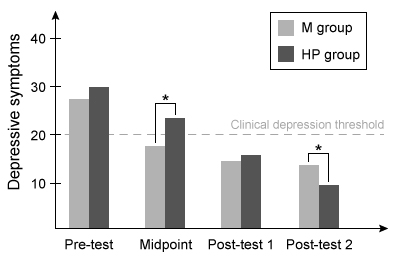 Figure 1 Depressive symptoms at pre-test, midpoint, post-test 1, and post-test 2 (Note: * indicates p < .05.)In Study 2, researchers examined the impact of coping strategies on distress in 80 parents of children with muscular dystrophy. Participants were asked to think of a recent stressful, threatening event and report whether they had classified their future expectancy for the event as "changeable" (situation is able to be modified) or "unchangeable" (situation is not able to be modified). They were then asked whether they attempted to cope with the event primarily by regulating their emotions (emotion-focused) or by modifying aspects of the situation (problem-focused), such as seeking help from others. Lastly, they were surveyed about their level of distress after they tried to cope with the stressor. Figure 2 illustrates the findings.
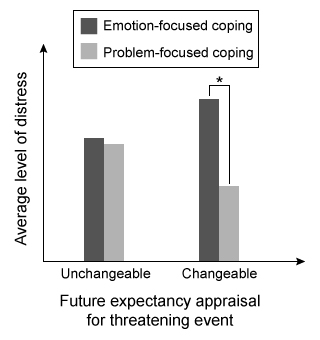 Figure 2 Average level of distress by coping strategy (emotion-focused vs. problem-focused) and future expectancy appraisal for the threatening event (Note: * indicates p < .05.)
-Based on Figure 2, the most accurate conclusion is that:
Figure 1 Depressive symptoms at pre-test, midpoint, post-test 1, and post-test 2 (Note: * indicates p < .05.)In Study 2, researchers examined the impact of coping strategies on distress in 80 parents of children with muscular dystrophy. Participants were asked to think of a recent stressful, threatening event and report whether they had classified their future expectancy for the event as "changeable" (situation is able to be modified) or "unchangeable" (situation is not able to be modified). They were then asked whether they attempted to cope with the event primarily by regulating their emotions (emotion-focused) or by modifying aspects of the situation (problem-focused), such as seeking help from others. Lastly, they were surveyed about their level of distress after they tried to cope with the stressor. Figure 2 illustrates the findings.
Figure 2 Average level of distress by coping strategy (emotion-focused vs. problem-focused) and future expectancy appraisal for the threatening event (Note: * indicates p < .05.)
-Based on Figure 2, the most accurate conclusion is that: (Multiple Choice)
4.9/5 (78)
(78) Passage
During the 19th century, the industrial revolution led to advances in health care in the United States that resulted in declines in the death rate followed by population growth. Around 1860, the U.S. birth rate also began to steadily decline until reaching its current plateau of about two births per woman during her lifetime. Since 1860, the U.S. birth rate has significantly increased during only one period: the post-World War II era known as the baby boom."Baby boomers," the generation of Americans born roughly between 1946 and 1964, are living longer than any prior generation, and their aging has evolving social and historical significance. By 2030, it is estimated that there will be about 61 million baby boomers in their eighties. In 1950, there were approximately seven times more producers (people age 15-64) than elderly (people age 65 and over); by 2030 there are projected to be less than three times more producers than elderly. Providing medical and social care to this aging cohort will have a major negative impact on the American economy due to the costs associated with health care and basic social services.Also impacting the U.S. population distribution is the fact that younger Americans (referred to as "millennials," born roughly between 1982 and 2004) are delaying marriage and children more so than any preceding generation, resulting in declining U.S. fertility rates. Figure 1 compares the U.S. population pyramid in 2000 to a projected population pyramid in 2030.
Figure 1 United States population pyramid from 2000 and a projected population pyramid for 2030
-Based on Figure 1, which of the following is predicted to decrease by 2030?
Figure 1 United States population pyramid from 2000 and a projected population pyramid for 2030
-Based on Figure 1, which of the following is predicted to decrease by 2030? (Multiple Choice)
4.9/5 (75)
(75) 
Filters
- Essay(0)
- Multiple Choice(0)
- Short Answer(0)
- True False(0)
- Matching(0)