



 Chat with AI
Exam 6: Organic Chemistry

Exam 1: Behavioral Sciences343 Questions
Exam 2: Biochemistry307 Questions
Exam 3: Biology319 Questions
Exam 4: Critical Analysis & Reasoning Skills358 Questions
Exam 5: General Chemistry317 Questions
Exam 6: Organic Chemistry191 Questions
Exam 7: Physics200 Questions
Select questions type


Passage
The N-terminus of an amino acid must be protected with 9-fluorenylmethoxycarbonyl (Fmoc) during solid state peptide synthesis to avoid side reactions (Scheme I).
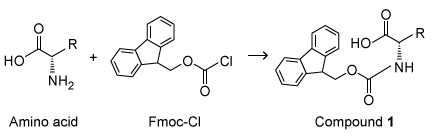 Scheme IThe Fmoc protecting group is typically removed with piperidine (Scheme II), a heterocyclic secondary amine.
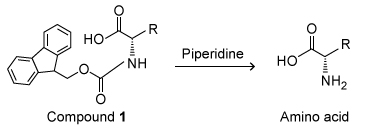 Scheme IIBecause the use of piperidine is restricted, structurally similar amines were examined as possible replacements. To determine whether piperidine analogues were suitable alternatives for Fmoc removal, deprotection of Compound 2 was carried out with several amine bases (Scheme III).
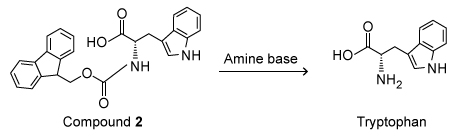 Scheme IIICompound 2 was prepared from L-tryptophan and Fmoc-Cl, and the reaction was monitored by thin-layer chromatography (TLC) and visualized by ultraviolet light. The deprotections were done with piperidine and each analogue using a microwave set to 155 watts at 75 °C for 15 seconds. The products of the deprotections were analyzed by high-performance liquid chromatography (HPLC) and mass spectrometry; the retention times of the products were compared to tryptophan and Compound 2 standards.
Adapted from O.P. Luna et al, "Deprotection Reagents in Fmoc Solid Phase Peptide Synthesis: Moving Away from Piperidine?." Molecules. ©2016 MDPI.
-If a C18 hydrocarbon HPLC column is used for analysis of the Scheme III reaction results, which of the following solvents would NOT be used for the mobile phase?
Scheme IThe Fmoc protecting group is typically removed with piperidine (Scheme II), a heterocyclic secondary amine.
Scheme IIBecause the use of piperidine is restricted, structurally similar amines were examined as possible replacements. To determine whether piperidine analogues were suitable alternatives for Fmoc removal, deprotection of Compound 2 was carried out with several amine bases (Scheme III).
Scheme IIICompound 2 was prepared from L-tryptophan and Fmoc-Cl, and the reaction was monitored by thin-layer chromatography (TLC) and visualized by ultraviolet light. The deprotections were done with piperidine and each analogue using a microwave set to 155 watts at 75 °C for 15 seconds. The products of the deprotections were analyzed by high-performance liquid chromatography (HPLC) and mass spectrometry; the retention times of the products were compared to tryptophan and Compound 2 standards.
Adapted from O.P. Luna et al, "Deprotection Reagents in Fmoc Solid Phase Peptide Synthesis: Moving Away from Piperidine?." Molecules. ©2016 MDPI.
-If a C18 hydrocarbon HPLC column is used for analysis of the Scheme III reaction results, which of the following solvents would NOT be used for the mobile phase?
Free
(Multiple Choice)
5.0/5  (90)
(90) Correct Answer: Verified
C
If thin-layer chromatography shows that a distillation of molecules with boiling points above 150 °C results in an impure compound, one can conclude that a possible error made during the distillation was:
Free
(Multiple Choice)
4.8/5 (88)
(88) Correct Answer:Verified
VerifiedC
Passage
Solid-phase peptide synthesis is normally carried out on a resin bathed multiple times in dimethylformamide (DMF)-a toxic, polar, aprotic solvent-which poses an environmental problem because a large amount of toxic solvent waste is created. Cyclic carbonates such as propylene carbonate (PC) and ethylene carbonate (EC) are nontoxic, polar, aprotic solvents that could be used as an alternative to DMF.Compounds 1 and 2 are modified L-amino acids. They were coupled to form Compound 3, a dipeptide, which was then deprotected to yield Compound 4 (Figure 1).
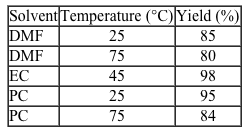
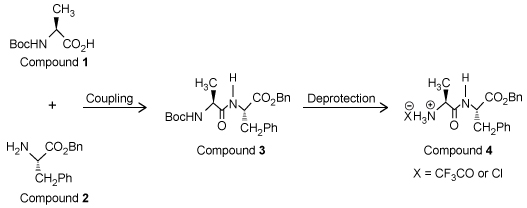 Figure 1 Synthesis of Compound 4To determine the effect that solvent type and temperature have on the synthesis of this peptide, the nontoxic solvents PC and EC as well as the toxic solvent DMF were each used in separate syntheses of Compound 4 at different temperatures. The reaction solvent was also used to rinse the resin. Table 1 shows the results of these syntheses.Table 1 Results from the Synthesis of Compound 4
 The successful synthesis of Compound 4 using nontoxic solvents encouraged researchers to pursue the synthesis of a larger, biologically active peptide. Bradykinin, a vasodilator containing nine amino acids (Arg-Pro-Pro-Gly-Phe-Ser-Pro-Phe-Arg), was synthesized using the same solid-state peptide synthesis protocol used to synthesize Compound 4. Separate syntheses were done using either DMF or PC, and the purity of bradykinin from each synthesis was analyzed by high-performance liquid chromatography (HPLC) (Figure 2).In each chromatogram, peak 1 has the same retention time as commercially obtained bradykinin, and the other peaks correspond to impurities. In chromatogram A, the impurity has a similar retention time to the product peak whereas the impurity peaks in chromatogram B have distinct retention times compared to the product peak.
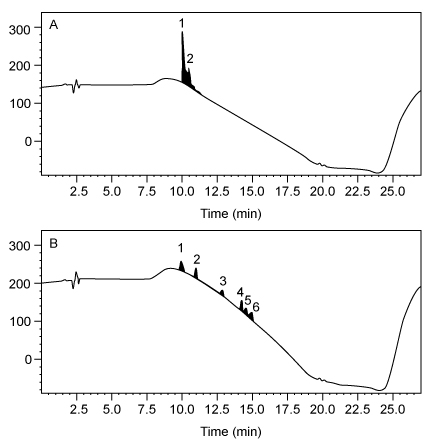 Figure 2 HPLC of synthetic bradykinin: (A) synthesis in DMF; (B) synthesis in PC
Adapted from S. B. Lawrenson et al., "The greening of peptide synthesis." Green Chem. ©2017 The Royal Society of Chemistry.
-Why is PC a better solvent than DMF for peptide synthesis? Results of the peptide syntheses as described in the passage indicate that when PC is used as a solvent:
Figure 1 Synthesis of Compound 4To determine the effect that solvent type and temperature have on the synthesis of this peptide, the nontoxic solvents PC and EC as well as the toxic solvent DMF were each used in separate syntheses of Compound 4 at different temperatures. The reaction solvent was also used to rinse the resin. Table 1 shows the results of these syntheses.Table 1 Results from the Synthesis of Compound 4
The successful synthesis of Compound 4 using nontoxic solvents encouraged researchers to pursue the synthesis of a larger, biologically active peptide. Bradykinin, a vasodilator containing nine amino acids (Arg-Pro-Pro-Gly-Phe-Ser-Pro-Phe-Arg), was synthesized using the same solid-state peptide synthesis protocol used to synthesize Compound 4. Separate syntheses were done using either DMF or PC, and the purity of bradykinin from each synthesis was analyzed by high-performance liquid chromatography (HPLC) (Figure 2).In each chromatogram, peak 1 has the same retention time as commercially obtained bradykinin, and the other peaks correspond to impurities. In chromatogram A, the impurity has a similar retention time to the product peak whereas the impurity peaks in chromatogram B have distinct retention times compared to the product peak.
Figure 2 HPLC of synthetic bradykinin: (A) synthesis in DMF; (B) synthesis in PC
Adapted from S. B. Lawrenson et al., "The greening of peptide synthesis." Green Chem. ©2017 The Royal Society of Chemistry.
-Why is PC a better solvent than DMF for peptide synthesis? Results of the peptide syntheses as described in the passage indicate that when PC is used as a solvent:Free
(Multiple Choice)
4.9/5 (77)
(77) Correct Answer:Verified
VerifiedB
Passage
Two key ingredients found in many soaps are PEG 150 distearate and ethylhexyl glycerin. Both can be synthesized from glyceryl tristearate (Figure 1).
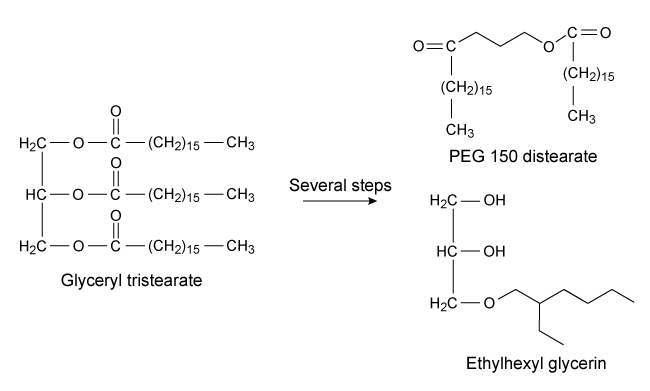 Figure 1 Formation of PEG 150 distearate and ethylhexyl glycerin from glyceryl tristearateThe first step in this process requires the saponification of glyceryl tristearate. The resulting stearate molecules can then react with PEG 150 in an acid-catalyzed Fischer esterification to form PEG 150 distearate. The glycerol produced during saponification is used as a nucleophile to form ethylhexyl glycerin through a base-catalyzed SN2 reaction with an ethylhexyl halide.Studies have shown that hand washing with soap can substantially reduce the number of germs present on hands and that washing hands before preparing food is particularly effective in reducing illness. Researchers examined the effect of washing for 20 seconds with different amounts of soap containing PEG 150 distearate and ethylhexyl glycerin and found an inverse correlation between the volume of soap used and the amount of bacteria recovered from the hands. The data are shown in Figure 2.
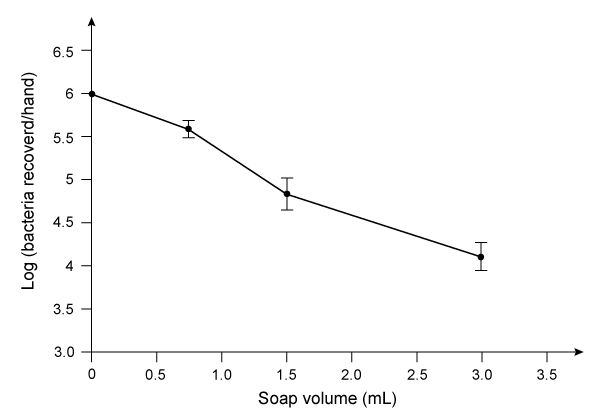 Figure 2 Bacteria recovered from hands after washing with varying amounts of soapThe researchers then investigated the effect of hand washing with different kinds of soap on the transfer of bacteria from hands to objects. Volunteers washed with a fixed volume of soap for 30 seconds, then handled sterilized plastic spheres for 30 seconds. Bacteria were then recovered from the spheres. The results are shown in Table 1.Table 1 Bacteria Recovered from Objects
 Adapted from Fuls JL, Rodgers ND, Fischler GE, et al. Alternative hand contamination technique to compare the activities of antimicrobial and nonantimicrobial soaps under different test conditions. Appl Environ Microbiol. 2008.
-Researchers produced ethylhexyl glycerin using a partially deuterated ethylhexyl halide and generated the product shown below.
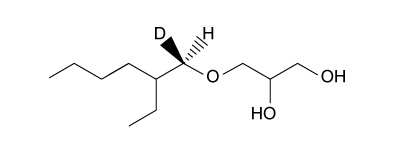 What was the configuration of the deuterated carbon prior to the reaction?
Figure 1 Formation of PEG 150 distearate and ethylhexyl glycerin from glyceryl tristearateThe first step in this process requires the saponification of glyceryl tristearate. The resulting stearate molecules can then react with PEG 150 in an acid-catalyzed Fischer esterification to form PEG 150 distearate. The glycerol produced during saponification is used as a nucleophile to form ethylhexyl glycerin through a base-catalyzed SN2 reaction with an ethylhexyl halide.Studies have shown that hand washing with soap can substantially reduce the number of germs present on hands and that washing hands before preparing food is particularly effective in reducing illness. Researchers examined the effect of washing for 20 seconds with different amounts of soap containing PEG 150 distearate and ethylhexyl glycerin and found an inverse correlation between the volume of soap used and the amount of bacteria recovered from the hands. The data are shown in Figure 2.
Figure 2 Bacteria recovered from hands after washing with varying amounts of soapThe researchers then investigated the effect of hand washing with different kinds of soap on the transfer of bacteria from hands to objects. Volunteers washed with a fixed volume of soap for 30 seconds, then handled sterilized plastic spheres for 30 seconds. Bacteria were then recovered from the spheres. The results are shown in Table 1.Table 1 Bacteria Recovered from Objects
Adapted from Fuls JL, Rodgers ND, Fischler GE, et al. Alternative hand contamination technique to compare the activities of antimicrobial and nonantimicrobial soaps under different test conditions. Appl Environ Microbiol. 2008.
-Researchers produced ethylhexyl glycerin using a partially deuterated ethylhexyl halide and generated the product shown below. What was the configuration of the deuterated carbon prior to the reaction? (Multiple Choice)
4.9/5 (85)
(85) The amino acids Val, Leu, and Ile are all degraded outside the liver by an aminotransferase and an α-keto acid dehydrogenase complex. These amino acids can all be classified as:
(Multiple Choice)
4.8/5 (91)
(91) What is the product of the reaction of butanoic acid and ethanol under acidic conditions?
(Multiple Choice)
4.8/5 (91)
(91) Passage
Students used three classification tests to study the reactivity of alcohol, aldehyde, and ketone functional groups in organic compounds. The organic compounds provided to the students are given in Table 1.Table 1 Organic Compounds Tested
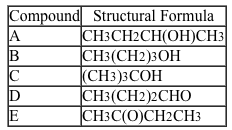 First, the students performed the Lucas test by mixing a few drops of each compound with 2 mL of the Lucas reagent (ZnCl2 and HCl). This reagent is used to test for secondary and tertiary alcohols. A positive test result is indicated by a cloudy reaction mixture upon addition of the Lucas reagent due to the formation of an insoluble compound by an SN1 reaction with a secondary or tertiary alcohol (Reaction 1).
 Reaction 1Next, a test for alcohols and aldehydes was performed by the addition of a drop of chromic acid reagent (CrO3 dissolved in aqueous H2SO4) into samples of the organic compounds. The disappearance of the orange color from chromic acid and formation of a blue-green suspension is indicative of a positive result for this test. Compound A was found to be an example of a positive result, as shown in Reaction 2.
 Reaction 2Finally, samples of the compounds were also dissolved in water, followed by the addition of NaOH and iodine. This test is known as the iodoform test, which is used to identify methyl ketones and secondary alcohols. A positive result is indicated by the formation of iodoform (CHI3), a yellow precipitate (Reaction 3).
 3Table 2 Selected Observations from the Classification Tests
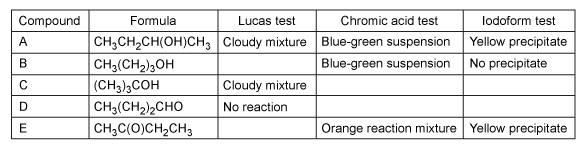 -Compound E does not give a positive result for the Lucas test. However, after reaction with LiAlH4, a positive result for the Lucas test is observed. Which compound is the product of the reaction of Compound E with LiAlH4?
First, the students performed the Lucas test by mixing a few drops of each compound with 2 mL of the Lucas reagent (ZnCl2 and HCl). This reagent is used to test for secondary and tertiary alcohols. A positive test result is indicated by a cloudy reaction mixture upon addition of the Lucas reagent due to the formation of an insoluble compound by an SN1 reaction with a secondary or tertiary alcohol (Reaction 1).
Reaction 1Next, a test for alcohols and aldehydes was performed by the addition of a drop of chromic acid reagent (CrO3 dissolved in aqueous H2SO4) into samples of the organic compounds. The disappearance of the orange color from chromic acid and formation of a blue-green suspension is indicative of a positive result for this test. Compound A was found to be an example of a positive result, as shown in Reaction 2.
Reaction 2Finally, samples of the compounds were also dissolved in water, followed by the addition of NaOH and iodine. This test is known as the iodoform test, which is used to identify methyl ketones and secondary alcohols. A positive result is indicated by the formation of iodoform (CHI3), a yellow precipitate (Reaction 3).
3Table 2 Selected Observations from the Classification Tests
-Compound E does not give a positive result for the Lucas test. However, after reaction with LiAlH4, a positive result for the Lucas test is observed. Which compound is the product of the reaction of Compound E with LiAlH4? (Multiple Choice)
4.8/5 (65)
(65) Which of the following amino acids would most likely be used as a precursor in the synthesis of Compound X, shown below? 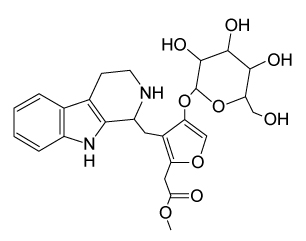 Compound X
 (Multiple Choice)
4.8/5 (87)
(87) Passage
Aldehydes are organic compounds encountered in everyday life and used as intermediates in metabolism. Common aldehydes include formaldehyde, which is used in the fixation of tissues, and cinnamaldehyde, which provides the flavor and smell of cinnamon (Figure 1).
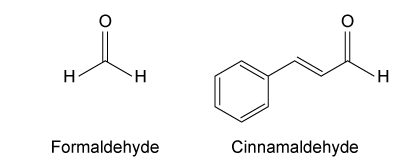 Figure 1 Common aldehydesThe aldol condensation shown in Figure 2 is an important carbon-carbon bond-forming reaction that has many applications in the synthesis of bioactive molecules. It also takes place in some metabolic processes, such as the citric acid cycle and gluconeogenesis. The aldol condensation begins with the aldol reaction, which can be acid- or base-catalyzed and requires nucleophilic addition to a carbonyl to provide the aldol product, which can be a β-hydroxy ketone or aldehyde. The final step of the aldol condensation consists of an acid- or base-catalyzed dehydration of the aldol product to yield an α,β-unsaturated ketone or aldehyde.
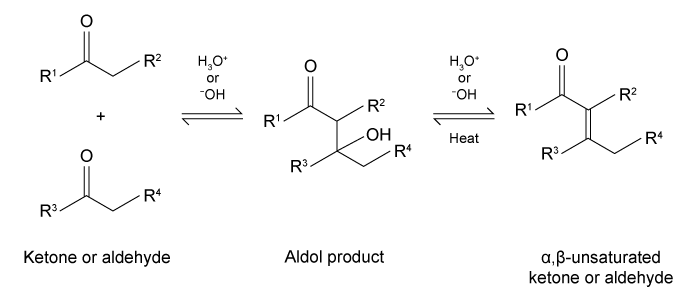 Figure 2 General aldol reaction and condensationThe reverse of an aldol reaction or condensation is known as a retro-aldol, which is important in metabolism, most notably in glycolysis. This reaction breaks a carbon-carbon bond to form aldehydes and/or ketones. In glycolysis, fructose 1,6-bisphosphate is broken down into an aldehyde and a ketone, glyceraldehyde 3-phosphate (GAP) and dihydroxyacetone phosphate (DHAP), respectively (Figure 3).
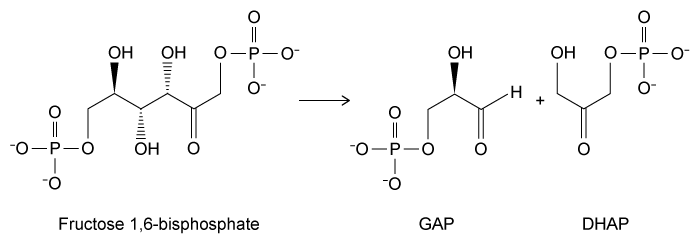 Figure 3 Retro-aldol in glycolysis
-What is the product if the compound shown below undergoes a retro-aldol reaction?
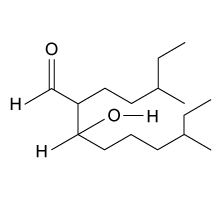
Figure 1 Common aldehydesThe aldol condensation shown in Figure 2 is an important carbon-carbon bond-forming reaction that has many applications in the synthesis of bioactive molecules. It also takes place in some metabolic processes, such as the citric acid cycle and gluconeogenesis. The aldol condensation begins with the aldol reaction, which can be acid- or base-catalyzed and requires nucleophilic addition to a carbonyl to provide the aldol product, which can be a β-hydroxy ketone or aldehyde. The final step of the aldol condensation consists of an acid- or base-catalyzed dehydration of the aldol product to yield an α,β-unsaturated ketone or aldehyde.
Figure 2 General aldol reaction and condensationThe reverse of an aldol reaction or condensation is known as a retro-aldol, which is important in metabolism, most notably in glycolysis. This reaction breaks a carbon-carbon bond to form aldehydes and/or ketones. In glycolysis, fructose 1,6-bisphosphate is broken down into an aldehyde and a ketone, glyceraldehyde 3-phosphate (GAP) and dihydroxyacetone phosphate (DHAP), respectively (Figure 3).
Figure 3 Retro-aldol in glycolysis
-What is the product if the compound shown below undergoes a retro-aldol reaction? (Multiple Choice)
4.8/5 (84)
(84) Compound 1 shown below is converted to Compound 2 by a base-catalyzed aldol condensation. 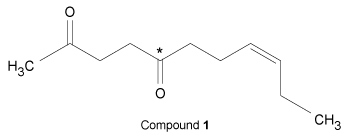 If the carbonyl labeled with an asterisk is the carbonyl in the final product, what is the structure of Compound 2?
 (Multiple Choice)
4.7/5 (71)
(71) 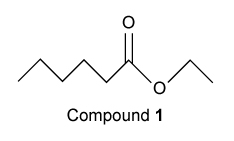 Compound 1, a carboxylic acid derivative, cannot undergo decarboxylation because the carboxylic acid derivative:
 (Multiple Choice)
4.9/5 (84)
(84) The enzyme phenylalanine hydroxylase catalyzes the conversion of phenylalanine to tyrosine. The disease phenylketonuria (PKU) is caused by an inactivating mutation in the gene encoding phenylalanine hydroxylase. Which structure corresponds to the amino acid that will NOT form as a result of PKU?
(Multiple Choice)
4.8/5 (79)
(79) Passage
Malaria is caused by the parasite Plasmodium falciparum and is transmitted through a female mosquito bite. Although there are antimalarial treatments available, P. falciparum has become resistant to many of these drugs. P. falciparum cells contain a respiratory organelle called the apicoplast that is necessary for the parasite's survival but is not found in humans. Therefore, a new drug that targets this organelle could be useful in the treatment of malaria.A portion of the apicoplast protein ferredoxin (PfFd) is shown in Figure 1, with certain amino acid residues labeled. In the apicoplast, ferredoxin NADP+ reductase (PfFNR) interacts electrostatically with PfFd and catalyzes an electron transfer reaction. A compound that selectively inhibits this interaction could be a beneficial antimalarial agent.
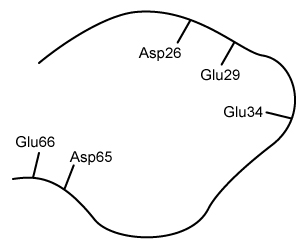 Figure 1 Structure of a portion of PfFdChalcone (Compound 3) is a compound that interacts with PfFd and exhibits antimalarial properties. A series of chalcone derivatives (Compounds 4-8) were synthesized via the aldol condensation shown in Scheme 1, where nucleophilic addition of Compound 1 to Compound 2 is followed by elimination to yield α,β-unsaturated carbonyl molecules, Compounds 3-8.
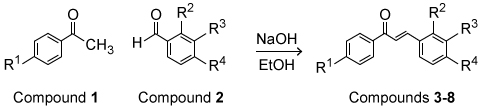 Scheme 1An inhibition assay was performed to compare chalcone (Compound 3) and its derivatives by determining the extent to which these compounds inhibited electron transfer between PfFNR and PfFd (Table 1).Table 1 Inhibition of electron transfer assay results
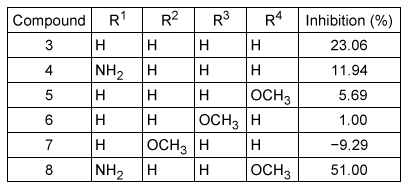 Adapted from H. Suwito et al. "Design and synthesis of chalcone derivatives as inhibitors of the ferredoxin - ferredoxin-NADP+ reductase interaction of Plasmodium falciparum: pursuing new antimalarial agents." Molecules. ©2014 MDPI.
-If Compound 4 is heated and treated with a base, which of the following functional groups would result from this reaction?
Figure 1 Structure of a portion of PfFdChalcone (Compound 3) is a compound that interacts with PfFd and exhibits antimalarial properties. A series of chalcone derivatives (Compounds 4-8) were synthesized via the aldol condensation shown in Scheme 1, where nucleophilic addition of Compound 1 to Compound 2 is followed by elimination to yield α,β-unsaturated carbonyl molecules, Compounds 3-8.
Scheme 1An inhibition assay was performed to compare chalcone (Compound 3) and its derivatives by determining the extent to which these compounds inhibited electron transfer between PfFNR and PfFd (Table 1).Table 1 Inhibition of electron transfer assay results
Adapted from H. Suwito et al. "Design and synthesis of chalcone derivatives as inhibitors of the ferredoxin - ferredoxin-NADP+ reductase interaction of Plasmodium falciparum: pursuing new antimalarial agents." Molecules. ©2014 MDPI.
-If Compound 4 is heated and treated with a base, which of the following functional groups would result from this reaction? (Multiple Choice)
4.8/5 (86)
(86) Passage
Students perform a synthesis of a carboxylic acid derivative.They mix a 10.00-mL sample of hexanoic acid, 2.33 mL of ethanol, and 0.64 mL of concentrated sulfuric acid in a flask with a water condenser fitted to its neck. The mixture is boiled for one hour and then poured into water when the reaction is complete. The aqueous and organic layers are separated, and the organic layer is washed once with NaHCO3 and twice with water. Solid Na2SO4 is added to the organic layer to remove any water present. The organic layer and Na2SO4 are separated by filtration. The filtrate is purified by fractional distillation to yield the carboxylic acid derivative, a colorless liquid.
-What is the product formed by the reaction of hexanoic acid and ethanol described in the passage?
(Multiple Choice)
4.8/5 (79)
(79) Compound 1 and PBr3 react to form Compound 2 as shown below. 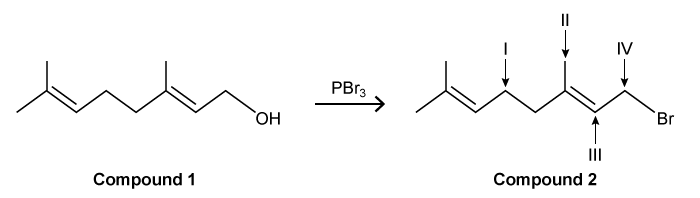 Which position in Compound 2 corresponds to the hydrogen(s) that appear as a doublet at approximately 4.0 ppm in the 1H NMR spectrum?
 (Multiple Choice)
4.7/5 (69)
(69) Passage
Fluorescent amino acids are useful for labeling proteins because they can be visualized spectroscopically, facilitating the study of protein structure and interactions. The noncanonical amino acid dansylalanine, a fluorescent amino acid that is sensitive to the hydrophobicity of its environment, is a good candidate to be incorporated into proteins because of its small size and fluorescent capabilities. Dansyl chloride and Compound 1 were used to synthesize dansylalanine, as shown in Reaction 1. Dansylalanine absorbs maximally at 340 nm and emits at approximately 540 nm.
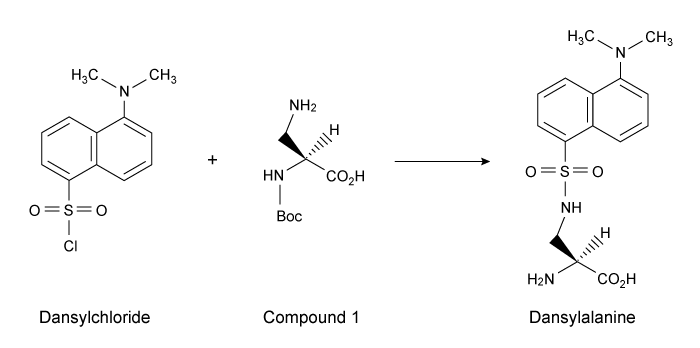 Reaction 1 Synthesis of dansylalanineA leucyl-tRNA synthetase from Escherichia coli was engineered to aminoacylate bacterial tRNAs containing a CUA anticodon with dansylalanine. After verifying that the tRNA/synthetase pair does not interact with endogenous amino acids or tRNAs, it was transfected into the yeast Saccharomyces cerevisiae along with a plasmid encoding a mutated human superoxide dismutase (hSOD). Using this system, dansylalanine was genetically incorporated into hSOD in place of either Gln-16 or Trp-33, and expressed in S. cerevisiae.Position 16 is located on the surface of hSOD at the N-terminus of a β-strand, and position 33 lies in the center of a strand within a β-barrel. To probe changes in the structure of hSOD, researchers exposed the purified protein to guanidinium chloride (GdmCl) to denature the protein at concentrations ranging 0-4.5 M. The experiment was conducted in a 35 mM sodium phosphate buffer at pH 7.2. The fluorescence of hSOD with dansylalanine at either position 16 or 33 was monitored at each GdmCl concentration, and the results of the unfolding experiment are shown in Figure 1.
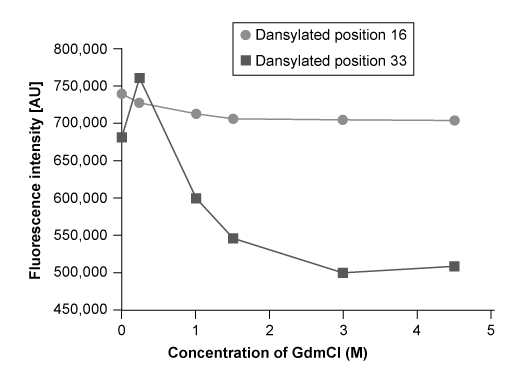 Figure 1 Plot of dansylalanine fluorescence at different concentrations of GdmCl
Adapted from Summerer D, Chen S, Wu N, Deiters A, Chin JW, Schultz PG. A genetically encoded fluorescent amino acid. Proc Natl Acad Sci USA. 2006.
-If researchers used the Gabriel synthesis to make the dansylalanine backbone, which of the following statements is true?
Reaction 1 Synthesis of dansylalanineA leucyl-tRNA synthetase from Escherichia coli was engineered to aminoacylate bacterial tRNAs containing a CUA anticodon with dansylalanine. After verifying that the tRNA/synthetase pair does not interact with endogenous amino acids or tRNAs, it was transfected into the yeast Saccharomyces cerevisiae along with a plasmid encoding a mutated human superoxide dismutase (hSOD). Using this system, dansylalanine was genetically incorporated into hSOD in place of either Gln-16 or Trp-33, and expressed in S. cerevisiae.Position 16 is located on the surface of hSOD at the N-terminus of a β-strand, and position 33 lies in the center of a strand within a β-barrel. To probe changes in the structure of hSOD, researchers exposed the purified protein to guanidinium chloride (GdmCl) to denature the protein at concentrations ranging 0-4.5 M. The experiment was conducted in a 35 mM sodium phosphate buffer at pH 7.2. The fluorescence of hSOD with dansylalanine at either position 16 or 33 was monitored at each GdmCl concentration, and the results of the unfolding experiment are shown in Figure 1.
Figure 1 Plot of dansylalanine fluorescence at different concentrations of GdmCl
Adapted from Summerer D, Chen S, Wu N, Deiters A, Chin JW, Schultz PG. A genetically encoded fluorescent amino acid. Proc Natl Acad Sci USA. 2006.
-If researchers used the Gabriel synthesis to make the dansylalanine backbone, which of the following statements is true? (Multiple Choice)
4.9/5 (87)
(87) Passage
Malaria is caused by the parasite Plasmodium falciparum and is transmitted through a female mosquito bite. Although there are antimalarial treatments available, P. falciparum has become resistant to many of these drugs. P. falciparum cells contain a respiratory organelle called the apicoplast that is necessary for the parasite's survival but is not found in humans. Therefore, a new drug that targets this organelle could be useful in the treatment of malaria.A portion of the apicoplast protein ferredoxin (PfFd) is shown in Figure 1, with certain amino acid residues labeled. In the apicoplast, ferredoxin NADP+ reductase (PfFNR) interacts electrostatically with PfFd and catalyzes an electron transfer reaction. A compound that selectively inhibits this interaction could be a beneficial antimalarial agent.
Figure 1 Structure of a portion of PfFdChalcone (Compound 3) is a compound that interacts with PfFd and exhibits antimalarial properties. A series of chalcone derivatives (Compounds 4-8) were synthesized via the aldol condensation shown in Scheme 1, where nucleophilic addition of Compound 1 to Compound 2 is followed by elimination to yield α,β-unsaturated carbonyl molecules, Compounds 3-8.
Scheme 1An inhibition assay was performed to compare chalcone (Compound 3) and its derivatives by determining the extent to which these compounds inhibited electron transfer between PfFNR and PfFd (Table 1).Table 1 Inhibition of electron transfer assay results
Adapted from H. Suwito et al. "Design and synthesis of chalcone derivatives as inhibitors of the ferredoxin - ferredoxin-NADP+ reductase interaction of Plasmodium falciparum: pursuing new antimalarial agents." Molecules. ©2014 MDPI.
-Which statement does NOT describe the aldol condensation explained in the passage?
Figure 1 Structure of a portion of PfFdChalcone (Compound 3) is a compound that interacts with PfFd and exhibits antimalarial properties. A series of chalcone derivatives (Compounds 4-8) were synthesized via the aldol condensation shown in Scheme 1, where nucleophilic addition of Compound 1 to Compound 2 is followed by elimination to yield α,β-unsaturated carbonyl molecules, Compounds 3-8.
Scheme 1An inhibition assay was performed to compare chalcone (Compound 3) and its derivatives by determining the extent to which these compounds inhibited electron transfer between PfFNR and PfFd (Table 1).Table 1 Inhibition of electron transfer assay results
Adapted from H. Suwito et al. "Design and synthesis of chalcone derivatives as inhibitors of the ferredoxin - ferredoxin-NADP+ reductase interaction of Plasmodium falciparum: pursuing new antimalarial agents." Molecules. ©2014 MDPI.
-Which statement does NOT describe the aldol condensation explained in the passage? (Multiple Choice)
4.8/5 (90)
(90) Passage
Two key ingredients found in many soaps are PEG 150 distearate and ethylhexyl glycerin. Both can be synthesized from glyceryl tristearate (Figure 1).
Figure 1 Formation of PEG 150 distearate and ethylhexyl glycerin from glyceryl tristearateThe first step in this process requires the saponification of glyceryl tristearate. The resulting stearate molecules can then react with PEG 150 in an acid-catalyzed Fischer esterification to form PEG 150 distearate. The glycerol produced during saponification is used as a nucleophile to form ethylhexyl glycerin through a base-catalyzed SN2 reaction with an ethylhexyl halide.Studies have shown that hand washing with soap can substantially reduce the number of germs present on hands and that washing hands before preparing food is particularly effective in reducing illness. Researchers examined the effect of washing for 20 seconds with different amounts of soap containing PEG 150 distearate and ethylhexyl glycerin and found an inverse correlation between the volume of soap used and the amount of bacteria recovered from the hands. The data are shown in Figure 2.
Figure 2 Bacteria recovered from hands after washing with varying amounts of soapThe researchers then investigated the effect of hand washing with different kinds of soap on the transfer of bacteria from hands to objects. Volunteers washed with a fixed volume of soap for 30 seconds, then handled sterilized plastic spheres for 30 seconds. Bacteria were then recovered from the spheres. The results are shown in Table 1.Table 1 Bacteria Recovered from Objects
Adapted from Fuls JL, Rodgers ND, Fischler GE, et al. Alternative hand contamination technique to compare the activities of antimicrobial and nonantimicrobial soaps under different test conditions. Appl Environ Microbiol. 2008.
-A reaction between a long-chain anhydride and phenylethylamine is done to produce a long-chain amide and a carboxylic acid. Which of the following aqueous solutions can separate the products of this reaction in an extraction?
Figure 1 Formation of PEG 150 distearate and ethylhexyl glycerin from glyceryl tristearateThe first step in this process requires the saponification of glyceryl tristearate. The resulting stearate molecules can then react with PEG 150 in an acid-catalyzed Fischer esterification to form PEG 150 distearate. The glycerol produced during saponification is used as a nucleophile to form ethylhexyl glycerin through a base-catalyzed SN2 reaction with an ethylhexyl halide.Studies have shown that hand washing with soap can substantially reduce the number of germs present on hands and that washing hands before preparing food is particularly effective in reducing illness. Researchers examined the effect of washing for 20 seconds with different amounts of soap containing PEG 150 distearate and ethylhexyl glycerin and found an inverse correlation between the volume of soap used and the amount of bacteria recovered from the hands. The data are shown in Figure 2.
Figure 2 Bacteria recovered from hands after washing with varying amounts of soapThe researchers then investigated the effect of hand washing with different kinds of soap on the transfer of bacteria from hands to objects. Volunteers washed with a fixed volume of soap for 30 seconds, then handled sterilized plastic spheres for 30 seconds. Bacteria were then recovered from the spheres. The results are shown in Table 1.Table 1 Bacteria Recovered from Objects
Adapted from Fuls JL, Rodgers ND, Fischler GE, et al. Alternative hand contamination technique to compare the activities of antimicrobial and nonantimicrobial soaps under different test conditions. Appl Environ Microbiol. 2008.
-A reaction between a long-chain anhydride and phenylethylamine is done to produce a long-chain amide and a carboxylic acid. Which of the following aqueous solutions can separate the products of this reaction in an extraction? (Multiple Choice)
4.7/5 (101)
(101) Terpenes are made up of two or more five-carbon groups known as isoprenes. The triterpenoid lanosterol, a steroid precursor, is shown below. 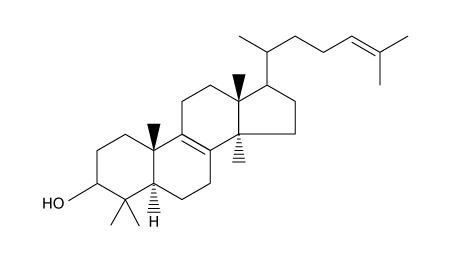 How many isoprene units are present in lanosterol?
 (Multiple Choice)
4.9/5 (83)
(83) Passage
The N-terminus of an amino acid must be protected with 9-fluorenylmethoxycarbonyl (Fmoc) during solid state peptide synthesis to avoid side reactions (Scheme I).
Scheme IThe Fmoc protecting group is typically removed with piperidine (Scheme II), a heterocyclic secondary amine.
Scheme IIBecause the use of piperidine is restricted, structurally similar amines were examined as possible replacements. To determine whether piperidine analogues were suitable alternatives for Fmoc removal, deprotection of Compound 2 was carried out with several amine bases (Scheme III).
Scheme IIICompound 2 was prepared from L-tryptophan and Fmoc-Cl, and the reaction was monitored by thin-layer chromatography (TLC) and visualized by ultraviolet light. The deprotections were done with piperidine and each analogue using a microwave set to 155 watts at 75 °C for 15 seconds. The products of the deprotections were analyzed by high-performance liquid chromatography (HPLC) and mass spectrometry; the retention times of the products were compared to tryptophan and Compound 2 standards.
Adapted from O.P. Luna et al, "Deprotection Reagents in Fmoc Solid Phase Peptide Synthesis: Moving Away from Piperidine?." Molecules. ©2016 MDPI.
-What can be inferred about the HPLC column used in the passage if tryptophan has a shorter retention time than Compound 2?
Scheme IThe Fmoc protecting group is typically removed with piperidine (Scheme II), a heterocyclic secondary amine.
Scheme IIBecause the use of piperidine is restricted, structurally similar amines were examined as possible replacements. To determine whether piperidine analogues were suitable alternatives for Fmoc removal, deprotection of Compound 2 was carried out with several amine bases (Scheme III).
Scheme IIICompound 2 was prepared from L-tryptophan and Fmoc-Cl, and the reaction was monitored by thin-layer chromatography (TLC) and visualized by ultraviolet light. The deprotections were done with piperidine and each analogue using a microwave set to 155 watts at 75 °C for 15 seconds. The products of the deprotections were analyzed by high-performance liquid chromatography (HPLC) and mass spectrometry; the retention times of the products were compared to tryptophan and Compound 2 standards.
Adapted from O.P. Luna et al, "Deprotection Reagents in Fmoc Solid Phase Peptide Synthesis: Moving Away from Piperidine?." Molecules. ©2016 MDPI.
-What can be inferred about the HPLC column used in the passage if tryptophan has a shorter retention time than Compound 2? (Multiple Choice)
4.9/5 (75)
(75) 
Filters
- Essay(0)
- Multiple Choice(0)
- Short Answer(0)
- True False(0)
- Matching(0)