
Exam 5: General Chemistry

arrow
  • Select Tags
search iconSearch Question
flashcardsStudy Flashcards
  • Select Tags

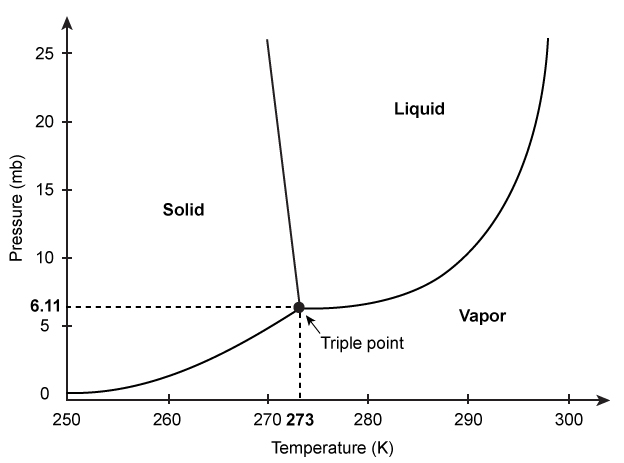
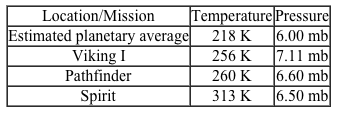
Passage Water is unique in that all three of its phases exist over a small range of pressures and temperatures, as shown in Figure 1. Passage Water is unique in that all three of its phases exist over a small range of pressures and temperatures, as shown in Figure 1.    <strong>Figure 1</strong>  Phase diagram for waterIn the liquid phase, water dissolves and transports molecules, and aids in the biochemical reactions necessary to support life.  For this reason, scientists believe liquid-phase water is essential to the existence of extraterrestrial life.  Although it has been known for some time that water is present in both the gas and ice phases on Mars, the question remains as to whether there are regions where liquid-phase water can stably exist.  Estimates of Mars' surface temperature and pressure generated from satellite readings and global climate models, as well as observations made by Mars rovers, reveal that surface conditions on the planet can vary greatly.<strong>Table 1</strong>  Temperature and Pressure of Various Locations on Mars    Despite the extremely low pressures and temperatures on Mars, satellite images have repeatedly found evidence of flowing liquid water in several regions during the late Martian summer season.  These regions, called recurring slope lineae (RSL), are hypothesized to be thermodynamically stable under certain Martian conditions due to the presence of dissolved salts.  A simple understanding of this hypothesis is afforded by Raoult law, which states that the vapor pressure and freezing point of an ideal solution are lowered as the number of moles of dissolved solute increases.  Moreover, this effect also impacts the solution boiling point (the point at which the vapor pressure of the solution becomes equal to the ambient pressure).The briny-water hypothesis was confirmed in 2015 when spectral data from the Compact Reconnaissance Imaging Spectrometer onboard the Mars Reconnaissance Orbiter revealed the presence of hydrated perchlorates in the same regions and times that RSL were observed.  Studies are already underway to determine how common such briny water flows are and whether the conditions within them are suitable for microbial life. -Which of the following conclusions can be made based on Figure 1 and the data in Table 1? Figure 1  Phase diagram for waterIn the liquid phase, water dissolves and transports molecules, and aids in the biochemical reactions necessary to support life.  For this reason, scientists believe liquid-phase water is essential to the existence of extraterrestrial life.  Although it has been known for some time that water is present in both the gas and ice phases on Mars, the question remains as to whether there are regions where liquid-phase water can stably exist.  Estimates of Mars' surface temperature and pressure generated from satellite readings and global climate models, as well as observations made by Mars rovers, reveal that surface conditions on the planet can vary greatly.Table 1  Temperature and Pressure of Various Locations on Mars Passage Water is unique in that all three of its phases exist over a small range of pressures and temperatures, as shown in Figure 1.    <strong>Figure 1</strong>  Phase diagram for waterIn the liquid phase, water dissolves and transports molecules, and aids in the biochemical reactions necessary to support life.  For this reason, scientists believe liquid-phase water is essential to the existence of extraterrestrial life.  Although it has been known for some time that water is present in both the gas and ice phases on Mars, the question remains as to whether there are regions where liquid-phase water can stably exist.  Estimates of Mars' surface temperature and pressure generated from satellite readings and global climate models, as well as observations made by Mars rovers, reveal that surface conditions on the planet can vary greatly.<strong>Table 1</strong>  Temperature and Pressure of Various Locations on Mars    Despite the extremely low pressures and temperatures on Mars, satellite images have repeatedly found evidence of flowing liquid water in several regions during the late Martian summer season.  These regions, called recurring slope lineae (RSL), are hypothesized to be thermodynamically stable under certain Martian conditions due to the presence of dissolved salts.  A simple understanding of this hypothesis is afforded by Raoult law, which states that the vapor pressure and freezing point of an ideal solution are lowered as the number of moles of dissolved solute increases.  Moreover, this effect also impacts the solution boiling point (the point at which the vapor pressure of the solution becomes equal to the ambient pressure).The briny-water hypothesis was confirmed in 2015 when spectral data from the Compact Reconnaissance Imaging Spectrometer onboard the Mars Reconnaissance Orbiter revealed the presence of hydrated perchlorates in the same regions and times that RSL were observed.  Studies are already underway to determine how common such briny water flows are and whether the conditions within them are suitable for microbial life. -Which of the following conclusions can be made based on Figure 1 and the data in Table 1? Despite the extremely low pressures and temperatures on Mars, satellite images have repeatedly found evidence of flowing liquid water in several regions during the late Martian summer season.  These regions, called recurring slope lineae (RSL), are hypothesized to be thermodynamically stable under certain Martian conditions due to the presence of dissolved salts.  A simple understanding of this hypothesis is afforded by Raoult law, which states that the vapor pressure and freezing point of an ideal solution are lowered as the number of moles of dissolved solute increases.  Moreover, this effect also impacts the solution boiling point (the point at which the vapor pressure of the solution becomes equal to the ambient pressure).The briny-water hypothesis was confirmed in 2015 when spectral data from the Compact Reconnaissance Imaging Spectrometer onboard the Mars Reconnaissance Orbiter revealed the presence of hydrated perchlorates in the same regions and times that RSL were observed.  Studies are already underway to determine how common such briny water flows are and whether the conditions within them are suitable for microbial life. -Which of the following conclusions can be made based on Figure 1 and the data in Table 1?
Free
(Multiple Choice)
4.9/5
(82)
Correct Answer:
Verified

D

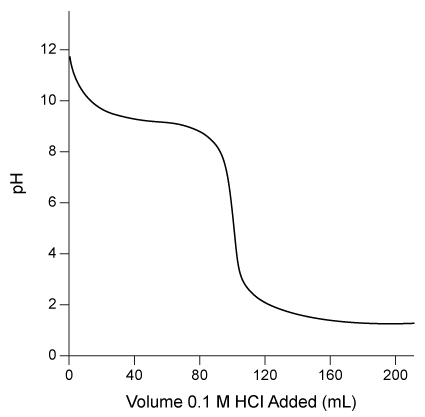
Consider the neutralization curve of aqueous ammonia with 0.1 M HCl, shown below. Consider the neutralization curve of aqueous ammonia with 0.1 M HCl, shown below.   The best indicator to use in the titration is: The best indicator to use in the titration is:
Free
(Multiple Choice)
4.8/5
(73)
Correct Answer:
Verified

B

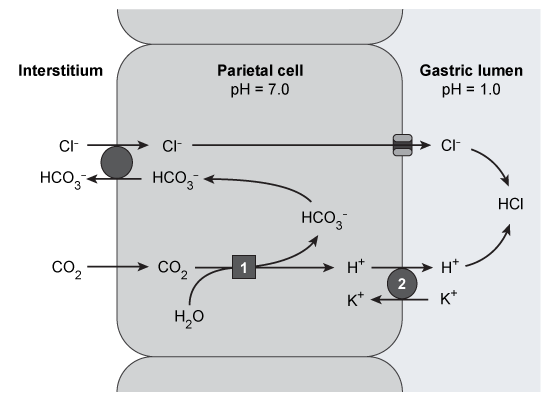
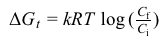
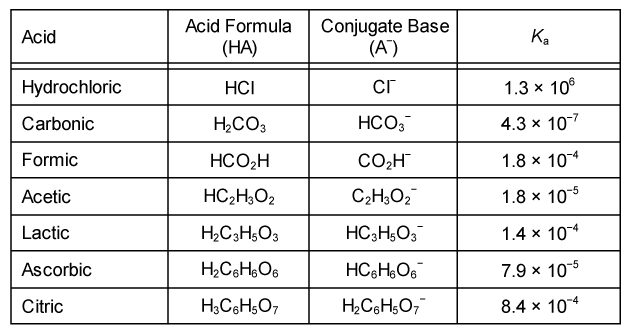
Passage Gastric acid is one of many acids important to biological function in the human body.  Production of the main component of gastric acid, hydrochloric acid (HCl), is accomplished in the stomach by the parietal cells, as shown in Figure 1. Passage Gastric acid is one of many acids important to biological function in the human body.  Production of the main component of gastric acid, hydrochloric acid (HCl), is accomplished in the stomach by the parietal cells, as shown in Figure 1.    <strong>Figure 1</strong>  Formation of gastric acid in the stomachFacilitated by the carbonate dehydratase enzyme (<strong>1</strong>), the parietal cells utilize the interaction between aqueous carbon dioxide and water in the blood as a source of bicarbonate ions and acidic H<sup>+</sup> ions (protons).  The H<sup>+</sup> ions produced in this process are then exchanged for potassium ions through the cell membrane by a proton pump, the H<sup>+</sup>/K<sup>+</sup>-ATPase (<strong>2</strong>).  In conjunction with this proton exchange, bicarbonate ions are also exchanged for chloride ions from the interstitial fluid.  As a result, H<sup>+</sup> and Cl<sup>−</sup> ions are concentrated in the lumen of the stomach to form aqueous hydrochloric acid.Because the production of the acid proceeds with a drop in pH from 7.0 in the cell cytosol to 1.0 in the stomach lumen, the process occurs against a concentration gradient and is endergonic, requiring the input of energy supplied by the hydrolysis of ATP.  Ignoring effects from ion charge, the free energy change for ion transport across the cell membrane (ΔG<sub>t</sub>) can be estimated by Equation 1:    ∆Gt=kRT logCfCi<strong>Equation 1</strong>where R is the gas constant (8.32 J/mol·K), k is a logarithm conversion constant, T is the absolute temperature, and C<sub>i</sub> and C<sub>f</sub> are the initial and final molar concentrations across the gradient, respectively.Although dilute, the gastric (hydrochloric) acid released into the lumen yields a strongly acidic environment crucial to protein digestion and the destruction of harmful micro-organisms.  A comparison of its acid dissociation constant (K<sub>a</sub>) to those of other biologically relevant organic acids is given in Table 1.<strong>Table 1</strong>  Comparison of Strengths of Selected 0.10 M Acids at 25°C    Adapted from Koolman J, Roehm KH. Color Atlas of Biochemistry. Thieme; 2011: 268-271; and Lehninger AL, Nelson DL, Cox MM. Lehninger Principles of Biochemistry. Macmillan; 2005: 397-398, 419, 520. -What is the estimated free energy change to transport H<sup>+</sup> ions across the cell membrane from the parietal cell cytosol to the stomach lumen at a physiological temperature? Figure 1  Formation of gastric acid in the stomachFacilitated by the carbonate dehydratase enzyme (1), the parietal cells utilize the interaction between aqueous carbon dioxide and water in the blood as a source of bicarbonate ions and acidic H+ ions (protons).  The H+ ions produced in this process are then exchanged for potassium ions through the cell membrane by a proton pump, the H+/K+-ATPase (2).  In conjunction with this proton exchange, bicarbonate ions are also exchanged for chloride ions from the interstitial fluid.  As a result, H+ and Cl− ions are concentrated in the lumen of the stomach to form aqueous hydrochloric acid.Because the production of the acid proceeds with a drop in pH from 7.0 in the cell cytosol to 1.0 in the stomach lumen, the process occurs against a concentration gradient and is endergonic, requiring the input of energy supplied by the hydrolysis of ATP.  Ignoring effects from ion charge, the free energy change for ion transport across the cell membrane (ΔGt) can be estimated by Equation 1: Passage Gastric acid is one of many acids important to biological function in the human body.  Production of the main component of gastric acid, hydrochloric acid (HCl), is accomplished in the stomach by the parietal cells, as shown in Figure 1.    <strong>Figure 1</strong>  Formation of gastric acid in the stomachFacilitated by the carbonate dehydratase enzyme (<strong>1</strong>), the parietal cells utilize the interaction between aqueous carbon dioxide and water in the blood as a source of bicarbonate ions and acidic H<sup>+</sup> ions (protons).  The H<sup>+</sup> ions produced in this process are then exchanged for potassium ions through the cell membrane by a proton pump, the H<sup>+</sup>/K<sup>+</sup>-ATPase (<strong>2</strong>).  In conjunction with this proton exchange, bicarbonate ions are also exchanged for chloride ions from the interstitial fluid.  As a result, H<sup>+</sup> and Cl<sup>−</sup> ions are concentrated in the lumen of the stomach to form aqueous hydrochloric acid.Because the production of the acid proceeds with a drop in pH from 7.0 in the cell cytosol to 1.0 in the stomach lumen, the process occurs against a concentration gradient and is endergonic, requiring the input of energy supplied by the hydrolysis of ATP.  Ignoring effects from ion charge, the free energy change for ion transport across the cell membrane (ΔG<sub>t</sub>) can be estimated by Equation 1:    ∆Gt=kRT logCfCi<strong>Equation 1</strong>where R is the gas constant (8.32 J/mol·K), k is a logarithm conversion constant, T is the absolute temperature, and C<sub>i</sub> and C<sub>f</sub> are the initial and final molar concentrations across the gradient, respectively.Although dilute, the gastric (hydrochloric) acid released into the lumen yields a strongly acidic environment crucial to protein digestion and the destruction of harmful micro-organisms.  A comparison of its acid dissociation constant (K<sub>a</sub>) to those of other biologically relevant organic acids is given in Table 1.<strong>Table 1</strong>  Comparison of Strengths of Selected 0.10 M Acids at 25°C    Adapted from Koolman J, Roehm KH. Color Atlas of Biochemistry. Thieme; 2011: 268-271; and Lehninger AL, Nelson DL, Cox MM. Lehninger Principles of Biochemistry. Macmillan; 2005: 397-398, 419, 520. -What is the estimated free energy change to transport H<sup>+</sup> ions across the cell membrane from the parietal cell cytosol to the stomach lumen at a physiological temperature? ∆Gt=kRT logCfCiEquation 1where R is the gas constant (8.32 J/mol·K), k is a logarithm conversion constant, T is the absolute temperature, and Ci and Cf are the initial and final molar concentrations across the gradient, respectively.Although dilute, the gastric (hydrochloric) acid released into the lumen yields a strongly acidic environment crucial to protein digestion and the destruction of harmful micro-organisms.  A comparison of its acid dissociation constant (Ka) to those of other biologically relevant organic acids is given in Table 1.Table 1  Comparison of Strengths of Selected 0.10 M Acids at 25°C Passage Gastric acid is one of many acids important to biological function in the human body.  Production of the main component of gastric acid, hydrochloric acid (HCl), is accomplished in the stomach by the parietal cells, as shown in Figure 1.    <strong>Figure 1</strong>  Formation of gastric acid in the stomachFacilitated by the carbonate dehydratase enzyme (<strong>1</strong>), the parietal cells utilize the interaction between aqueous carbon dioxide and water in the blood as a source of bicarbonate ions and acidic H<sup>+</sup> ions (protons).  The H<sup>+</sup> ions produced in this process are then exchanged for potassium ions through the cell membrane by a proton pump, the H<sup>+</sup>/K<sup>+</sup>-ATPase (<strong>2</strong>).  In conjunction with this proton exchange, bicarbonate ions are also exchanged for chloride ions from the interstitial fluid.  As a result, H<sup>+</sup> and Cl<sup>−</sup> ions are concentrated in the lumen of the stomach to form aqueous hydrochloric acid.Because the production of the acid proceeds with a drop in pH from 7.0 in the cell cytosol to 1.0 in the stomach lumen, the process occurs against a concentration gradient and is endergonic, requiring the input of energy supplied by the hydrolysis of ATP.  Ignoring effects from ion charge, the free energy change for ion transport across the cell membrane (ΔG<sub>t</sub>) can be estimated by Equation 1:    ∆Gt=kRT logCfCi<strong>Equation 1</strong>where R is the gas constant (8.32 J/mol·K), k is a logarithm conversion constant, T is the absolute temperature, and C<sub>i</sub> and C<sub>f</sub> are the initial and final molar concentrations across the gradient, respectively.Although dilute, the gastric (hydrochloric) acid released into the lumen yields a strongly acidic environment crucial to protein digestion and the destruction of harmful micro-organisms.  A comparison of its acid dissociation constant (K<sub>a</sub>) to those of other biologically relevant organic acids is given in Table 1.<strong>Table 1</strong>  Comparison of Strengths of Selected 0.10 M Acids at 25°C    Adapted from Koolman J, Roehm KH. Color Atlas of Biochemistry. Thieme; 2011: 268-271; and Lehninger AL, Nelson DL, Cox MM. Lehninger Principles of Biochemistry. Macmillan; 2005: 397-398, 419, 520. -What is the estimated free energy change to transport H<sup>+</sup> ions across the cell membrane from the parietal cell cytosol to the stomach lumen at a physiological temperature? Adapted from Koolman J, Roehm KH. Color Atlas of Biochemistry. Thieme; 2011: 268-271; and Lehninger AL, Nelson DL, Cox MM. Lehninger Principles of Biochemistry. Macmillan; 2005: 397-398, 419, 520. -What is the estimated free energy change to transport H+ ions across the cell membrane from the parietal cell cytosol to the stomach lumen at a physiological temperature?
Free
(Multiple Choice)
4.8/5
(79)
Correct Answer:
Verified

C

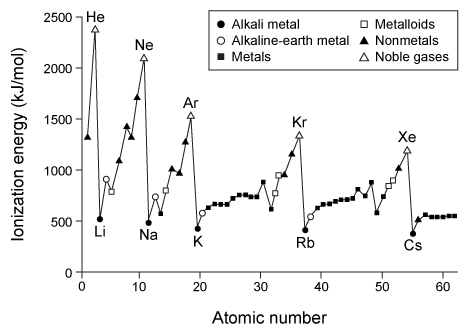
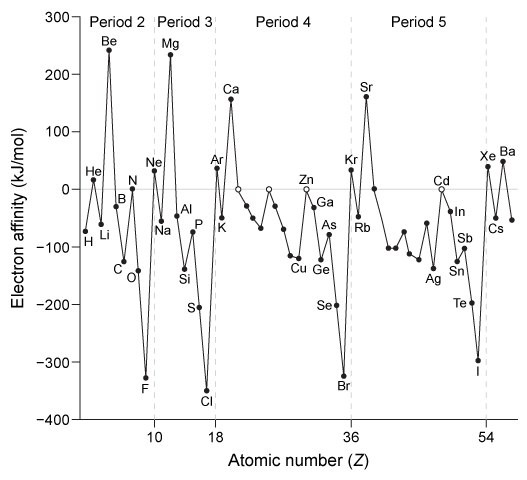
Passage Dmitri Mendeleev is credited with grouping the elements by atomic mass and observing that similar properties emerge periodically.  Henry Moseley then determined that a fundamental property, which Ernest Rutherford later called the atomic number, is more important than atomic mass for ordering the elements.As the periodic table took shape, scientists noted certain properties and trends.  For example, Rayleigh and Ramsay observed that some elements are unreactive and gave them the name noble gases.  But it was not until Niels Bohr described his model of the atom that scientists understood why noble gases are stable.Another important trend was discovered by Linus Pauling.  He was the first to identify electronegativity as a way to describe bonds that are neither completely ionic nor completely covalent.  Pauling assigned fluorine the highest electronegativity value of 4.0 because of its strong tendency to attract electrons when bonded to other atoms.  All other atoms were assigned values relative to fluorine.  This became known as the Pauling electronegativity scale.Scientists identified other trends based on x-ray crystallography and reactivity studies.  Figure 1 shows the first ionization energy of the elements, and Figure 2 shows electron affinity. Passage Dmitri Mendeleev is credited with grouping the elements by atomic mass and observing that similar properties emerge periodically.  Henry Moseley then determined that a fundamental property, which Ernest Rutherford later called the atomic number, is more important than atomic mass for ordering the elements.As the periodic table took shape, scientists noted certain properties and trends.  For example, Rayleigh and Ramsay observed that some elements are unreactive and gave them the name noble gases.  But it was not until Niels Bohr described his model of the atom that scientists understood why noble gases are stable.Another important trend was discovered by Linus Pauling.  He was the first to identify electronegativity as a way to describe bonds that are neither completely ionic nor completely covalent.  Pauling assigned fluorine the highest electronegativity value of 4.0 because of its strong tendency to attract electrons when bonded to other atoms.  All other atoms were assigned values relative to fluorine.  This became known as the Pauling electronegativity scale.Scientists identified other trends based on x-ray crystallography and reactivity studies.  Figure 1 shows the first ionization energy of the elements, and Figure 2 shows electron affinity.    <strong>Figure 1</strong>  First ionization energy of elements    <strong>Figure 2</strong>  Electron affinity of several elements (larger negative values indicate greater electron affinity) -According to the information in the passage, adding electrons to nonmetals is: Figure 1  First ionization energy of elements Passage Dmitri Mendeleev is credited with grouping the elements by atomic mass and observing that similar properties emerge periodically.  Henry Moseley then determined that a fundamental property, which Ernest Rutherford later called the atomic number, is more important than atomic mass for ordering the elements.As the periodic table took shape, scientists noted certain properties and trends.  For example, Rayleigh and Ramsay observed that some elements are unreactive and gave them the name noble gases.  But it was not until Niels Bohr described his model of the atom that scientists understood why noble gases are stable.Another important trend was discovered by Linus Pauling.  He was the first to identify electronegativity as a way to describe bonds that are neither completely ionic nor completely covalent.  Pauling assigned fluorine the highest electronegativity value of 4.0 because of its strong tendency to attract electrons when bonded to other atoms.  All other atoms were assigned values relative to fluorine.  This became known as the Pauling electronegativity scale.Scientists identified other trends based on x-ray crystallography and reactivity studies.  Figure 1 shows the first ionization energy of the elements, and Figure 2 shows electron affinity.    <strong>Figure 1</strong>  First ionization energy of elements    <strong>Figure 2</strong>  Electron affinity of several elements (larger negative values indicate greater electron affinity) -According to the information in the passage, adding electrons to nonmetals is: Figure 2  Electron affinity of several elements (larger negative values indicate greater electron affinity) -According to the information in the passage, adding electrons to nonmetals is:
(Multiple Choice)
4.9/5
(69)

Which of the following molecules has the carbon-oxygen bond with the highest bond dissociation energy?

(Multiple Choice)
4.8/5
(100)

Which of the following molecules exhibit an octahedral bonding configuration?ClF5SeCl6SF3Cl3CF4

(Multiple Choice)
4.9/5
(60)

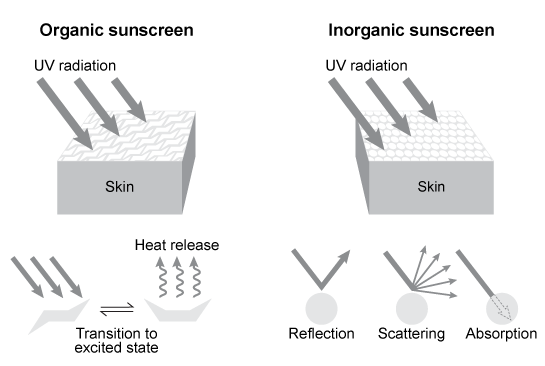
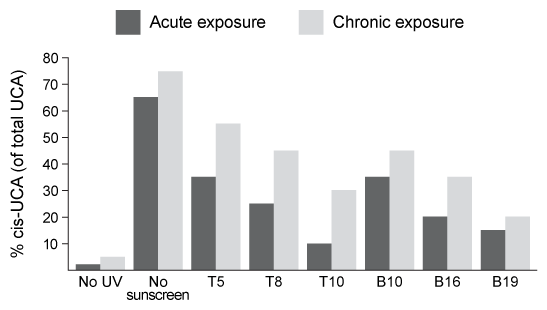
Passage Depending on the active compound's specific method of action, sunscreens are broadly classified into two groups: organic and inorganic.  Organic sunscreens typically contain aromatic compounds that absorb ultraviolet (UV) radiation. The absorbed energy from the UV radiation causes these compounds to enter electronically excited states which then relax back to the ground state and harmlessly re-emit the absorbed radiation as heat.  Alternatively, inorganic sunscreens contain metallic nanoparticles that serve to reflect, scatter, and absorb incident radiation.  The mechanism for UV protection of each group is shown in Figure 1. Passage Depending on the active compound's specific method of action, sunscreens are broadly classified into two groups: organic and inorganic.  Organic sunscreens typically contain aromatic compounds that absorb ultraviolet (UV) radiation. The absorbed energy from the UV radiation causes these compounds to enter electronically excited states which then relax back to the ground state and harmlessly re-emit the absorbed radiation as heat.  Alternatively, inorganic sunscreens contain metallic nanoparticles that serve to reflect, scatter, and absorb incident radiation.  The mechanism for UV protection of each group is shown in Figure 1.    <strong>Figure 1</strong>  Method of action for organic and inorganic sunscreensThe effectiveness of sunscreens is traditionally evaluated based on their ability to prevent reddening of the skin, as indicated by their sun protection factor (SPF).  However, studies have shown that additional deleterious effects, such as the suppression of T cell-mediated immune responses, can occur at lower UV doses than erythema, indicating the need for new metrics to judge sunscreen efficacy.  For this reason, researchers conducted a study to compare the protective ability of six sunscreens against photo-isomerization of the photoreceptor trans-urocanic acid (UCA) to its cis form, a process believed to be linked to UV-induced immunosuppression.  Table 1 lists the sunscreens tested and their relevant characteristics.<strong>Table 1</strong>  Results from Tested Sunscreens    In vivo experiments were conducted on two groups of human volunteers.  Participants in the acute exposure group received a single UV dose of 100 mJ/cm<sup>2</sup> whereas participants in the chronic exposure group received the same dosage once daily over four consecutive days.  Each sunscreen was applied to a different spot on the volunteers' back prior to irradiation.  A portion of skin without sunscreen was also irradiated to serve as a control.  After irradiation, the sunscreens were removed and the skin was wiped with filter papers.  Filters were washed with potassium hydroxide, and the aqueous solution was analyzed for UCA using high-pressure liquid chromatography.  Figure 2 shows the mean percentages of cis-UCA formed upon irradiation for each exposure type and sunscreen tested.    <strong>Figure 2</strong>  Percentage of UCA in cis configuration upon UV exposure with various sunscreens Adapted from Van der molen RG, Out-luiting C, Driller H, Claas FH, Koerten HK, Mommaas AM. Broad-spectrum sunscreens offer protection against urocanic acid photoisomerization by artificial ultraviolet radiation in human skin. J Invest Dermatol. 2000;115(3):421-6. -Which of the following statements is true concerning sunscreens? Figure 1  Method of action for organic and inorganic sunscreensThe effectiveness of sunscreens is traditionally evaluated based on their ability to prevent reddening of the skin, as indicated by their sun protection factor (SPF).  However, studies have shown that additional deleterious effects, such as the suppression of T cell-mediated immune responses, can occur at lower UV doses than erythema, indicating the need for new metrics to judge sunscreen efficacy.  For this reason, researchers conducted a study to compare the protective ability of six sunscreens against photo-isomerization of the photoreceptor trans-urocanic acid (UCA) to its cis form, a process believed to be linked to UV-induced immunosuppression.  Table 1 lists the sunscreens tested and their relevant characteristics.Table 1  Results from Tested Sunscreens Passage Depending on the active compound's specific method of action, sunscreens are broadly classified into two groups: organic and inorganic.  Organic sunscreens typically contain aromatic compounds that absorb ultraviolet (UV) radiation. The absorbed energy from the UV radiation causes these compounds to enter electronically excited states which then relax back to the ground state and harmlessly re-emit the absorbed radiation as heat.  Alternatively, inorganic sunscreens contain metallic nanoparticles that serve to reflect, scatter, and absorb incident radiation.  The mechanism for UV protection of each group is shown in Figure 1.    <strong>Figure 1</strong>  Method of action for organic and inorganic sunscreensThe effectiveness of sunscreens is traditionally evaluated based on their ability to prevent reddening of the skin, as indicated by their sun protection factor (SPF).  However, studies have shown that additional deleterious effects, such as the suppression of T cell-mediated immune responses, can occur at lower UV doses than erythema, indicating the need for new metrics to judge sunscreen efficacy.  For this reason, researchers conducted a study to compare the protective ability of six sunscreens against photo-isomerization of the photoreceptor trans-urocanic acid (UCA) to its cis form, a process believed to be linked to UV-induced immunosuppression.  Table 1 lists the sunscreens tested and their relevant characteristics.<strong>Table 1</strong>  Results from Tested Sunscreens    In vivo experiments were conducted on two groups of human volunteers.  Participants in the acute exposure group received a single UV dose of 100 mJ/cm<sup>2</sup> whereas participants in the chronic exposure group received the same dosage once daily over four consecutive days.  Each sunscreen was applied to a different spot on the volunteers' back prior to irradiation.  A portion of skin without sunscreen was also irradiated to serve as a control.  After irradiation, the sunscreens were removed and the skin was wiped with filter papers.  Filters were washed with potassium hydroxide, and the aqueous solution was analyzed for UCA using high-pressure liquid chromatography.  Figure 2 shows the mean percentages of cis-UCA formed upon irradiation for each exposure type and sunscreen tested.    <strong>Figure 2</strong>  Percentage of UCA in cis configuration upon UV exposure with various sunscreens Adapted from Van der molen RG, Out-luiting C, Driller H, Claas FH, Koerten HK, Mommaas AM. Broad-spectrum sunscreens offer protection against urocanic acid photoisomerization by artificial ultraviolet radiation in human skin. J Invest Dermatol. 2000;115(3):421-6. -Which of the following statements is true concerning sunscreens? In vivo experiments were conducted on two groups of human volunteers.  Participants in the acute exposure group received a single UV dose of 100 mJ/cm2 whereas participants in the chronic exposure group received the same dosage once daily over four consecutive days.  Each sunscreen was applied to a different spot on the volunteers' back prior to irradiation.  A portion of skin without sunscreen was also irradiated to serve as a control.  After irradiation, the sunscreens were removed and the skin was wiped with filter papers.  Filters were washed with potassium hydroxide, and the aqueous solution was analyzed for UCA using high-pressure liquid chromatography.  Figure 2 shows the mean percentages of cis-UCA formed upon irradiation for each exposure type and sunscreen tested. Passage Depending on the active compound's specific method of action, sunscreens are broadly classified into two groups: organic and inorganic.  Organic sunscreens typically contain aromatic compounds that absorb ultraviolet (UV) radiation. The absorbed energy from the UV radiation causes these compounds to enter electronically excited states which then relax back to the ground state and harmlessly re-emit the absorbed radiation as heat.  Alternatively, inorganic sunscreens contain metallic nanoparticles that serve to reflect, scatter, and absorb incident radiation.  The mechanism for UV protection of each group is shown in Figure 1.    <strong>Figure 1</strong>  Method of action for organic and inorganic sunscreensThe effectiveness of sunscreens is traditionally evaluated based on their ability to prevent reddening of the skin, as indicated by their sun protection factor (SPF).  However, studies have shown that additional deleterious effects, such as the suppression of T cell-mediated immune responses, can occur at lower UV doses than erythema, indicating the need for new metrics to judge sunscreen efficacy.  For this reason, researchers conducted a study to compare the protective ability of six sunscreens against photo-isomerization of the photoreceptor trans-urocanic acid (UCA) to its cis form, a process believed to be linked to UV-induced immunosuppression.  Table 1 lists the sunscreens tested and their relevant characteristics.<strong>Table 1</strong>  Results from Tested Sunscreens    In vivo experiments were conducted on two groups of human volunteers.  Participants in the acute exposure group received a single UV dose of 100 mJ/cm<sup>2</sup> whereas participants in the chronic exposure group received the same dosage once daily over four consecutive days.  Each sunscreen was applied to a different spot on the volunteers' back prior to irradiation.  A portion of skin without sunscreen was also irradiated to serve as a control.  After irradiation, the sunscreens were removed and the skin was wiped with filter papers.  Filters were washed with potassium hydroxide, and the aqueous solution was analyzed for UCA using high-pressure liquid chromatography.  Figure 2 shows the mean percentages of cis-UCA formed upon irradiation for each exposure type and sunscreen tested.    <strong>Figure 2</strong>  Percentage of UCA in cis configuration upon UV exposure with various sunscreens Adapted from Van der molen RG, Out-luiting C, Driller H, Claas FH, Koerten HK, Mommaas AM. Broad-spectrum sunscreens offer protection against urocanic acid photoisomerization by artificial ultraviolet radiation in human skin. J Invest Dermatol. 2000;115(3):421-6. -Which of the following statements is true concerning sunscreens? Figure 2  Percentage of UCA in cis configuration upon UV exposure with various sunscreens Adapted from Van der molen RG, Out-luiting C, Driller H, Claas FH, Koerten HK, Mommaas AM. Broad-spectrum sunscreens offer protection against urocanic acid photoisomerization by artificial ultraviolet radiation in human skin. J Invest Dermatol. 2000;115(3):421-6. -Which of the following statements is true concerning sunscreens?

(Multiple Choice)
4.9/5
(70)

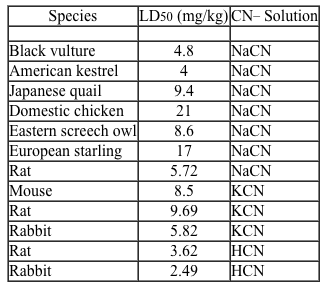
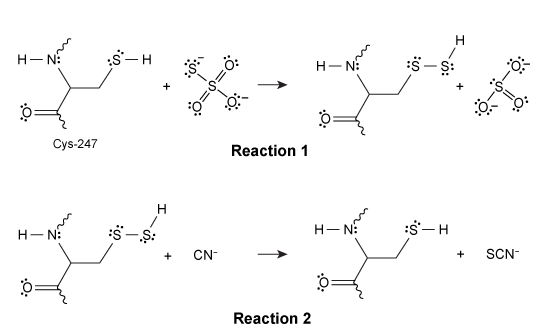
Passage Cyanide (CN−) is a powerful, rapid toxin that binds to the cellular respiratory enzyme cytochrome c oxidase.  The resulting enzyme-cyanide complex blocks the transfer of electrons to oxygen in the last step of the electron transport chain.  This results in cytotoxic anoxia, causing asphyxiation at the cellular level.Exposure to cyanide can occur from dietary sources, medical treatments, industrial applications, smoke inhalation (structural fires), and intentional use (suicide).  While dietary exposure from moderate consumption of naturally occurring plant compounds such as cyanogenic glycosides rarely results in acute adverse effects in humans, chronic effects have been observed from prolonged diets with significant levels of these compounds.  In the developed world, risk of significant cyanide exposure is most likely to result from smoke inhalation during building fires or from industrial/occupational exposures.The impact of a given exposure depends on the amount (dose, duration), the chemical composition of the cyanide compound (HCN, NaCN, KCN), and the route of exposure (inhalation, absorption, ingestion).  The ionic salts (NaCN, KCN) and free acid (HCN) forms of cyanide each have different acid-base properties that interact differently under the physiological conditions associated with each route of exposure.To better understand the toxicity of different forms of cyanide, animal models have been studied for comparison to known human exposure case studies.  Table 1 presents a summary of selected animal toxicity studies that examine exposure via ingestion.  The table provides the lethal dose to 50% of the population (LD50) in milligrams of cyanide per kilogram of body weight (mg/kg).Table 1  Compilation of LD50 Cyanide Values in Various Animal Species Passage Cyanide (CN<sup>−</sup>) is a powerful, rapid toxin that binds to the cellular respiratory enzyme cytochrome c oxidase.  The resulting enzyme-cyanide complex blocks the transfer of electrons to oxygen in the last step of the electron transport chain.  This results in cytotoxic anoxia, causing asphyxiation at the cellular level.Exposure to cyanide can occur from dietary sources, medical treatments, industrial applications, smoke inhalation (structural fires), and intentional use (suicide).  While dietary exposure from moderate consumption of naturally occurring plant compounds such as cyanogenic glycosides rarely results in acute adverse effects in humans, chronic effects have been observed from prolonged diets with significant levels of these compounds.  In the developed world, risk of significant cyanide exposure is most likely to result from smoke inhalation during building fires or from industrial/occupational exposures.The impact of a given exposure depends on the amount (dose, duration), the chemical composition of the cyanide compound (HCN, NaCN, KCN), and the route of exposure (inhalation, absorption, ingestion).  The ionic salts (NaCN, KCN) and free acid (HCN) forms of cyanide each have different acid-base properties that interact differently under the physiological conditions associated with each route of exposure.To better understand the toxicity of different forms of cyanide, animal models have been studied for comparison to known human exposure case studies.  Table 1 presents a summary of selected animal toxicity studies that examine exposure via ingestion.  The table provides the lethal dose to 50% of the population (LD<sub>50</sub>) in milligrams of cyanide per kilogram of body weight (mg/kg).<strong>Table 1</strong>  Compilation of LD<sub>50</sub> Cyanide Values in Various Animal Species    Based on animal models, one treatment developed for cyanide poisoning involves assisting the rhodanese enzyme in metabolizing CN<sup>−</sup> to SCN<sup>−</sup> via an intravenous solution of NaNO<sub>2</sub> and Na<sub>2</sub>S<sub>2</sub>O<sub>3</sub>.  The Na<sub>2</sub>S<sub>2</sub>O<sub>3</sub> assists in the formation of a reactive S-SH (persulfide) bond in the enzyme on cysteine-247 (Reaction 1), which then reacts with the cyanide ion to form thiocyanate (Reaction 2).    Adapted from: Hall AH, Isom GE, Rockwood GA. Toxicology of Cyanides and Cyanogens, Experimental, Applied and Clinical Aspects. John Wiley & Sons; 2015: 1-20; and Egekeze JO, Oehme FW. Cyanides and their toxicity: A literature review. Vet Q. 1980; 2(2): 104-114. -The acid dissociation constant K<sub>a</sub> for HCN is approximately 1 × 10<sup>−9</sup>.  What is the value of the pK<sub>b</sub>? Based on animal models, one treatment developed for cyanide poisoning involves assisting the rhodanese enzyme in metabolizing CN− to SCN− via an intravenous solution of NaNO2 and Na2S2O3.  The Na2S2O3 assists in the formation of a reactive S-SH (persulfide) bond in the enzyme on cysteine-247 (Reaction 1), which then reacts with the cyanide ion to form thiocyanate (Reaction 2). Passage Cyanide (CN<sup>−</sup>) is a powerful, rapid toxin that binds to the cellular respiratory enzyme cytochrome c oxidase.  The resulting enzyme-cyanide complex blocks the transfer of electrons to oxygen in the last step of the electron transport chain.  This results in cytotoxic anoxia, causing asphyxiation at the cellular level.Exposure to cyanide can occur from dietary sources, medical treatments, industrial applications, smoke inhalation (structural fires), and intentional use (suicide).  While dietary exposure from moderate consumption of naturally occurring plant compounds such as cyanogenic glycosides rarely results in acute adverse effects in humans, chronic effects have been observed from prolonged diets with significant levels of these compounds.  In the developed world, risk of significant cyanide exposure is most likely to result from smoke inhalation during building fires or from industrial/occupational exposures.The impact of a given exposure depends on the amount (dose, duration), the chemical composition of the cyanide compound (HCN, NaCN, KCN), and the route of exposure (inhalation, absorption, ingestion).  The ionic salts (NaCN, KCN) and free acid (HCN) forms of cyanide each have different acid-base properties that interact differently under the physiological conditions associated with each route of exposure.To better understand the toxicity of different forms of cyanide, animal models have been studied for comparison to known human exposure case studies.  Table 1 presents a summary of selected animal toxicity studies that examine exposure via ingestion.  The table provides the lethal dose to 50% of the population (LD<sub>50</sub>) in milligrams of cyanide per kilogram of body weight (mg/kg).<strong>Table 1</strong>  Compilation of LD<sub>50</sub> Cyanide Values in Various Animal Species    Based on animal models, one treatment developed for cyanide poisoning involves assisting the rhodanese enzyme in metabolizing CN<sup>−</sup> to SCN<sup>−</sup> via an intravenous solution of NaNO<sub>2</sub> and Na<sub>2</sub>S<sub>2</sub>O<sub>3</sub>.  The Na<sub>2</sub>S<sub>2</sub>O<sub>3</sub> assists in the formation of a reactive S-SH (persulfide) bond in the enzyme on cysteine-247 (Reaction 1), which then reacts with the cyanide ion to form thiocyanate (Reaction 2).    Adapted from: Hall AH, Isom GE, Rockwood GA. Toxicology of Cyanides and Cyanogens, Experimental, Applied and Clinical Aspects. John Wiley & Sons; 2015: 1-20; and Egekeze JO, Oehme FW. Cyanides and their toxicity: A literature review. Vet Q. 1980; 2(2): 104-114. -The acid dissociation constant K<sub>a</sub> for HCN is approximately 1 × 10<sup>−9</sup>.  What is the value of the pK<sub>b</sub>? Adapted from: Hall AH, Isom GE, Rockwood GA. Toxicology of Cyanides and Cyanogens, Experimental, Applied and Clinical Aspects. John Wiley & Sons; 2015: 1-20; and Egekeze JO, Oehme FW. Cyanides and their toxicity: A literature review. Vet Q. 1980; 2(2): 104-114. -The acid dissociation constant Ka for HCN is approximately 1 × 10⁻⁹.  What is the value of the pKb?
(Multiple Choice)
4.8/5
(81)

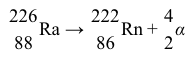
Passage The alkaline-earth metals are a highly reactive family of metals occupying Group 2 (IIA) of the periodic table.  In their elemental form, the alkaline-earth metals have a shiny, silvery-white to slightly yellowish appearance.  The alkaline-earth metals exhibit some similarities to the chemistry of the alkali metals (Group 1) but are a little less reactive.Atoms of the alkaline-earth metals (M) have only two valence electrons and a low first and second ionization energy.  Consequently, these metals readily lose both electrons to produce cations with a +2 charge (M+2) during reactions with nonmetals.  As a result, the alkaline-earth metals do not exist in their elemental metallic form in nature.  Instead, the Group 2 elements are found primarily as metal oxides, which form by reacting oxygen (Reaction 1). Passage The alkaline-earth metals are a highly reactive family of metals occupying Group 2 (IIA) of the periodic table.  In their elemental form, the alkaline-earth metals have a shiny, silvery-white to slightly yellowish appearance.  The alkaline-earth metals exhibit some similarities to the chemistry of the alkali metals (Group 1) but are a little less reactive.Atoms of the alkaline-earth metals (M) have only two valence electrons and a low first and second ionization energy.  Consequently, these metals readily lose both electrons to produce cations with a +2 charge (M<sup>+2</sup>) during reactions with nonmetals.  As a result, the alkaline-earth metals do not exist in their elemental metallic form in nature.  Instead, the Group 2 elements are found primarily as metal oxides, which form by reacting oxygen (Reaction 1).     Similarly, elemental samples of alkaline-earth metals will react with elemental halogens (X<sub>2</sub>) to form metal halides (Reaction 2), all of which are ionic except for BeCl<sub>2</sub>.     Except for beryllium, the alkaline-earth metals react with water to produce very basic metal hydroxide solutions and hydrogen gas (Reaction 3).     The most difficult alkaline-earth metal to study is radium, because it is a rare radioactive element that is produced from the nuclear decay of uranium.  The most common natural isotope, radium-226, has a half-life of 1,600 years and decays by alpha emission into radon-222 (Reaction 4).    -Moving down the column, the alkaline-earth metals are observed to give increasingly vigorous reactions when forming ionic bonds with nonmetals (Reactions 1-3).  Based on atomic properties, this trend in reactivity is best explained by comparing: Similarly, elemental samples of alkaline-earth metals will react with elemental halogens (X2) to form metal halides (Reaction 2), all of which are ionic except for BeCl2. Passage The alkaline-earth metals are a highly reactive family of metals occupying Group 2 (IIA) of the periodic table.  In their elemental form, the alkaline-earth metals have a shiny, silvery-white to slightly yellowish appearance.  The alkaline-earth metals exhibit some similarities to the chemistry of the alkali metals (Group 1) but are a little less reactive.Atoms of the alkaline-earth metals (M) have only two valence electrons and a low first and second ionization energy.  Consequently, these metals readily lose both electrons to produce cations with a +2 charge (M<sup>+2</sup>) during reactions with nonmetals.  As a result, the alkaline-earth metals do not exist in their elemental metallic form in nature.  Instead, the Group 2 elements are found primarily as metal oxides, which form by reacting oxygen (Reaction 1).     Similarly, elemental samples of alkaline-earth metals will react with elemental halogens (X<sub>2</sub>) to form metal halides (Reaction 2), all of which are ionic except for BeCl<sub>2</sub>.     Except for beryllium, the alkaline-earth metals react with water to produce very basic metal hydroxide solutions and hydrogen gas (Reaction 3).     The most difficult alkaline-earth metal to study is radium, because it is a rare radioactive element that is produced from the nuclear decay of uranium.  The most common natural isotope, radium-226, has a half-life of 1,600 years and decays by alpha emission into radon-222 (Reaction 4).    -Moving down the column, the alkaline-earth metals are observed to give increasingly vigorous reactions when forming ionic bonds with nonmetals (Reactions 1-3).  Based on atomic properties, this trend in reactivity is best explained by comparing: Except for beryllium, the alkaline-earth metals react with water to produce very basic metal hydroxide solutions and hydrogen gas (Reaction 3). Passage The alkaline-earth metals are a highly reactive family of metals occupying Group 2 (IIA) of the periodic table.  In their elemental form, the alkaline-earth metals have a shiny, silvery-white to slightly yellowish appearance.  The alkaline-earth metals exhibit some similarities to the chemistry of the alkali metals (Group 1) but are a little less reactive.Atoms of the alkaline-earth metals (M) have only two valence electrons and a low first and second ionization energy.  Consequently, these metals readily lose both electrons to produce cations with a +2 charge (M<sup>+2</sup>) during reactions with nonmetals.  As a result, the alkaline-earth metals do not exist in their elemental metallic form in nature.  Instead, the Group 2 elements are found primarily as metal oxides, which form by reacting oxygen (Reaction 1).     Similarly, elemental samples of alkaline-earth metals will react with elemental halogens (X<sub>2</sub>) to form metal halides (Reaction 2), all of which are ionic except for BeCl<sub>2</sub>.     Except for beryllium, the alkaline-earth metals react with water to produce very basic metal hydroxide solutions and hydrogen gas (Reaction 3).     The most difficult alkaline-earth metal to study is radium, because it is a rare radioactive element that is produced from the nuclear decay of uranium.  The most common natural isotope, radium-226, has a half-life of 1,600 years and decays by alpha emission into radon-222 (Reaction 4).    -Moving down the column, the alkaline-earth metals are observed to give increasingly vigorous reactions when forming ionic bonds with nonmetals (Reactions 1-3).  Based on atomic properties, this trend in reactivity is best explained by comparing: The most difficult alkaline-earth metal to study is radium, because it is a rare radioactive element that is produced from the nuclear decay of uranium.  The most common natural isotope, radium-226, has a half-life of 1,600 years and decays by alpha emission into radon-222 (Reaction 4). Passage The alkaline-earth metals are a highly reactive family of metals occupying Group 2 (IIA) of the periodic table.  In their elemental form, the alkaline-earth metals have a shiny, silvery-white to slightly yellowish appearance.  The alkaline-earth metals exhibit some similarities to the chemistry of the alkali metals (Group 1) but are a little less reactive.Atoms of the alkaline-earth metals (M) have only two valence electrons and a low first and second ionization energy.  Consequently, these metals readily lose both electrons to produce cations with a +2 charge (M<sup>+2</sup>) during reactions with nonmetals.  As a result, the alkaline-earth metals do not exist in their elemental metallic form in nature.  Instead, the Group 2 elements are found primarily as metal oxides, which form by reacting oxygen (Reaction 1).     Similarly, elemental samples of alkaline-earth metals will react with elemental halogens (X<sub>2</sub>) to form metal halides (Reaction 2), all of which are ionic except for BeCl<sub>2</sub>.     Except for beryllium, the alkaline-earth metals react with water to produce very basic metal hydroxide solutions and hydrogen gas (Reaction 3).     The most difficult alkaline-earth metal to study is radium, because it is a rare radioactive element that is produced from the nuclear decay of uranium.  The most common natural isotope, radium-226, has a half-life of 1,600 years and decays by alpha emission into radon-222 (Reaction 4).    -Moving down the column, the alkaline-earth metals are observed to give increasingly vigorous reactions when forming ionic bonds with nonmetals (Reactions 1-3).  Based on atomic properties, this trend in reactivity is best explained by comparing: -Moving down the column, the alkaline-earth metals are observed to give increasingly vigorous reactions when forming ionic bonds with nonmetals (Reactions 1-3).  Based on atomic properties, this trend in reactivity is best explained by comparing:



(Multiple Choice)
4.7/5
(83)

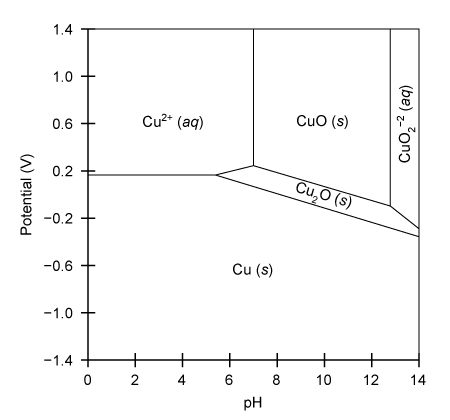
Copper plays a vital role as a trace mineral for biological processes, including the electron transport chain and collagen synthesis.  The Pourbaix diagram below outlines the relationship between several copper species as a function of solution pH and applied potential.  Which statement accurately describes the chemical changes shown in this diagram? Copper plays a vital role as a trace mineral for biological processes, including the electron transport chain and collagen synthesis.  The Pourbaix diagram below outlines the relationship between several copper species as a function of solution pH and applied potential.  Which statement accurately describes the chemical changes shown in this diagram?
(Multiple Choice)
4.9/5
(82)

Passage The alkaline-earth metals are a highly reactive family of metals occupying Group 2 (IIA) of the periodic table.  In their elemental form, the alkaline-earth metals have a shiny, silvery-white to slightly yellowish appearance.  The alkaline-earth metals exhibit some similarities to the chemistry of the alkali metals (Group 1) but are a little less reactive.Atoms of the alkaline-earth metals (M) have only two valence electrons and a low first and second ionization energy.  Consequently, these metals readily lose both electrons to produce cations with a +2 charge (M+2) during reactions with nonmetals.  As a result, the alkaline-earth metals do not exist in their elemental metallic form in nature.  Instead, the Group 2 elements are found primarily as metal oxides, which form by reacting oxygen (Reaction 1). Passage The alkaline-earth metals are a highly reactive family of metals occupying Group 2 (IIA) of the periodic table.  In their elemental form, the alkaline-earth metals have a shiny, silvery-white to slightly yellowish appearance.  The alkaline-earth metals exhibit some similarities to the chemistry of the alkali metals (Group 1) but are a little less reactive.Atoms of the alkaline-earth metals (M) have only two valence electrons and a low first and second ionization energy.  Consequently, these metals readily lose both electrons to produce cations with a +2 charge (M<sup>+2</sup>) during reactions with nonmetals.  As a result, the alkaline-earth metals do not exist in their elemental metallic form in nature.  Instead, the Group 2 elements are found primarily as metal oxides, which form by reacting oxygen (Reaction 1).     Similarly, elemental samples of alkaline-earth metals will react with elemental halogens (X<sub>2</sub>) to form metal halides (Reaction 2), all of which are ionic except for BeCl<sub>2</sub>.     Except for beryllium, the alkaline-earth metals react with water to produce very basic metal hydroxide solutions and hydrogen gas (Reaction 3).     The most difficult alkaline-earth metal to study is radium, because it is a rare radioactive element that is produced from the nuclear decay of uranium.  The most common natural isotope, radium-226, has a half-life of 1,600 years and decays by alpha emission into radon-222 (Reaction 4).    -If radium-226 were to undergo radioactive decay by electron capture (a type of beta decay) instead of by alpha emission, the resulting nucleus would be: Similarly, elemental samples of alkaline-earth metals will react with elemental halogens (X2) to form metal halides (Reaction 2), all of which are ionic except for BeCl2. Passage The alkaline-earth metals are a highly reactive family of metals occupying Group 2 (IIA) of the periodic table.  In their elemental form, the alkaline-earth metals have a shiny, silvery-white to slightly yellowish appearance.  The alkaline-earth metals exhibit some similarities to the chemistry of the alkali metals (Group 1) but are a little less reactive.Atoms of the alkaline-earth metals (M) have only two valence electrons and a low first and second ionization energy.  Consequently, these metals readily lose both electrons to produce cations with a +2 charge (M<sup>+2</sup>) during reactions with nonmetals.  As a result, the alkaline-earth metals do not exist in their elemental metallic form in nature.  Instead, the Group 2 elements are found primarily as metal oxides, which form by reacting oxygen (Reaction 1).     Similarly, elemental samples of alkaline-earth metals will react with elemental halogens (X<sub>2</sub>) to form metal halides (Reaction 2), all of which are ionic except for BeCl<sub>2</sub>.     Except for beryllium, the alkaline-earth metals react with water to produce very basic metal hydroxide solutions and hydrogen gas (Reaction 3).     The most difficult alkaline-earth metal to study is radium, because it is a rare radioactive element that is produced from the nuclear decay of uranium.  The most common natural isotope, radium-226, has a half-life of 1,600 years and decays by alpha emission into radon-222 (Reaction 4).    -If radium-226 were to undergo radioactive decay by electron capture (a type of beta decay) instead of by alpha emission, the resulting nucleus would be: Except for beryllium, the alkaline-earth metals react with water to produce very basic metal hydroxide solutions and hydrogen gas (Reaction 3). Passage The alkaline-earth metals are a highly reactive family of metals occupying Group 2 (IIA) of the periodic table.  In their elemental form, the alkaline-earth metals have a shiny, silvery-white to slightly yellowish appearance.  The alkaline-earth metals exhibit some similarities to the chemistry of the alkali metals (Group 1) but are a little less reactive.Atoms of the alkaline-earth metals (M) have only two valence electrons and a low first and second ionization energy.  Consequently, these metals readily lose both electrons to produce cations with a +2 charge (M<sup>+2</sup>) during reactions with nonmetals.  As a result, the alkaline-earth metals do not exist in their elemental metallic form in nature.  Instead, the Group 2 elements are found primarily as metal oxides, which form by reacting oxygen (Reaction 1).     Similarly, elemental samples of alkaline-earth metals will react with elemental halogens (X<sub>2</sub>) to form metal halides (Reaction 2), all of which are ionic except for BeCl<sub>2</sub>.     Except for beryllium, the alkaline-earth metals react with water to produce very basic metal hydroxide solutions and hydrogen gas (Reaction 3).     The most difficult alkaline-earth metal to study is radium, because it is a rare radioactive element that is produced from the nuclear decay of uranium.  The most common natural isotope, radium-226, has a half-life of 1,600 years and decays by alpha emission into radon-222 (Reaction 4).    -If radium-226 were to undergo radioactive decay by electron capture (a type of beta decay) instead of by alpha emission, the resulting nucleus would be: The most difficult alkaline-earth metal to study is radium, because it is a rare radioactive element that is produced from the nuclear decay of uranium.  The most common natural isotope, radium-226, has a half-life of 1,600 years and decays by alpha emission into radon-222 (Reaction 4). Passage The alkaline-earth metals are a highly reactive family of metals occupying Group 2 (IIA) of the periodic table.  In their elemental form, the alkaline-earth metals have a shiny, silvery-white to slightly yellowish appearance.  The alkaline-earth metals exhibit some similarities to the chemistry of the alkali metals (Group 1) but are a little less reactive.Atoms of the alkaline-earth metals (M) have only two valence electrons and a low first and second ionization energy.  Consequently, these metals readily lose both electrons to produce cations with a +2 charge (M<sup>+2</sup>) during reactions with nonmetals.  As a result, the alkaline-earth metals do not exist in their elemental metallic form in nature.  Instead, the Group 2 elements are found primarily as metal oxides, which form by reacting oxygen (Reaction 1).     Similarly, elemental samples of alkaline-earth metals will react with elemental halogens (X<sub>2</sub>) to form metal halides (Reaction 2), all of which are ionic except for BeCl<sub>2</sub>.     Except for beryllium, the alkaline-earth metals react with water to produce very basic metal hydroxide solutions and hydrogen gas (Reaction 3).     The most difficult alkaline-earth metal to study is radium, because it is a rare radioactive element that is produced from the nuclear decay of uranium.  The most common natural isotope, radium-226, has a half-life of 1,600 years and decays by alpha emission into radon-222 (Reaction 4).    -If radium-226 were to undergo radioactive decay by electron capture (a type of beta decay) instead of by alpha emission, the resulting nucleus would be: -If radium-226 were to undergo radioactive decay by electron capture (a type of beta decay) instead of by alpha emission, the resulting nucleus would be:

(Multiple Choice)
4.9/5
(71)

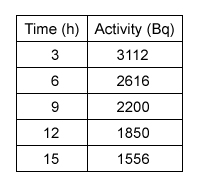
A sample of potassium-42 was measured to have the radioactivity shown in the table below. A sample of potassium-42 was measured to have the radioactivity shown in the table below.   Based on the given data, what must the initial activity of the sample have been at zero hours? Based on the given data, what must the initial activity of the sample have been at zero hours?
(Multiple Choice)
4.8/5
(90)

Passage Catabolism is an oxidative process in which electrons are transferred from lipids, proteins, and carbohydrates to generate high-energy electron carriers from nicotinamide adenine dinucleotide (NADH/NAD+) and flavin adenine dinucleotide (FADH2/FAD).  Both are used in the electron transport chain (ETC) as electron providers in a series of reactions.  The transfer of electrons provides energy that drives oxidative phosphorylation and the production of ATP.  Reduction of NAD+ proceeds according to the following half-reaction: Passage Catabolism is an oxidative process in which electrons are transferred from lipids, proteins, and carbohydrates to generate high-energy electron carriers from nicotinamide adenine dinucleotide (NADH/NAD<sup>+</sup>) and flavin adenine dinucleotide (FADH<sub>2</sub>/FAD).  Both are used in the electron transport chain (ETC) as electron providers in a series of reactions.  The transfer of electrons provides energy that drives oxidative phosphorylation and the production of ATP.  Reduction of NAD<sup>+</sup> proceeds according to the following half-reaction:    <strong>Reaction 1</strong>Reactions in the ETC occur in four protein complexes (I-IV) located in the inner mitochondrial membrane.  Here high-energy electrons are shuttled from complexes I, II, and III to complex IV, where O<sub>2</sub> serves as the final electron acceptor.  The net result of NADH oxidation is described by Reaction 2.    NADH+H++12O2→NAD++H2O<strong>Reaction 2</strong>At complexes I, III, and IV, hydrogen ions move from the mitochondrial matrix to the intermembrane space and create the electrochemical gradient, or proton motive force (pmf), that drives ATP synthesis.  Each NADH molecule drives the net pumping of 10 protons across the membrane, as per Reaction 3.    NADH+11H++12O2→NAD++10H++H2O<strong>Reaction 3</strong> Adapted from Garrett R, Grisham CM, Sabat M. Biochemistry. Cengage Learning; 2011. -For biological processes, which of the following is true of oxidation-reduction reactions?Reduction often involves the formation of bonds to hydrogen.Oxidation often involves the formation of bonds to oxygen.Reducing agents undergo a change to a lower oxidation state. Reaction 1Reactions in the ETC occur in four protein complexes (I-IV) located in the inner mitochondrial membrane.  Here high-energy electrons are shuttled from complexes I, II, and III to complex IV, where O2 serves as the final electron acceptor.  The net result of NADH oxidation is described by Reaction 2. Passage Catabolism is an oxidative process in which electrons are transferred from lipids, proteins, and carbohydrates to generate high-energy electron carriers from nicotinamide adenine dinucleotide (NADH/NAD<sup>+</sup>) and flavin adenine dinucleotide (FADH<sub>2</sub>/FAD).  Both are used in the electron transport chain (ETC) as electron providers in a series of reactions.  The transfer of electrons provides energy that drives oxidative phosphorylation and the production of ATP.  Reduction of NAD<sup>+</sup> proceeds according to the following half-reaction:    <strong>Reaction 1</strong>Reactions in the ETC occur in four protein complexes (I-IV) located in the inner mitochondrial membrane.  Here high-energy electrons are shuttled from complexes I, II, and III to complex IV, where O<sub>2</sub> serves as the final electron acceptor.  The net result of NADH oxidation is described by Reaction 2.    NADH+H++12O2→NAD++H2O<strong>Reaction 2</strong>At complexes I, III, and IV, hydrogen ions move from the mitochondrial matrix to the intermembrane space and create the electrochemical gradient, or proton motive force (pmf), that drives ATP synthesis.  Each NADH molecule drives the net pumping of 10 protons across the membrane, as per Reaction 3.    NADH+11H++12O2→NAD++10H++H2O<strong>Reaction 3</strong> Adapted from Garrett R, Grisham CM, Sabat M. Biochemistry. Cengage Learning; 2011. -For biological processes, which of the following is true of oxidation-reduction reactions?Reduction often involves the formation of bonds to hydrogen.Oxidation often involves the formation of bonds to oxygen.Reducing agents undergo a change to a lower oxidation state. NADH+H++12O2→NAD++H2OReaction 2At complexes I, III, and IV, hydrogen ions move from the mitochondrial matrix to the intermembrane space and create the electrochemical gradient, or proton motive force (pmf), that drives ATP synthesis.  Each NADH molecule drives the net pumping of 10 protons across the membrane, as per Reaction 3. Passage Catabolism is an oxidative process in which electrons are transferred from lipids, proteins, and carbohydrates to generate high-energy electron carriers from nicotinamide adenine dinucleotide (NADH/NAD<sup>+</sup>) and flavin adenine dinucleotide (FADH<sub>2</sub>/FAD).  Both are used in the electron transport chain (ETC) as electron providers in a series of reactions.  The transfer of electrons provides energy that drives oxidative phosphorylation and the production of ATP.  Reduction of NAD<sup>+</sup> proceeds according to the following half-reaction:    <strong>Reaction 1</strong>Reactions in the ETC occur in four protein complexes (I-IV) located in the inner mitochondrial membrane.  Here high-energy electrons are shuttled from complexes I, II, and III to complex IV, where O<sub>2</sub> serves as the final electron acceptor.  The net result of NADH oxidation is described by Reaction 2.    NADH+H++12O2→NAD++H2O<strong>Reaction 2</strong>At complexes I, III, and IV, hydrogen ions move from the mitochondrial matrix to the intermembrane space and create the electrochemical gradient, or proton motive force (pmf), that drives ATP synthesis.  Each NADH molecule drives the net pumping of 10 protons across the membrane, as per Reaction 3.    NADH+11H++12O2→NAD++10H++H2O<strong>Reaction 3</strong> Adapted from Garrett R, Grisham CM, Sabat M. Biochemistry. Cengage Learning; 2011. -For biological processes, which of the following is true of oxidation-reduction reactions?Reduction often involves the formation of bonds to hydrogen.Oxidation often involves the formation of bonds to oxygen.Reducing agents undergo a change to a lower oxidation state. NADH+11H++12O2→NAD++10H++H2OReaction 3 Adapted from Garrett R, Grisham CM, Sabat M. Biochemistry. Cengage Learning; 2011. -For biological processes, which of the following is true of oxidation-reduction reactions?Reduction often involves the formation of bonds to hydrogen.Oxidation often involves the formation of bonds to oxygen.Reducing agents undergo a change to a lower oxidation state.



(Multiple Choice)
4.9/5
(75)

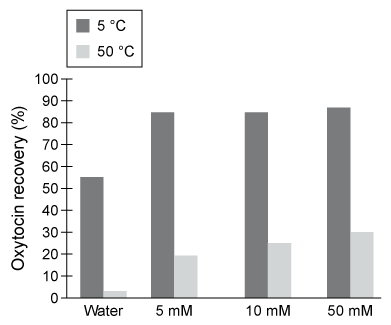
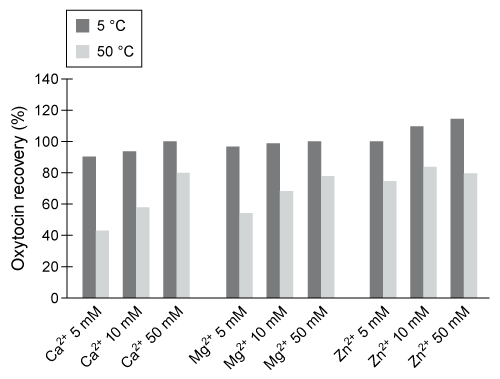
Passage Oxytocin is a naturally occurring peptide hormone that is used clinically to prevent postpartum hemorrhage, one of the leading causes of maternal mortality globally.  Because oxytocin is heat and light sensitive, it requires refrigeration at temperatures below 8 °C.  However, in underdeveloped regions with hot climates (such as sub-Saharan Africa), refrigeration is often unavailable for pharmaceutical storage and transport.In an effort to improve the availability of oxytocin in regions with limited refrigeration, researchers conducted two experiments to investigate the use of buffers and divalent alkaline-earth metal salt additives as a means to produce an aqueous oxytocin formulation that is stable when stored at temperatures up to 50 °C.Experiment 1To evaluate effects from buffer concentration, two sets of solutions were prepared containing 0.3 mg/mL oxytocin monoacetate salt in 5, 10, and 50 mM citrate buffer solution made from a mixture of citric acid (a weak acid) and sodium citrate (a salt of the conjugate base).  An unbuffered aqueous solution served as a control sample.  Using 1.0 M NaOH, the buffered solutions were adjusted to pH 4.5 (the pH at which oxytocin is more stable) and then stored at 5 °C (set 1) and 50 °C (set 2) for 4 weeks in a dark area.  After storage, the amount of undegraded oxytocin in each sample was determined (Figure 1) using reverse-phase, high-performance liquid chromatography (RP-HPLC). Passage Oxytocin is a naturally occurring peptide hormone that is used clinically to prevent postpartum hemorrhage, one of the leading causes of maternal mortality globally.  Because oxytocin is heat and light sensitive, it requires refrigeration at temperatures below 8 °C.  However, in underdeveloped regions with hot climates (such as sub-Saharan Africa), refrigeration is often unavailable for pharmaceutical storage and transport.In an effort to improve the availability of oxytocin in regions with limited refrigeration, researchers conducted two experiments to investigate the use of buffers and divalent alkaline-earth metal salt additives as a means to produce an aqueous oxytocin formulation that is stable when stored at temperatures up to 50 °C.Experiment 1To evaluate effects from buffer concentration, two sets of solutions were prepared containing 0.3 mg/mL oxytocin monoacetate salt in 5, 10, and 50 mM citrate buffer solution made from a mixture of citric acid (a weak acid) and sodium citrate (a salt of the conjugate base).  An unbuffered aqueous solution served as a control sample.  Using 1.0 M NaOH, the buffered solutions were adjusted to pH 4.5 (the pH at which oxytocin is more stable) and then stored at 5 °C (set 1) and 50 °C (set 2) for 4 weeks in a dark area.  After storage, the amount of undegraded oxytocin in each sample was determined (Figure 1) using reverse-phase, high-performance liquid chromatography (RP-HPLC).    <strong>Figure 1</strong>  Oxytocin recovery in a citrate buffer (pH 4.5) and water (pH 6.8)Experiment 2To examine the effect of divalent alkaline-earth metal cation additives, Experiment 1 was repeated, but the solutions were modified to contain 0.3 mg/mL of oxytocin with 5, 10, or 50 mM of a divalent cation (from a chloride salt) dissolved in 10 mM citrate buffer.  The results are shown in Figure 2.    <strong>Figure 2</strong>  Oxytocin in 10 mM citrate buffer with added Ca<sup>2+</sup>, Mg<sup>2+</sup>, or Zn<sup>2+</sup> salts -What approximate volume of the oxytocin solution with the 10 mM Zn<sup>2+</sup> additive was analyzed if 2.2 × 10<sup>−6</sup> moles of oxytocin acetate (MW = 1067 g/mol) were recovered from the sample after 4 weeks at 50 °C? Figure 1  Oxytocin recovery in a citrate buffer (pH 4.5) and water (pH 6.8)Experiment 2To examine the effect of divalent alkaline-earth metal cation additives, Experiment 1 was repeated, but the solutions were modified to contain 0.3 mg/mL of oxytocin with 5, 10, or 50 mM of a divalent cation (from a chloride salt) dissolved in 10 mM citrate buffer.  The results are shown in Figure 2. Passage Oxytocin is a naturally occurring peptide hormone that is used clinically to prevent postpartum hemorrhage, one of the leading causes of maternal mortality globally.  Because oxytocin is heat and light sensitive, it requires refrigeration at temperatures below 8 °C.  However, in underdeveloped regions with hot climates (such as sub-Saharan Africa), refrigeration is often unavailable for pharmaceutical storage and transport.In an effort to improve the availability of oxytocin in regions with limited refrigeration, researchers conducted two experiments to investigate the use of buffers and divalent alkaline-earth metal salt additives as a means to produce an aqueous oxytocin formulation that is stable when stored at temperatures up to 50 °C.Experiment 1To evaluate effects from buffer concentration, two sets of solutions were prepared containing 0.3 mg/mL oxytocin monoacetate salt in 5, 10, and 50 mM citrate buffer solution made from a mixture of citric acid (a weak acid) and sodium citrate (a salt of the conjugate base).  An unbuffered aqueous solution served as a control sample.  Using 1.0 M NaOH, the buffered solutions were adjusted to pH 4.5 (the pH at which oxytocin is more stable) and then stored at 5 °C (set 1) and 50 °C (set 2) for 4 weeks in a dark area.  After storage, the amount of undegraded oxytocin in each sample was determined (Figure 1) using reverse-phase, high-performance liquid chromatography (RP-HPLC).    <strong>Figure 1</strong>  Oxytocin recovery in a citrate buffer (pH 4.5) and water (pH 6.8)Experiment 2To examine the effect of divalent alkaline-earth metal cation additives, Experiment 1 was repeated, but the solutions were modified to contain 0.3 mg/mL of oxytocin with 5, 10, or 50 mM of a divalent cation (from a chloride salt) dissolved in 10 mM citrate buffer.  The results are shown in Figure 2.    <strong>Figure 2</strong>  Oxytocin in 10 mM citrate buffer with added Ca<sup>2+</sup>, Mg<sup>2+</sup>, or Zn<sup>2+</sup> salts -What approximate volume of the oxytocin solution with the 10 mM Zn<sup>2+</sup> additive was analyzed if 2.2 × 10<sup>−6</sup> moles of oxytocin acetate (MW = 1067 g/mol) were recovered from the sample after 4 weeks at 50 °C? Figure 2  Oxytocin in 10 mM citrate buffer with added Ca2+, Mg2+, or Zn2+ salts -What approximate volume of the oxytocin solution with the 10 mM Zn2+ additive was analyzed if 2.2 × 10⁻⁶ moles of oxytocin acetate (MW = 1067 g/mol) were recovered from the sample after 4 weeks at 50 °C?
(Multiple Choice)
5.0/5
(60)

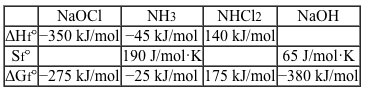
Passage Household cleaners commonly contain either ammonia (NH3) or bleach (NaOCl) as the principal active ingredient.  Mixing ammonia-based and bleach-based cleaners can be hazardous, as the resulting reactions can form several toxic products.  One of these reactions forms the irritant dichloramine (NHCl2) as follows: Passage Household cleaners commonly contain either ammonia (NH<sub>3</sub>) or bleach (NaOCl) as the principal active ingredient.  Mixing ammonia-based and bleach-based cleaners can be hazardous, as the resulting reactions can form several toxic products.  One of these reactions forms the irritant dichloramine (NHCl<sub>2</sub>) as follows:    <strong>Reaction 1</strong>The overall reaction has a standard enthalpy change of −55 kJ/mol and a standard entropy change of −150 J/mol·K.  Partial thermodynamic data for formation of Reaction 1 reagents from their elements are shown in Table 1.<strong>Table 1</strong>  Partial Data for Enthalpies, Entropies, and Free Energies of Formation of Several Compounds at 25 °C    After it is formed, dichloramine readily enters the gas phase, where it may be inhaled.  In the lungs, dichloramine reacts with water to produce hydrochloric acid and ammonia, as well as reactive oxygen species.  In small doses, these products cause mild irritation, but inhalation of large amounts of chloramines can lead to pneumonitis (inflammation of the lungs) and may require medical intervention. Adapted from Trogolo D, Arey JS. Benchmark thermochemistry of chloramines, bromamines, and bromochloramines: halogen oxidants stabilized by electron correlation. Phys Chem Chem Phys. 2015;17(5):3584-98. -During the formation of dichloramine and NaOH, the order (organization) of the system: Reaction 1The overall reaction has a standard enthalpy change of −55 kJ/mol and a standard entropy change of −150 J/mol·K.  Partial thermodynamic data for formation of Reaction 1 reagents from their elements are shown in Table 1.Table 1  Partial Data for Enthalpies, Entropies, and Free Energies of Formation of Several Compounds at 25 °C Passage Household cleaners commonly contain either ammonia (NH<sub>3</sub>) or bleach (NaOCl) as the principal active ingredient.  Mixing ammonia-based and bleach-based cleaners can be hazardous, as the resulting reactions can form several toxic products.  One of these reactions forms the irritant dichloramine (NHCl<sub>2</sub>) as follows:    <strong>Reaction 1</strong>The overall reaction has a standard enthalpy change of −55 kJ/mol and a standard entropy change of −150 J/mol·K.  Partial thermodynamic data for formation of Reaction 1 reagents from their elements are shown in Table 1.<strong>Table 1</strong>  Partial Data for Enthalpies, Entropies, and Free Energies of Formation of Several Compounds at 25 °C    After it is formed, dichloramine readily enters the gas phase, where it may be inhaled.  In the lungs, dichloramine reacts with water to produce hydrochloric acid and ammonia, as well as reactive oxygen species.  In small doses, these products cause mild irritation, but inhalation of large amounts of chloramines can lead to pneumonitis (inflammation of the lungs) and may require medical intervention. Adapted from Trogolo D, Arey JS. Benchmark thermochemistry of chloramines, bromamines, and bromochloramines: halogen oxidants stabilized by electron correlation. Phys Chem Chem Phys. 2015;17(5):3584-98. -During the formation of dichloramine and NaOH, the order (organization) of the system: After it is formed, dichloramine readily enters the gas phase, where it may be inhaled.  In the lungs, dichloramine reacts with water to produce hydrochloric acid and ammonia, as well as reactive oxygen species.  In small doses, these products cause mild irritation, but inhalation of large amounts of chloramines can lead to pneumonitis (inflammation of the lungs) and may require medical intervention. Adapted from Trogolo D, Arey JS. Benchmark thermochemistry of chloramines, bromamines, and bromochloramines: halogen oxidants stabilized by electron correlation. Phys Chem Chem Phys. 2015;17(5):3584-98. -During the formation of dichloramine and NaOH, the order (organization) of the system:

(Multiple Choice)
4.9/5
(85)

If MgCO3 undergoes a double replacement reaction in 6 M HCl, and one of the resulting products then undergoes a decomposition reaction, the gas that evolves is:

(Multiple Choice)
4.8/5
(72)

The C=S double bond in carbon disulfide (CS2) consists of a combination of one σ bond and one π bond.  Compared to the bond dissociation energy (bond strength) of the π bond, the bond dissociation energy of the σ bond portion of the C=S bond is:

(Multiple Choice)
4.9/5
(83)

Passage Potassium permanganate (KMnO4) is a highly reactive inorganic salt that appears as granular dark purple crystals, nearly black in color.  Due to its useful chemical properties and the fact that its reactions typically do not produce compounds that are toxic, KMnO4 is employed in a variety of applications, including use as a topical skin disinfectant, an antifungal agent, a fire starter, and a disinfectant for drinking water.KMnO4 is widely used as an alternative water treatment agent both to disinfect drinking water and to remove undesirable dissolved iron and sulfur compounds.  The crystals are highly soluble in water and form bright pink aqueous solutions that provide a visual indication of the presence of KMnO4 treatment residual.  As a drinking water disinfectant, a KMnO4 concentration of 1 mg/L is recommended unless higher levels of contamination are indicated by the absence of a pink residual.Industrial production of potassium permanganate is accomplished in two steps.  In step 1, manganese(IV) oxide (MnO2) is heated with potassium hydroxide in the presence of oxygen to produce potassium manganate (K2MnO4), as outlined in Reaction 1.2 MnO2 + 4 KOH + O2 → 2 K2MnO4 + 2 H2OReaction 1In step 2, the potassium manganate is then converted into potassium permanganate electrochemically according to Reaction 2.2 K2MnO4 + 2 H2O → 2 KMnO4 + 2 KOH + H2Reaction 2 -Suppose 0.80 L of 3.0 M aqueous K2MnO4 is combined with 0.20 L of 2.0 M aqueous KMnO4 to make a solution.  What is the concentration of potassium ions in the solution?

(Multiple Choice)
4.9/5
(77)

Passage The tendency of a chemical species to undergo reduction during an electrochemical reaction is indicated by the standard potential E° for the reaction.  As represented generally by Reaction 1, E° measures the potential Z at which element X with oxidation number N accepts N electrons and is reduced to its elemental state.X(N) + Ne− → X(0),    E° = Z voltsReaction 1In a galvanic cell, E° > 0 indicates a spontaneous reaction.  Therefore, chemical species with higher positive E° values are reduced more easily than those with lower E° values.Using E° as a basis of comparison, the relative thermodynamic stabilities of different chemical species involving the same element at different oxidation states can be presented graphically using a Frost diagram.  For a series of compounds containing element X, a Frost diagram plots the value of NE° for each compound against the corresponding oxidation number N of element X within the species.  Frost diagrams for several species containing manganese or chlorine are shown in Figure 1. Passage The tendency of a chemical species to undergo reduction during an electrochemical reaction is indicated by the standard potential E° for the reaction.  As represented generally by Reaction 1, E° measures the potential Z at which element X with oxidation number N accepts N electrons and is reduced to its elemental state.X(N) + Ne<sup>−</sup> → X(0),    E° = Z volts<strong>Reaction 1</strong>In a galvanic cell, E° > 0 indicates a spontaneous reaction.  Therefore, chemical species with higher positive E° values are reduced more easily than those with lower E° values.Using E° as a basis of comparison, the relative thermodynamic stabilities of different chemical species involving the same element at different oxidation states can be presented graphically using a Frost diagram.  For a series of compounds containing element X, a Frost diagram plots the value of NE° for each compound against the corresponding oxidation number N of element X within the species.  Frost diagrams for several species containing manganese or chlorine are shown in Figure 1.    <strong>Figure 1</strong>  Frost diagrams for manganese and chlorineOn a Frost diagram, NE° is proportional to the standard Gibbs free energy ΔG° according to the relationshipΔG° = −FNE° = −nFE°<strong>Equation 1</strong>where n is the number of moles of electrons transferred during the electrochemical process and F is the Faraday constant.  Free energy considerations also show that a species is prone to disproportionation if its position on the Frost diagram lies above a line connecting the points of two adjacent species, as seen for species B in Figure 2.    <strong>Figure 2</strong>  General Frost diagram for an element forming species A, B, C, and D.The slope of a line segment joining two species on a Frost diagram is equal to the standard reduction potential for the couple.  A greater slope indicates a higher corresponding reduction potential.  As a result, in Figure 2, the reduction potential for B to A is lower than that for D to C. -What is the standard potential E° for the half-reaction below?ClO<sub>3</sub><sup>−</sup>(aq) + 3H<sup>+</sup>(aq) + 2e<sup>−</sup>  →  HClO<sub>2</sub>(aq) + H<sub>2</sub>O(l) Figure 1  Frost diagrams for manganese and chlorineOn a Frost diagram, NE° is proportional to the standard Gibbs free energy ΔG° according to the relationshipΔG° = −FNE° = −nFE°Equation 1where n is the number of moles of electrons transferred during the electrochemical process and F is the Faraday constant.  Free energy considerations also show that a species is prone to disproportionation if its position on the Frost diagram lies above a line connecting the points of two adjacent species, as seen for species B in Figure 2. Passage The tendency of a chemical species to undergo reduction during an electrochemical reaction is indicated by the standard potential E° for the reaction.  As represented generally by Reaction 1, E° measures the potential Z at which element X with oxidation number N accepts N electrons and is reduced to its elemental state.X(N) + Ne<sup>−</sup> → X(0),    E° = Z volts<strong>Reaction 1</strong>In a galvanic cell, E° > 0 indicates a spontaneous reaction.  Therefore, chemical species with higher positive E° values are reduced more easily than those with lower E° values.Using E° as a basis of comparison, the relative thermodynamic stabilities of different chemical species involving the same element at different oxidation states can be presented graphically using a Frost diagram.  For a series of compounds containing element X, a Frost diagram plots the value of NE° for each compound against the corresponding oxidation number N of element X within the species.  Frost diagrams for several species containing manganese or chlorine are shown in Figure 1.    <strong>Figure 1</strong>  Frost diagrams for manganese and chlorineOn a Frost diagram, NE° is proportional to the standard Gibbs free energy ΔG° according to the relationshipΔG° = −FNE° = −nFE°<strong>Equation 1</strong>where n is the number of moles of electrons transferred during the electrochemical process and F is the Faraday constant.  Free energy considerations also show that a species is prone to disproportionation if its position on the Frost diagram lies above a line connecting the points of two adjacent species, as seen for species B in Figure 2.    <strong>Figure 2</strong>  General Frost diagram for an element forming species A, B, C, and D.The slope of a line segment joining two species on a Frost diagram is equal to the standard reduction potential for the couple.  A greater slope indicates a higher corresponding reduction potential.  As a result, in Figure 2, the reduction potential for B to A is lower than that for D to C. -What is the standard potential E° for the half-reaction below?ClO<sub>3</sub><sup>−</sup>(aq) + 3H<sup>+</sup>(aq) + 2e<sup>−</sup>  →  HClO<sub>2</sub>(aq) + H<sub>2</sub>O(l) Figure 2  General Frost diagram for an element forming species A, B, C, and D.The slope of a line segment joining two species on a Frost diagram is equal to the standard reduction potential for the couple.  A greater slope indicates a higher corresponding reduction potential.  As a result, in Figure 2, the reduction potential for B to A is lower than that for D to C. -What is the standard potential E° for the half-reaction below?ClO3−(aq) + 3H+(aq) + 2e−  →  HClO2(aq) + H2O(l)
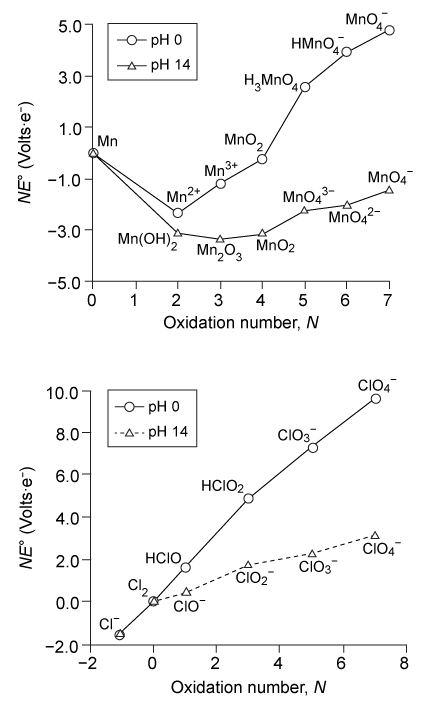
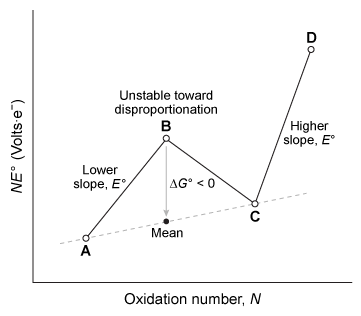
(Multiple Choice)
4.8/5
(83)

In chemical bond formation, covalent bonds are generally formed by electron:

(Multiple Choice)
4.7/5
(73)
Showing 1 - 20 of 317
close modal

Filters

  • Essay(0)
  • Multiple Choice(0)
  • Short Answer(0)
  • True False(0)
  • Matching(0)