



 Chat with AI
Exam 5: General Chemistry

Exam 1: Behavioral Sciences343 Questions
Exam 2: Biochemistry307 Questions
Exam 3: Biology319 Questions
Exam 4: Critical Analysis & Reasoning Skills358 Questions
Exam 5: General Chemistry317 Questions
Exam 6: Organic Chemistry191 Questions
Exam 7: Physics200 Questions
Select questions type


A 0.040 M HCl solution is measured in the laboratory and has an osmotic pressure of 1.9 atm. What is the estimated osmotic pressure of gastric acid (approximated as 0.10 M HCl) under the same conditions?
(Multiple Choice)
4.8/5  (74)
(74) Passage
Catabolism is an oxidative process in which electrons are transferred from lipids, proteins, and carbohydrates to generate high-energy electron carriers from nicotinamide adenine dinucleotide (NADH/NAD+) and flavin adenine dinucleotide (FADH2/FAD). Both are used in the electron transport chain (ETC) as electron providers in a series of reactions. The transfer of electrons provides energy that drives oxidative phosphorylation and the production of ATP. Reduction of NAD+ proceeds according to the following half-reaction:
 Reaction 1Reactions in the ETC occur in four protein complexes (I-IV) located in the inner mitochondrial membrane. Here high-energy electrons are shuttled from complexes I, II, and III to complex IV, where O2 serves as the final electron acceptor. The net result of NADH oxidation is described by Reaction 2.
 NADH+H++12O2→NAD++H2OReaction 2At complexes I, III, and IV, hydrogen ions move from the mitochondrial matrix to the intermembrane space and create the electrochemical gradient, or proton motive force (pmf), that drives ATP synthesis. Each NADH molecule drives the net pumping of 10 protons across the membrane, as per Reaction 3.
 NADH+11H++12O2→NAD++10H++H2OReaction 3
Adapted from Garrett R, Grisham CM, Sabat M. Biochemistry. Cengage Learning; 2011.
-If the ETC is a spontaneous process, which of the following MUST be true about the redox reactions within each of the four complexes?
Reaction 1Reactions in the ETC occur in four protein complexes (I-IV) located in the inner mitochondrial membrane. Here high-energy electrons are shuttled from complexes I, II, and III to complex IV, where O2 serves as the final electron acceptor. The net result of NADH oxidation is described by Reaction 2.
NADH+H++12O2→NAD++H2OReaction 2At complexes I, III, and IV, hydrogen ions move from the mitochondrial matrix to the intermembrane space and create the electrochemical gradient, or proton motive force (pmf), that drives ATP synthesis. Each NADH molecule drives the net pumping of 10 protons across the membrane, as per Reaction 3.
NADH+11H++12O2→NAD++10H++H2OReaction 3
Adapted from Garrett R, Grisham CM, Sabat M. Biochemistry. Cengage Learning; 2011.
-If the ETC is a spontaneous process, which of the following MUST be true about the redox reactions within each of the four complexes? (Multiple Choice)
4.9/5 (68)
(68) Passage
An automated external defibrillator (AED) is a medical device used to send an electric shock to the heart after cardiac arrest. A key component of the AED is the power source, or battery. Batteries used in AEDs need to have a good charge-to-weight ratio; they must be safe and reliable as well as rechargeable.Two types of rechargeable batteries used in early models of AEDs are the lead storage (also called lead-acid) battery and the nickel-cadmium (NiCd) battery. These batteries consist of multiple electrochemical cells that are connected in series to deliver a potential between 9 V and 18 V. A capacitor allows the AED to accumulate charge so that it can deliver between 300 V and 1,000 V.Some AEDs use a sealed lead storage battery. Lead storage batteries are robust and hold a charge for a long time. However, they have a low energy-to-weight ratio. Each lead storage cell delivers approximately 2.0 V, and a battery of four cells weighing 1000 g can provide 30 W∙h of energy.
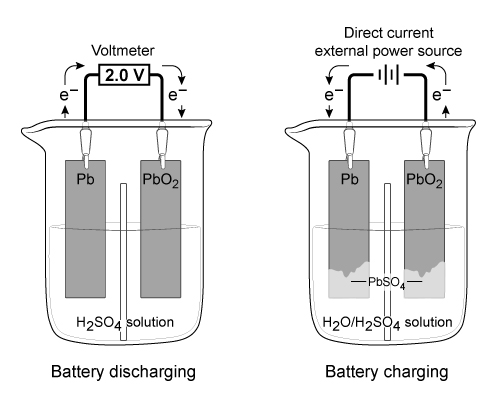 Figure 1 Electron flow in a lead storage battery when discharging and chargingThe half reactions for the anode and cathode of a lead storage battery in 4 M of sulfuric acid (H2SO4) are shown in Reactions 1 and 2:
 Reaction 1
 Reaction 2
NiCd batteries have a higher energy-to-weight ratio than lead storage batteries but cannot hold as much charge. Each NiCd cell delivers approximately 1.3 V, and a single-cell battery weighing 120 g can provide 7.2 W∙h of energy.The half reactions at the anode and cathode for a NiCd battery in KOH are shown in Reactions 3 and 4:
 Reaction 3
 Reaction 4
-If the electromotive force of the battery in an AED is found to be −2.0 V while it is charging, the battery is functioning as a:
Figure 1 Electron flow in a lead storage battery when discharging and chargingThe half reactions for the anode and cathode of a lead storage battery in 4 M of sulfuric acid (H2SO4) are shown in Reactions 1 and 2:
Reaction 1
Reaction 2
NiCd batteries have a higher energy-to-weight ratio than lead storage batteries but cannot hold as much charge. Each NiCd cell delivers approximately 1.3 V, and a single-cell battery weighing 120 g can provide 7.2 W∙h of energy.The half reactions at the anode and cathode for a NiCd battery in KOH are shown in Reactions 3 and 4:
Reaction 3
Reaction 4
-If the electromotive force of the battery in an AED is found to be −2.0 V while it is charging, the battery is functioning as a: (Multiple Choice)
4.9/5 (90)
(90) The spin quantum number ms describes the quantum state of an electron in an orbital with respect to its angular momentum. According to the Pauli exclusion principle, what are the values of ms for each of the electrons in the 4s orbital of a calcium atom?
(Multiple Choice)
4.8/5 (69)
(69) Passage
Household cleaners commonly contain either ammonia (NH3) or bleach (NaOCl) as the principal active ingredient. Mixing ammonia-based and bleach-based cleaners can be hazardous, as the resulting reactions can form several toxic products. One of these reactions forms the irritant dichloramine (NHCl2) as follows:
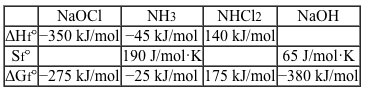
 Reaction 1The overall reaction has a standard enthalpy change of −55 kJ/mol and a standard entropy change of −150 J/mol·K. Partial thermodynamic data for formation of Reaction 1 reagents from their elements are shown in Table 1.Table 1 Partial Data for Enthalpies, Entropies, and Free Energies of Formation of Several Compounds at 25 °C
 After it is formed, dichloramine readily enters the gas phase, where it may be inhaled. In the lungs, dichloramine reacts with water to produce hydrochloric acid and ammonia, as well as reactive oxygen species. In small doses, these products cause mild irritation, but inhalation of large amounts of chloramines can lead to pneumonitis (inflammation of the lungs) and may require medical intervention.
Adapted from Trogolo D, Arey JS. Benchmark thermochemistry of chloramines, bromamines, and bromochloramines: halogen oxidants stabilized by electron correlation. Phys Chem Chem Phys. 2015;17(5):3584-98.
-If dichloramine formation is spontaneous under standard conditions, the equilibrium constant must be:
Reaction 1The overall reaction has a standard enthalpy change of −55 kJ/mol and a standard entropy change of −150 J/mol·K. Partial thermodynamic data for formation of Reaction 1 reagents from their elements are shown in Table 1.Table 1 Partial Data for Enthalpies, Entropies, and Free Energies of Formation of Several Compounds at 25 °C
After it is formed, dichloramine readily enters the gas phase, where it may be inhaled. In the lungs, dichloramine reacts with water to produce hydrochloric acid and ammonia, as well as reactive oxygen species. In small doses, these products cause mild irritation, but inhalation of large amounts of chloramines can lead to pneumonitis (inflammation of the lungs) and may require medical intervention.
Adapted from Trogolo D, Arey JS. Benchmark thermochemistry of chloramines, bromamines, and bromochloramines: halogen oxidants stabilized by electron correlation. Phys Chem Chem Phys. 2015;17(5):3584-98.
-If dichloramine formation is spontaneous under standard conditions, the equilibrium constant must be: (Multiple Choice)
4.8/5 (84)
(84) Passage
In polluted urban environments, airborne proteins can undergo nitration reactions that increase their allergenic potential toward the human respiratory system. For example, upon exposure to ozone (O3) and nitrogen dioxide (NO2) under atmospheric conditions, the amino acid tyrosine is known to undergo a two-step irreversible reaction leading to the formation of nitrotyrosine. The first step involves the formation of a reactive oxygen intermediate (ROI) tyrosyl radical through oxidation of the phenolic site of tyrosine. Nitrotyrosine is then formed in the second step through addition of NO2 by a radical-radical termination reaction. The elementary steps for this reaction are shown in Scheme 1.
 Scheme 1 Elementary steps of nitration of tyrosineAirborne protein particles can exist in a variety of environments including the aqueous phase, gaseous phase, or as conglomerates with other biomolecules such as lipids. Because the thermodynamic properties and kinetics of the nitration reaction vary based on the chemical environment in which it occurs, recent studies have focused on understanding the reaction under different conditions.Density functional theory is a powerful computational quantum-mechanical modeling method that can determine the properties of many-electron systems by producing approximate solutions to the Schrödinger equation. Researchers used density functional theory to model the geometries and potential energy surfaces of the reactants, intermediates, and products of the nitration reaction in gaseous, aqueous, and lipid-rich environments. From this modeling, the thermodynamic and kinetic properties were calculated. Figure 1 shows the calculated activation energies Ea in kJ/mol, and Table 1 lists the associated thermochemical properties for both steps of the reaction in all three environments.
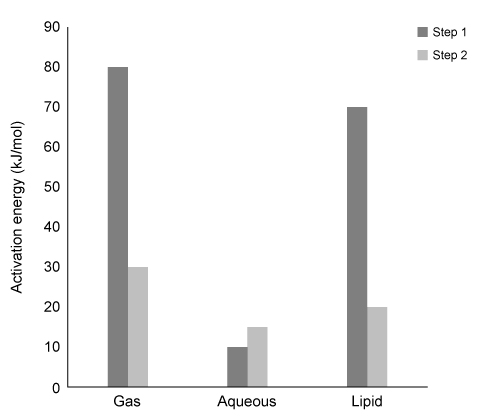 Figure 1 Calculated activation energies for each step of the studied reactions in three environmentsTable 1 Calculated Thermochemical Properties of the Studied Reactions (298.15 K)
 Adapted from Sandhiya L, Kolandaivel P, Senthilkumar K. Oxidation and nitration of tyrosine by ozone and nitrogen dioxide: reaction mechanisms and biological and atmospheric implications. J Phys Chem B. 2014;118(13):3479-90.
-Which of the following are true concerning the overall reaction in an aqueous environment?The rate constant increases exponentially with increasing temperature.The rate constant increases exponentially with decreasing activation energy.The reaction rate decreases exponentially with increasing activation energy.The rate constant of the catalyzed reaction will be smaller than the rate constant of the uncatalyzed reaction.
Scheme 1 Elementary steps of nitration of tyrosineAirborne protein particles can exist in a variety of environments including the aqueous phase, gaseous phase, or as conglomerates with other biomolecules such as lipids. Because the thermodynamic properties and kinetics of the nitration reaction vary based on the chemical environment in which it occurs, recent studies have focused on understanding the reaction under different conditions.Density functional theory is a powerful computational quantum-mechanical modeling method that can determine the properties of many-electron systems by producing approximate solutions to the Schrödinger equation. Researchers used density functional theory to model the geometries and potential energy surfaces of the reactants, intermediates, and products of the nitration reaction in gaseous, aqueous, and lipid-rich environments. From this modeling, the thermodynamic and kinetic properties were calculated. Figure 1 shows the calculated activation energies Ea in kJ/mol, and Table 1 lists the associated thermochemical properties for both steps of the reaction in all three environments.
Figure 1 Calculated activation energies for each step of the studied reactions in three environmentsTable 1 Calculated Thermochemical Properties of the Studied Reactions (298.15 K)
Adapted from Sandhiya L, Kolandaivel P, Senthilkumar K. Oxidation and nitration of tyrosine by ozone and nitrogen dioxide: reaction mechanisms and biological and atmospheric implications. J Phys Chem B. 2014;118(13):3479-90.
-Which of the following are true concerning the overall reaction in an aqueous environment?The rate constant increases exponentially with increasing temperature.The rate constant increases exponentially with decreasing activation energy.The reaction rate decreases exponentially with increasing activation energy.The rate constant of the catalyzed reaction will be smaller than the rate constant of the uncatalyzed reaction. (Multiple Choice)
4.9/5 (86)
(86) Passage
Students were asked to bring items from home to serve as examples for different types of reactions. The instructor provided additional reactants, solvents, heat, or a catalyst to demonstrate reactions with the household items.The students brought aluminum foil, table salt, sugar, baking soda, vinegar, toilet bowl cleaner, hydrogen peroxide, and antacid tablets.Experiment 1Reactions were performed using the household items. The reaction conditions and student observations are recorded in Table 1.Table 1 Reaction Conditions and Visual Observations
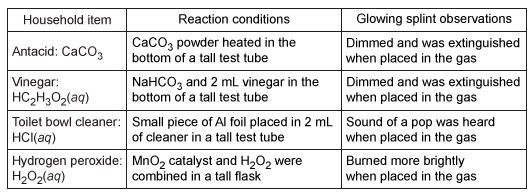
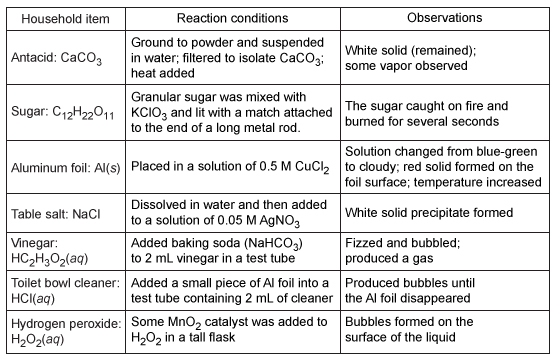 Experiment 2The reactions that were observed to produce gas bubbles in Experiment 1 were repeated, and samples of the gases produced were collected. Each gas sample was tested by holding a burning (glowing) wooden splint within the reaction vessel to determine if the reaction evolved O2, H2, or CO2. A glowing splint placed in O2 will burn more brightly, one placed in H2 will ignite the gas, and one placed in CO2 will be extinguished. The results of the gas tests are recorded in Table 2.Table 2 Glowing Splint Gas Test Observations
 -When 2 g of aluminum foil is added to 500 mL of the CuCl2 solution indicated in Table 1, the following reaction takes place:2 Al(s) + 3 CuCl2(aq) → 2 AlCl3(aq) + 3 Cu(s)The limiting reactant is:
Experiment 2The reactions that were observed to produce gas bubbles in Experiment 1 were repeated, and samples of the gases produced were collected. Each gas sample was tested by holding a burning (glowing) wooden splint within the reaction vessel to determine if the reaction evolved O2, H2, or CO2. A glowing splint placed in O2 will burn more brightly, one placed in H2 will ignite the gas, and one placed in CO2 will be extinguished. The results of the gas tests are recorded in Table 2.Table 2 Glowing Splint Gas Test Observations
-When 2 g of aluminum foil is added to 500 mL of the CuCl2 solution indicated in Table 1, the following reaction takes place:2 Al(s) + 3 CuCl2(aq) → 2 AlCl3(aq) + 3 Cu(s)The limiting reactant is: (Multiple Choice)
4.8/5 (80)
(80) Passage
The tendency of a chemical species to undergo reduction during an electrochemical reaction is indicated by the standard potential E° for the reaction. As represented generally by Reaction 1, E° measures the potential Z at which element X with oxidation number N accepts N electrons and is reduced to its elemental state.X(N) + Ne− → X(0), E° = Z voltsReaction 1In a galvanic cell, E° > 0 indicates a spontaneous reaction. Therefore, chemical species with higher positive E° values are reduced more easily than those with lower E° values.Using E° as a basis of comparison, the relative thermodynamic stabilities of different chemical species involving the same element at different oxidation states can be presented graphically using a Frost diagram. For a series of compounds containing element X, a Frost diagram plots the value of NE° for each compound against the corresponding oxidation number N of element X within the species. Frost diagrams for several species containing manganese or chlorine are shown in Figure 1.
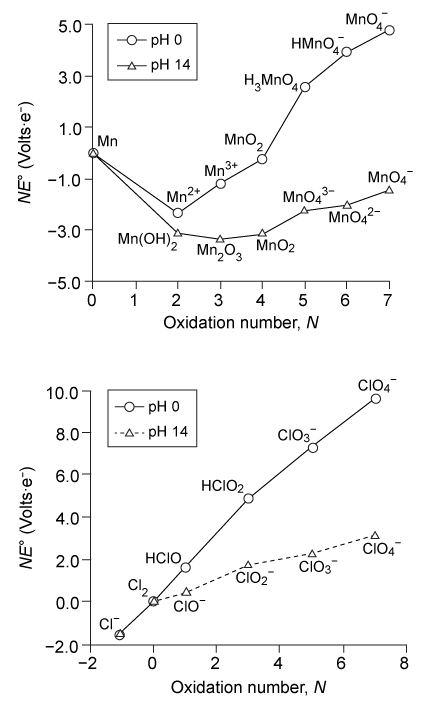 Figure 1 Frost diagrams for manganese and chlorineOn a Frost diagram, NE° is proportional to the standard Gibbs free energy ΔG° according to the relationshipΔG° = −FNE° = −nFE°Equation 1where n is the number of moles of electrons transferred during the electrochemical process and F is the Faraday constant. Free energy considerations also show that a species is prone to disproportionation if its position on the Frost diagram lies above a line connecting the points of two adjacent species, as seen for species B in Figure 2.
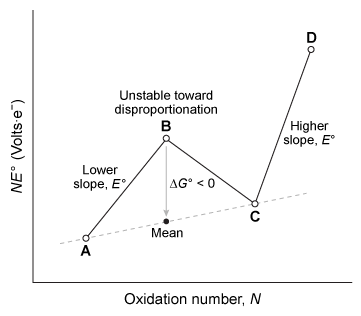 Figure 2 General Frost diagram for an element forming species A, B, C, and D.The slope of a line segment joining two species on a Frost diagram is equal to the standard reduction potential for the couple. A greater slope indicates a higher corresponding reduction potential. As a result, in Figure 2, the reduction potential for B to A is lower than that for D to C.
-Formal charge and oxidation state are two different ways of accounting for electrons between atoms. Based on the Lewis structure of the ClO− anion, which of the following pairs of values corresponds to the formal charge of the chlorine atom and the oxidation state of the oxygen atom, respectively?
Figure 1 Frost diagrams for manganese and chlorineOn a Frost diagram, NE° is proportional to the standard Gibbs free energy ΔG° according to the relationshipΔG° = −FNE° = −nFE°Equation 1where n is the number of moles of electrons transferred during the electrochemical process and F is the Faraday constant. Free energy considerations also show that a species is prone to disproportionation if its position on the Frost diagram lies above a line connecting the points of two adjacent species, as seen for species B in Figure 2.
Figure 2 General Frost diagram for an element forming species A, B, C, and D.The slope of a line segment joining two species on a Frost diagram is equal to the standard reduction potential for the couple. A greater slope indicates a higher corresponding reduction potential. As a result, in Figure 2, the reduction potential for B to A is lower than that for D to C.
-Formal charge and oxidation state are two different ways of accounting for electrons between atoms. Based on the Lewis structure of the ClO− anion, which of the following pairs of values corresponds to the formal charge of the chlorine atom and the oxidation state of the oxygen atom, respectively? (Multiple Choice)
4.7/5 (84)
(84) Passage
Nuclear medicine uses radiopharmaceuticals for disease treatment and as tracers in medical imaging studies. Yttrium-90 (90Y) is a radiopharmaceutical agent used to treat overgrown joint lining known as pigmented villonodular synovitis, as well as some forms of liver cancer. It has a half-life of about 64 hours.Although the relatively short half-life of 90Y is optimal for use in medical applications, transportation and storage of the radiopharmaceutical are not feasible. As a result, strontium-90 (90Sr), with a half-life of 28.8 years, is the most common source of 90Y. 90Sr is created by a nuclear fission process that begins with uranium-235 (235U) in a nuclear reactor as shown in Reaction 1.235U → 90Sr + ZReaction 1Fission of 235U produces 90Sr as well as additional fission products (Z) including, but not limited to, technetium-99 (99Tc), iodine-129 (129I), and zirconium-93 (93Zr). Figure 1 shows the distribution of fission products.
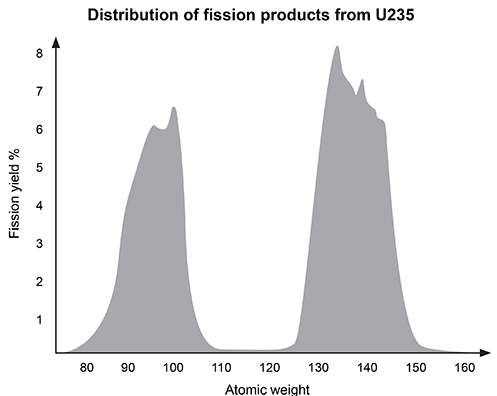 Figure 1 Distribution of 235U fission products by atomic weightTo create the final 90Y required for nuclear medicine studies, 90Sr decay is carried out in a controlled 90Y generator. 90Y is then separated from residual 90Sr for use in clinical applications.
Adapted from Wheeler CE. Comments on vaccines, August 1987. J Am Acad Dermatol. 1988;18(1 Pt 2):232-4.
-90Y converts to 90Zr by beta decay. Which of the following elements exhibits chemical properties most similar to zirconium-90? (Note: Assume that 90Zr gains any needed valence electrons from its environment immediately after being formed by the nuclear conversion.)
Figure 1 Distribution of 235U fission products by atomic weightTo create the final 90Y required for nuclear medicine studies, 90Sr decay is carried out in a controlled 90Y generator. 90Y is then separated from residual 90Sr for use in clinical applications.
Adapted from Wheeler CE. Comments on vaccines, August 1987. J Am Acad Dermatol. 1988;18(1 Pt 2):232-4.
-90Y converts to 90Zr by beta decay. Which of the following elements exhibits chemical properties most similar to zirconium-90? (Note: Assume that 90Zr gains any needed valence electrons from its environment immediately after being formed by the nuclear conversion.) (Multiple Choice)
4.7/5 (96)
(96) Passage
In polluted urban environments, airborne proteins can undergo nitration reactions that increase their allergenic potential toward the human respiratory system. For example, upon exposure to ozone (O3) and nitrogen dioxide (NO2) under atmospheric conditions, the amino acid tyrosine is known to undergo a two-step irreversible reaction leading to the formation of nitrotyrosine. The first step involves the formation of a reactive oxygen intermediate (ROI) tyrosyl radical through oxidation of the phenolic site of tyrosine. Nitrotyrosine is then formed in the second step through addition of NO2 by a radical-radical termination reaction. The elementary steps for this reaction are shown in Scheme 1.
Scheme 1 Elementary steps of nitration of tyrosineAirborne protein particles can exist in a variety of environments including the aqueous phase, gaseous phase, or as conglomerates with other biomolecules such as lipids. Because the thermodynamic properties and kinetics of the nitration reaction vary based on the chemical environment in which it occurs, recent studies have focused on understanding the reaction under different conditions.Density functional theory is a powerful computational quantum-mechanical modeling method that can determine the properties of many-electron systems by producing approximate solutions to the Schrödinger equation. Researchers used density functional theory to model the geometries and potential energy surfaces of the reactants, intermediates, and products of the nitration reaction in gaseous, aqueous, and lipid-rich environments. From this modeling, the thermodynamic and kinetic properties were calculated. Figure 1 shows the calculated activation energies Ea in kJ/mol, and Table 1 lists the associated thermochemical properties for both steps of the reaction in all three environments.
Figure 1 Calculated activation energies for each step of the studied reactions in three environmentsTable 1 Calculated Thermochemical Properties of the Studied Reactions (298.15 K)
Adapted from Sandhiya L, Kolandaivel P, Senthilkumar K. Oxidation and nitration of tyrosine by ozone and nitrogen dioxide: reaction mechanisms and biological and atmospheric implications. J Phys Chem B. 2014;118(13):3479-90.
-Suppose a chemist decides to conduct and monitor the reaction for 10 min at 298.15 K in the three environments described in the passage. Which of the three reactions is most likely to form the greatest amount of product?
Scheme 1 Elementary steps of nitration of tyrosineAirborne protein particles can exist in a variety of environments including the aqueous phase, gaseous phase, or as conglomerates with other biomolecules such as lipids. Because the thermodynamic properties and kinetics of the nitration reaction vary based on the chemical environment in which it occurs, recent studies have focused on understanding the reaction under different conditions.Density functional theory is a powerful computational quantum-mechanical modeling method that can determine the properties of many-electron systems by producing approximate solutions to the Schrödinger equation. Researchers used density functional theory to model the geometries and potential energy surfaces of the reactants, intermediates, and products of the nitration reaction in gaseous, aqueous, and lipid-rich environments. From this modeling, the thermodynamic and kinetic properties were calculated. Figure 1 shows the calculated activation energies Ea in kJ/mol, and Table 1 lists the associated thermochemical properties for both steps of the reaction in all three environments.
Figure 1 Calculated activation energies for each step of the studied reactions in three environmentsTable 1 Calculated Thermochemical Properties of the Studied Reactions (298.15 K)
Adapted from Sandhiya L, Kolandaivel P, Senthilkumar K. Oxidation and nitration of tyrosine by ozone and nitrogen dioxide: reaction mechanisms and biological and atmospheric implications. J Phys Chem B. 2014;118(13):3479-90.
-Suppose a chemist decides to conduct and monitor the reaction for 10 min at 298.15 K in the three environments described in the passage. Which of the three reactions is most likely to form the greatest amount of product? (Multiple Choice)
4.8/5 (83)
(83) Which compound has the bond with the smallest dipole moment?
(Multiple Choice)
5.0/5 (84)
(84) The reactivity of three oxides mixed in H2O, HCl, and NaOH is shown in the table. All experiments were performed at 25 °C.  Based on the data, which statement best describes how SO2 compares to MgO?
 (Multiple Choice)
4.9/5 (80)
(80) Passage
Umami is one of five basic tastes that humans recognize, and it is triggered by L-amino acids as well as some synthetic ingredients and organic acids. Three common umami tastant molecules are shown in Figure 1.
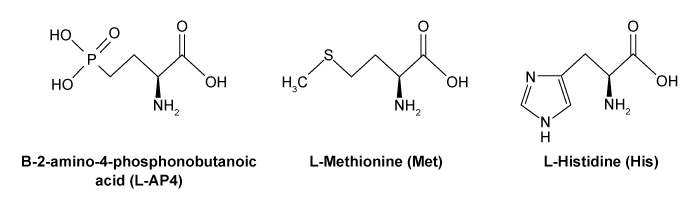 Figure 1 Three common tastant molecules known to trigger the umami taste sensationUmami taste signals are triggered upon binding of tastant molecules to the G protein-coupled receptor (GPCR) heterodimer T1R1-T1R3, which ultimately causes the breakdown of phosphatidylinositol 4,5-bisphosphate (PIP2) into the messenger molecules inositol-1,4,5-trisphosphate (IP3) and diacylglycerol (DAG). IP3 triggers the release of Ca2+ cations and the subsequent gating of the taste-transduction channels (Figure 2).
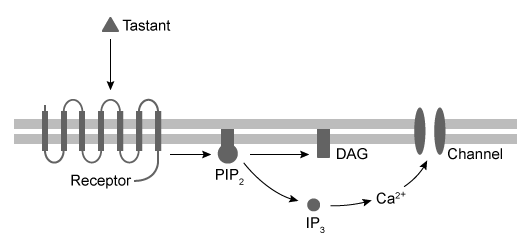 Figure 2 Signal pathway for transduction of umami taste sensationInosine monophosphate (IMP) has been suggested as enhancing (potentiating) the response of T1R1+T1R3 GPCRs to umami tastant molecules. Scientists tested this hypothesis by culturing receptors from human embryonic kidney (HEK) cells containing promiscuous G proteins. The HEK cells were then stimulated with umami tastants in the presence or absence of IMP. In each test, the cells were exposed to the same amounts of amino acid tastant and IMP. The number of cells that responded to each tastant was measured using a calcium indicator dye (FURA-2AM) in conjunction with fluorescence microscopy. By comparing the cellular response ratio of the stimulated to unstimulated HEK cells, the extent of potentiation can be assessed. The results are shown in Figure 3.
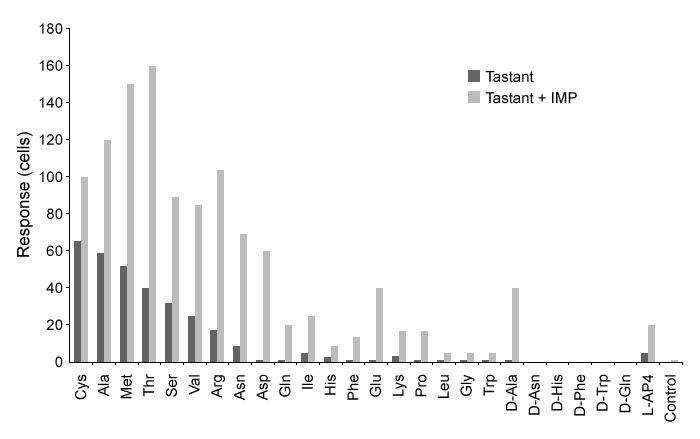 Figure 3 Quantification of amino-acid responses for T1R1+T1R3 with and without IMP
Adapted from Nelson G, Chandrashekar J, Hoon MA, et al. An amino-acid taste receptor. Nature. 2002;416(6877):199-202.
-Which of the following statements is true concerning the results shown in Figure 3?
Figure 1 Three common tastant molecules known to trigger the umami taste sensationUmami taste signals are triggered upon binding of tastant molecules to the G protein-coupled receptor (GPCR) heterodimer T1R1-T1R3, which ultimately causes the breakdown of phosphatidylinositol 4,5-bisphosphate (PIP2) into the messenger molecules inositol-1,4,5-trisphosphate (IP3) and diacylglycerol (DAG). IP3 triggers the release of Ca2+ cations and the subsequent gating of the taste-transduction channels (Figure 2).
Figure 2 Signal pathway for transduction of umami taste sensationInosine monophosphate (IMP) has been suggested as enhancing (potentiating) the response of T1R1+T1R3 GPCRs to umami tastant molecules. Scientists tested this hypothesis by culturing receptors from human embryonic kidney (HEK) cells containing promiscuous G proteins. The HEK cells were then stimulated with umami tastants in the presence or absence of IMP. In each test, the cells were exposed to the same amounts of amino acid tastant and IMP. The number of cells that responded to each tastant was measured using a calcium indicator dye (FURA-2AM) in conjunction with fluorescence microscopy. By comparing the cellular response ratio of the stimulated to unstimulated HEK cells, the extent of potentiation can be assessed. The results are shown in Figure 3.
Figure 3 Quantification of amino-acid responses for T1R1+T1R3 with and without IMP
Adapted from Nelson G, Chandrashekar J, Hoon MA, et al. An amino-acid taste receptor. Nature. 2002;416(6877):199-202.
-Which of the following statements is true concerning the results shown in Figure 3? (Multiple Choice)
4.9/5 (75)
(75) Which chemical properties below are those of the alkaline-earth metals?Form ions with a +1 chargeReadily oxidized to an oxidation state of +2Increasing reactivity with increasing atomic numberDecreasing reactivity with increasing atomic numberSoft Group 1 metals that form basic hydroxides in waterGroup 2 metals that form hydrogen gas when reacting with water
(Multiple Choice)
4.8/5 (81)
(81) The conjugate acid of the dihydrogen orthosilicate anion (H2SiO42−) is:
(Multiple Choice)
4.8/5 (78)
(78) Passage
The alkaline-earth metals are a highly reactive family of metals occupying Group 2 (IIA) of the periodic table. In their elemental form, the alkaline-earth metals have a shiny, silvery-white to slightly yellowish appearance. The alkaline-earth metals exhibit some similarities to the chemistry of the alkali metals (Group 1) but are a little less reactive.Atoms of the alkaline-earth metals (M) have only two valence electrons and a low first and second ionization energy. Consequently, these metals readily lose both electrons to produce cations with a +2 charge (M+2) during reactions with nonmetals. As a result, the alkaline-earth metals do not exist in their elemental metallic form in nature. Instead, the Group 2 elements are found primarily as metal oxides, which form by reacting oxygen (Reaction 1).
 Similarly, elemental samples of alkaline-earth metals will react with elemental halogens (X2) to form metal halides (Reaction 2), all of which are ionic except for BeCl2.
 Except for beryllium, the alkaline-earth metals react with water to produce very basic metal hydroxide solutions and hydrogen gas (Reaction 3).
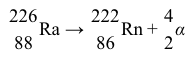
 The most difficult alkaline-earth metal to study is radium, because it is a rare radioactive element that is produced from the nuclear decay of uranium. The most common natural isotope, radium-226, has a half-life of 1,600 years and decays by alpha emission into radon-222 (Reaction 4).
 -Which expression correctly describes the equilibrium constant Keq for the formation of Compound 2 from the intermediate?
Similarly, elemental samples of alkaline-earth metals will react with elemental halogens (X2) to form metal halides (Reaction 2), all of which are ionic except for BeCl2.
Except for beryllium, the alkaline-earth metals react with water to produce very basic metal hydroxide solutions and hydrogen gas (Reaction 3).
The most difficult alkaline-earth metal to study is radium, because it is a rare radioactive element that is produced from the nuclear decay of uranium. The most common natural isotope, radium-226, has a half-life of 1,600 years and decays by alpha emission into radon-222 (Reaction 4).
-Which expression correctly describes the equilibrium constant Keq for the formation of Compound 2 from the intermediate? (Multiple Choice)
4.7/5 (79)
(79) Passage
Bone growth and remodeling during fracture healing are often slow and have potentially poor outcomes, including malunion or nonunion at the fracture site. Magnesium bone implants can aid in bone formation and safely biodegrade in the body according to the following reaction:Mg(s) + 2H2O(l) → Mg(OH)2(s) + H2(g)Reaction 1 Corrosion of magnesium metal in aqueous mediumHowever, magnesium metal tends to degrade too quickly and forms hydrogen gas pockets in the body. Corrosion is slowed as the metal naturally forms a protective layer of magnesium hydroxide in a process called passivation. Magnesium hydroxide is less soluble than magnesium metal, and its dissolution is described by the endothermic reaction:
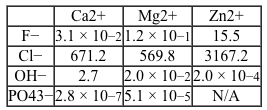
 Reaction 2 Solubility equilibrium of Mg(OH)2 in water at 25°CAlthough passivation slows down the corrosion rate, it must be slowed even further to adequately facilitate bone reformation.Researchers are interested in the differences in the corrosion rates of magnesium metal protected by different biocompatible coatings. They compared 10-mm magnesium disks coated with compounds of various cation and anion combinations, with solubility results shown in Table 1. The coated disks were immersed in simulated body fluid (SBF) at room temperature for 50 hours.Table 1 Solubility for Biocompatible Inorganic Salts Given in mmol/100mL of Pure Water at 25°C
 Adapted from Huan ZG, Leeflang MA, Zhou J, Fratila-apachitei LE, Duszczyk J. In vitro degradation behavior and cytocompatibility of Mg-Zn-Zr alloys. J Mater Sci Mater Med. 2010;21(9):2623-35.
-Throughout the experiment, researchers monitored the amount of magnesium that dissolved at various time points. Which of the following is NOT a valid test for the rate of magnesium corrosion?
Reaction 2 Solubility equilibrium of Mg(OH)2 in water at 25°CAlthough passivation slows down the corrosion rate, it must be slowed even further to adequately facilitate bone reformation.Researchers are interested in the differences in the corrosion rates of magnesium metal protected by different biocompatible coatings. They compared 10-mm magnesium disks coated with compounds of various cation and anion combinations, with solubility results shown in Table 1. The coated disks were immersed in simulated body fluid (SBF) at room temperature for 50 hours.Table 1 Solubility for Biocompatible Inorganic Salts Given in mmol/100mL of Pure Water at 25°C
Adapted from Huan ZG, Leeflang MA, Zhou J, Fratila-apachitei LE, Duszczyk J. In vitro degradation behavior and cytocompatibility of Mg-Zn-Zr alloys. J Mater Sci Mater Med. 2010;21(9):2623-35.
-Throughout the experiment, researchers monitored the amount of magnesium that dissolved at various time points. Which of the following is NOT a valid test for the rate of magnesium corrosion? (Multiple Choice)
4.8/5 (91)
(91) Passage
The radiopharmaceutical 2-deoxy-2-(18F)fluoro-D-glucose (abbreviated as 18F-FDG) is a modified form of D-glucose in which the hydroxyl group on the 2-carbon of the molecule has been replaced with a positron-emitting 18F radionuclide. Synthesis of 18F-FDG is accomplished in several steps involving both nuclear and chemical reactions, as shown in Figure 1.
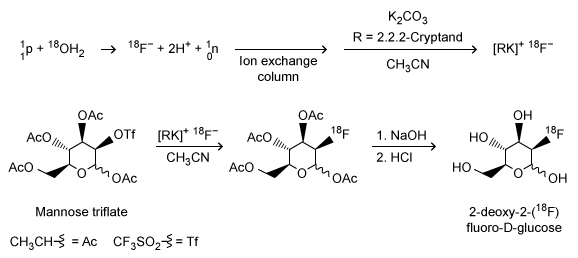 Figure 1 Synthetic scheme for 2-deoxy-2-(18F)fluoro-D-glucoseInitially, a target of 18O-enriched water (18OH2) is bombarded by protons using a cyclotron to achieve a (p-n) nuclear reaction in which a proton hitting the 18O nucleus is absorbed by the nucleus, causing the ejection of a neutron and forming an 18F nucleus. Following separation of the resulting 18F− anions from the residual 18OH2 via an ion exchange column, 18F− is used in a nucleophilic substitution reaction with an acetylated mannose triflate substrate. Subsequent hydrolysis to remove the acetyl protecting groups yields 18F-FDG.Because 18F-FDG is an analog of D-glucose, it is readily taken into cells by the same metabolic processes as D-glucose. Once inside the cells, the positron emissions of the 18F radionuclide can be detected by positron emission tomography (PET) scans to produce diagnostic medical images of objects such as tumors. Emissions from the 18F radionuclide subsequently diminish over time via radioactive decay (Figure 2).
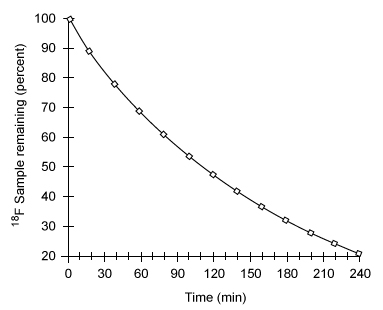 Figure 2 Nuclear decay of the 18F radionuclideBecause of limitations in the spatial resolution of PET scanners, when an object (such as a tumor) is smaller than 30 mm in diameter, the measured specific uptake value (SUV) of 18F-FDG accumulated within the object is lower than the actual SUV. The recovery coefficient (the ratio of the measured SUV to the actual SUV) shows that the measured SUV decreases as the size of the object decreases below the 30-mm threshold (Figure 3).
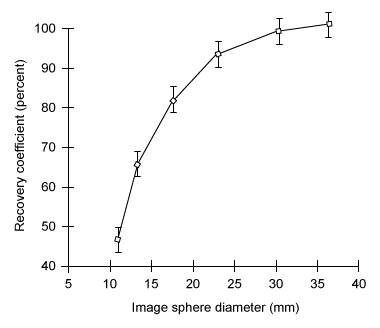 Figure 3 Recovery coefficient as a function of object size in a PET scan with a spatial resolution of 7 mm using ordered subsets expectation maximization (OSEM) image processing
Adapted from: S. Yu. "Review of F-FDG Synthesis and Quality Control." Biomed Imaging Interv J. ©2006 Department of Biomedical Imaging, Faculty of Medicine, University of Malaysa; and P. E. Kinahan, et al., "Positron emission tomography-computed tomography standardized uptake values in clinical practice and assessing response to therapy." Semin Ultrasound CT MR. ©2010 Elsevier.
-If the initial activity from a 1-mL dose of 18F-FDG is 200 millicuries, what will be the approximate activity of the dose after 1.5 half-lives of 18F have passed?
Figure 1 Synthetic scheme for 2-deoxy-2-(18F)fluoro-D-glucoseInitially, a target of 18O-enriched water (18OH2) is bombarded by protons using a cyclotron to achieve a (p-n) nuclear reaction in which a proton hitting the 18O nucleus is absorbed by the nucleus, causing the ejection of a neutron and forming an 18F nucleus. Following separation of the resulting 18F− anions from the residual 18OH2 via an ion exchange column, 18F− is used in a nucleophilic substitution reaction with an acetylated mannose triflate substrate. Subsequent hydrolysis to remove the acetyl protecting groups yields 18F-FDG.Because 18F-FDG is an analog of D-glucose, it is readily taken into cells by the same metabolic processes as D-glucose. Once inside the cells, the positron emissions of the 18F radionuclide can be detected by positron emission tomography (PET) scans to produce diagnostic medical images of objects such as tumors. Emissions from the 18F radionuclide subsequently diminish over time via radioactive decay (Figure 2).
Figure 2 Nuclear decay of the 18F radionuclideBecause of limitations in the spatial resolution of PET scanners, when an object (such as a tumor) is smaller than 30 mm in diameter, the measured specific uptake value (SUV) of 18F-FDG accumulated within the object is lower than the actual SUV. The recovery coefficient (the ratio of the measured SUV to the actual SUV) shows that the measured SUV decreases as the size of the object decreases below the 30-mm threshold (Figure 3).
Figure 3 Recovery coefficient as a function of object size in a PET scan with a spatial resolution of 7 mm using ordered subsets expectation maximization (OSEM) image processing
Adapted from: S. Yu. "Review of F-FDG Synthesis and Quality Control." Biomed Imaging Interv J. ©2006 Department of Biomedical Imaging, Faculty of Medicine, University of Malaysa; and P. E. Kinahan, et al., "Positron emission tomography-computed tomography standardized uptake values in clinical practice and assessing response to therapy." Semin Ultrasound CT MR. ©2010 Elsevier.
-If the initial activity from a 1-mL dose of 18F-FDG is 200 millicuries, what will be the approximate activity of the dose after 1.5 half-lives of 18F have passed? (Multiple Choice)
4.8/5 (81)
(81) When comparing single, double, and triple covalent bonds formed between two atoms X and Y, decreasing the number of π bonds between the atoms will:decrease the overall bond dissociation energy and bond strength.increase the bond length.decrease the bond rigidity (allow more bond rotation).
(Multiple Choice)
4.8/5 (81)
(81) Passage
Household cleaners commonly contain either ammonia (NH3) or bleach (NaOCl) as the principal active ingredient. Mixing ammonia-based and bleach-based cleaners can be hazardous, as the resulting reactions can form several toxic products. One of these reactions forms the irritant dichloramine (NHCl2) as follows:
Reaction 1The overall reaction has a standard enthalpy change of −55 kJ/mol and a standard entropy change of −150 J/mol·K. Partial thermodynamic data for formation of Reaction 1 reagents from their elements are shown in Table 1.Table 1 Partial Data for Enthalpies, Entropies, and Free Energies of Formation of Several Compounds at 25 °C
After it is formed, dichloramine readily enters the gas phase, where it may be inhaled. In the lungs, dichloramine reacts with water to produce hydrochloric acid and ammonia, as well as reactive oxygen species. In small doses, these products cause mild irritation, but inhalation of large amounts of chloramines can lead to pneumonitis (inflammation of the lungs) and may require medical intervention.
Adapted from Trogolo D, Arey JS. Benchmark thermochemistry of chloramines, bromamines, and bromochloramines: halogen oxidants stabilized by electron correlation. Phys Chem Chem Phys. 2015;17(5):3584-98.
-Which of the following graphs depicts the expected change in temperature of the reaction mixture over the course of the reaction described in the passage?
Reaction 1The overall reaction has a standard enthalpy change of −55 kJ/mol and a standard entropy change of −150 J/mol·K. Partial thermodynamic data for formation of Reaction 1 reagents from their elements are shown in Table 1.Table 1 Partial Data for Enthalpies, Entropies, and Free Energies of Formation of Several Compounds at 25 °C
After it is formed, dichloramine readily enters the gas phase, where it may be inhaled. In the lungs, dichloramine reacts with water to produce hydrochloric acid and ammonia, as well as reactive oxygen species. In small doses, these products cause mild irritation, but inhalation of large amounts of chloramines can lead to pneumonitis (inflammation of the lungs) and may require medical intervention.
Adapted from Trogolo D, Arey JS. Benchmark thermochemistry of chloramines, bromamines, and bromochloramines: halogen oxidants stabilized by electron correlation. Phys Chem Chem Phys. 2015;17(5):3584-98.
-Which of the following graphs depicts the expected change in temperature of the reaction mixture over the course of the reaction described in the passage? (Multiple Choice)
5.0/5 (93)
(93) 
Filters
- Essay(0)
- Multiple Choice(0)
- Short Answer(0)
- True False(0)
- Matching(0)