



 Chat with AI
Exam 5: General Chemistry

Exam 1: Behavioral Sciences343 Questions
Exam 2: Biochemistry307 Questions
Exam 3: Biology319 Questions
Exam 4: Critical Analysis & Reasoning Skills358 Questions
Exam 5: General Chemistry317 Questions
Exam 6: Organic Chemistry191 Questions
Exam 7: Physics200 Questions
Select questions type


Passage
Sulfur is the 10th most abundant element on Earth and is an essential element in biological systems. Sulfur can form a variety of chemical compounds and will react with nearly every element except Au, Pt, Ir, Te, and the noble gases. A list of several common inorganic compounds of sulfur is given in Table 1.Table 1 Selected Common Inorganic Sulfur Compounds
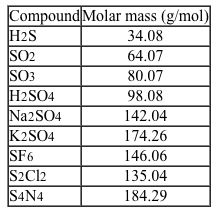 Reduction of elemental sulfur by bacteria during anaerobic digestion produces the toxic, foul-smelling gas H2S. Oxidation of elemental sulfur via combustion or volcanic processes yields gases of SO2 and SO3. When dissolved in water, both SO2 and SO3 produce acidic solutions, and SO3 reacts with water to form the acid H2SO4. Neutralization of H2SO4 can provide a variety of salts, including Na2SO4.Elemental sulfur can also react with halogen gases to form sulfur halides such as the industrially important insulator gas SF6 and the synthetic reagent S2Cl2. S2Cl2 facilitates the formation of other sulfur compounds. For example, reacting S2Cl2 with NH3 produces the sulfur pnictide S4N4.
-The anion SO32− and sulfur trioxide, SO3, have the same elemental composition. These two chemical species are:
Reduction of elemental sulfur by bacteria during anaerobic digestion produces the toxic, foul-smelling gas H2S. Oxidation of elemental sulfur via combustion or volcanic processes yields gases of SO2 and SO3. When dissolved in water, both SO2 and SO3 produce acidic solutions, and SO3 reacts with water to form the acid H2SO4. Neutralization of H2SO4 can provide a variety of salts, including Na2SO4.Elemental sulfur can also react with halogen gases to form sulfur halides such as the industrially important insulator gas SF6 and the synthetic reagent S2Cl2. S2Cl2 facilitates the formation of other sulfur compounds. For example, reacting S2Cl2 with NH3 produces the sulfur pnictide S4N4.
-The anion SO32− and sulfur trioxide, SO3, have the same elemental composition. These two chemical species are: (Multiple Choice)
4.8/5  (66)
(66) Passage
Dmitri Mendeleev is credited with grouping the elements by atomic mass and observing that similar properties emerge periodically. Henry Moseley then determined that a fundamental property, which Ernest Rutherford later called the atomic number, is more important than atomic mass for ordering the elements.As the periodic table took shape, scientists noted certain properties and trends. For example, Rayleigh and Ramsay observed that some elements are unreactive and gave them the name noble gases. But it was not until Niels Bohr described his model of the atom that scientists understood why noble gases are stable.Another important trend was discovered by Linus Pauling. He was the first to identify electronegativity as a way to describe bonds that are neither completely ionic nor completely covalent. Pauling assigned fluorine the highest electronegativity value of 4.0 because of its strong tendency to attract electrons when bonded to other atoms. All other atoms were assigned values relative to fluorine. This became known as the Pauling electronegativity scale.Scientists identified other trends based on x-ray crystallography and reactivity studies. Figure 1 shows the first ionization energy of the elements, and Figure 2 shows electron affinity.
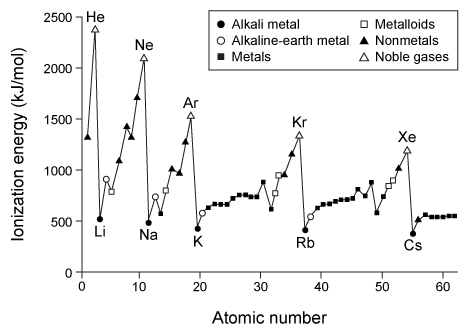 Figure 1 First ionization energy of elements
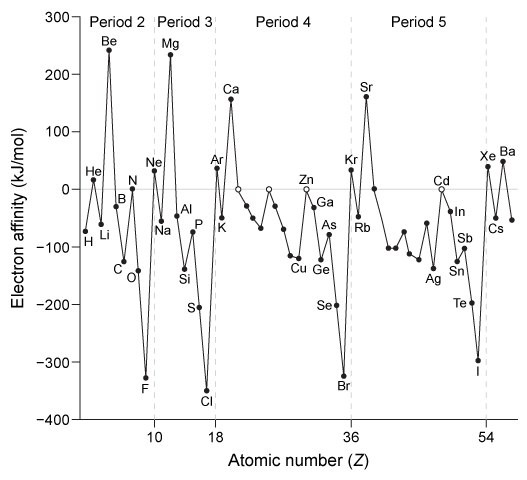 Figure 2 Electron affinity of several elements (larger negative values indicate greater electron affinity)
-According to trends in ionization energy, which metal would be the most reactive with Group 6A and 7A nonmetals?
Figure 1 First ionization energy of elements
Figure 2 Electron affinity of several elements (larger negative values indicate greater electron affinity)
-According to trends in ionization energy, which metal would be the most reactive with Group 6A and 7A nonmetals? (Multiple Choice)
5.0/5 (73)
(73) Passage
Nuclear medicine uses radiopharmaceuticals for disease treatment and as tracers in medical imaging studies. Yttrium-90 (90Y) is a radiopharmaceutical agent used to treat overgrown joint lining known as pigmented villonodular synovitis, as well as some forms of liver cancer. It has a half-life of about 64 hours.Although the relatively short half-life of 90Y is optimal for use in medical applications, transportation and storage of the radiopharmaceutical are not feasible. As a result, strontium-90 (90Sr), with a half-life of 28.8 years, is the most common source of 90Y. 90Sr is created by a nuclear fission process that begins with uranium-235 (235U) in a nuclear reactor as shown in Reaction 1.235U → 90Sr + ZReaction 1Fission of 235U produces 90Sr as well as additional fission products (Z) including, but not limited to, technetium-99 (99Tc), iodine-129 (129I), and zirconium-93 (93Zr). Figure 1 shows the distribution of fission products.
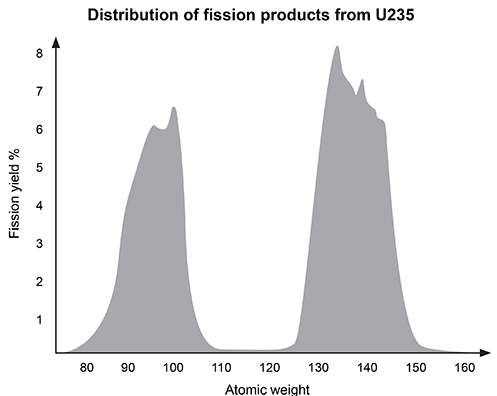 Figure 1 Distribution of 235U fission products by atomic weightTo create the final 90Y required for nuclear medicine studies, 90Sr decay is carried out in a controlled 90Y generator. 90Y is then separated from residual 90Sr for use in clinical applications.
Adapted from Wheeler CE. Comments on vaccines, August 1987. J Am Acad Dermatol. 1988;18(1 Pt 2):232-4.
-Strontium is converted to yttrium by which of the following processes?
Figure 1 Distribution of 235U fission products by atomic weightTo create the final 90Y required for nuclear medicine studies, 90Sr decay is carried out in a controlled 90Y generator. 90Y is then separated from residual 90Sr for use in clinical applications.
Adapted from Wheeler CE. Comments on vaccines, August 1987. J Am Acad Dermatol. 1988;18(1 Pt 2):232-4.
-Strontium is converted to yttrium by which of the following processes? (Multiple Choice)
4.9/5 (69)
(69) Passage
Although acetylsalicylic acid (aspirin) is a well-known and widely used analgesic and anti-inflammatory agent, copper(II) acetylsalicylate, a copper complex formed from aspirin and copper, has also been found to exhibit some distinctive and potentially beneficial pharmacological properties. Formation of copper(II) acetylsalicylate is achieved when the conjugate base of aspirin, acetylsalicylate (C9H7O4−), binds to Cu2+ ions in solution, as outlined in Reaction 1.4 NaC9H7O4(aq) + 2 CuSO4(aq) → Cu2(C9H7O4)4(s) + 2 Na2SO4(aq)Reaction 1Using Reaction 1, a researcher synthesized a sample of copper(II) acetylsalicylate for analysis. A small volume of 0.50 M aqueous copper(II) sulfate (molar mass = 159.6) was mixed into 100 mL of filtered, saturated aqueous sodium acetylsalicylate (molar mass = 202.2) at room temperature and slowly stirred. Formation of copper(II) acetylsalicylate (molar mass = 843.7) was immediately observed as a bright blue precipitate. The precipitate was then isolated by filtration and dried, affording the product complex in high yield.
Adapted from: Seguel GV, Rivas BL, Contreras JG. Synthesis and characterization of copper complexes: interaction of metalliccarboxylates with 1,3-thiazole ligand. Journal of the Chilean Chemical Society. 1970; 58(4):1967.
-What volume of the copper(II) sulfate solution should be used in the reaction to deliver 0.8 g of CuSO4 into the reaction mixture?
(Multiple Choice)
4.8/5 (87)
(87) Passage
The bicarbonate (HCO3−) buffer system (Reaction 1) helps to maintain acid-base homeostasis and a blood pH near 7.4. Therefore, concentrations of carbon dioxide (CO2) and HCO3− must be tightly regulated through adaptations in respiratory and renal physiology. For patients with suspected acid-base imbalance, these concentrations can be monitored by blood gas analysis performed on arterial or venous blood.
 CO2g+H2Ol⇔carbonic anhydraseH2CO3aq⇔pKa=6.35HCO3-aq+H+aqReaction 1In most automated blood gas analyzers, ionized hydrogen, CO2, and oxygen (O2) in the sample diffuse through semipermeable membranes and are measured at separate electrodes (Figure 1). The pH-sensitive glass electrode (E1) is separated from the blood sample by a membrane permeable to hydrogen ions. The sample pH is determined according to the voltage difference between E1 and a reference electrode maintained in a solution of standard pH. CO2 diffuses across a gas-permeable membrane to E2, where it reacts to generate HCO3− and free hydrogen ions. In a modification of the mechanism used in E1, partial pressure of CO2 (PaCO2) is calculated indirectly from the change in pH, as determined by the potential difference between E2 and its reference electrode.E3, also called the Clark electrode, is an electrochemical cell containing a silver anode and a platinum cathode. O2 diffuses through another gas-permeable membrane and reacts with hydrogen ions to form water. The current measured at E3 is then used to calculate PaO2 in the blood sample.
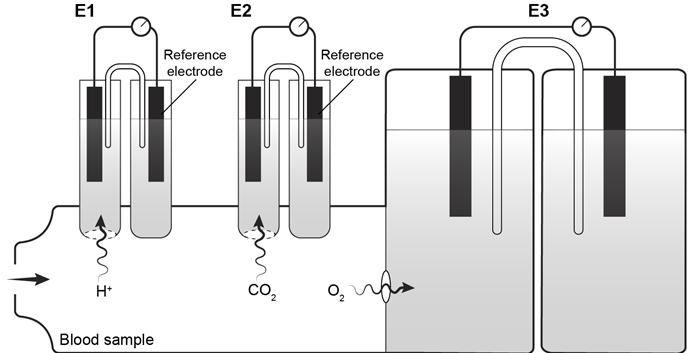 Figure 1 Automated blood gas analyzerThe concentration of carbonic acid (H2CO3), reported in milliequivalents per liter (mEq/L), can be calculated from PaCO2 by Equation 1:
 H2CO3mEqL=0.03×PaCO2mm HgEquation 1Subsequently, using the concentration of H2CO3 obtained from Equation 1, the HCO3− concentration resulting from decomposition of carbonic acid can then be calculated by applying the Henderson-Hasselbalch equation.
-In the alveoli, hypoventilation (decreased gas exchange) and hyperventilation (increased gas exchange) can lead to abnormalities in acid-base homeostasis. Which of the following is true of the immediate effects of abnormal ventilation?
CO2g+H2Ol⇔carbonic anhydraseH2CO3aq⇔pKa=6.35HCO3-aq+H+aqReaction 1In most automated blood gas analyzers, ionized hydrogen, CO2, and oxygen (O2) in the sample diffuse through semipermeable membranes and are measured at separate electrodes (Figure 1). The pH-sensitive glass electrode (E1) is separated from the blood sample by a membrane permeable to hydrogen ions. The sample pH is determined according to the voltage difference between E1 and a reference electrode maintained in a solution of standard pH. CO2 diffuses across a gas-permeable membrane to E2, where it reacts to generate HCO3− and free hydrogen ions. In a modification of the mechanism used in E1, partial pressure of CO2 (PaCO2) is calculated indirectly from the change in pH, as determined by the potential difference between E2 and its reference electrode.E3, also called the Clark electrode, is an electrochemical cell containing a silver anode and a platinum cathode. O2 diffuses through another gas-permeable membrane and reacts with hydrogen ions to form water. The current measured at E3 is then used to calculate PaO2 in the blood sample.
Figure 1 Automated blood gas analyzerThe concentration of carbonic acid (H2CO3), reported in milliequivalents per liter (mEq/L), can be calculated from PaCO2 by Equation 1:
H2CO3mEqL=0.03×PaCO2mm HgEquation 1Subsequently, using the concentration of H2CO3 obtained from Equation 1, the HCO3− concentration resulting from decomposition of carbonic acid can then be calculated by applying the Henderson-Hasselbalch equation.
-In the alveoli, hypoventilation (decreased gas exchange) and hyperventilation (increased gas exchange) can lead to abnormalities in acid-base homeostasis. Which of the following is true of the immediate effects of abnormal ventilation? (Multiple Choice)
4.9/5 (77)
(77) Passage
Kidney stones are a common ailment affecting approximately 10% of adults in the United States. They form when solutes precipitate out of solution as crystals in the urinary tract, and they can cause severe pain in the side, back, abdomen, and groin. Individuals who have been previously diagnosed with kidney stones have an increased probability of developing new stones relative to unaffected individuals. Different measures may help prevent the formation of different kinds of stones, so analysis of the composition of stones that have been passed or removed can aid in preventing recurrence. Stones can be ground into fine powders, dissolved in a small amount of solvent, and analyzed by infrared (IR) spectroscopy, as shown in Figure 1.
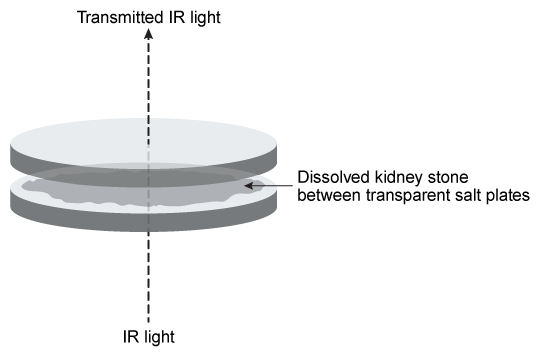 Figure 1 Schematic of kidney stone analysis by IR spectroscopyIR analysis of kidney stones from 50 individuals revealed the percentage of stones that contain each component, shown in Table 1 along with solubility data.Table 1 Kidney Stone Composition Parameters
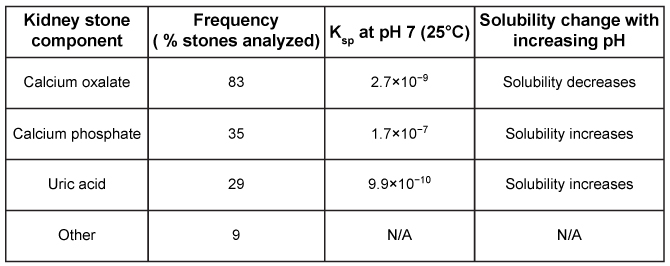 Some studies indicate that potassium citrate, taken orally, may prevent the formation of calcium oxalate crystals, the most abundant component of kidney stones. Oxalic acid, shown in Figure 2, is significantly more soluble than calcium oxalate.
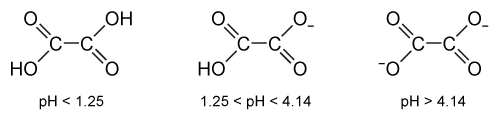 Figure 2 Structure of oxalic acid and its associated anions with increasing pHPotassium citrate alkalinizes the urine, potentially causing a decrease in oxalate solubility and the formation of more crystals. However, potassium citrate can also react with calcium oxalate according to the unbalanced equation shown in Reaction 1:CaC2O4 + K3(C6H5O7) → Ca3(C6H5O7)2 + K2C2O4Reaction 1Calcium citrate and potassium oxalate are both hundreds of times more soluble than calcium oxalate, so the presence of citrate and potassium ions can help maintain calcium and oxalate ions in solution. This effect may be sufficient to overcome the decreased solubility that occurs at higher pH levels.
Adapted from Primiano A, Persichilli S, Gambaro G, et al. FT-IR analysis of urinary stones: a helpful tool for clinician comparison with the chemical spot test. Dis Markers. 2014;2014:176165.
-Given the unbalanced equation (Reaction 1) and the molecular weight of calcium citrate (498.5 g/mol), if 15 nmol of calcium oxalate is mixed with 15 nmol of potassium citrate, what is the approximate theoretical yield of calcium citrate?
Figure 1 Schematic of kidney stone analysis by IR spectroscopyIR analysis of kidney stones from 50 individuals revealed the percentage of stones that contain each component, shown in Table 1 along with solubility data.Table 1 Kidney Stone Composition Parameters
Some studies indicate that potassium citrate, taken orally, may prevent the formation of calcium oxalate crystals, the most abundant component of kidney stones. Oxalic acid, shown in Figure 2, is significantly more soluble than calcium oxalate.
Figure 2 Structure of oxalic acid and its associated anions with increasing pHPotassium citrate alkalinizes the urine, potentially causing a decrease in oxalate solubility and the formation of more crystals. However, potassium citrate can also react with calcium oxalate according to the unbalanced equation shown in Reaction 1:CaC2O4 + K3(C6H5O7) → Ca3(C6H5O7)2 + K2C2O4Reaction 1Calcium citrate and potassium oxalate are both hundreds of times more soluble than calcium oxalate, so the presence of citrate and potassium ions can help maintain calcium and oxalate ions in solution. This effect may be sufficient to overcome the decreased solubility that occurs at higher pH levels.
Adapted from Primiano A, Persichilli S, Gambaro G, et al. FT-IR analysis of urinary stones: a helpful tool for clinician comparison with the chemical spot test. Dis Markers. 2014;2014:176165.
-Given the unbalanced equation (Reaction 1) and the molecular weight of calcium citrate (498.5 g/mol), if 15 nmol of calcium oxalate is mixed with 15 nmol of potassium citrate, what is the approximate theoretical yield of calcium citrate? (Multiple Choice)
4.7/5 (73)
(73) During beta decay, a radioactive atomic nucleus emits either an electron (β− decay) or a positron (β+ decay). If a cobalt-59 atom is formed from the β− decay of a radionuclide, what must the original nucleus have been?
(Multiple Choice)
4.8/5 (87)
(87) Passage
Copper plays a vital role as a trace mineral for biological processes. The amount of dietary copper needed by an adult each day is about 30 μg/kg of body weight, and blood plasma normally has a copper concentration of 1 mg/L.Copper is an essential element, and toxic effects are not common. However, given sufficient exposure to high levels by inhalation, absorption, or ingestion from sources such as industrial hazards or contaminated groundwater, copper toxicity can occur.Salts that are more soluble tend to exhibit higher toxicity when ingested, but the solubilities of copper salts vary and are also temperature-dependent, as shown by selected examples in Figure 1.
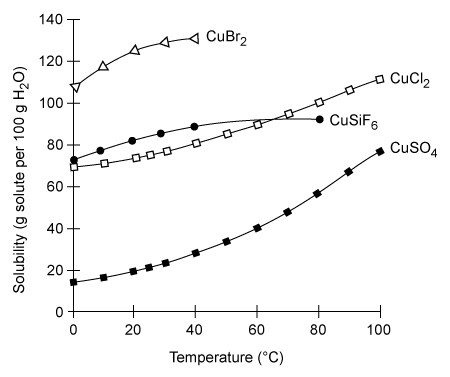 Figure 1 The solubility of selected copper salts in distilled water with increasing temperatureSome copper salts have solubilities much lower than those shown in Figure 1. For example, CuF2 has a solubility of only 0.075 g per 100 g of water (at 25 °C). This indicates that CuF2 dissociates in water only to a small extent (Reaction 1) and that the equilibrium favors the undissociated salt, giving CuF2 a solubility product constant of Ksp = 1.6 × 10⁻⁶.
 Reaction 1Compound-specific properties can also impact solubility. In CuF2, the dissociated F− ion is mildly basic (pKb = 10.8), causing the equilibrium to be influenced by the pH of the solution.Specific characteristics of copper can also play a role. For example, copper ions in solution express an affinity to form coordinate bonds with available lone-pair electrons of nitrogen atoms in amines (Reaction 2).
 Reaction 2If excess amine ligands are present, coordinate bonds like that shown in Reaction 2 will continue to form until each Cu2+ ion in solution is coordinated with four nitrogen atoms. This acquisition of copper ions by ligands in solution can also impact the solubility equilibrium of copper salts by forming soluble coordination complexes.
-Suppose that a research technician wants to separate an aqueous mixture of CuF2 and BaF2 (Ksp = 3.0 × 10⁻⁶) by precipitating CuF2 from the solution. What should be added to the solution to perform the separation?
Figure 1 The solubility of selected copper salts in distilled water with increasing temperatureSome copper salts have solubilities much lower than those shown in Figure 1. For example, CuF2 has a solubility of only 0.075 g per 100 g of water (at 25 °C). This indicates that CuF2 dissociates in water only to a small extent (Reaction 1) and that the equilibrium favors the undissociated salt, giving CuF2 a solubility product constant of Ksp = 1.6 × 10⁻⁶.
Reaction 1Compound-specific properties can also impact solubility. In CuF2, the dissociated F− ion is mildly basic (pKb = 10.8), causing the equilibrium to be influenced by the pH of the solution.Specific characteristics of copper can also play a role. For example, copper ions in solution express an affinity to form coordinate bonds with available lone-pair electrons of nitrogen atoms in amines (Reaction 2).
Reaction 2If excess amine ligands are present, coordinate bonds like that shown in Reaction 2 will continue to form until each Cu2+ ion in solution is coordinated with four nitrogen atoms. This acquisition of copper ions by ligands in solution can also impact the solubility equilibrium of copper salts by forming soluble coordination complexes.
-Suppose that a research technician wants to separate an aqueous mixture of CuF2 and BaF2 (Ksp = 3.0 × 10⁻⁶) by precipitating CuF2 from the solution. What should be added to the solution to perform the separation? (Multiple Choice)
4.8/5 (72)
(72) Passage
Copper plays a vital role as a trace mineral for biological processes. The amount of dietary copper needed by an adult each day is about 30 μg/kg of body weight, and blood plasma normally has a copper concentration of 1 mg/L.Copper is an essential element, and toxic effects are not common. However, given sufficient exposure to high levels by inhalation, absorption, or ingestion from sources such as industrial hazards or contaminated groundwater, copper toxicity can occur.Salts that are more soluble tend to exhibit higher toxicity when ingested, but the solubilities of copper salts vary and are also temperature-dependent, as shown by selected examples in Figure 1.
Figure 1 The solubility of selected copper salts in distilled water with increasing temperatureSome copper salts have solubilities much lower than those shown in Figure 1. For example, CuF2 has a solubility of only 0.075 g per 100 g of water (at 25 °C). This indicates that CuF2 dissociates in water only to a small extent (Reaction 1) and that the equilibrium favors the undissociated salt, giving CuF2 a solubility product constant of Ksp = 1.6 × 10⁻⁶.
Reaction 1Compound-specific properties can also impact solubility. In CuF2, the dissociated F− ion is mildly basic (pKb = 10.8), causing the equilibrium to be influenced by the pH of the solution.Specific characteristics of copper can also play a role. For example, copper ions in solution express an affinity to form coordinate bonds with available lone-pair electrons of nitrogen atoms in amines (Reaction 2).
Reaction 2If excess amine ligands are present, coordinate bonds like that shown in Reaction 2 will continue to form until each Cu2+ ion in solution is coordinated with four nitrogen atoms. This acquisition of copper ions by ligands in solution can also impact the solubility equilibrium of copper salts by forming soluble coordination complexes.
-In pure water at 25 °C, the concentration of a saturated solution of CuF2 is 7.4 × 10⁻³ M. If measured at the same temperature, what is the concentration of a saturated solution of CuF2 in aqueous 0.20 M NaF?
Figure 1 The solubility of selected copper salts in distilled water with increasing temperatureSome copper salts have solubilities much lower than those shown in Figure 1. For example, CuF2 has a solubility of only 0.075 g per 100 g of water (at 25 °C). This indicates that CuF2 dissociates in water only to a small extent (Reaction 1) and that the equilibrium favors the undissociated salt, giving CuF2 a solubility product constant of Ksp = 1.6 × 10⁻⁶.
Reaction 1Compound-specific properties can also impact solubility. In CuF2, the dissociated F− ion is mildly basic (pKb = 10.8), causing the equilibrium to be influenced by the pH of the solution.Specific characteristics of copper can also play a role. For example, copper ions in solution express an affinity to form coordinate bonds with available lone-pair electrons of nitrogen atoms in amines (Reaction 2).
Reaction 2If excess amine ligands are present, coordinate bonds like that shown in Reaction 2 will continue to form until each Cu2+ ion in solution is coordinated with four nitrogen atoms. This acquisition of copper ions by ligands in solution can also impact the solubility equilibrium of copper salts by forming soluble coordination complexes.
-In pure water at 25 °C, the concentration of a saturated solution of CuF2 is 7.4 × 10⁻³ M. If measured at the same temperature, what is the concentration of a saturated solution of CuF2 in aqueous 0.20 M NaF? (Multiple Choice)
4.9/5 (86)
(86) Passage
The tendency of a chemical species to undergo reduction during an electrochemical reaction is indicated by the standard potential E° for the reaction. As represented generally by Reaction 1, E° measures the potential Z at which element X with oxidation number N accepts N electrons and is reduced to its elemental state.X(N) + Ne− → X(0), E° = Z voltsReaction 1In a galvanic cell, E° > 0 indicates a spontaneous reaction. Therefore, chemical species with higher positive E° values are reduced more easily than those with lower E° values.Using E° as a basis of comparison, the relative thermodynamic stabilities of different chemical species involving the same element at different oxidation states can be presented graphically using a Frost diagram. For a series of compounds containing element X, a Frost diagram plots the value of NE° for each compound against the corresponding oxidation number N of element X within the species. Frost diagrams for several species containing manganese or chlorine are shown in Figure 1.
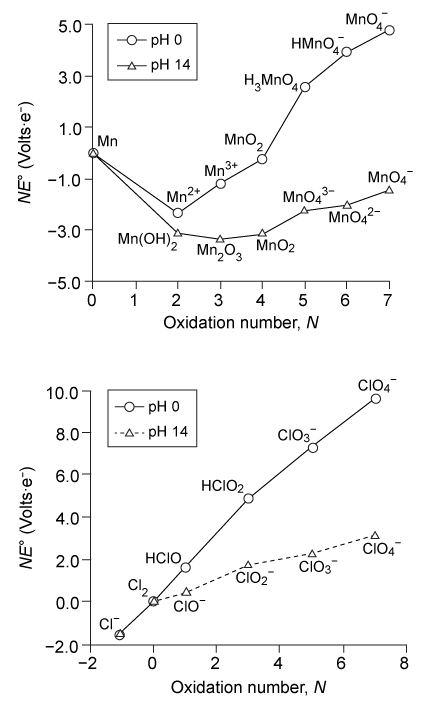 Figure 1 Frost diagrams for manganese and chlorineOn a Frost diagram, NE° is proportional to the standard Gibbs free energy ΔG° according to the relationshipΔG° = −FNE° = −nFE°Equation 1where n is the number of moles of electrons transferred during the electrochemical process and F is the Faraday constant. Free energy considerations also show that a species is prone to disproportionation if its position on the Frost diagram lies above a line connecting the points of two adjacent species, as seen for species B in Figure 2.
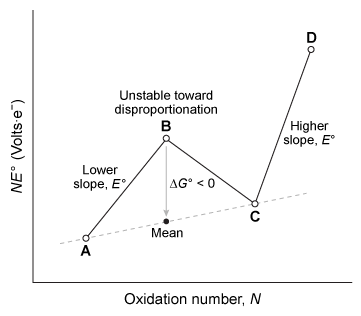 Figure 2 General Frost diagram for an element forming species A, B, C, and D.The slope of a line segment joining two species on a Frost diagram is equal to the standard reduction potential for the couple. A greater slope indicates a higher corresponding reduction potential. As a result, in Figure 2, the reduction potential for B to A is lower than that for D to C.
-3 H2O + 5 ClO3− + 3 I2 → 5 Cl− + 6 IO3− + 6 H+Consider the reaction of iodine with ClO3− under acidic conditions, as shown above. If 6 moles of electrons are required to reduce 1 mole of ClO3−, how many moles of electrons are required to completely reduce all the ClO3− ions present in 250 mL of a 4.8 M ClO3− solution?
Figure 1 Frost diagrams for manganese and chlorineOn a Frost diagram, NE° is proportional to the standard Gibbs free energy ΔG° according to the relationshipΔG° = −FNE° = −nFE°Equation 1where n is the number of moles of electrons transferred during the electrochemical process and F is the Faraday constant. Free energy considerations also show that a species is prone to disproportionation if its position on the Frost diagram lies above a line connecting the points of two adjacent species, as seen for species B in Figure 2.
Figure 2 General Frost diagram for an element forming species A, B, C, and D.The slope of a line segment joining two species on a Frost diagram is equal to the standard reduction potential for the couple. A greater slope indicates a higher corresponding reduction potential. As a result, in Figure 2, the reduction potential for B to A is lower than that for D to C.
-3 H2O + 5 ClO3− + 3 I2 → 5 Cl− + 6 IO3− + 6 H+Consider the reaction of iodine with ClO3− under acidic conditions, as shown above. If 6 moles of electrons are required to reduce 1 mole of ClO3−, how many moles of electrons are required to completely reduce all the ClO3− ions present in 250 mL of a 4.8 M ClO3− solution? (Multiple Choice)
5.0/5 (74)
(74) 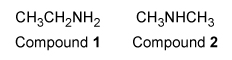 Given that the boiling point of Compound 1 is 18 °C, the boiling point of Compound 2 would most likely be:
 (Multiple Choice)
4.9/5 (81)
(81) Passage
Amino acids and copper both serve vital roles in many biological processes of living organisms. Beyond their separate biological roles, however, chemists have also discovered that amino acids are able to function as chelates with Cu2+ ions to form blue complexes with potential medicinal applications. One such complex, copper(II) glycinate, has shown to be effective against some oral diseases. The reaction to form copper(II) glycinate is shown in Figure 1.
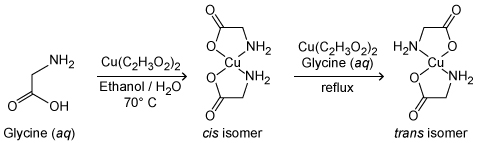 Figure 1 Synthesis of two isomers of copper(II) glycinateTwo different isomers can form depending on the reaction conditions. Mixing hot aqueous glycine (70 °C) with a hot solution of copper(II) acetate dissolved in 50% aqueous ethanol, followed by cooling the mixture on ice, yields a precipitate of only the cis isomer. If a suspension of the cis isomer is held at boiling for an hour or longer in a solution of glycine and copper(II) acetate, the trans isomer is obtained.Because of the geometric differences between the two isomers, the stretching vibrations of the central Cu-N and Cu-O bonds in each isomer are different. Symmetric and asymmetric bond stretching give four possible vibrational modes for each isomer, as shown in Figure 2.
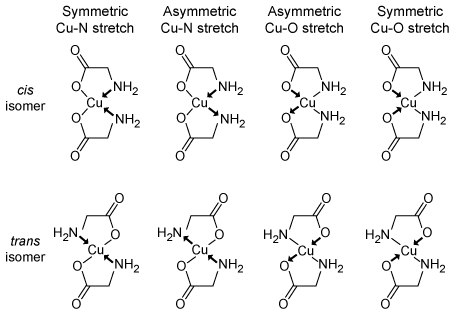 Figure 2 Vibrational modes of the coordinate bonds in copper(II) glycinateIf the stretching of the bonds during vibration causes a transient, unequal distribution of electron density between the atoms within the bond, an oscillating dipole will form. Bonds with dipoles that are not cancelled out by another dipole in the molecule will absorb infrared light at particular frequencies (often expressed in wave numbers) and are designated as IR-active. As a result, the vibrational differences between the two isomers can be analyzed by far-infrared (far-IR) spectroscopy, as shown in Figure 3.
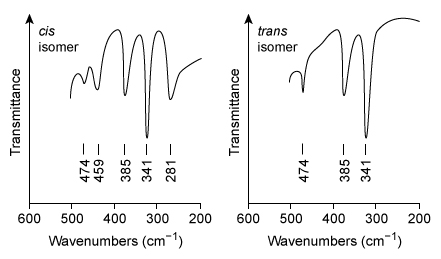 Figure 3 Far-IR spectra of the cis and trans isomers of copper(II) glycinateBoth isomers show a skeletal absorbance (unrelated to coordinate bond vibration) near 385 cm−1. Additional absorbance bands are seen that specifically relate to the vibrational modes of the bonds in each isomer.
-The copper(II) glycinate isomers contain atoms with different hybridization states.
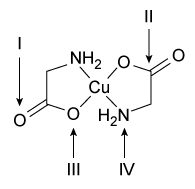 Based on the chemical structure shown above, which of the indicated atoms in the trans isomer are NOT sp3 hybridized? (Note: Ignore any effects from resonance contributors.)
Figure 1 Synthesis of two isomers of copper(II) glycinateTwo different isomers can form depending on the reaction conditions. Mixing hot aqueous glycine (70 °C) with a hot solution of copper(II) acetate dissolved in 50% aqueous ethanol, followed by cooling the mixture on ice, yields a precipitate of only the cis isomer. If a suspension of the cis isomer is held at boiling for an hour or longer in a solution of glycine and copper(II) acetate, the trans isomer is obtained.Because of the geometric differences between the two isomers, the stretching vibrations of the central Cu-N and Cu-O bonds in each isomer are different. Symmetric and asymmetric bond stretching give four possible vibrational modes for each isomer, as shown in Figure 2.
Figure 2 Vibrational modes of the coordinate bonds in copper(II) glycinateIf the stretching of the bonds during vibration causes a transient, unequal distribution of electron density between the atoms within the bond, an oscillating dipole will form. Bonds with dipoles that are not cancelled out by another dipole in the molecule will absorb infrared light at particular frequencies (often expressed in wave numbers) and are designated as IR-active. As a result, the vibrational differences between the two isomers can be analyzed by far-infrared (far-IR) spectroscopy, as shown in Figure 3.
Figure 3 Far-IR spectra of the cis and trans isomers of copper(II) glycinateBoth isomers show a skeletal absorbance (unrelated to coordinate bond vibration) near 385 cm−1. Additional absorbance bands are seen that specifically relate to the vibrational modes of the bonds in each isomer.
-The copper(II) glycinate isomers contain atoms with different hybridization states. Based on the chemical structure shown above, which of the indicated atoms in the trans isomer are NOT sp3 hybridized? (Note: Ignore any effects from resonance contributors.) (Multiple Choice)
4.9/5 (85)
(85) Passage
Sulfur is the 10th most abundant element on Earth and is an essential element in biological systems. Sulfur can form a variety of chemical compounds and will react with nearly every element except Au, Pt, Ir, Te, and the noble gases. A list of several common inorganic compounds of sulfur is given in Table 1.Table 1 Selected Common Inorganic Sulfur Compounds
Reduction of elemental sulfur by bacteria during anaerobic digestion produces the toxic, foul-smelling gas H2S. Oxidation of elemental sulfur via combustion or volcanic processes yields gases of SO2 and SO3. When dissolved in water, both SO2 and SO3 produce acidic solutions, and SO3 reacts with water to form the acid H2SO4. Neutralization of H2SO4 can provide a variety of salts, including Na2SO4.Elemental sulfur can also react with halogen gases to form sulfur halides such as the industrially important insulator gas SF6 and the synthetic reagent S2Cl2. S2Cl2 facilitates the formation of other sulfur compounds. For example, reacting S2Cl2 with NH3 produces the sulfur pnictide S4N4.
-Which of the following sulfur compounds from Table 1 has a chemical structure that contains both ionic and covalent bonds?
Reduction of elemental sulfur by bacteria during anaerobic digestion produces the toxic, foul-smelling gas H2S. Oxidation of elemental sulfur via combustion or volcanic processes yields gases of SO2 and SO3. When dissolved in water, both SO2 and SO3 produce acidic solutions, and SO3 reacts with water to form the acid H2SO4. Neutralization of H2SO4 can provide a variety of salts, including Na2SO4.Elemental sulfur can also react with halogen gases to form sulfur halides such as the industrially important insulator gas SF6 and the synthetic reagent S2Cl2. S2Cl2 facilitates the formation of other sulfur compounds. For example, reacting S2Cl2 with NH3 produces the sulfur pnictide S4N4.
-Which of the following sulfur compounds from Table 1 has a chemical structure that contains both ionic and covalent bonds? (Multiple Choice)
4.9/5 (84)
(84) Passage
Sulfur is the 10th most abundant element on Earth and is an essential element in biological systems. Sulfur can form a variety of chemical compounds and will react with nearly every element except Au, Pt, Ir, Te, and the noble gases. A list of several common inorganic compounds of sulfur is given in Table 1.Table 1 Selected Common Inorganic Sulfur Compounds
Reduction of elemental sulfur by bacteria during anaerobic digestion produces the toxic, foul-smelling gas H2S. Oxidation of elemental sulfur via combustion or volcanic processes yields gases of SO2 and SO3. When dissolved in water, both SO2 and SO3 produce acidic solutions, and SO3 reacts with water to form the acid H2SO4. Neutralization of H2SO4 can provide a variety of salts, including Na2SO4.Elemental sulfur can also react with halogen gases to form sulfur halides such as the industrially important insulator gas SF6 and the synthetic reagent S2Cl2. S2Cl2 facilitates the formation of other sulfur compounds. For example, reacting S2Cl2 with NH3 produces the sulfur pnictide S4N4.
-The chemical structures of sulfur compounds H2S, SF6, S2Cl2, and S4N4 each contain only single (sigma) bonds. The compound that contains the longest bond between sulfur and an atom of another element is:
Reduction of elemental sulfur by bacteria during anaerobic digestion produces the toxic, foul-smelling gas H2S. Oxidation of elemental sulfur via combustion or volcanic processes yields gases of SO2 and SO3. When dissolved in water, both SO2 and SO3 produce acidic solutions, and SO3 reacts with water to form the acid H2SO4. Neutralization of H2SO4 can provide a variety of salts, including Na2SO4.Elemental sulfur can also react with halogen gases to form sulfur halides such as the industrially important insulator gas SF6 and the synthetic reagent S2Cl2. S2Cl2 facilitates the formation of other sulfur compounds. For example, reacting S2Cl2 with NH3 produces the sulfur pnictide S4N4.
-The chemical structures of sulfur compounds H2S, SF6, S2Cl2, and S4N4 each contain only single (sigma) bonds. The compound that contains the longest bond between sulfur and an atom of another element is: (Multiple Choice)
5.0/5 (62)
(62) Passage
Potassium permanganate (KMnO4) is a highly reactive inorganic salt that appears as granular dark purple crystals, nearly black in color. Due to its useful chemical properties and the fact that its reactions typically do not produce compounds that are toxic, KMnO4 is employed in a variety of applications, including use as a topical skin disinfectant, an antifungal agent, a fire starter, and a disinfectant for drinking water.KMnO4 is widely used as an alternative water treatment agent both to disinfect drinking water and to remove undesirable dissolved iron and sulfur compounds. The crystals are highly soluble in water and form bright pink aqueous solutions that provide a visual indication of the presence of KMnO4 treatment residual. As a drinking water disinfectant, a KMnO4 concentration of 1 mg/L is recommended unless higher levels of contamination are indicated by the absence of a pink residual.Industrial production of potassium permanganate is accomplished in two steps. In step 1, manganese(IV) oxide (MnO2) is heated with potassium hydroxide in the presence of oxygen to produce potassium manganate (K2MnO4), as outlined in Reaction 1.2 MnO2 + 4 KOH + O2 → 2 K2MnO4 + 2 H2OReaction 1In step 2, the potassium manganate is then converted into potassium permanganate electrochemically according to Reaction 2.2 K2MnO4 + 2 H2O → 2 KMnO4 + 2 KOH + H2Reaction 2
-In which compound does manganese have a +6 oxidation number?
(Multiple Choice)
4.9/5 (91)
(91) Passage
Dmitri Mendeleev is credited with grouping the elements by atomic mass and observing that similar properties emerge periodically. Henry Moseley then determined that a fundamental property, which Ernest Rutherford later called the atomic number, is more important than atomic mass for ordering the elements.As the periodic table took shape, scientists noted certain properties and trends. For example, Rayleigh and Ramsay observed that some elements are unreactive and gave them the name noble gases. But it was not until Niels Bohr described his model of the atom that scientists understood why noble gases are stable.Another important trend was discovered by Linus Pauling. He was the first to identify electronegativity as a way to describe bonds that are neither completely ionic nor completely covalent. Pauling assigned fluorine the highest electronegativity value of 4.0 because of its strong tendency to attract electrons when bonded to other atoms. All other atoms were assigned values relative to fluorine. This became known as the Pauling electronegativity scale.Scientists identified other trends based on x-ray crystallography and reactivity studies. Figure 1 shows the first ionization energy of the elements, and Figure 2 shows electron affinity.
Figure 1 First ionization energy of elements
Figure 2 Electron affinity of several elements (larger negative values indicate greater electron affinity)
-The difference between the first and second ionization energies for magnesium is approximately 700 kJ/mol. The difference between the second and third ionization energies will likely be:
Figure 1 First ionization energy of elements
Figure 2 Electron affinity of several elements (larger negative values indicate greater electron affinity)
-The difference between the first and second ionization energies for magnesium is approximately 700 kJ/mol. The difference between the second and third ionization energies will likely be: (Multiple Choice)
4.9/5 (79)
(79) The overall reaction for the generation of an NO2+ electrophile:  can be stated in two separate, reversible steps as a protonation followed by a decomposition (Reactions 1 and 2).
 Reaction 1
 Reaction 2Which molecule acts as a Lewis acid, but NOT as a Brønsted-Lowry acid, in these reactions?
can be stated in two separate, reversible steps as a protonation followed by a decomposition (Reactions 1 and 2).
Reaction 1
Reaction 2Which molecule acts as a Lewis acid, but NOT as a Brønsted-Lowry acid, in these reactions? (Multiple Choice)
4.9/5 (93)
(93) Passage
Magnetic resonance imaging (MRI) interprets the nuclear relaxation or relaxivity of hydrogen nuclei in resident water molecules. Hydrogen nuclei in water have two magnetic spin states: alpha and beta. In the presence of an applied magnetic field, these spins will align with the field in an "excited" state and then relax back to the "ground" state, producing a signal with intensity proportional to relaxivity. Frequently, an MRI contrast agent is used to increase the relaxation time in coordinated molecules, resulting in a more intense signal.Commonly used contrast agents include gadolinium-based agents. Depending on its environment, gadolinium (Gd) can have eight or nine sites in its coordination sphere, allowing Gd3+ to interact with eight water molecules as in Gd(H2O)83+. The electronic configuration of gadolinium is shown in Figure 1.
 Figure 1 Electronic configuration of gadoliniumGd3+ alone is toxic to cells because its ionic radius is similar to that of Ca2+, allowing Gd3+ to displace Ca2+ in biologically important settings. Therefore, Gd3+ must be coordinated to an organic ligand such as 1,4,7,10-tetraazacyclododecane-1,4,7,10-tetraacetic acid (DOTA) to allow it to pass through the body safely. When chelated, DOTA displaces the water around gadolinium and leaves only one coordination site for a water molecule (Figure 2).
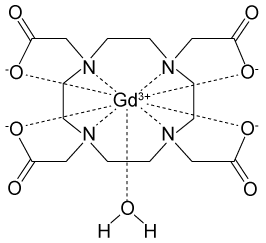 Figure 2 Gd-DOTA with a water coordinated to Gd3+Zinc ions (Zn2+) are required to store insulin and are co-released when insulin is secreted by the pancreas. To detect zinc ions in the body, researchers have designed a variation of Gd-DOTA called Gd-daa3 with two diaminoacetate (daa) arms that preferentially bind to Zn2+ ions (Figure 3). When Zn2+ is absent, these arms coordinate to Gd3+ and create a nine-coordinate complex that prohibits water from binding to Gd3+. Binding of diaminoacetate arms to Zn2+ frees Gd3+ to coordinate with water molecules. This configuration results in increased signal intensity in the parts of the cell where Zn2+ is located.
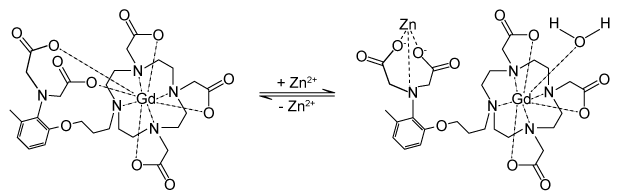 Figure 3 Gd-daa3 when Zn2+ is present
Adapted from Louie A. MRI biosensors: a short primer. J Magn Reson Imaging. 2013;38(3):530-9.
-Gadolinium becomes ionized to Gd3+ when it loses electrons from which orbital(s)?
Figure 1 Electronic configuration of gadoliniumGd3+ alone is toxic to cells because its ionic radius is similar to that of Ca2+, allowing Gd3+ to displace Ca2+ in biologically important settings. Therefore, Gd3+ must be coordinated to an organic ligand such as 1,4,7,10-tetraazacyclododecane-1,4,7,10-tetraacetic acid (DOTA) to allow it to pass through the body safely. When chelated, DOTA displaces the water around gadolinium and leaves only one coordination site for a water molecule (Figure 2).
Figure 2 Gd-DOTA with a water coordinated to Gd3+Zinc ions (Zn2+) are required to store insulin and are co-released when insulin is secreted by the pancreas. To detect zinc ions in the body, researchers have designed a variation of Gd-DOTA called Gd-daa3 with two diaminoacetate (daa) arms that preferentially bind to Zn2+ ions (Figure 3). When Zn2+ is absent, these arms coordinate to Gd3+ and create a nine-coordinate complex that prohibits water from binding to Gd3+. Binding of diaminoacetate arms to Zn2+ frees Gd3+ to coordinate with water molecules. This configuration results in increased signal intensity in the parts of the cell where Zn2+ is located.
Figure 3 Gd-daa3 when Zn2+ is present
Adapted from Louie A. MRI biosensors: a short primer. J Magn Reson Imaging. 2013;38(3):530-9.
-Gadolinium becomes ionized to Gd3+ when it loses electrons from which orbital(s)? (Multiple Choice)
4.9/5 (94)
(94) Passage
Combustion occurs when an oxidation-reduction reaction takes place between a reduced fuel source and an oxidizer, most frequently oxygen. The reaction between hydrogen and oxygen forms water (Reaction 1) and is highly exothermic and thermodynamically favorable. At the completion of hydrogen combustion, essentially all H2 molecules have been converted to water. Nevertheless, at room temperature and atmospheric pressure, molecular hydrogen and oxygen can coexist quite stably.2 H2 + O2 → 2 H2OReaction 1A group of researchers designed two prototype internal combustion engines, each of which could inject a hydrogen/oxygen mixture into a 5-mL combustion chamber at a total pressure of 1 atm and could repeat this process for several cycles. In one engine design, a spark was generated to initiate combustion as hydrogen and oxygen were injected. In another method, the combustion chamber was coated with a small amount of platinum powder. Platinum dramatically increases the reaction rate at room temperature without the need for a spark. The platinum itself is not altered by the reaction and can be reused. Researchers measured the maximum power output of both engine designs under identical injection and temperature conditions (Figure 1).
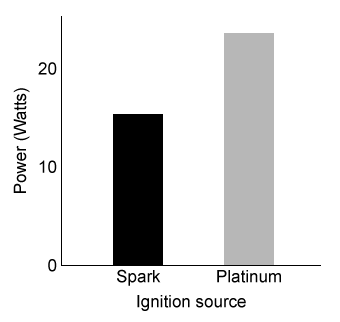 Figure 1 Relative power outputs of hydrogen engines with different ignition sources at 298 KThe power output of an engine is directly related to the rate of combustion. In the presence of platinum, researchers measured the engine's rate of water production at various temperatures and H2/O2 mixture compositions. The results are shown in Figure 2.
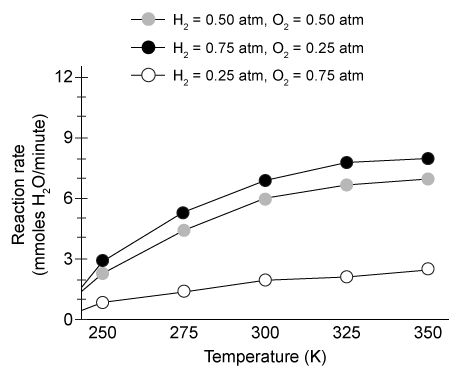 Figure 2 Rate of combustion in platinum-coated engines under various conditions
Adapted from Schultze M, Mantzaras J. Hetero-/homogeneous combustion of hydrogen/air mixtures over platinum: Fuel-lean versus fuel-rich combustion modes doi: 10.1016/j.ijhydene.2013.06.069
-In the absence of platinum, a spark initiates combustion by doing which of the following?
Figure 1 Relative power outputs of hydrogen engines with different ignition sources at 298 KThe power output of an engine is directly related to the rate of combustion. In the presence of platinum, researchers measured the engine's rate of water production at various temperatures and H2/O2 mixture compositions. The results are shown in Figure 2.
Figure 2 Rate of combustion in platinum-coated engines under various conditions
Adapted from Schultze M, Mantzaras J. Hetero-/homogeneous combustion of hydrogen/air mixtures over platinum: Fuel-lean versus fuel-rich combustion modes doi: 10.1016/j.ijhydene.2013.06.069
-In the absence of platinum, a spark initiates combustion by doing which of the following? (Multiple Choice)
4.8/5 (67)
(67) Passage
In polluted urban environments, airborne proteins can undergo nitration reactions that increase their allergenic potential toward the human respiratory system. For example, upon exposure to ozone (O3) and nitrogen dioxide (NO2) under atmospheric conditions, the amino acid tyrosine is known to undergo a two-step irreversible reaction leading to the formation of nitrotyrosine. The first step involves the formation of a reactive oxygen intermediate (ROI) tyrosyl radical through oxidation of the phenolic site of tyrosine. Nitrotyrosine is then formed in the second step through addition of NO2 by a radical-radical termination reaction. The elementary steps for this reaction are shown in Scheme 1.
 Scheme 1 Elementary steps of nitration of tyrosineAirborne protein particles can exist in a variety of environments including the aqueous phase, gaseous phase, or as conglomerates with other biomolecules such as lipids. Because the thermodynamic properties and kinetics of the nitration reaction vary based on the chemical environment in which it occurs, recent studies have focused on understanding the reaction under different conditions.Density functional theory is a powerful computational quantum-mechanical modeling method that can determine the properties of many-electron systems by producing approximate solutions to the Schrödinger equation. Researchers used density functional theory to model the geometries and potential energy surfaces of the reactants, intermediates, and products of the nitration reaction in gaseous, aqueous, and lipid-rich environments. From this modeling, the thermodynamic and kinetic properties were calculated. Figure 1 shows the calculated activation energies Ea in kJ/mol, and Table 1 lists the associated thermochemical properties for both steps of the reaction in all three environments.
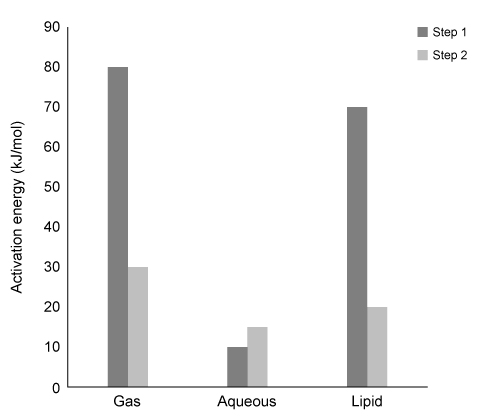 Figure 1 Calculated activation energies for each step of the studied reactions in three environmentsTable 1 Calculated Thermochemical Properties of the Studied Reactions (298.15 K)
 Adapted from Sandhiya L, Kolandaivel P, Senthilkumar K. Oxidation and nitration of tyrosine by ozone and nitrogen dioxide: reaction mechanisms and biological and atmospheric implications. J Phys Chem B. 2014;118(13):3479-90.
-If the first step of the nitration of tyrosine in a lipid environment is slower than the second step, what is the rate law for the overall reaction?
Scheme 1 Elementary steps of nitration of tyrosineAirborne protein particles can exist in a variety of environments including the aqueous phase, gaseous phase, or as conglomerates with other biomolecules such as lipids. Because the thermodynamic properties and kinetics of the nitration reaction vary based on the chemical environment in which it occurs, recent studies have focused on understanding the reaction under different conditions.Density functional theory is a powerful computational quantum-mechanical modeling method that can determine the properties of many-electron systems by producing approximate solutions to the Schrödinger equation. Researchers used density functional theory to model the geometries and potential energy surfaces of the reactants, intermediates, and products of the nitration reaction in gaseous, aqueous, and lipid-rich environments. From this modeling, the thermodynamic and kinetic properties were calculated. Figure 1 shows the calculated activation energies Ea in kJ/mol, and Table 1 lists the associated thermochemical properties for both steps of the reaction in all three environments.
Figure 1 Calculated activation energies for each step of the studied reactions in three environmentsTable 1 Calculated Thermochemical Properties of the Studied Reactions (298.15 K)
Adapted from Sandhiya L, Kolandaivel P, Senthilkumar K. Oxidation and nitration of tyrosine by ozone and nitrogen dioxide: reaction mechanisms and biological and atmospheric implications. J Phys Chem B. 2014;118(13):3479-90.
-If the first step of the nitration of tyrosine in a lipid environment is slower than the second step, what is the rate law for the overall reaction? (Multiple Choice)
4.8/5 (70)
(70) 
Filters
- Essay(0)
- Multiple Choice(0)
- Short Answer(0)
- True False(0)
- Matching(0)