



 Chat with AI
Exam 5: General Chemistry

Exam 1: Behavioral Sciences343 Questions
Exam 2: Biochemistry307 Questions
Exam 3: Biology319 Questions
Exam 4: Critical Analysis & Reasoning Skills358 Questions
Exam 5: General Chemistry317 Questions
Exam 6: Organic Chemistry191 Questions
Exam 7: Physics200 Questions
Select questions type


Passage
Catabolism is an oxidative process in which electrons are transferred from lipids, proteins, and carbohydrates to generate high-energy electron carriers from nicotinamide adenine dinucleotide (NADH/NAD+) and flavin adenine dinucleotide (FADH2/FAD). Both are used in the electron transport chain (ETC) as electron providers in a series of reactions. The transfer of electrons provides energy that drives oxidative phosphorylation and the production of ATP. Reduction of NAD+ proceeds according to the following half-reaction:
 Reaction 1Reactions in the ETC occur in four protein complexes (I-IV) located in the inner mitochondrial membrane. Here high-energy electrons are shuttled from complexes I, II, and III to complex IV, where O2 serves as the final electron acceptor. The net result of NADH oxidation is described by Reaction 2.
 NADH+H++12O2→NAD++H2OReaction 2At complexes I, III, and IV, hydrogen ions move from the mitochondrial matrix to the intermembrane space and create the electrochemical gradient, or proton motive force (pmf), that drives ATP synthesis. Each NADH molecule drives the net pumping of 10 protons across the membrane, as per Reaction 3.
 NADH+11H++12O2→NAD++10H++H2OReaction 3
Adapted from Garrett R, Grisham CM, Sabat M. Biochemistry. Cengage Learning; 2011.
-Barbiturates are known to inhibit complex I but do not affect complexes II-IV. Based on this fact, how will barbiturates affect the proton motive force?
Reaction 1Reactions in the ETC occur in four protein complexes (I-IV) located in the inner mitochondrial membrane. Here high-energy electrons are shuttled from complexes I, II, and III to complex IV, where O2 serves as the final electron acceptor. The net result of NADH oxidation is described by Reaction 2.
NADH+H++12O2→NAD++H2OReaction 2At complexes I, III, and IV, hydrogen ions move from the mitochondrial matrix to the intermembrane space and create the electrochemical gradient, or proton motive force (pmf), that drives ATP synthesis. Each NADH molecule drives the net pumping of 10 protons across the membrane, as per Reaction 3.
NADH+11H++12O2→NAD++10H++H2OReaction 3
Adapted from Garrett R, Grisham CM, Sabat M. Biochemistry. Cengage Learning; 2011.
-Barbiturates are known to inhibit complex I but do not affect complexes II-IV. Based on this fact, how will barbiturates affect the proton motive force? (Multiple Choice)
4.9/5  (88)
(88) Passage
An automated external defibrillator (AED) is a medical device used to send an electric shock to the heart after cardiac arrest. A key component of the AED is the power source, or battery. Batteries used in AEDs need to have a good charge-to-weight ratio; they must be safe and reliable as well as rechargeable.Two types of rechargeable batteries used in early models of AEDs are the lead storage (also called lead-acid) battery and the nickel-cadmium (NiCd) battery. These batteries consist of multiple electrochemical cells that are connected in series to deliver a potential between 9 V and 18 V. A capacitor allows the AED to accumulate charge so that it can deliver between 300 V and 1,000 V.Some AEDs use a sealed lead storage battery. Lead storage batteries are robust and hold a charge for a long time. However, they have a low energy-to-weight ratio. Each lead storage cell delivers approximately 2.0 V, and a battery of four cells weighing 1000 g can provide 30 W∙h of energy.
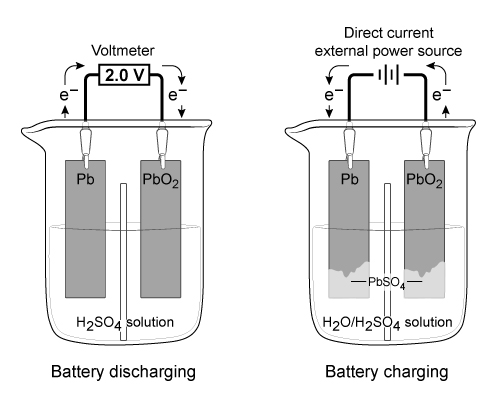 Figure 1 Electron flow in a lead storage battery when discharging and chargingThe half reactions for the anode and cathode of a lead storage battery in 4 M of sulfuric acid (H2SO4) are shown in Reactions 1 and 2:
 Reaction 1
 Reaction 2
NiCd batteries have a higher energy-to-weight ratio than lead storage batteries but cannot hold as much charge. Each NiCd cell delivers approximately 1.3 V, and a single-cell battery weighing 120 g can provide 7.2 W∙h of energy.The half reactions at the anode and cathode for a NiCd battery in KOH are shown in Reactions 3 and 4:
 Reaction 3
 Reaction 4
-To charge the NiCd cell, the applied external potential must be:
Figure 1 Electron flow in a lead storage battery when discharging and chargingThe half reactions for the anode and cathode of a lead storage battery in 4 M of sulfuric acid (H2SO4) are shown in Reactions 1 and 2:
Reaction 1
Reaction 2
NiCd batteries have a higher energy-to-weight ratio than lead storage batteries but cannot hold as much charge. Each NiCd cell delivers approximately 1.3 V, and a single-cell battery weighing 120 g can provide 7.2 W∙h of energy.The half reactions at the anode and cathode for a NiCd battery in KOH are shown in Reactions 3 and 4:
Reaction 3
Reaction 4
-To charge the NiCd cell, the applied external potential must be: (Multiple Choice)
4.9/5 (74)
(74) When ammonia burns in air, nitrogen dioxide and water are produced according to the reaction below:
4 NH3(g) + 7 O2(g) → 4 NO2(g) + 6 H2O(l)
At 0 °C and 1 atm pressure, burning 44.8 L of ammonia requires:
(Multiple Choice)
5.0/5 (88)
(88) Passage
Oxytocin is a naturally occurring peptide hormone that is used clinically to prevent postpartum hemorrhage, one of the leading causes of maternal mortality globally. Because oxytocin is heat and light sensitive, it requires refrigeration at temperatures below 8 °C. However, in underdeveloped regions with hot climates (such as sub-Saharan Africa), refrigeration is often unavailable for pharmaceutical storage and transport.In an effort to improve the availability of oxytocin in regions with limited refrigeration, researchers conducted two experiments to investigate the use of buffers and divalent alkaline-earth metal salt additives as a means to produce an aqueous oxytocin formulation that is stable when stored at temperatures up to 50 °C.Experiment 1To evaluate effects from buffer concentration, two sets of solutions were prepared containing 0.3 mg/mL oxytocin monoacetate salt in 5, 10, and 50 mM citrate buffer solution made from a mixture of citric acid (a weak acid) and sodium citrate (a salt of the conjugate base). An unbuffered aqueous solution served as a control sample. Using 1.0 M NaOH, the buffered solutions were adjusted to pH 4.5 (the pH at which oxytocin is more stable) and then stored at 5 °C (set 1) and 50 °C (set 2) for 4 weeks in a dark area. After storage, the amount of undegraded oxytocin in each sample was determined (Figure 1) using reverse-phase, high-performance liquid chromatography (RP-HPLC).
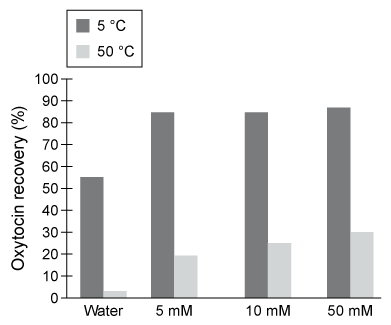 Figure 1 Oxytocin recovery in a citrate buffer (pH 4.5) and water (pH 6.8)Experiment 2To examine the effect of divalent alkaline-earth metal cation additives, Experiment 1 was repeated, but the solutions were modified to contain 0.3 mg/mL of oxytocin with 5, 10, or 50 mM of a divalent cation (from a chloride salt) dissolved in 10 mM citrate buffer. The results are shown in Figure 2.
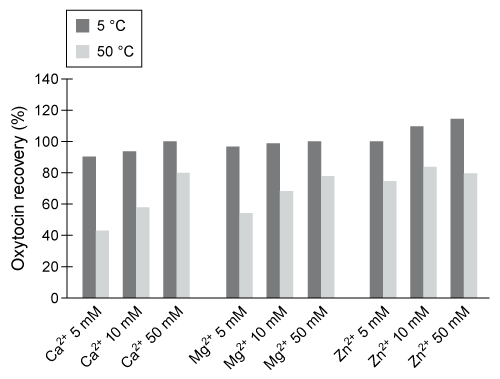 Figure 2 Oxytocin in 10 mM citrate buffer with added Ca2+, Mg2+, or Zn2+ salts
-Based on the passage, which of the following buffers could be used instead of the citrate buffer in Experiments 1 and 2?
Figure 1 Oxytocin recovery in a citrate buffer (pH 4.5) and water (pH 6.8)Experiment 2To examine the effect of divalent alkaline-earth metal cation additives, Experiment 1 was repeated, but the solutions were modified to contain 0.3 mg/mL of oxytocin with 5, 10, or 50 mM of a divalent cation (from a chloride salt) dissolved in 10 mM citrate buffer. The results are shown in Figure 2.
Figure 2 Oxytocin in 10 mM citrate buffer with added Ca2+, Mg2+, or Zn2+ salts
-Based on the passage, which of the following buffers could be used instead of the citrate buffer in Experiments 1 and 2? (Multiple Choice)
4.8/5 (84)
(84) Some test strips for blood glucose meters utilize [Fe(CN)6]3− as an electron transport mediator for the indirect electrochemical detection of the two-electron oxidation of D-glucose into D-gluconolactone, as shown in the figure below. 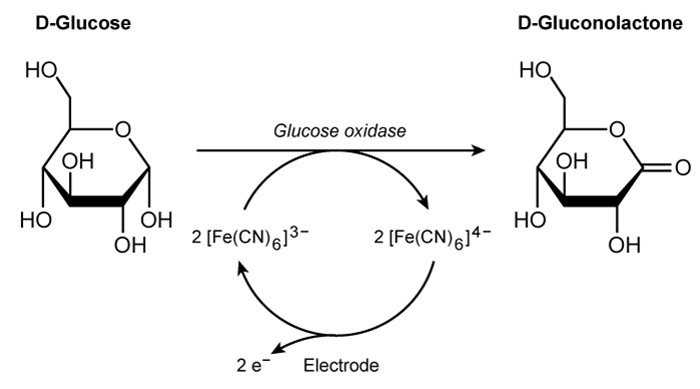 How many moles of electrons will be detected by the glucose meter if 160 μg of [Fe(CN)6]3− (molar mass 211.9 g/mol) react in a test strip during a measurement and each [Fe(CN)6]3− ion reacts only once?
 (Multiple Choice)
4.9/5 (73)
(73) Passage
Catabolism is an oxidative process in which electrons are transferred from lipids, proteins, and carbohydrates to generate high-energy electron carriers from nicotinamide adenine dinucleotide (NADH/NAD+) and flavin adenine dinucleotide (FADH2/FAD). Both are used in the electron transport chain (ETC) as electron providers in a series of reactions. The transfer of electrons provides energy that drives oxidative phosphorylation and the production of ATP. Reduction of NAD+ proceeds according to the following half-reaction:
Reaction 1Reactions in the ETC occur in four protein complexes (I-IV) located in the inner mitochondrial membrane. Here high-energy electrons are shuttled from complexes I, II, and III to complex IV, where O2 serves as the final electron acceptor. The net result of NADH oxidation is described by Reaction 2.
NADH+H++12O2→NAD++H2OReaction 2At complexes I, III, and IV, hydrogen ions move from the mitochondrial matrix to the intermembrane space and create the electrochemical gradient, or proton motive force (pmf), that drives ATP synthesis. Each NADH molecule drives the net pumping of 10 protons across the membrane, as per Reaction 3.
NADH+11H++12O2→NAD++10H++H2OReaction 3
Adapted from Garrett R, Grisham CM, Sabat M. Biochemistry. Cengage Learning; 2011.
-Researchers want to measure the reduction potential when NADH is oxidized by oxygen to compare the experimental potential with the calculated reduction potential in the mitochondria. They set up a galvanic cell, as shown in the following diagram. 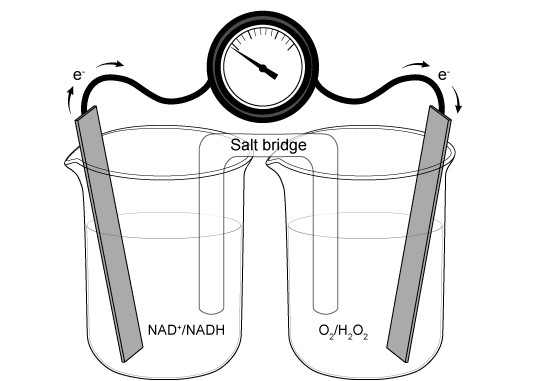 Which of the following statements is true about NAD+/NADH in this experiment?
Reaction 1Reactions in the ETC occur in four protein complexes (I-IV) located in the inner mitochondrial membrane. Here high-energy electrons are shuttled from complexes I, II, and III to complex IV, where O2 serves as the final electron acceptor. The net result of NADH oxidation is described by Reaction 2.
NADH+H++12O2→NAD++H2OReaction 2At complexes I, III, and IV, hydrogen ions move from the mitochondrial matrix to the intermembrane space and create the electrochemical gradient, or proton motive force (pmf), that drives ATP synthesis. Each NADH molecule drives the net pumping of 10 protons across the membrane, as per Reaction 3.
NADH+11H++12O2→NAD++10H++H2OReaction 3
Adapted from Garrett R, Grisham CM, Sabat M. Biochemistry. Cengage Learning; 2011.
-Researchers want to measure the reduction potential when NADH is oxidized by oxygen to compare the experimental potential with the calculated reduction potential in the mitochondria. They set up a galvanic cell, as shown in the following diagram. Which of the following statements is true about NAD+/NADH in this experiment? (Multiple Choice)
4.9/5 (82)
(82) Consider the titration curve for aqueous ammonia shown below. 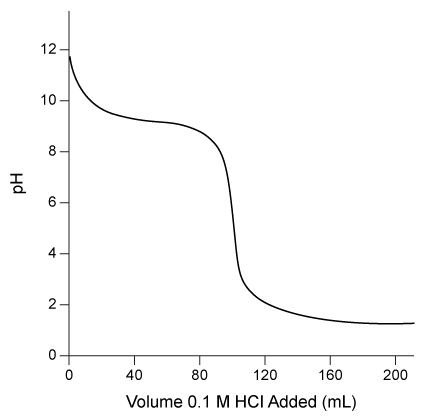 The quantity of hydrochloric acid required to reach the equivalence point in the titration is:
 (Multiple Choice)
4.9/5 (64)
(64) Passage
The alkali metals are a highly reactive family of metals occupying Group 1 (1A) of the periodic table. In their elemental form, the alkali metals have a shiny, metallic appearance, but they are also very soft and can be easily cut by hand. Due to their high reactivity, however, the alkali metals do not exist in their elemental form in nature.Because the alkali metals possess only a single valence electron with a low first ionization energy, the alkali metals (M) readily react with nonmetals and lose this electron to form cations with a +1 charge (M+) that are incorporated into ionic compounds. Consequently, elemental samples of alkali metals will rapidly tarnish in oxygen by forming oxides (Reaction 1) and vigorously react with elemental halogens (X2) to form halide salts (Reaction 2).2 M(s) + O2(g) → M2O(s)Reaction 12 M(s) + X2(g) → 2 MX(s)Reaction 2Alkali metals also react violently with water to form very basic metal hydroxide (alkali) solutions while releasing hydrogen gas in the process (Reaction 3).2 M(s) + 2 H2O(l) → 2 MOH(aq) + H2(g)Reaction 3As demonstrated by these reactions, alkali metals possess a low electron affinity that makes accepting an additional electron to form an anion less favorable than losing the valence electron to form a cation.Of the alkali metals, francium is the rarest since it is a trace radioactive byproduct formed from the decay of uranium ores and has a very short half-life. As a result, any francium formed will quickly decay into radium or astatine by beta decay or by alpha decay, respectively.Whereas hydrogen is a part of Group 1 based on its number of valence electrons, hydrogen is not an alkali metal. Interestingly, some research has suggested that under extreme pressures and very low temperatures, hydrogen may form a solid with metallic properties.
-What is the number of neutrons in an atom of francium-223?
(Multiple Choice)
4.9/5 (78)
(78) A combination reaction was performed as described by the reaction:A + 2B → 2CAnalysis of the kinetics for the reaction found that the reaction progress responded to changes in reagent concentration as given in the following table: 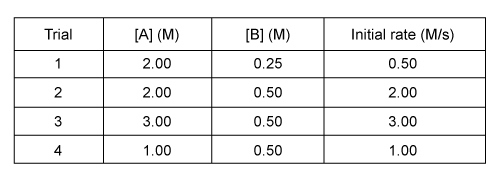 Based on the kinetic data, which of the following expressions gives the rate constant for the rate law of this reaction?
 (Multiple Choice)
4.8/5 (108)
(108) Passage
Kidney stones are a common ailment affecting approximately 10% of adults in the United States. They form when solutes precipitate out of solution as crystals in the urinary tract, and they can cause severe pain in the side, back, abdomen, and groin. Individuals who have been previously diagnosed with kidney stones have an increased probability of developing new stones relative to unaffected individuals. Different measures may help prevent the formation of different kinds of stones, so analysis of the composition of stones that have been passed or removed can aid in preventing recurrence. Stones can be ground into fine powders, dissolved in a small amount of solvent, and analyzed by infrared (IR) spectroscopy, as shown in Figure 1.
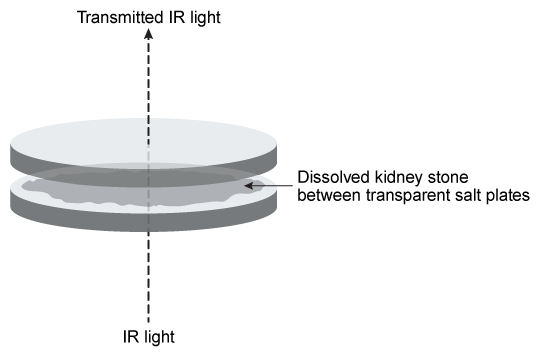 Figure 1 Schematic of kidney stone analysis by IR spectroscopyIR analysis of kidney stones from 50 individuals revealed the percentage of stones that contain each component, shown in Table 1 along with solubility data.Table 1 Kidney Stone Composition Parameters
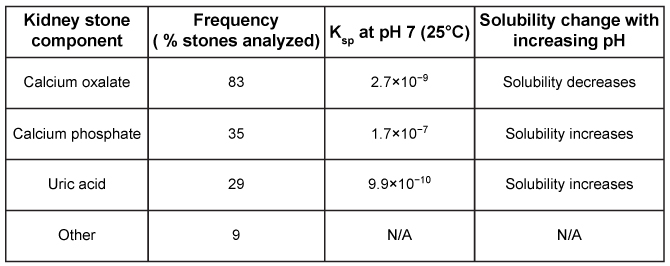 Some studies indicate that potassium citrate, taken orally, may prevent the formation of calcium oxalate crystals, the most abundant component of kidney stones. Oxalic acid, shown in Figure 2, is significantly more soluble than calcium oxalate.
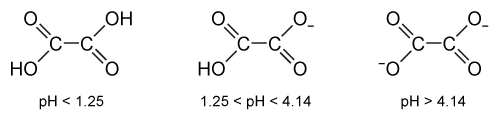 Figure 2 Structure of oxalic acid and its associated anions with increasing pHPotassium citrate alkalinizes the urine, potentially causing a decrease in oxalate solubility and the formation of more crystals. However, potassium citrate can also react with calcium oxalate according to the unbalanced equation shown in Reaction 1:CaC2O4 + K3(C6H5O7) → Ca3(C6H5O7)2 + K2C2O4Reaction 1Calcium citrate and potassium oxalate are both hundreds of times more soluble than calcium oxalate, so the presence of citrate and potassium ions can help maintain calcium and oxalate ions in solution. This effect may be sufficient to overcome the decreased solubility that occurs at higher pH levels.
Adapted from Primiano A, Persichilli S, Gambaro G, et al. FT-IR analysis of urinary stones: a helpful tool for clinician comparison with the chemical spot test. Dis Markers. 2014;2014:176165.
-Based on the reaction in the passage, what are the charges of the oxalate and citrate ions, respectively?
Figure 1 Schematic of kidney stone analysis by IR spectroscopyIR analysis of kidney stones from 50 individuals revealed the percentage of stones that contain each component, shown in Table 1 along with solubility data.Table 1 Kidney Stone Composition Parameters
Some studies indicate that potassium citrate, taken orally, may prevent the formation of calcium oxalate crystals, the most abundant component of kidney stones. Oxalic acid, shown in Figure 2, is significantly more soluble than calcium oxalate.
Figure 2 Structure of oxalic acid and its associated anions with increasing pHPotassium citrate alkalinizes the urine, potentially causing a decrease in oxalate solubility and the formation of more crystals. However, potassium citrate can also react with calcium oxalate according to the unbalanced equation shown in Reaction 1:CaC2O4 + K3(C6H5O7) → Ca3(C6H5O7)2 + K2C2O4Reaction 1Calcium citrate and potassium oxalate are both hundreds of times more soluble than calcium oxalate, so the presence of citrate and potassium ions can help maintain calcium and oxalate ions in solution. This effect may be sufficient to overcome the decreased solubility that occurs at higher pH levels.
Adapted from Primiano A, Persichilli S, Gambaro G, et al. FT-IR analysis of urinary stones: a helpful tool for clinician comparison with the chemical spot test. Dis Markers. 2014;2014:176165.
-Based on the reaction in the passage, what are the charges of the oxalate and citrate ions, respectively? (Multiple Choice)
4.8/5 (84)
(84) Passage
In polluted urban environments, airborne proteins can undergo nitration reactions that increase their allergenic potential toward the human respiratory system. For example, upon exposure to ozone (O3) and nitrogen dioxide (NO2) under atmospheric conditions, the amino acid tyrosine is known to undergo a two-step irreversible reaction leading to the formation of nitrotyrosine. The first step involves the formation of a reactive oxygen intermediate (ROI) tyrosyl radical through oxidation of the phenolic site of tyrosine. Nitrotyrosine is then formed in the second step through addition of NO2 by a radical-radical termination reaction. The elementary steps for this reaction are shown in Scheme 1.
 Scheme 1 Elementary steps of nitration of tyrosineAirborne protein particles can exist in a variety of environments including the aqueous phase, gaseous phase, or as conglomerates with other biomolecules such as lipids. Because the thermodynamic properties and kinetics of the nitration reaction vary based on the chemical environment in which it occurs, recent studies have focused on understanding the reaction under different conditions.Density functional theory is a powerful computational quantum-mechanical modeling method that can determine the properties of many-electron systems by producing approximate solutions to the Schrödinger equation. Researchers used density functional theory to model the geometries and potential energy surfaces of the reactants, intermediates, and products of the nitration reaction in gaseous, aqueous, and lipid-rich environments. From this modeling, the thermodynamic and kinetic properties were calculated. Figure 1 shows the calculated activation energies Ea in kJ/mol, and Table 1 lists the associated thermochemical properties for both steps of the reaction in all three environments.
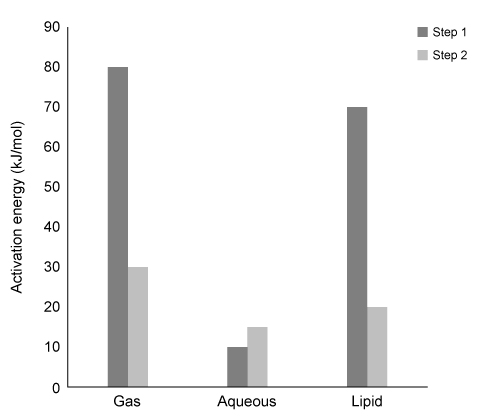 Figure 1 Calculated activation energies for each step of the studied reactions in three environmentsTable 1 Calculated Thermochemical Properties of the Studied Reactions (298.15 K)
 Adapted from Sandhiya L, Kolandaivel P, Senthilkumar K. Oxidation and nitration of tyrosine by ozone and nitrogen dioxide: reaction mechanisms and biological and atmospheric implications. J Phys Chem B. 2014;118(13):3479-90.
-Which of the following reaction coordinate diagrams best represents the two-step reaction involving tyrosine to nitrotyrosine in a lipid environment?
Scheme 1 Elementary steps of nitration of tyrosineAirborne protein particles can exist in a variety of environments including the aqueous phase, gaseous phase, or as conglomerates with other biomolecules such as lipids. Because the thermodynamic properties and kinetics of the nitration reaction vary based on the chemical environment in which it occurs, recent studies have focused on understanding the reaction under different conditions.Density functional theory is a powerful computational quantum-mechanical modeling method that can determine the properties of many-electron systems by producing approximate solutions to the Schrödinger equation. Researchers used density functional theory to model the geometries and potential energy surfaces of the reactants, intermediates, and products of the nitration reaction in gaseous, aqueous, and lipid-rich environments. From this modeling, the thermodynamic and kinetic properties were calculated. Figure 1 shows the calculated activation energies Ea in kJ/mol, and Table 1 lists the associated thermochemical properties for both steps of the reaction in all three environments.
Figure 1 Calculated activation energies for each step of the studied reactions in three environmentsTable 1 Calculated Thermochemical Properties of the Studied Reactions (298.15 K)
Adapted from Sandhiya L, Kolandaivel P, Senthilkumar K. Oxidation and nitration of tyrosine by ozone and nitrogen dioxide: reaction mechanisms and biological and atmospheric implications. J Phys Chem B. 2014;118(13):3479-90.
-Which of the following reaction coordinate diagrams best represents the two-step reaction involving tyrosine to nitrotyrosine in a lipid environment? (Multiple Choice)
4.8/5 (72)
(72) The electrolysis of aqueous silver nitrate involves two separate half-reactions that occur at the anode (Reaction 1) and the cathode (Reaction 2).2H2O(l) → O2(g) + 4H+(aq) + 4e−Reaction 1Ag+(aq) + e− → Ag(s)Reaction 2Which of the following net reactions occurs during the electrolysis?
(Multiple Choice)
4.9/5 (65)
(65) Passage
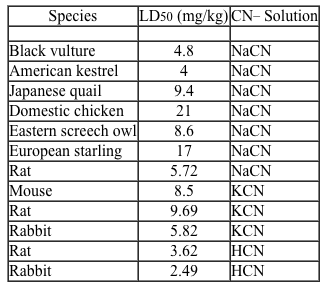
Cyanide (CN−) is a powerful, rapid toxin that binds to the cellular respiratory enzyme cytochrome c oxidase. The resulting enzyme-cyanide complex blocks the transfer of electrons to oxygen in the last step of the electron transport chain. This results in cytotoxic anoxia, causing asphyxiation at the cellular level.Exposure to cyanide can occur from dietary sources, medical treatments, industrial applications, smoke inhalation (structural fires), and intentional use (suicide). While dietary exposure from moderate consumption of naturally occurring plant compounds such as cyanogenic glycosides rarely results in acute adverse effects in humans, chronic effects have been observed from prolonged diets with significant levels of these compounds. In the developed world, risk of significant cyanide exposure is most likely to result from smoke inhalation during building fires or from industrial/occupational exposures.The impact of a given exposure depends on the amount (dose, duration), the chemical composition of the cyanide compound (HCN, NaCN, KCN), and the route of exposure (inhalation, absorption, ingestion). The ionic salts (NaCN, KCN) and free acid (HCN) forms of cyanide each have different acid-base properties that interact differently under the physiological conditions associated with each route of exposure.To better understand the toxicity of different forms of cyanide, animal models have been studied for comparison to known human exposure case studies. Table 1 presents a summary of selected animal toxicity studies that examine exposure via ingestion. The table provides the lethal dose to 50% of the population (LD50) in milligrams of cyanide per kilogram of body weight (mg/kg).Table 1 Compilation of LD50 Cyanide Values in Various Animal Species
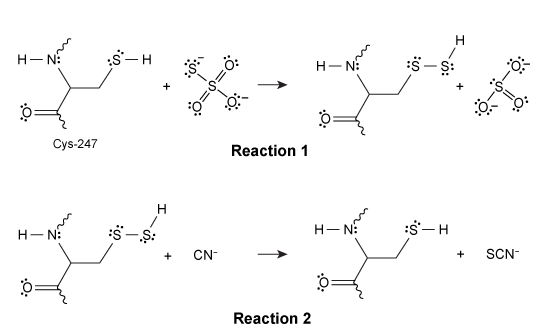
 Based on animal models, one treatment developed for cyanide poisoning involves assisting the rhodanese enzyme in metabolizing CN− to SCN− via an intravenous solution of NaNO2 and Na2S2O3. The Na2S2O3 assists in the formation of a reactive S-SH (persulfide) bond in the enzyme on cysteine-247 (Reaction 1), which then reacts with the cyanide ion to form thiocyanate (Reaction 2).
 Adapted from: Hall AH, Isom GE, Rockwood GA. Toxicology of Cyanides and Cyanogens, Experimental, Applied and Clinical Aspects. John Wiley & Sons; 2015: 1-20; and Egekeze JO, Oehme FW. Cyanides and their toxicity: A literature review. Vet Q. 1980; 2(2): 104-114.
-Based on the experimental data in Table 1, which cyanide compound(s) likely diffuse(s) most readily across the gastric lipid membrane?HCNNaCNKCN
Based on animal models, one treatment developed for cyanide poisoning involves assisting the rhodanese enzyme in metabolizing CN− to SCN− via an intravenous solution of NaNO2 and Na2S2O3. The Na2S2O3 assists in the formation of a reactive S-SH (persulfide) bond in the enzyme on cysteine-247 (Reaction 1), which then reacts with the cyanide ion to form thiocyanate (Reaction 2).
Adapted from: Hall AH, Isom GE, Rockwood GA. Toxicology of Cyanides and Cyanogens, Experimental, Applied and Clinical Aspects. John Wiley & Sons; 2015: 1-20; and Egekeze JO, Oehme FW. Cyanides and their toxicity: A literature review. Vet Q. 1980; 2(2): 104-114.
-Based on the experimental data in Table 1, which cyanide compound(s) likely diffuse(s) most readily across the gastric lipid membrane?HCNNaCNKCN (Multiple Choice)
4.9/5 (88)
(88) An unknown metal M forms an ionic hydroxide with the formula M(OH)2 that exhibits the equilibrium 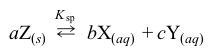 aqin a saturated aqueous solution. If the solution pH is 10, the solubility product constant Ksp of the compound is:
 (Multiple Choice)
4.8/5 (81)
(81) Passage
The primary structure of a protein is a series of amino acids that are connected in a long chain via C−N peptide bonds (Figure 1).
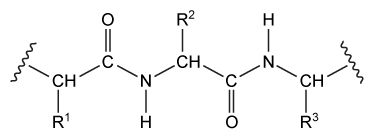 Figure 1 Peptide bonds within a protein segment (Note: Rn = amino acid side chains)Protein chain folding is guided by multiple intramolecular interactions that can occur between two peptide bonds, between a peptide bond and a side chain, or between two side chains, as shown in the protein in Figure 2. Although these interactions are intramolecular because they are within the same molecule, they act effectively like intermolecular interactions because proteins are such large molecules.
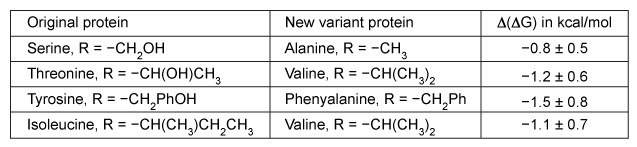
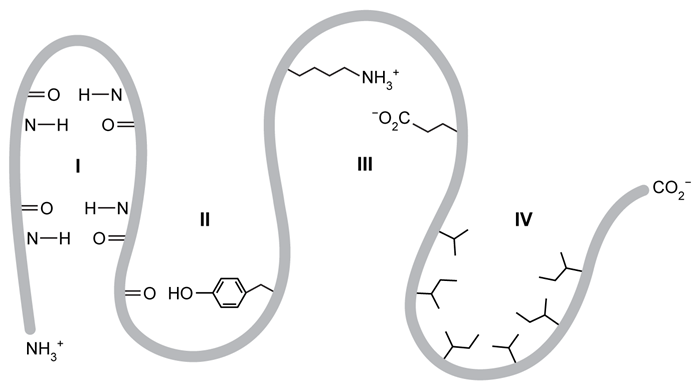 Figure 2 Intramolecular interactions between the peptide chain and amino acid side chains within a hypothetical proteinBecause intramolecular interactions play a significant role in maintaining the three-dimensional folded structure of a protein, having a greater number of interactions or stronger interactions will result in increased protein stability. The energy required to break these interactions within a protein is related to free energy, ΔG. The greater the ΔG value, the more stable the protein.To find the overall contribution of particular intramolecular interactions to protein stability, researchers made several protein variants in which one amino acid is replaced by another to change the noncovalent interactions between the side chains. The difference in free energy between the variant and the original protein, Δ(ΔG), indicates the change in overall stability of the protein. A negative Δ(ΔG) means the variant protein is less stable than the original.Table 1 shows the results of the amino acid substitution experiments for a protein with the approximate energy difference when each amino acid is changed.Table 1 Change in Free Energy Based on Changing Intramolecular Interactions Caused by Amino Acid Substitutions
 Adapted from: C. N. Pace, J. M. Scholtz, G. R. Grimsley, "Forces stabilizing proteins." FEBS Lett. ©2014 Wiley.
-In the protein shown in Figure 2, the folding of region I is predominantly stabilized by:
Figure 1 Peptide bonds within a protein segment (Note: Rn = amino acid side chains)Protein chain folding is guided by multiple intramolecular interactions that can occur between two peptide bonds, between a peptide bond and a side chain, or between two side chains, as shown in the protein in Figure 2. Although these interactions are intramolecular because they are within the same molecule, they act effectively like intermolecular interactions because proteins are such large molecules.
Figure 2 Intramolecular interactions between the peptide chain and amino acid side chains within a hypothetical proteinBecause intramolecular interactions play a significant role in maintaining the three-dimensional folded structure of a protein, having a greater number of interactions or stronger interactions will result in increased protein stability. The energy required to break these interactions within a protein is related to free energy, ΔG. The greater the ΔG value, the more stable the protein.To find the overall contribution of particular intramolecular interactions to protein stability, researchers made several protein variants in which one amino acid is replaced by another to change the noncovalent interactions between the side chains. The difference in free energy between the variant and the original protein, Δ(ΔG), indicates the change in overall stability of the protein. A negative Δ(ΔG) means the variant protein is less stable than the original.Table 1 shows the results of the amino acid substitution experiments for a protein with the approximate energy difference when each amino acid is changed.Table 1 Change in Free Energy Based on Changing Intramolecular Interactions Caused by Amino Acid Substitutions
Adapted from: C. N. Pace, J. M. Scholtz, G. R. Grimsley, "Forces stabilizing proteins." FEBS Lett. ©2014 Wiley.
-In the protein shown in Figure 2, the folding of region I is predominantly stabilized by: (Multiple Choice)
4.9/5 (76)
(76) Passage
The alkali metals are a highly reactive family of metals occupying Group 1 (1A) of the periodic table. In their elemental form, the alkali metals have a shiny, metallic appearance, but they are also very soft and can be easily cut by hand. Due to their high reactivity, however, the alkali metals do not exist in their elemental form in nature.Because the alkali metals possess only a single valence electron with a low first ionization energy, the alkali metals (M) readily react with nonmetals and lose this electron to form cations with a +1 charge (M+) that are incorporated into ionic compounds. Consequently, elemental samples of alkali metals will rapidly tarnish in oxygen by forming oxides (Reaction 1) and vigorously react with elemental halogens (X2) to form halide salts (Reaction 2).2 M(s) + O2(g) → M2O(s)Reaction 12 M(s) + X2(g) → 2 MX(s)Reaction 2Alkali metals also react violently with water to form very basic metal hydroxide (alkali) solutions while releasing hydrogen gas in the process (Reaction 3).2 M(s) + 2 H2O(l) → 2 MOH(aq) + H2(g)Reaction 3As demonstrated by these reactions, alkali metals possess a low electron affinity that makes accepting an additional electron to form an anion less favorable than losing the valence electron to form a cation.Of the alkali metals, francium is the rarest since it is a trace radioactive byproduct formed from the decay of uranium ores and has a very short half-life. As a result, any francium formed will quickly decay into radium or astatine by beta decay or by alpha decay, respectively.Whereas hydrogen is a part of Group 1 based on its number of valence electrons, hydrogen is not an alkali metal. Interestingly, some research has suggested that under extreme pressures and very low temperatures, hydrogen may form a solid with metallic properties.
-Which of the following alkali metals is LEAST likely to accept an additional electron?
(Multiple Choice)
4.8/5 (74)
(74) Passage
Water is unique in that all three of its phases exist over a small range of pressures and temperatures, as shown in Figure 1.
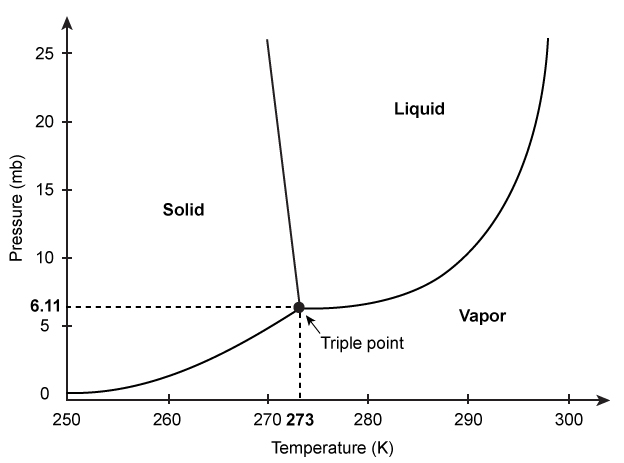 Figure 1 Phase diagram for waterIn the liquid phase, water dissolves and transports molecules, and aids in the biochemical reactions necessary to support life. For this reason, scientists believe liquid-phase water is essential to the existence of extraterrestrial life. Although it has been known for some time that water is present in both the gas and ice phases on Mars, the question remains as to whether there are regions where liquid-phase water can stably exist. Estimates of Mars' surface temperature and pressure generated from satellite readings and global climate models, as well as observations made by Mars rovers, reveal that surface conditions on the planet can vary greatly.Table 1 Temperature and Pressure of Various Locations on Mars
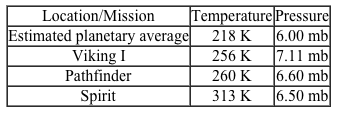 Despite the extremely low pressures and temperatures on Mars, satellite images have repeatedly found evidence of flowing liquid water in several regions during the late Martian summer season. These regions, called recurring slope lineae (RSL), are hypothesized to be thermodynamically stable under certain Martian conditions due to the presence of dissolved salts. A simple understanding of this hypothesis is afforded by Raoult law, which states that the vapor pressure and freezing point of an ideal solution are lowered as the number of moles of dissolved solute increases. Moreover, this effect also impacts the solution boiling point (the point at which the vapor pressure of the solution becomes equal to the ambient pressure).The briny-water hypothesis was confirmed in 2015 when spectral data from the Compact Reconnaissance Imaging Spectrometer onboard the Mars Reconnaissance Orbiter revealed the presence of hydrated perchlorates in the same regions and times that RSL were observed. Studies are already underway to determine how common such briny water flows are and whether the conditions within them are suitable for microbial life.
-Which of the following phase diagrams best shows the change from pure water's phase boundaries to the phase boundaries of the briny water found on Mars?
Figure 1 Phase diagram for waterIn the liquid phase, water dissolves and transports molecules, and aids in the biochemical reactions necessary to support life. For this reason, scientists believe liquid-phase water is essential to the existence of extraterrestrial life. Although it has been known for some time that water is present in both the gas and ice phases on Mars, the question remains as to whether there are regions where liquid-phase water can stably exist. Estimates of Mars' surface temperature and pressure generated from satellite readings and global climate models, as well as observations made by Mars rovers, reveal that surface conditions on the planet can vary greatly.Table 1 Temperature and Pressure of Various Locations on Mars
Despite the extremely low pressures and temperatures on Mars, satellite images have repeatedly found evidence of flowing liquid water in several regions during the late Martian summer season. These regions, called recurring slope lineae (RSL), are hypothesized to be thermodynamically stable under certain Martian conditions due to the presence of dissolved salts. A simple understanding of this hypothesis is afforded by Raoult law, which states that the vapor pressure and freezing point of an ideal solution are lowered as the number of moles of dissolved solute increases. Moreover, this effect also impacts the solution boiling point (the point at which the vapor pressure of the solution becomes equal to the ambient pressure).The briny-water hypothesis was confirmed in 2015 when spectral data from the Compact Reconnaissance Imaging Spectrometer onboard the Mars Reconnaissance Orbiter revealed the presence of hydrated perchlorates in the same regions and times that RSL were observed. Studies are already underway to determine how common such briny water flows are and whether the conditions within them are suitable for microbial life.
-Which of the following phase diagrams best shows the change from pure water's phase boundaries to the phase boundaries of the briny water found on Mars? (Multiple Choice)
4.7/5 (79)
(79) Assume that helium behaves as an ideal gas. What is the estimated density of 1.0 g of helium gas at a temperature of 27 °C and a pressure of 3.0 atm? (Note: Use R = 0.0821 L∙atm∙mol−1∙K−1)
(Multiple Choice)
4.8/5 (69)
(69) Passage
Gastric acid is one of many acids important to biological function in the human body. Production of the main component of gastric acid, hydrochloric acid (HCl), is accomplished in the stomach by the parietal cells, as shown in Figure 1.
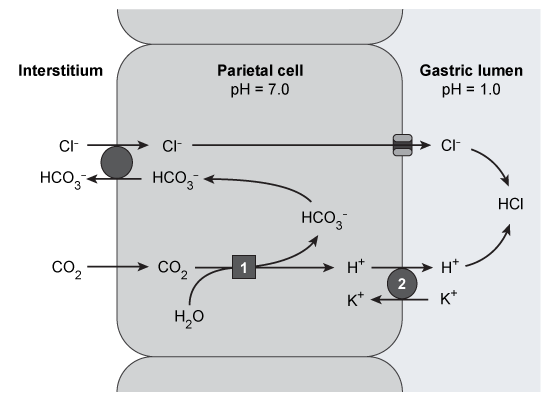 Figure 1 Formation of gastric acid in the stomachFacilitated by the carbonate dehydratase enzyme (1), the parietal cells utilize the interaction between aqueous carbon dioxide and water in the blood as a source of bicarbonate ions and acidic H+ ions (protons). The H+ ions produced in this process are then exchanged for potassium ions through the cell membrane by a proton pump, the H+/K+-ATPase (2). In conjunction with this proton exchange, bicarbonate ions are also exchanged for chloride ions from the interstitial fluid. As a result, H+ and Cl− ions are concentrated in the lumen of the stomach to form aqueous hydrochloric acid.Because the production of the acid proceeds with a drop in pH from 7.0 in the cell cytosol to 1.0 in the stomach lumen, the process occurs against a concentration gradient and is endergonic, requiring the input of energy supplied by the hydrolysis of ATP. Ignoring effects from ion charge, the free energy change for ion transport across the cell membrane (ΔGt) can be estimated by Equation 1:
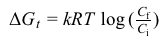 ∆Gt=kRT logCfCiEquation 1where R is the gas constant (8.32 J/mol·K), k is a logarithm conversion constant, T is the absolute temperature, and Ci and Cf are the initial and final molar concentrations across the gradient, respectively.Although dilute, the gastric (hydrochloric) acid released into the lumen yields a strongly acidic environment crucial to protein digestion and the destruction of harmful micro-organisms. A comparison of its acid dissociation constant (Ka) to those of other biologically relevant organic acids is given in Table 1.Table 1 Comparison of Strengths of Selected 0.10 M Acids at 25°C
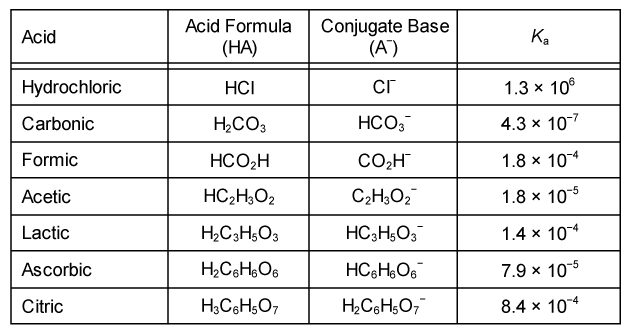 Adapted from Koolman J, Roehm KH. Color Atlas of Biochemistry. Thieme; 2011: 268-271; and Lehninger AL, Nelson DL, Cox MM. Lehninger Principles of Biochemistry. Macmillan; 2005: 397-398, 419, 520.
-What is the molar concentration of hydroxide in the duodenum (pH 6.0), where neutralization of the gastric acid leaving the stomach begins to take place?
Figure 1 Formation of gastric acid in the stomachFacilitated by the carbonate dehydratase enzyme (1), the parietal cells utilize the interaction between aqueous carbon dioxide and water in the blood as a source of bicarbonate ions and acidic H+ ions (protons). The H+ ions produced in this process are then exchanged for potassium ions through the cell membrane by a proton pump, the H+/K+-ATPase (2). In conjunction with this proton exchange, bicarbonate ions are also exchanged for chloride ions from the interstitial fluid. As a result, H+ and Cl− ions are concentrated in the lumen of the stomach to form aqueous hydrochloric acid.Because the production of the acid proceeds with a drop in pH from 7.0 in the cell cytosol to 1.0 in the stomach lumen, the process occurs against a concentration gradient and is endergonic, requiring the input of energy supplied by the hydrolysis of ATP. Ignoring effects from ion charge, the free energy change for ion transport across the cell membrane (ΔGt) can be estimated by Equation 1:
∆Gt=kRT logCfCiEquation 1where R is the gas constant (8.32 J/mol·K), k is a logarithm conversion constant, T is the absolute temperature, and Ci and Cf are the initial and final molar concentrations across the gradient, respectively.Although dilute, the gastric (hydrochloric) acid released into the lumen yields a strongly acidic environment crucial to protein digestion and the destruction of harmful micro-organisms. A comparison of its acid dissociation constant (Ka) to those of other biologically relevant organic acids is given in Table 1.Table 1 Comparison of Strengths of Selected 0.10 M Acids at 25°C
Adapted from Koolman J, Roehm KH. Color Atlas of Biochemistry. Thieme; 2011: 268-271; and Lehninger AL, Nelson DL, Cox MM. Lehninger Principles of Biochemistry. Macmillan; 2005: 397-398, 419, 520.
-What is the molar concentration of hydroxide in the duodenum (pH 6.0), where neutralization of the gastric acid leaving the stomach begins to take place? (Multiple Choice)
4.9/5 (84)
(84) Passage
Combustion occurs when an oxidation-reduction reaction takes place between a reduced fuel source and an oxidizer, most frequently oxygen. The reaction between hydrogen and oxygen forms water (Reaction 1) and is highly exothermic and thermodynamically favorable. At the completion of hydrogen combustion, essentially all H2 molecules have been converted to water. Nevertheless, at room temperature and atmospheric pressure, molecular hydrogen and oxygen can coexist quite stably.2 H2 + O2 → 2 H2OReaction 1A group of researchers designed two prototype internal combustion engines, each of which could inject a hydrogen/oxygen mixture into a 5-mL combustion chamber at a total pressure of 1 atm and could repeat this process for several cycles. In one engine design, a spark was generated to initiate combustion as hydrogen and oxygen were injected. In another method, the combustion chamber was coated with a small amount of platinum powder. Platinum dramatically increases the reaction rate at room temperature without the need for a spark. The platinum itself is not altered by the reaction and can be reused. Researchers measured the maximum power output of both engine designs under identical injection and temperature conditions (Figure 1).
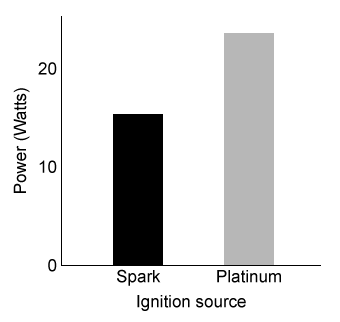 Figure 1 Relative power outputs of hydrogen engines with different ignition sources at 298 KThe power output of an engine is directly related to the rate of combustion. In the presence of platinum, researchers measured the engine's rate of water production at various temperatures and H2/O2 mixture compositions. The results are shown in Figure 2.
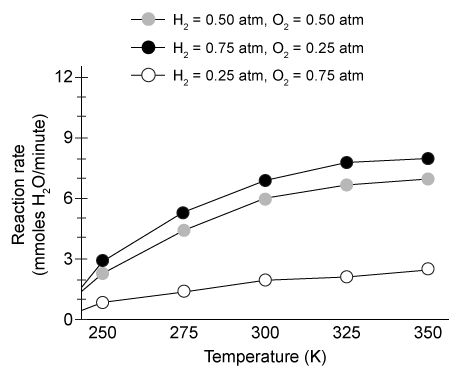 Figure 2 Rate of combustion in platinum-coated engines under various conditions
Adapted from Schultze M, Mantzaras J. Hetero-/homogeneous combustion of hydrogen/air mixtures over platinum: Fuel-lean versus fuel-rich combustion modes doi: 10.1016/j.ijhydene.2013.06.069
-Platinum most likely increases the reaction rate by stabilizing:
Figure 1 Relative power outputs of hydrogen engines with different ignition sources at 298 KThe power output of an engine is directly related to the rate of combustion. In the presence of platinum, researchers measured the engine's rate of water production at various temperatures and H2/O2 mixture compositions. The results are shown in Figure 2.
Figure 2 Rate of combustion in platinum-coated engines under various conditions
Adapted from Schultze M, Mantzaras J. Hetero-/homogeneous combustion of hydrogen/air mixtures over platinum: Fuel-lean versus fuel-rich combustion modes doi: 10.1016/j.ijhydene.2013.06.069
-Platinum most likely increases the reaction rate by stabilizing: (Multiple Choice)
4.8/5 (75)
(75) 
Filters
- Essay(0)
- Multiple Choice(0)
- Short Answer(0)
- True False(0)
- Matching(0)