Multiple Choice
Passage
Water is unique in that all three of its phases exist over a small range of pressures and temperatures, as shown in Figure 1.
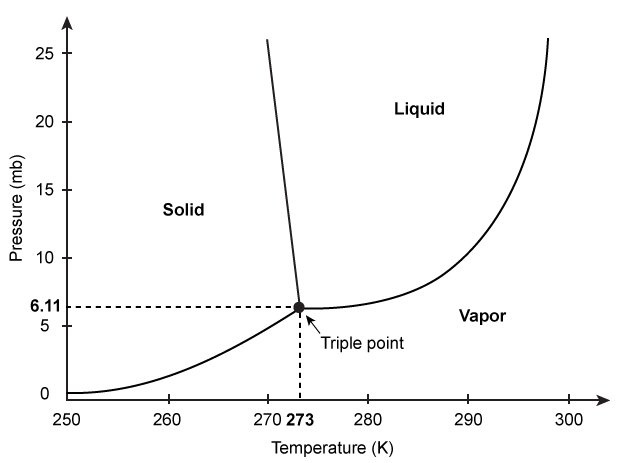 Figure 1 Phase diagram for waterIn the liquid phase, water dissolves and transports molecules, and aids in the biochemical reactions necessary to support life. For this reason, scientists believe liquid-phase water is essential to the existence of extraterrestrial life. Although it has been known for some time that water is present in both the gas and ice phases on Mars, the question remains as to whether there are regions where liquid-phase water can stably exist. Estimates of Mars' surface temperature and pressure generated from satellite readings and global climate models, as well as observations made by Mars rovers, reveal that surface conditions on the planet can vary greatly.Table 1 Temperature and Pressure of Various Locations on Mars
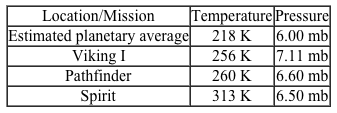 Despite the extremely low pressures and temperatures on Mars, satellite images have repeatedly found evidence of flowing liquid water in several regions during the late Martian summer season. These regions, called recurring slope lineae (RSL) , are hypothesized to be thermodynamically stable under certain Martian conditions due to the presence of dissolved salts. A simple understanding of this hypothesis is afforded by Raoult law, which states that the vapor pressure and freezing point of an ideal solution are lowered as the number of moles of dissolved solute increases. Moreover, this effect also impacts the solution boiling point (the point at which the vapor pressure of the solution becomes equal to the ambient pressure) .The briny-water hypothesis was confirmed in 2015 when spectral data from the Compact Reconnaissance Imaging Spectrometer onboard the Mars Reconnaissance Orbiter revealed the presence of hydrated perchlorates in the same regions and times that RSL were observed. Studies are already underway to determine how common such briny water flows are and whether the conditions within them are suitable for microbial life.
-Which of the following phase diagrams best shows the change from pure water's phase boundaries to the phase boundaries of the briny water found on Mars?
A) 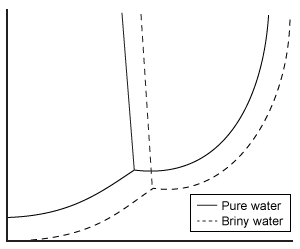
B) 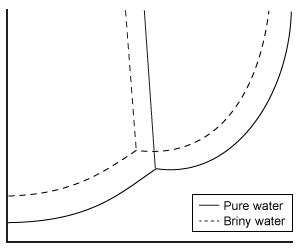
C) 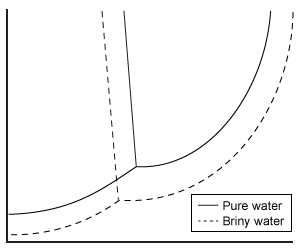
D) 
Correct Answer:

Verified
Correct Answer:
Verified
Q192: The electrolysis of aqueous silver nitrate involves
Q193: Passage<br>Cyanide (CN<sup>−</sup>) is a powerful, rapid toxin
Q194: An unknown metal M forms an ionic
Q195: Passage<br>The primary structure of a protein is
Q196: Passage<br>The alkali metals are a highly reactive
Q198: Assume that helium behaves as an ideal
Q199: Passage<br>Gastric acid is one of many acids
Q200: Passage<br>Combustion occurs when an oxidation-reduction reaction takes
Q201: The reversible reaction <img src="https://d2lvgg3v3hfg70.cloudfront.net/MD0008/.jpg" alt="The reversible
Q202: Sebacic acid (HOOC−(CH<sub>2</sub>)<sub>8</sub>−COOH) is a naturally occurring