Passage Combustion Occurs When an Oxidation-Reduction Reaction Takes Place Between a a Reduced
Multiple Choice
Passage
Combustion occurs when an oxidation-reduction reaction takes place between a reduced fuel source and an oxidizer, most frequently oxygen. The reaction between hydrogen and oxygen forms water (Reaction 1) and is highly exothermic and thermodynamically favorable. At the completion of hydrogen combustion, essentially all H2 molecules have been converted to water. Nevertheless, at room temperature and atmospheric pressure, molecular hydrogen and oxygen can coexist quite stably.2 H2 + O2 → 2 H2OReaction 1A group of researchers designed two prototype internal combustion engines, each of which could inject a hydrogen/oxygen mixture into a 5-mL combustion chamber at a total pressure of 1 atm and could repeat this process for several cycles. In one engine design, a spark was generated to initiate combustion as hydrogen and oxygen were injected. In another method, the combustion chamber was coated with a small amount of platinum powder. Platinum dramatically increases the reaction rate at room temperature without the need for a spark. The platinum itself is not altered by the reaction and can be reused. Researchers measured the maximum power output of both engine designs under identical injection and temperature conditions (Figure 1) .
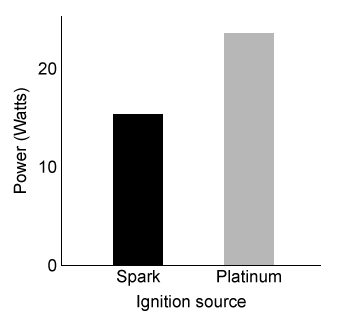 Figure 1 Relative power outputs of hydrogen engines with different ignition sources at 298 KThe power output of an engine is directly related to the rate of combustion. In the presence of platinum, researchers measured the engine's rate of water production at various temperatures and H2/O2 mixture compositions. The results are shown in Figure 2.
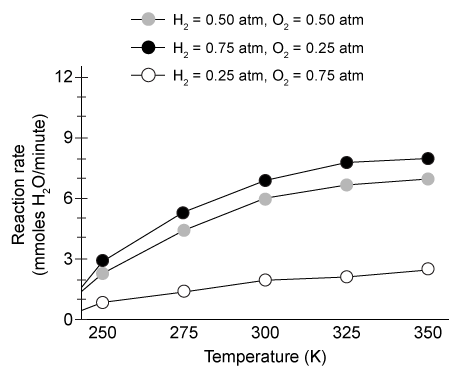 Figure 2 Rate of combustion in platinum-coated engines under various conditions
Adapted from Schultze M, Mantzaras J. Hetero-/homogeneous combustion of hydrogen/air mixtures over platinum: Fuel-lean versus fuel-rich combustion modes doi: 10.1016/j.ijhydene.2013.06.069
-Platinum most likely increases the reaction rate by stabilizing:
A) the reactants.
B) the products.
C) the intermediate step.
D) the transition state.
Correct Answer:

Verified
Correct Answer:
Verified
Q195: Passage<br>The primary structure of a protein is
Q196: Passage<br>The alkali metals are a highly reactive
Q197: Passage<br>Water is unique in that all three
Q198: Assume that helium behaves as an ideal
Q199: Passage<br>Gastric acid is one of many acids
Q201: The reversible reaction <img src="https://d2lvgg3v3hfg70.cloudfront.net/MD0008/.jpg" alt="The reversible
Q202: Sebacic acid (HOOC−(CH<sub>2</sub>)<sub>8</sub>−COOH) is a naturally occurring
Q203: Passage<br>Oxytocin is a naturally occurring peptide hormone
Q204: Which of the following equations correctly represents
Q205: Passage<br>In polluted urban environments, airborne proteins can