
Exam 5: General Chemistry

arrow
  • Select Tags
search iconSearch Question
flashcardsStudy Flashcards
  • Select Tags

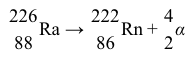
Passage The alkaline-earth metals are a highly reactive family of metals occupying Group 2 (IIA) of the periodic table.  In their elemental form, the alkaline-earth metals have a shiny, silvery-white to slightly yellowish appearance.  The alkaline-earth metals exhibit some similarities to the chemistry of the alkali metals (Group 1) but are a little less reactive.Atoms of the alkaline-earth metals (M) have only two valence electrons and a low first and second ionization energy.  Consequently, these metals readily lose both electrons to produce cations with a +2 charge (M+2) during reactions with nonmetals.  As a result, the alkaline-earth metals do not exist in their elemental metallic form in nature.  Instead, the Group 2 elements are found primarily as metal oxides, which form by reacting oxygen (Reaction 1). Passage The alkaline-earth metals are a highly reactive family of metals occupying Group 2 (IIA) of the periodic table.  In their elemental form, the alkaline-earth metals have a shiny, silvery-white to slightly yellowish appearance.  The alkaline-earth metals exhibit some similarities to the chemistry of the alkali metals (Group 1) but are a little less reactive.Atoms of the alkaline-earth metals (M) have only two valence electrons and a low first and second ionization energy.  Consequently, these metals readily lose both electrons to produce cations with a +2 charge (M<sup>+2</sup>) during reactions with nonmetals.  As a result, the alkaline-earth metals do not exist in their elemental metallic form in nature.  Instead, the Group 2 elements are found primarily as metal oxides, which form by reacting oxygen (Reaction 1).     Similarly, elemental samples of alkaline-earth metals will react with elemental halogens (X<sub>2</sub>) to form metal halides (Reaction 2), all of which are ionic except for BeCl<sub>2</sub>.     Except for beryllium, the alkaline-earth metals react with water to produce very basic metal hydroxide solutions and hydrogen gas (Reaction 3).     The most difficult alkaline-earth metal to study is radium, because it is a rare radioactive element that is produced from the nuclear decay of uranium.  The most common natural isotope, radium-226, has a half-life of 1,600 years and decays by alpha emission into radon-222 (Reaction 4).    -When comparing atoms across the same row of the periodic table, which of the following groups will contain the atom with the lowest second ionization energy? Similarly, elemental samples of alkaline-earth metals will react with elemental halogens (X2) to form metal halides (Reaction 2), all of which are ionic except for BeCl2. Passage The alkaline-earth metals are a highly reactive family of metals occupying Group 2 (IIA) of the periodic table.  In their elemental form, the alkaline-earth metals have a shiny, silvery-white to slightly yellowish appearance.  The alkaline-earth metals exhibit some similarities to the chemistry of the alkali metals (Group 1) but are a little less reactive.Atoms of the alkaline-earth metals (M) have only two valence electrons and a low first and second ionization energy.  Consequently, these metals readily lose both electrons to produce cations with a +2 charge (M<sup>+2</sup>) during reactions with nonmetals.  As a result, the alkaline-earth metals do not exist in their elemental metallic form in nature.  Instead, the Group 2 elements are found primarily as metal oxides, which form by reacting oxygen (Reaction 1).     Similarly, elemental samples of alkaline-earth metals will react with elemental halogens (X<sub>2</sub>) to form metal halides (Reaction 2), all of which are ionic except for BeCl<sub>2</sub>.     Except for beryllium, the alkaline-earth metals react with water to produce very basic metal hydroxide solutions and hydrogen gas (Reaction 3).     The most difficult alkaline-earth metal to study is radium, because it is a rare radioactive element that is produced from the nuclear decay of uranium.  The most common natural isotope, radium-226, has a half-life of 1,600 years and decays by alpha emission into radon-222 (Reaction 4).    -When comparing atoms across the same row of the periodic table, which of the following groups will contain the atom with the lowest second ionization energy? Except for beryllium, the alkaline-earth metals react with water to produce very basic metal hydroxide solutions and hydrogen gas (Reaction 3). Passage The alkaline-earth metals are a highly reactive family of metals occupying Group 2 (IIA) of the periodic table.  In their elemental form, the alkaline-earth metals have a shiny, silvery-white to slightly yellowish appearance.  The alkaline-earth metals exhibit some similarities to the chemistry of the alkali metals (Group 1) but are a little less reactive.Atoms of the alkaline-earth metals (M) have only two valence electrons and a low first and second ionization energy.  Consequently, these metals readily lose both electrons to produce cations with a +2 charge (M<sup>+2</sup>) during reactions with nonmetals.  As a result, the alkaline-earth metals do not exist in their elemental metallic form in nature.  Instead, the Group 2 elements are found primarily as metal oxides, which form by reacting oxygen (Reaction 1).     Similarly, elemental samples of alkaline-earth metals will react with elemental halogens (X<sub>2</sub>) to form metal halides (Reaction 2), all of which are ionic except for BeCl<sub>2</sub>.     Except for beryllium, the alkaline-earth metals react with water to produce very basic metal hydroxide solutions and hydrogen gas (Reaction 3).     The most difficult alkaline-earth metal to study is radium, because it is a rare radioactive element that is produced from the nuclear decay of uranium.  The most common natural isotope, radium-226, has a half-life of 1,600 years and decays by alpha emission into radon-222 (Reaction 4).    -When comparing atoms across the same row of the periodic table, which of the following groups will contain the atom with the lowest second ionization energy? The most difficult alkaline-earth metal to study is radium, because it is a rare radioactive element that is produced from the nuclear decay of uranium.  The most common natural isotope, radium-226, has a half-life of 1,600 years and decays by alpha emission into radon-222 (Reaction 4). Passage The alkaline-earth metals are a highly reactive family of metals occupying Group 2 (IIA) of the periodic table.  In their elemental form, the alkaline-earth metals have a shiny, silvery-white to slightly yellowish appearance.  The alkaline-earth metals exhibit some similarities to the chemistry of the alkali metals (Group 1) but are a little less reactive.Atoms of the alkaline-earth metals (M) have only two valence electrons and a low first and second ionization energy.  Consequently, these metals readily lose both electrons to produce cations with a +2 charge (M<sup>+2</sup>) during reactions with nonmetals.  As a result, the alkaline-earth metals do not exist in their elemental metallic form in nature.  Instead, the Group 2 elements are found primarily as metal oxides, which form by reacting oxygen (Reaction 1).     Similarly, elemental samples of alkaline-earth metals will react with elemental halogens (X<sub>2</sub>) to form metal halides (Reaction 2), all of which are ionic except for BeCl<sub>2</sub>.     Except for beryllium, the alkaline-earth metals react with water to produce very basic metal hydroxide solutions and hydrogen gas (Reaction 3).     The most difficult alkaline-earth metal to study is radium, because it is a rare radioactive element that is produced from the nuclear decay of uranium.  The most common natural isotope, radium-226, has a half-life of 1,600 years and decays by alpha emission into radon-222 (Reaction 4).    -When comparing atoms across the same row of the periodic table, which of the following groups will contain the atom with the lowest second ionization energy? -When comparing atoms across the same row of the periodic table, which of the following groups will contain the atom with the lowest second ionization energy?



(Multiple Choice)
4.9/5
(80)

The radioisotope gallium-68 is used in nuclear medicine as a traceable radioactive emitter for diagnostic imaging procedures.  The 68Ga isotope is generated from 68Ge by:

(Multiple Choice)
4.7/5
(85)

Passage Within the renal system, two buffers operate to counter the production of excess H+ from luminal H2CO3.  They are located within the tubular lumen, and maintain urinary pH levels between 4.5 and 8.0.The first of these is a phosphate buffer, which serves as the primary buffer for urine because its pKa is very close to extracellular fluid pH of 7.4.  The phosphate buffer operates according to Reaction 1.  H2PO4− is excreted in urine. Passage Within the renal system, two buffers operate to counter the production of excess H<sup>+</sup> from luminal H<sub>2</sub>CO<sub>3</sub>.  They are located within the tubular lumen, and maintain urinary pH levels between 4.5 and 8.0.The first of these is a phosphate buffer, which serves as the primary buffer for urine because its pK<sub>a</sub> is very close to extracellular fluid pH of 7.4.  The phosphate buffer operates according to Reaction 1.  H<sub>2</sub>PO<sub>4</sub><sup>−</sup> is excreted in urine.    <strong>Reaction 1</strong>During acidosis when tubular pH is low, the phosphate buffer system becomes saturated.  An ammonia buffer system then becomes the primary buffer, and NH<sub>4</sub><sup>+</sup> is excreted in urine.    <strong>Reaction 2</strong>Titratable acid (TA) is the total acid in urine, and it can be found using Folin's method.  Under normal physiological conditions, TA is approximately equal to the amount of phosphate in urine, which is a product of serum phosphate concentration and glomerular filtration rate.  This makes TA a good indicator of kidney function.Folin's method involves back titration of a urine sample to a pH of 7.4 using a strong base.  In a typical procedure, potassium oxalate is added to remove calcium from the sample prior to titration with 1.0 M NaOH.  The titration continues until the solution reaches a pH of 7.4 (measured by a pH meter).  The amount of base required for the titration can then be used to calculate the amount of H<sub>2</sub>PO<sub>4</sub><sup>−</sup> in the urine sample. -If a student adds bromothymol blue as an indicator to determine the amount of titratable acid in 25 mL of urine according to Folin's method, what effect will the bromothymol blue have on the pH of the urine sample? Reaction 1During acidosis when tubular pH is low, the phosphate buffer system becomes saturated.  An ammonia buffer system then becomes the primary buffer, and NH4+ is excreted in urine. Passage Within the renal system, two buffers operate to counter the production of excess H<sup>+</sup> from luminal H<sub>2</sub>CO<sub>3</sub>.  They are located within the tubular lumen, and maintain urinary pH levels between 4.5 and 8.0.The first of these is a phosphate buffer, which serves as the primary buffer for urine because its pK<sub>a</sub> is very close to extracellular fluid pH of 7.4.  The phosphate buffer operates according to Reaction 1.  H<sub>2</sub>PO<sub>4</sub><sup>−</sup> is excreted in urine.    <strong>Reaction 1</strong>During acidosis when tubular pH is low, the phosphate buffer system becomes saturated.  An ammonia buffer system then becomes the primary buffer, and NH<sub>4</sub><sup>+</sup> is excreted in urine.    <strong>Reaction 2</strong>Titratable acid (TA) is the total acid in urine, and it can be found using Folin's method.  Under normal physiological conditions, TA is approximately equal to the amount of phosphate in urine, which is a product of serum phosphate concentration and glomerular filtration rate.  This makes TA a good indicator of kidney function.Folin's method involves back titration of a urine sample to a pH of 7.4 using a strong base.  In a typical procedure, potassium oxalate is added to remove calcium from the sample prior to titration with 1.0 M NaOH.  The titration continues until the solution reaches a pH of 7.4 (measured by a pH meter).  The amount of base required for the titration can then be used to calculate the amount of H<sub>2</sub>PO<sub>4</sub><sup>−</sup> in the urine sample. -If a student adds bromothymol blue as an indicator to determine the amount of titratable acid in 25 mL of urine according to Folin's method, what effect will the bromothymol blue have on the pH of the urine sample? Reaction 2Titratable acid (TA) is the total acid in urine, and it can be found using Folin's method.  Under normal physiological conditions, TA is approximately equal to the amount of phosphate in urine, which is a product of serum phosphate concentration and glomerular filtration rate.  This makes TA a good indicator of kidney function.Folin's method involves back titration of a urine sample to a pH of 7.4 using a strong base.  In a typical procedure, potassium oxalate is added to remove calcium from the sample prior to titration with 1.0 M NaOH.  The titration continues until the solution reaches a pH of 7.4 (measured by a pH meter).  The amount of base required for the titration can then be used to calculate the amount of H2PO4− in the urine sample. -If a student adds bromothymol blue as an indicator to determine the amount of titratable acid in 25 mL of urine according to Folin's method, what effect will the bromothymol blue have on the pH of the urine sample?


(Multiple Choice)
4.8/5
(75)

The mean serum urate concentration (from uric acid) in a sample of urine was measured to be 64 mg/L.  If a 2.0 mL aliquot of the urine sample is analyzed, what is the total mass of the serum urate present in the aliquot?

(Multiple Choice)
4.8/5
(73)

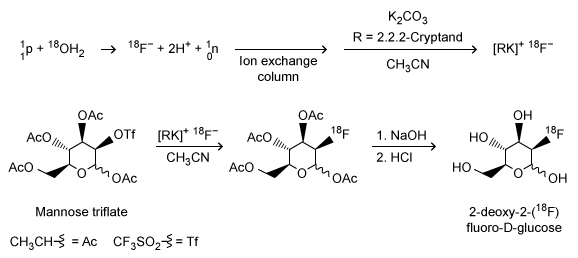
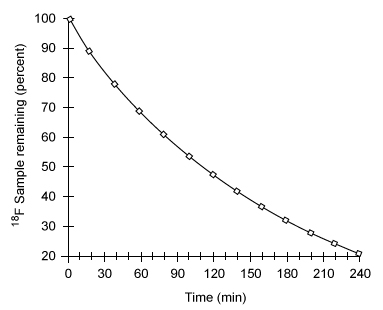
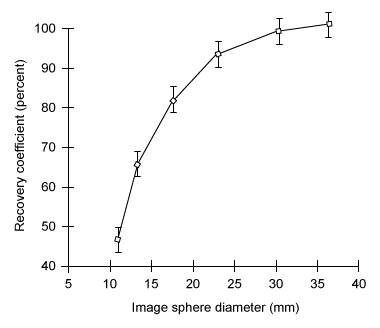
Passage The radiopharmaceutical 2-deoxy-2-(18F)fluoro-D-glucose (abbreviated as 18F-FDG) is a modified form of D-glucose in which the hydroxyl group on the 2-carbon of the molecule has been replaced with a positron-emitting 18F radionuclide.  Synthesis of 18F-FDG is accomplished in several steps involving both nuclear and chemical reactions, as shown in Figure 1. Passage The radiopharmaceutical 2-deoxy-2-(<sup>18</sup>F)fluoro-D-glucose (abbreviated as <sup>18</sup>F-FDG) is a modified form of D-glucose in which the hydroxyl group on the 2-carbon of the molecule has been replaced with a positron-emitting <sup>18</sup>F radionuclide.  Synthesis of <sup>18</sup>F-FDG is accomplished in several steps involving both nuclear and chemical reactions, as shown in Figure 1.    <strong>Figure 1</strong>  Synthetic scheme for 2-deoxy-2-(<sup>18</sup>F)fluoro-D-glucoseInitially, a target of <sup>18</sup>O-enriched water (<sup>18</sup>OH<sub>2</sub>) is bombarded by protons using a cyclotron to achieve a (p-n) nuclear reaction in which a proton hitting the <sup>18</sup>O nucleus is absorbed by the nucleus, causing the ejection of a neutron and forming an <sup>18</sup>F nucleus.  Following separation of the resulting <sup>18</sup>F<sup>−</sup> anions from the residual <sup>18</sup>OH<sub>2</sub> via an ion exchange column, <sup>18</sup>F<sup>−</sup> is used in a nucleophilic substitution reaction with an acetylated mannose triflate substrate.  Subsequent hydrolysis to remove the acetyl protecting groups yields <sup>18</sup>F-FDG.Because <sup>18</sup>F-FDG is an analog of D-glucose, it is readily taken into cells by the same metabolic processes as D-glucose.  Once inside the cells, the positron emissions of the <sup>18</sup>F radionuclide can be detected by positron emission tomography (PET) scans to produce diagnostic medical images of objects such as tumors.  Emissions from the <sup>18</sup>F radionuclide subsequently diminish over time via radioactive decay (Figure 2).    <strong>Figure 2</strong>  Nuclear decay of the <sup>18</sup>F radionuclideBecause of limitations in the spatial resolution of PET scanners, when an object (such as a tumor) is smaller than 30 mm in diameter, the measured specific uptake value (SUV) of <sup>18</sup>F-FDG accumulated within the object is lower than the actual SUV.  The recovery coefficient (the ratio of the measured SUV to the actual SUV) shows that the measured SUV decreases as the size of the object decreases below the 30-mm threshold (Figure 3).    <strong>Figure 3</strong>  Recovery coefficient as a function of object size in a PET scan with a spatial resolution of 7 mm using ordered subsets expectation maximization (OSEM) image processing Adapted from: S. Yu. Review of F-FDG Synthesis and Quality Control. Biomed Imaging Interv J. ©2006 Department of Biomedical Imaging, Faculty of Medicine, University of Malaysa; and P. E. Kinahan, et al., Positron emission tomography-computed tomography standardized uptake values in clinical practice and assessing response to therapy. Semin Ultrasound CT MR. ©2010 Elsevier. -Based on the imaging resolution data provided in the passage, what measured specific uptake value (SUV) is likely to be observed when imaging a 1.7-cm tumor with an actual SUV of 3.0? Figure 1  Synthetic scheme for 2-deoxy-2-(18F)fluoro-D-glucoseInitially, a target of 18O-enriched water (18OH2) is bombarded by protons using a cyclotron to achieve a (p-n) nuclear reaction in which a proton hitting the 18O nucleus is absorbed by the nucleus, causing the ejection of a neutron and forming an 18F nucleus.  Following separation of the resulting 18F− anions from the residual 18OH2 via an ion exchange column, 18F− is used in a nucleophilic substitution reaction with an acetylated mannose triflate substrate.  Subsequent hydrolysis to remove the acetyl protecting groups yields 18F-FDG.Because 18F-FDG is an analog of D-glucose, it is readily taken into cells by the same metabolic processes as D-glucose.  Once inside the cells, the positron emissions of the 18F radionuclide can be detected by positron emission tomography (PET) scans to produce diagnostic medical images of objects such as tumors.  Emissions from the 18F radionuclide subsequently diminish over time via radioactive decay (Figure 2). Passage The radiopharmaceutical 2-deoxy-2-(<sup>18</sup>F)fluoro-D-glucose (abbreviated as <sup>18</sup>F-FDG) is a modified form of D-glucose in which the hydroxyl group on the 2-carbon of the molecule has been replaced with a positron-emitting <sup>18</sup>F radionuclide.  Synthesis of <sup>18</sup>F-FDG is accomplished in several steps involving both nuclear and chemical reactions, as shown in Figure 1.    <strong>Figure 1</strong>  Synthetic scheme for 2-deoxy-2-(<sup>18</sup>F)fluoro-D-glucoseInitially, a target of <sup>18</sup>O-enriched water (<sup>18</sup>OH<sub>2</sub>) is bombarded by protons using a cyclotron to achieve a (p-n) nuclear reaction in which a proton hitting the <sup>18</sup>O nucleus is absorbed by the nucleus, causing the ejection of a neutron and forming an <sup>18</sup>F nucleus.  Following separation of the resulting <sup>18</sup>F<sup>−</sup> anions from the residual <sup>18</sup>OH<sub>2</sub> via an ion exchange column, <sup>18</sup>F<sup>−</sup> is used in a nucleophilic substitution reaction with an acetylated mannose triflate substrate.  Subsequent hydrolysis to remove the acetyl protecting groups yields <sup>18</sup>F-FDG.Because <sup>18</sup>F-FDG is an analog of D-glucose, it is readily taken into cells by the same metabolic processes as D-glucose.  Once inside the cells, the positron emissions of the <sup>18</sup>F radionuclide can be detected by positron emission tomography (PET) scans to produce diagnostic medical images of objects such as tumors.  Emissions from the <sup>18</sup>F radionuclide subsequently diminish over time via radioactive decay (Figure 2).    <strong>Figure 2</strong>  Nuclear decay of the <sup>18</sup>F radionuclideBecause of limitations in the spatial resolution of PET scanners, when an object (such as a tumor) is smaller than 30 mm in diameter, the measured specific uptake value (SUV) of <sup>18</sup>F-FDG accumulated within the object is lower than the actual SUV.  The recovery coefficient (the ratio of the measured SUV to the actual SUV) shows that the measured SUV decreases as the size of the object decreases below the 30-mm threshold (Figure 3).    <strong>Figure 3</strong>  Recovery coefficient as a function of object size in a PET scan with a spatial resolution of 7 mm using ordered subsets expectation maximization (OSEM) image processing Adapted from: S. Yu. Review of F-FDG Synthesis and Quality Control. Biomed Imaging Interv J. ©2006 Department of Biomedical Imaging, Faculty of Medicine, University of Malaysa; and P. E. Kinahan, et al., Positron emission tomography-computed tomography standardized uptake values in clinical practice and assessing response to therapy. Semin Ultrasound CT MR. ©2010 Elsevier. -Based on the imaging resolution data provided in the passage, what measured specific uptake value (SUV) is likely to be observed when imaging a 1.7-cm tumor with an actual SUV of 3.0? Figure 2  Nuclear decay of the 18F radionuclideBecause of limitations in the spatial resolution of PET scanners, when an object (such as a tumor) is smaller than 30 mm in diameter, the measured specific uptake value (SUV) of 18F-FDG accumulated within the object is lower than the actual SUV.  The recovery coefficient (the ratio of the measured SUV to the actual SUV) shows that the measured SUV decreases as the size of the object decreases below the 30-mm threshold (Figure 3). Passage The radiopharmaceutical 2-deoxy-2-(<sup>18</sup>F)fluoro-D-glucose (abbreviated as <sup>18</sup>F-FDG) is a modified form of D-glucose in which the hydroxyl group on the 2-carbon of the molecule has been replaced with a positron-emitting <sup>18</sup>F radionuclide.  Synthesis of <sup>18</sup>F-FDG is accomplished in several steps involving both nuclear and chemical reactions, as shown in Figure 1.    <strong>Figure 1</strong>  Synthetic scheme for 2-deoxy-2-(<sup>18</sup>F)fluoro-D-glucoseInitially, a target of <sup>18</sup>O-enriched water (<sup>18</sup>OH<sub>2</sub>) is bombarded by protons using a cyclotron to achieve a (p-n) nuclear reaction in which a proton hitting the <sup>18</sup>O nucleus is absorbed by the nucleus, causing the ejection of a neutron and forming an <sup>18</sup>F nucleus.  Following separation of the resulting <sup>18</sup>F<sup>−</sup> anions from the residual <sup>18</sup>OH<sub>2</sub> via an ion exchange column, <sup>18</sup>F<sup>−</sup> is used in a nucleophilic substitution reaction with an acetylated mannose triflate substrate.  Subsequent hydrolysis to remove the acetyl protecting groups yields <sup>18</sup>F-FDG.Because <sup>18</sup>F-FDG is an analog of D-glucose, it is readily taken into cells by the same metabolic processes as D-glucose.  Once inside the cells, the positron emissions of the <sup>18</sup>F radionuclide can be detected by positron emission tomography (PET) scans to produce diagnostic medical images of objects such as tumors.  Emissions from the <sup>18</sup>F radionuclide subsequently diminish over time via radioactive decay (Figure 2).    <strong>Figure 2</strong>  Nuclear decay of the <sup>18</sup>F radionuclideBecause of limitations in the spatial resolution of PET scanners, when an object (such as a tumor) is smaller than 30 mm in diameter, the measured specific uptake value (SUV) of <sup>18</sup>F-FDG accumulated within the object is lower than the actual SUV.  The recovery coefficient (the ratio of the measured SUV to the actual SUV) shows that the measured SUV decreases as the size of the object decreases below the 30-mm threshold (Figure 3).    <strong>Figure 3</strong>  Recovery coefficient as a function of object size in a PET scan with a spatial resolution of 7 mm using ordered subsets expectation maximization (OSEM) image processing Adapted from: S. Yu. Review of F-FDG Synthesis and Quality Control. Biomed Imaging Interv J. ©2006 Department of Biomedical Imaging, Faculty of Medicine, University of Malaysa; and P. E. Kinahan, et al., Positron emission tomography-computed tomography standardized uptake values in clinical practice and assessing response to therapy. Semin Ultrasound CT MR. ©2010 Elsevier. -Based on the imaging resolution data provided in the passage, what measured specific uptake value (SUV) is likely to be observed when imaging a 1.7-cm tumor with an actual SUV of 3.0? Figure 3  Recovery coefficient as a function of object size in a PET scan with a spatial resolution of 7 mm using ordered subsets expectation maximization (OSEM) image processing Adapted from: S. Yu. "Review of F-FDG Synthesis and Quality Control." Biomed Imaging Interv J. ©2006 Department of Biomedical Imaging, Faculty of Medicine, University of Malaysa; and P. E. Kinahan, et al., "Positron emission tomography-computed tomography standardized uptake values in clinical practice and assessing response to therapy." Semin Ultrasound CT MR. ©2010 Elsevier. -Based on the imaging resolution data provided in the passage, what measured specific uptake value (SUV) is likely to be observed when imaging a 1.7-cm tumor with an actual SUV of 3.0?
(Multiple Choice)
4.9/5
(76)

Passage The alkali metals are a highly reactive family of metals occupying Group 1 (1A) of the periodic table.  In their elemental form, the alkali metals have a shiny, metallic appearance, but they are also very soft and can be easily cut by hand.  Due to their high reactivity, however, the alkali metals do not exist in their elemental form in nature.Because the alkali metals possess only a single valence electron with a low first ionization energy, the alkali metals (M) readily react with nonmetals and lose this electron to form cations with a +1 charge (M+) that are incorporated into ionic compounds.  Consequently, elemental samples of alkali metals will rapidly tarnish in oxygen by forming oxides (Reaction 1) and vigorously react with elemental halogens (X2) to form halide salts (Reaction 2).2 M(s) + O2(g) → M2O(s)Reaction 12 M(s) + X2(g) → 2 MX(s)Reaction 2Alkali metals also react violently with water to form very basic metal hydroxide (alkali) solutions while releasing hydrogen gas in the process (Reaction 3).2 M(s) + 2 H2O(l) → 2 MOH(aq) + H2(g)Reaction 3As demonstrated by these reactions, alkali metals possess a low electron affinity that makes accepting an additional electron to form an anion less favorable than losing the valence electron to form a cation.Of the alkali metals, francium is the rarest since it is a trace radioactive byproduct formed from the decay of uranium ores and has a very short half-life.  As a result, any francium formed will quickly decay into radium or astatine by beta decay or by alpha decay, respectively.Whereas hydrogen is a part of Group 1 based on its number of valence electrons, hydrogen is not an alkali metal.  Interestingly, some research has suggested that under extreme pressures and very low temperatures, hydrogen may form a solid with metallic properties. -At higher concentrations, alkali metal ions close to the size of a potassium ion can displace potassium ions in biological systems and promote low potassium levels (hypokalemia).  Which cation is most likely to displace K+ ions?

(Multiple Choice)
4.9/5
(71)

Litmus paper will turn blue when immersed in all of the following EXCEPT:

(Multiple Choice)
4.8/5
(72)

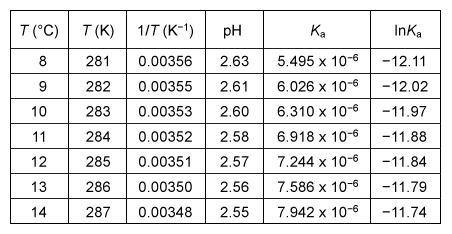
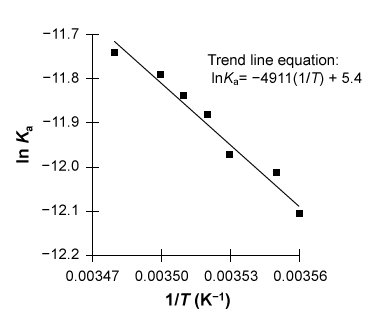
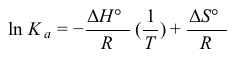
Passage Students conducted an experiment to determine the changes in enthalpy ΔH°, entropy ΔS°, and Gibbs free energy ΔG° resulting from the dissociation of acetic acid (CH3COOH) in water.  The students first determined the acid dissociation constant Ka for the reaction by measuring the pH of a 1 M acetic acid solution at various temperatures over a narrow range of less than 10 °C.To perform the pH measurements, the acetic acid solution was initially cooled to 0 °C using an ice bath and then warmed with gentle heating to room temperature with continuous stirring.  The pH was recorded at intervals of 1 °C.  From the pH data, the value of Ka at each temperature T was calculated.  The experimental results over the selected temperature range are shown in Table 1.Table 1  Student Data for the pH and Ka of Acetic Acid with Increasing Temperature Passage Students conducted an experiment to determine the changes in enthalpy ΔH°, entropy ΔS°, and Gibbs free energy ΔG° resulting from the dissociation of acetic acid (CH<sub>3</sub>COOH) in water.  The students first determined the acid dissociation constant K<sub>a</sub> for the reaction by measuring the pH of a 1 M acetic acid solution at various temperatures over a narrow range of less than 10 °C.To perform the pH measurements, the acetic acid solution was initially cooled to 0 °C using an ice bath and then warmed with gentle heating to room temperature with continuous stirring.  The pH was recorded at intervals of 1 °C.  From the pH data, the value of K<sub>a</sub> at each temperature T was calculated.  The experimental results over the selected temperature range are shown in Table 1.<strong>Table 1</strong>  Student Data for the pH and K<sub>a</sub> of Acetic Acid with Increasing Temperature    To evaluate ΔH° and ΔS°, the students constructed a van 't Hoff plot (Figure 1), which is a graph of the natural log of the dissociation constant (ln K<sub>a</sub>) vs. the reciprocal absolute temperature (1/T).    <strong>Figure 1</strong>  Linear van 't Hoff plot relating the dissociation constant K<sub>a</sub> of acetic acid to temperature TThe relationship between K<sub>a</sub>, T, ΔH°, and ΔS° in the van 't Hoff plot was then described using a linear fit of the data following the form of Equation 1, in which R is the gas constant (8.3 J∙mol<sup>−1</sup>∙K<sup>−1</sup>).    Adapted from: C. Rezsnyak Determination of Thermodynamic Values (S°, H°, and G°) from the Dissociation of a Weak Acid World Journal of Chemical Education. ©2017 Science and Education Publishing. -Compared to ΔG° for the dissociation of acetic acid at a temperature yielding a pH of 2.6, ΔG° for the dissociation of acetic acid at another temperature yielding a pH of 2.0 would be: To evaluate ΔH° and ΔS°, the students constructed a van 't Hoff plot (Figure 1), which is a graph of the natural log of the dissociation constant (ln Ka) vs. the reciprocal absolute temperature (1/T). Passage Students conducted an experiment to determine the changes in enthalpy ΔH°, entropy ΔS°, and Gibbs free energy ΔG° resulting from the dissociation of acetic acid (CH<sub>3</sub>COOH) in water.  The students first determined the acid dissociation constant K<sub>a</sub> for the reaction by measuring the pH of a 1 M acetic acid solution at various temperatures over a narrow range of less than 10 °C.To perform the pH measurements, the acetic acid solution was initially cooled to 0 °C using an ice bath and then warmed with gentle heating to room temperature with continuous stirring.  The pH was recorded at intervals of 1 °C.  From the pH data, the value of K<sub>a</sub> at each temperature T was calculated.  The experimental results over the selected temperature range are shown in Table 1.<strong>Table 1</strong>  Student Data for the pH and K<sub>a</sub> of Acetic Acid with Increasing Temperature    To evaluate ΔH° and ΔS°, the students constructed a van 't Hoff plot (Figure 1), which is a graph of the natural log of the dissociation constant (ln K<sub>a</sub>) vs. the reciprocal absolute temperature (1/T).    <strong>Figure 1</strong>  Linear van 't Hoff plot relating the dissociation constant K<sub>a</sub> of acetic acid to temperature TThe relationship between K<sub>a</sub>, T, ΔH°, and ΔS° in the van 't Hoff plot was then described using a linear fit of the data following the form of Equation 1, in which R is the gas constant (8.3 J∙mol<sup>−1</sup>∙K<sup>−1</sup>).    Adapted from: C. Rezsnyak Determination of Thermodynamic Values (S°, H°, and G°) from the Dissociation of a Weak Acid World Journal of Chemical Education. ©2017 Science and Education Publishing. -Compared to ΔG° for the dissociation of acetic acid at a temperature yielding a pH of 2.6, ΔG° for the dissociation of acetic acid at another temperature yielding a pH of 2.0 would be: Figure 1  Linear van 't Hoff plot relating the dissociation constant Ka of acetic acid to temperature TThe relationship between Ka, T, ΔH°, and ΔS° in the van 't Hoff plot was then described using a linear fit of the data following the form of Equation 1, in which R is the gas constant (8.3 J∙mol−1∙K−1). Passage Students conducted an experiment to determine the changes in enthalpy ΔH°, entropy ΔS°, and Gibbs free energy ΔG° resulting from the dissociation of acetic acid (CH<sub>3</sub>COOH) in water.  The students first determined the acid dissociation constant K<sub>a</sub> for the reaction by measuring the pH of a 1 M acetic acid solution at various temperatures over a narrow range of less than 10 °C.To perform the pH measurements, the acetic acid solution was initially cooled to 0 °C using an ice bath and then warmed with gentle heating to room temperature with continuous stirring.  The pH was recorded at intervals of 1 °C.  From the pH data, the value of K<sub>a</sub> at each temperature T was calculated.  The experimental results over the selected temperature range are shown in Table 1.<strong>Table 1</strong>  Student Data for the pH and K<sub>a</sub> of Acetic Acid with Increasing Temperature    To evaluate ΔH° and ΔS°, the students constructed a van 't Hoff plot (Figure 1), which is a graph of the natural log of the dissociation constant (ln K<sub>a</sub>) vs. the reciprocal absolute temperature (1/T).    <strong>Figure 1</strong>  Linear van 't Hoff plot relating the dissociation constant K<sub>a</sub> of acetic acid to temperature TThe relationship between K<sub>a</sub>, T, ΔH°, and ΔS° in the van 't Hoff plot was then described using a linear fit of the data following the form of Equation 1, in which R is the gas constant (8.3 J∙mol<sup>−1</sup>∙K<sup>−1</sup>).    Adapted from: C. Rezsnyak Determination of Thermodynamic Values (S°, H°, and G°) from the Dissociation of a Weak Acid World Journal of Chemical Education. ©2017 Science and Education Publishing. -Compared to ΔG° for the dissociation of acetic acid at a temperature yielding a pH of 2.6, ΔG° for the dissociation of acetic acid at another temperature yielding a pH of 2.0 would be: Adapted from: C. Rezsnyak "Determination of Thermodynamic Values (S°, H°, and G°) from the Dissociation of a Weak Acid" World Journal of Chemical Education. ©2017 Science and Education Publishing. -Compared to ΔG° for the dissociation of acetic acid at a temperature yielding a pH of 2.6, ΔG° for the dissociation of acetic acid at another temperature yielding a pH of 2.0 would be:
(Multiple Choice)
4.7/5
(102)

Which of the following pressure measurements is equivalent to a pressure of 152 mmHg?0.2 atm20.3 kPa76 torr

(Multiple Choice)
4.8/5
(66)

Passage Hyperbaric oxygenation therapy involves placing a patient in a chamber with oxygen-rich air at greater than atmospheric pressure.  Normal air has approximately 78% N2, 21% O2, and trace amounts of other gases.  The pressure within the hyperbaric chamber is typically measured in terms of ATA, or atmospheres absolute (1 ATA is the average atmospheric pressure at sea level, or 1 atm).  A hyperbaric chamber set at 2.5 ATA would be the average atmospheric pressure at sea level (1 ATA) plus the additional pressure applied to the chamber (1.5 ATA).There are two main types of hyperbaric chambers: monoplace chambers and multiplace chambers.  Monoplace chambers accommodate a single person.  The air in these chambers is 100% oxygen and can be raised to a maximum pressure of 3 ATA.  Monoplace chambers are used as therapy for conditions where oxygen supply has been depleted, such as carbon monoxide poisoning.  They are also used when a higher concentration of oxygen in plasma is needed, such as in wound healing.Multiplace chambers are large enough to house at least four people.  The air in these chambers is typically a mixture of oxygen and nitrogen, but the patient breathes pure oxygen through a mask.  Some multiplace chambers can endure maximum pressures of 6 ATA and are typically used to eliminate intravascular air bubbles that can occur from decompression sickness or embolisms.  The high pressure from the multiplace chamber results in a decrease in volume of any air pockets within the body, including the sinuses, inner ear, and unwanted air bubbles in the arteries or veins.Patients report that their ears "pop" during the pressurization process, similar to being on an airplane in flight.  In addition, they report that although there is an initial sense of temperature increasing, the chamber's temperature stays relatively stable during both the pressurization and the depressurization processes. -Assume that the pressure in a 1500 L monoplace chamber is increased from 1 ATA to 2 ATA.  Which expression gives the number of moles of oxygen that is added to the chamber if the temperature remains constant at 27 °C?

(Multiple Choice)
4.8/5
(78)

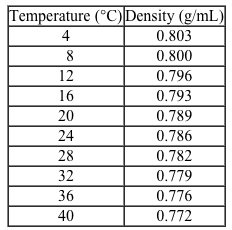
The density of ethanol varies slightly with temperature, as shown in the table below. The density of ethanol varies slightly with temperature, as shown in the table below.   Based on this data, how many molecules of ethanol are contained in 30 mL of ethanol at 8 °C?  (Note: The molar mass of ethanol is 46.08 g/mol.) Based on this data, how many molecules of ethanol are contained in 30 mL of ethanol at 8 °C?  (Note: The molar mass of ethanol is 46.08 g/mol.)
(Multiple Choice)
4.8/5
(77)

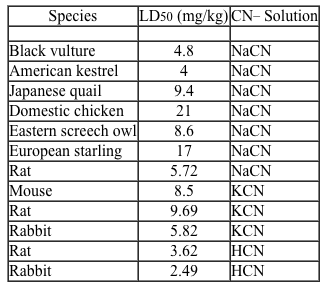
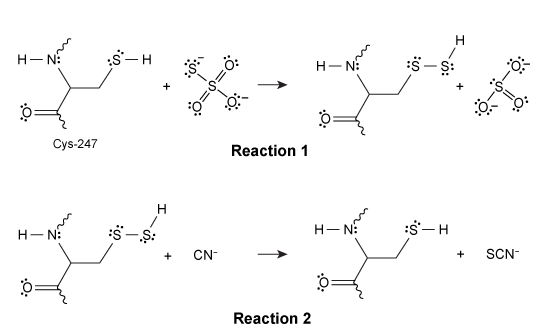
Passage Cyanide (CN−) is a powerful, rapid toxin that binds to the cellular respiratory enzyme cytochrome c oxidase.  The resulting enzyme-cyanide complex blocks the transfer of electrons to oxygen in the last step of the electron transport chain.  This results in cytotoxic anoxia, causing asphyxiation at the cellular level.Exposure to cyanide can occur from dietary sources, medical treatments, industrial applications, smoke inhalation (structural fires), and intentional use (suicide).  While dietary exposure from moderate consumption of naturally occurring plant compounds such as cyanogenic glycosides rarely results in acute adverse effects in humans, chronic effects have been observed from prolonged diets with significant levels of these compounds.  In the developed world, risk of significant cyanide exposure is most likely to result from smoke inhalation during building fires or from industrial/occupational exposures.The impact of a given exposure depends on the amount (dose, duration), the chemical composition of the cyanide compound (HCN, NaCN, KCN), and the route of exposure (inhalation, absorption, ingestion).  The ionic salts (NaCN, KCN) and free acid (HCN) forms of cyanide each have different acid-base properties that interact differently under the physiological conditions associated with each route of exposure.To better understand the toxicity of different forms of cyanide, animal models have been studied for comparison to known human exposure case studies.  Table 1 presents a summary of selected animal toxicity studies that examine exposure via ingestion.  The table provides the lethal dose to 50% of the population (LD50) in milligrams of cyanide per kilogram of body weight (mg/kg).Table 1  Compilation of LD50 Cyanide Values in Various Animal Species Passage Cyanide (CN<sup>−</sup>) is a powerful, rapid toxin that binds to the cellular respiratory enzyme cytochrome c oxidase.  The resulting enzyme-cyanide complex blocks the transfer of electrons to oxygen in the last step of the electron transport chain.  This results in cytotoxic anoxia, causing asphyxiation at the cellular level.Exposure to cyanide can occur from dietary sources, medical treatments, industrial applications, smoke inhalation (structural fires), and intentional use (suicide).  While dietary exposure from moderate consumption of naturally occurring plant compounds such as cyanogenic glycosides rarely results in acute adverse effects in humans, chronic effects have been observed from prolonged diets with significant levels of these compounds.  In the developed world, risk of significant cyanide exposure is most likely to result from smoke inhalation during building fires or from industrial/occupational exposures.The impact of a given exposure depends on the amount (dose, duration), the chemical composition of the cyanide compound (HCN, NaCN, KCN), and the route of exposure (inhalation, absorption, ingestion).  The ionic salts (NaCN, KCN) and free acid (HCN) forms of cyanide each have different acid-base properties that interact differently under the physiological conditions associated with each route of exposure.To better understand the toxicity of different forms of cyanide, animal models have been studied for comparison to known human exposure case studies.  Table 1 presents a summary of selected animal toxicity studies that examine exposure via ingestion.  The table provides the lethal dose to 50% of the population (LD<sub>50</sub>) in milligrams of cyanide per kilogram of body weight (mg/kg).<strong>Table 1</strong>  Compilation of LD<sub>50</sub> Cyanide Values in Various Animal Species    Based on animal models, one treatment developed for cyanide poisoning involves assisting the rhodanese enzyme in metabolizing CN<sup>−</sup> to SCN<sup>−</sup> via an intravenous solution of NaNO<sub>2</sub> and Na<sub>2</sub>S<sub>2</sub>O<sub>3</sub>.  The Na<sub>2</sub>S<sub>2</sub>O<sub>3</sub> assists in the formation of a reactive S-SH (persulfide) bond in the enzyme on cysteine-247 (Reaction 1), which then reacts with the cyanide ion to form thiocyanate (Reaction 2).    Adapted from: Hall AH, Isom GE, Rockwood GA. Toxicology of Cyanides and Cyanogens, Experimental, Applied and Clinical Aspects. John Wiley & Sons; 2015: 1-20; and Egekeze JO, Oehme FW. Cyanides and their toxicity: A literature review. Vet Q. 1980; 2(2): 104-114. -Which of the following is the base dissociation constant K<sub>b</sub> for the conjugate base of HCN? Based on animal models, one treatment developed for cyanide poisoning involves assisting the rhodanese enzyme in metabolizing CN− to SCN− via an intravenous solution of NaNO2 and Na2S2O3.  The Na2S2O3 assists in the formation of a reactive S-SH (persulfide) bond in the enzyme on cysteine-247 (Reaction 1), which then reacts with the cyanide ion to form thiocyanate (Reaction 2). Passage Cyanide (CN<sup>−</sup>) is a powerful, rapid toxin that binds to the cellular respiratory enzyme cytochrome c oxidase.  The resulting enzyme-cyanide complex blocks the transfer of electrons to oxygen in the last step of the electron transport chain.  This results in cytotoxic anoxia, causing asphyxiation at the cellular level.Exposure to cyanide can occur from dietary sources, medical treatments, industrial applications, smoke inhalation (structural fires), and intentional use (suicide).  While dietary exposure from moderate consumption of naturally occurring plant compounds such as cyanogenic glycosides rarely results in acute adverse effects in humans, chronic effects have been observed from prolonged diets with significant levels of these compounds.  In the developed world, risk of significant cyanide exposure is most likely to result from smoke inhalation during building fires or from industrial/occupational exposures.The impact of a given exposure depends on the amount (dose, duration), the chemical composition of the cyanide compound (HCN, NaCN, KCN), and the route of exposure (inhalation, absorption, ingestion).  The ionic salts (NaCN, KCN) and free acid (HCN) forms of cyanide each have different acid-base properties that interact differently under the physiological conditions associated with each route of exposure.To better understand the toxicity of different forms of cyanide, animal models have been studied for comparison to known human exposure case studies.  Table 1 presents a summary of selected animal toxicity studies that examine exposure via ingestion.  The table provides the lethal dose to 50% of the population (LD<sub>50</sub>) in milligrams of cyanide per kilogram of body weight (mg/kg).<strong>Table 1</strong>  Compilation of LD<sub>50</sub> Cyanide Values in Various Animal Species    Based on animal models, one treatment developed for cyanide poisoning involves assisting the rhodanese enzyme in metabolizing CN<sup>−</sup> to SCN<sup>−</sup> via an intravenous solution of NaNO<sub>2</sub> and Na<sub>2</sub>S<sub>2</sub>O<sub>3</sub>.  The Na<sub>2</sub>S<sub>2</sub>O<sub>3</sub> assists in the formation of a reactive S-SH (persulfide) bond in the enzyme on cysteine-247 (Reaction 1), which then reacts with the cyanide ion to form thiocyanate (Reaction 2).    Adapted from: Hall AH, Isom GE, Rockwood GA. Toxicology of Cyanides and Cyanogens, Experimental, Applied and Clinical Aspects. John Wiley & Sons; 2015: 1-20; and Egekeze JO, Oehme FW. Cyanides and their toxicity: A literature review. Vet Q. 1980; 2(2): 104-114. -Which of the following is the base dissociation constant K<sub>b</sub> for the conjugate base of HCN? Adapted from: Hall AH, Isom GE, Rockwood GA. Toxicology of Cyanides and Cyanogens, Experimental, Applied and Clinical Aspects. John Wiley & Sons; 2015: 1-20; and Egekeze JO, Oehme FW. Cyanides and their toxicity: A literature review. Vet Q. 1980; 2(2): 104-114. -Which of the following is the base dissociation constant Kb for the conjugate base of HCN?
(Multiple Choice)
4.9/5
(68)

Passage The alkaline-earth metals are a highly reactive family of metals occupying Group 2 (IIA) of the periodic table.  In their elemental form, the alkaline-earth metals have a shiny, silvery-white to slightly yellowish appearance.  The alkaline-earth metals exhibit some similarities to the chemistry of the alkali metals (Group 1) but are a little less reactive.Atoms of the alkaline-earth metals (M) have only two valence electrons and a low first and second ionization energy.  Consequently, these metals readily lose both electrons to produce cations with a +2 charge (M+2) during reactions with nonmetals.  As a result, the alkaline-earth metals do not exist in their elemental metallic form in nature.  Instead, the Group 2 elements are found primarily as metal oxides, which form by reacting oxygen (Reaction 1). Passage The alkaline-earth metals are a highly reactive family of metals occupying Group 2 (IIA) of the periodic table.  In their elemental form, the alkaline-earth metals have a shiny, silvery-white to slightly yellowish appearance.  The alkaline-earth metals exhibit some similarities to the chemistry of the alkali metals (Group 1) but are a little less reactive.Atoms of the alkaline-earth metals (M) have only two valence electrons and a low first and second ionization energy.  Consequently, these metals readily lose both electrons to produce cations with a +2 charge (M<sup>+2</sup>) during reactions with nonmetals.  As a result, the alkaline-earth metals do not exist in their elemental metallic form in nature.  Instead, the Group 2 elements are found primarily as metal oxides, which form by reacting oxygen (Reaction 1).     Similarly, elemental samples of alkaline-earth metals will react with elemental halogens (X<sub>2</sub>) to form metal halides (Reaction 2), all of which are ionic except for BeCl<sub>2</sub>.     Except for beryllium, the alkaline-earth metals react with water to produce very basic metal hydroxide solutions and hydrogen gas (Reaction 3).     The most difficult alkaline-earth metal to study is radium, because it is a rare radioactive element that is produced from the nuclear decay of uranium.  The most common natural isotope, radium-226, has a half-life of 1,600 years and decays by alpha emission into radon-222 (Reaction 4).    -Which of the following is the electron configuration of a Ca<sup>2+</sup> ion? Similarly, elemental samples of alkaline-earth metals will react with elemental halogens (X2) to form metal halides (Reaction 2), all of which are ionic except for BeCl2. Passage The alkaline-earth metals are a highly reactive family of metals occupying Group 2 (IIA) of the periodic table.  In their elemental form, the alkaline-earth metals have a shiny, silvery-white to slightly yellowish appearance.  The alkaline-earth metals exhibit some similarities to the chemistry of the alkali metals (Group 1) but are a little less reactive.Atoms of the alkaline-earth metals (M) have only two valence electrons and a low first and second ionization energy.  Consequently, these metals readily lose both electrons to produce cations with a +2 charge (M<sup>+2</sup>) during reactions with nonmetals.  As a result, the alkaline-earth metals do not exist in their elemental metallic form in nature.  Instead, the Group 2 elements are found primarily as metal oxides, which form by reacting oxygen (Reaction 1).     Similarly, elemental samples of alkaline-earth metals will react with elemental halogens (X<sub>2</sub>) to form metal halides (Reaction 2), all of which are ionic except for BeCl<sub>2</sub>.     Except for beryllium, the alkaline-earth metals react with water to produce very basic metal hydroxide solutions and hydrogen gas (Reaction 3).     The most difficult alkaline-earth metal to study is radium, because it is a rare radioactive element that is produced from the nuclear decay of uranium.  The most common natural isotope, radium-226, has a half-life of 1,600 years and decays by alpha emission into radon-222 (Reaction 4).    -Which of the following is the electron configuration of a Ca<sup>2+</sup> ion? Except for beryllium, the alkaline-earth metals react with water to produce very basic metal hydroxide solutions and hydrogen gas (Reaction 3). Passage The alkaline-earth metals are a highly reactive family of metals occupying Group 2 (IIA) of the periodic table.  In their elemental form, the alkaline-earth metals have a shiny, silvery-white to slightly yellowish appearance.  The alkaline-earth metals exhibit some similarities to the chemistry of the alkali metals (Group 1) but are a little less reactive.Atoms of the alkaline-earth metals (M) have only two valence electrons and a low first and second ionization energy.  Consequently, these metals readily lose both electrons to produce cations with a +2 charge (M<sup>+2</sup>) during reactions with nonmetals.  As a result, the alkaline-earth metals do not exist in their elemental metallic form in nature.  Instead, the Group 2 elements are found primarily as metal oxides, which form by reacting oxygen (Reaction 1).     Similarly, elemental samples of alkaline-earth metals will react with elemental halogens (X<sub>2</sub>) to form metal halides (Reaction 2), all of which are ionic except for BeCl<sub>2</sub>.     Except for beryllium, the alkaline-earth metals react with water to produce very basic metal hydroxide solutions and hydrogen gas (Reaction 3).     The most difficult alkaline-earth metal to study is radium, because it is a rare radioactive element that is produced from the nuclear decay of uranium.  The most common natural isotope, radium-226, has a half-life of 1,600 years and decays by alpha emission into radon-222 (Reaction 4).    -Which of the following is the electron configuration of a Ca<sup>2+</sup> ion? The most difficult alkaline-earth metal to study is radium, because it is a rare radioactive element that is produced from the nuclear decay of uranium.  The most common natural isotope, radium-226, has a half-life of 1,600 years and decays by alpha emission into radon-222 (Reaction 4). Passage The alkaline-earth metals are a highly reactive family of metals occupying Group 2 (IIA) of the periodic table.  In their elemental form, the alkaline-earth metals have a shiny, silvery-white to slightly yellowish appearance.  The alkaline-earth metals exhibit some similarities to the chemistry of the alkali metals (Group 1) but are a little less reactive.Atoms of the alkaline-earth metals (M) have only two valence electrons and a low first and second ionization energy.  Consequently, these metals readily lose both electrons to produce cations with a +2 charge (M<sup>+2</sup>) during reactions with nonmetals.  As a result, the alkaline-earth metals do not exist in their elemental metallic form in nature.  Instead, the Group 2 elements are found primarily as metal oxides, which form by reacting oxygen (Reaction 1).     Similarly, elemental samples of alkaline-earth metals will react with elemental halogens (X<sub>2</sub>) to form metal halides (Reaction 2), all of which are ionic except for BeCl<sub>2</sub>.     Except for beryllium, the alkaline-earth metals react with water to produce very basic metal hydroxide solutions and hydrogen gas (Reaction 3).     The most difficult alkaline-earth metal to study is radium, because it is a rare radioactive element that is produced from the nuclear decay of uranium.  The most common natural isotope, radium-226, has a half-life of 1,600 years and decays by alpha emission into radon-222 (Reaction 4).    -Which of the following is the electron configuration of a Ca<sup>2+</sup> ion? -Which of the following is the electron configuration of a Ca2+ ion?

(Multiple Choice)
4.9/5
(62)

Passage The alkaline-earth metals are a highly reactive family of metals occupying Group 2 (IIA) of the periodic table.  In their elemental form, the alkaline-earth metals have a shiny, silvery-white to slightly yellowish appearance.  The alkaline-earth metals exhibit some similarities to the chemistry of the alkali metals (Group 1) but are a little less reactive.Atoms of the alkaline-earth metals (M) have only two valence electrons and a low first and second ionization energy.  Consequently, these metals readily lose both electrons to produce cations with a +2 charge (M+2) during reactions with nonmetals.  As a result, the alkaline-earth metals do not exist in their elemental metallic form in nature.  Instead, the Group 2 elements are found primarily as metal oxides, which form by reacting oxygen (Reaction 1). Passage The alkaline-earth metals are a highly reactive family of metals occupying Group 2 (IIA) of the periodic table.  In their elemental form, the alkaline-earth metals have a shiny, silvery-white to slightly yellowish appearance.  The alkaline-earth metals exhibit some similarities to the chemistry of the alkali metals (Group 1) but are a little less reactive.Atoms of the alkaline-earth metals (M) have only two valence electrons and a low first and second ionization energy.  Consequently, these metals readily lose both electrons to produce cations with a +2 charge (M<sup>+2</sup>) during reactions with nonmetals.  As a result, the alkaline-earth metals do not exist in their elemental metallic form in nature.  Instead, the Group 2 elements are found primarily as metal oxides, which form by reacting oxygen (Reaction 1).     Similarly, elemental samples of alkaline-earth metals will react with elemental halogens (X<sub>2</sub>) to form metal halides (Reaction 2), all of which are ionic except for BeCl<sub>2</sub>.     Except for beryllium, the alkaline-earth metals react with water to produce very basic metal hydroxide solutions and hydrogen gas (Reaction 3).     The most difficult alkaline-earth metal to study is radium, because it is a rare radioactive element that is produced from the nuclear decay of uranium.  The most common natural isotope, radium-226, has a half-life of 1,600 years and decays by alpha emission into radon-222 (Reaction 4).    -The rate-determining step for the overall reaction in Figure 1 is the conversion of: Similarly, elemental samples of alkaline-earth metals will react with elemental halogens (X2) to form metal halides (Reaction 2), all of which are ionic except for BeCl2. Passage The alkaline-earth metals are a highly reactive family of metals occupying Group 2 (IIA) of the periodic table.  In their elemental form, the alkaline-earth metals have a shiny, silvery-white to slightly yellowish appearance.  The alkaline-earth metals exhibit some similarities to the chemistry of the alkali metals (Group 1) but are a little less reactive.Atoms of the alkaline-earth metals (M) have only two valence electrons and a low first and second ionization energy.  Consequently, these metals readily lose both electrons to produce cations with a +2 charge (M<sup>+2</sup>) during reactions with nonmetals.  As a result, the alkaline-earth metals do not exist in their elemental metallic form in nature.  Instead, the Group 2 elements are found primarily as metal oxides, which form by reacting oxygen (Reaction 1).     Similarly, elemental samples of alkaline-earth metals will react with elemental halogens (X<sub>2</sub>) to form metal halides (Reaction 2), all of which are ionic except for BeCl<sub>2</sub>.     Except for beryllium, the alkaline-earth metals react with water to produce very basic metal hydroxide solutions and hydrogen gas (Reaction 3).     The most difficult alkaline-earth metal to study is radium, because it is a rare radioactive element that is produced from the nuclear decay of uranium.  The most common natural isotope, radium-226, has a half-life of 1,600 years and decays by alpha emission into radon-222 (Reaction 4).    -The rate-determining step for the overall reaction in Figure 1 is the conversion of: Except for beryllium, the alkaline-earth metals react with water to produce very basic metal hydroxide solutions and hydrogen gas (Reaction 3). Passage The alkaline-earth metals are a highly reactive family of metals occupying Group 2 (IIA) of the periodic table.  In their elemental form, the alkaline-earth metals have a shiny, silvery-white to slightly yellowish appearance.  The alkaline-earth metals exhibit some similarities to the chemistry of the alkali metals (Group 1) but are a little less reactive.Atoms of the alkaline-earth metals (M) have only two valence electrons and a low first and second ionization energy.  Consequently, these metals readily lose both electrons to produce cations with a +2 charge (M<sup>+2</sup>) during reactions with nonmetals.  As a result, the alkaline-earth metals do not exist in their elemental metallic form in nature.  Instead, the Group 2 elements are found primarily as metal oxides, which form by reacting oxygen (Reaction 1).     Similarly, elemental samples of alkaline-earth metals will react with elemental halogens (X<sub>2</sub>) to form metal halides (Reaction 2), all of which are ionic except for BeCl<sub>2</sub>.     Except for beryllium, the alkaline-earth metals react with water to produce very basic metal hydroxide solutions and hydrogen gas (Reaction 3).     The most difficult alkaline-earth metal to study is radium, because it is a rare radioactive element that is produced from the nuclear decay of uranium.  The most common natural isotope, radium-226, has a half-life of 1,600 years and decays by alpha emission into radon-222 (Reaction 4).    -The rate-determining step for the overall reaction in Figure 1 is the conversion of: The most difficult alkaline-earth metal to study is radium, because it is a rare radioactive element that is produced from the nuclear decay of uranium.  The most common natural isotope, radium-226, has a half-life of 1,600 years and decays by alpha emission into radon-222 (Reaction 4). Passage The alkaline-earth metals are a highly reactive family of metals occupying Group 2 (IIA) of the periodic table.  In their elemental form, the alkaline-earth metals have a shiny, silvery-white to slightly yellowish appearance.  The alkaline-earth metals exhibit some similarities to the chemistry of the alkali metals (Group 1) but are a little less reactive.Atoms of the alkaline-earth metals (M) have only two valence electrons and a low first and second ionization energy.  Consequently, these metals readily lose both electrons to produce cations with a +2 charge (M<sup>+2</sup>) during reactions with nonmetals.  As a result, the alkaline-earth metals do not exist in their elemental metallic form in nature.  Instead, the Group 2 elements are found primarily as metal oxides, which form by reacting oxygen (Reaction 1).     Similarly, elemental samples of alkaline-earth metals will react with elemental halogens (X<sub>2</sub>) to form metal halides (Reaction 2), all of which are ionic except for BeCl<sub>2</sub>.     Except for beryllium, the alkaline-earth metals react with water to produce very basic metal hydroxide solutions and hydrogen gas (Reaction 3).     The most difficult alkaline-earth metal to study is radium, because it is a rare radioactive element that is produced from the nuclear decay of uranium.  The most common natural isotope, radium-226, has a half-life of 1,600 years and decays by alpha emission into radon-222 (Reaction 4).    -The rate-determining step for the overall reaction in Figure 1 is the conversion of: -The rate-determining step for the overall reaction in Figure 1 is the conversion of:

(Multiple Choice)
4.9/5
(76)

Which of the following values gives the number of parts per million (ppm) of NaCl in a 0.90% saline solution?

(Multiple Choice)
4.7/5
(82)

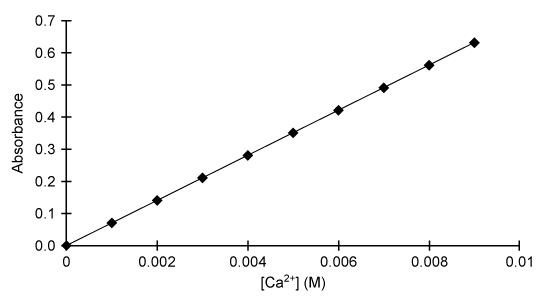
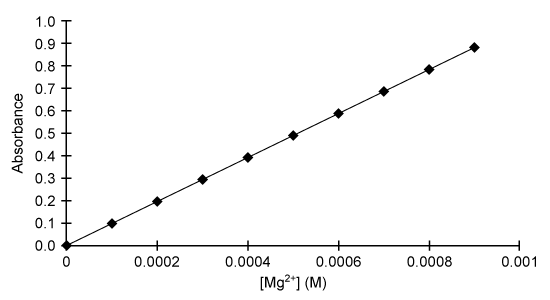
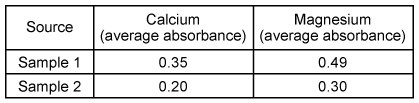
Passage A group of students were given water from two reservoirs and asked to determine water hardness using flame atomic absorbance (AA) spectroscopy.  Water hardness can be found by relating the concentration of calcium and magnesium ions to the concentration of carbonate species in the sample using Equation 1.[CO32-] = 2.5[Ca2+] + 4.1[Mg2+]Equation 1To correlate the concentration of the metal ions to absorbance, the students made standard solutions of MgO (MW = 40.31 g/mol) and CaO (MW = 56.08 g/mol) by diluting small portions of 0.01 M MgO and 0.01 M CaO stock solutions with 2% HNO3 into 100 mL volumetric flasks.  The calibration curves generated from the standard solutions are shown in Figures 1 and 2. Passage A group of students were given water from two reservoirs and asked to determine water hardness using flame atomic absorbance (AA) spectroscopy.  Water hardness can be found by relating the concentration of calcium and magnesium ions to the concentration of carbonate species in the sample using Equation 1.[CO<sub>3</sub><sup>2-</sup>] = 2.5[Ca<sup>2+</sup>] + 4.1[Mg<sup>2+</sup>]<strong>Equation 1</strong>To correlate the concentration of the metal ions to absorbance, the students made standard solutions of MgO (MW = 40.31 g/mol) and CaO (MW = 56.08 g/mol) by diluting small portions of 0.01 M MgO and 0.01 M CaO stock solutions with 2% HNO<sub>3</sub> into 100 mL volumetric flasks.  The calibration curves generated from the standard solutions are shown in Figures 1 and 2.    <strong>Figure 1</strong>  Calibration curve from the absorption of the Ca<sup>2+</sup> solution standards    <strong>Figure 2</strong>  Calibration curve from the absorption of the Mg<sup>2+</sup> solution standardsLanthanum(III) chloride (MM = 245.25) can be used to eliminate chemical interference in a sample by competitively binding to PO<sub>4</sub><sup>3−</sup>, releasing calcium to be atomized in the flame for detection.The students prepared unknown Samples 1 and 2 by mixing 25 mL reservoir water, 16 mL of 2% HNO<sub>3</sub>, and 9 mL of 0.1 M LaCl<sub>3</sub> for a total sample volume of 50 mL each.  The samples were each tested three times using flame AA spectroscopy, yielding the results reported in Table 1.<strong>Table 1</strong>  AA Spectroscopy Results for Reservoir Water Samples    -When 0.1 M LaCl<sub>3</sub> is added to a sample, the following reactions take place:   Ca3PO42s⇄ 3 Ca2++2 PO43-   2 La3++2 PO43-→2 LaPO4sIf 2 × 10<sup>−4</sup> moles of Ca<sub>3</sub>(PO<sub>4</sub>)<sub>2</sub> react, the maximum number of grams of LaPO<sub>4</sub> (MW = 234 g/mol) that can be produced is: Figure 1  Calibration curve from the absorption of the Ca2+ solution standards Passage A group of students were given water from two reservoirs and asked to determine water hardness using flame atomic absorbance (AA) spectroscopy.  Water hardness can be found by relating the concentration of calcium and magnesium ions to the concentration of carbonate species in the sample using Equation 1.[CO<sub>3</sub><sup>2-</sup>] = 2.5[Ca<sup>2+</sup>] + 4.1[Mg<sup>2+</sup>]<strong>Equation 1</strong>To correlate the concentration of the metal ions to absorbance, the students made standard solutions of MgO (MW = 40.31 g/mol) and CaO (MW = 56.08 g/mol) by diluting small portions of 0.01 M MgO and 0.01 M CaO stock solutions with 2% HNO<sub>3</sub> into 100 mL volumetric flasks.  The calibration curves generated from the standard solutions are shown in Figures 1 and 2.    <strong>Figure 1</strong>  Calibration curve from the absorption of the Ca<sup>2+</sup> solution standards    <strong>Figure 2</strong>  Calibration curve from the absorption of the Mg<sup>2+</sup> solution standardsLanthanum(III) chloride (MM = 245.25) can be used to eliminate chemical interference in a sample by competitively binding to PO<sub>4</sub><sup>3−</sup>, releasing calcium to be atomized in the flame for detection.The students prepared unknown Samples 1 and 2 by mixing 25 mL reservoir water, 16 mL of 2% HNO<sub>3</sub>, and 9 mL of 0.1 M LaCl<sub>3</sub> for a total sample volume of 50 mL each.  The samples were each tested three times using flame AA spectroscopy, yielding the results reported in Table 1.<strong>Table 1</strong>  AA Spectroscopy Results for Reservoir Water Samples    -When 0.1 M LaCl<sub>3</sub> is added to a sample, the following reactions take place:   Ca3PO42s⇄ 3 Ca2++2 PO43-   2 La3++2 PO43-→2 LaPO4sIf 2 × 10<sup>−4</sup> moles of Ca<sub>3</sub>(PO<sub>4</sub>)<sub>2</sub> react, the maximum number of grams of LaPO<sub>4</sub> (MW = 234 g/mol) that can be produced is: Figure 2  Calibration curve from the absorption of the Mg2+ solution standardsLanthanum(III) chloride (MM = 245.25) can be used to eliminate chemical interference in a sample by competitively binding to PO43−, releasing calcium to be atomized in the flame for detection.The students prepared unknown Samples 1 and 2 by mixing 25 mL reservoir water, 16 mL of 2% HNO3, and 9 mL of 0.1 M LaCl3 for a total sample volume of 50 mL each.  The samples were each tested three times using flame AA spectroscopy, yielding the results reported in Table 1.Table 1  AA Spectroscopy Results for Reservoir Water Samples Passage A group of students were given water from two reservoirs and asked to determine water hardness using flame atomic absorbance (AA) spectroscopy.  Water hardness can be found by relating the concentration of calcium and magnesium ions to the concentration of carbonate species in the sample using Equation 1.[CO<sub>3</sub><sup>2-</sup>] = 2.5[Ca<sup>2+</sup>] + 4.1[Mg<sup>2+</sup>]<strong>Equation 1</strong>To correlate the concentration of the metal ions to absorbance, the students made standard solutions of MgO (MW = 40.31 g/mol) and CaO (MW = 56.08 g/mol) by diluting small portions of 0.01 M MgO and 0.01 M CaO stock solutions with 2% HNO<sub>3</sub> into 100 mL volumetric flasks.  The calibration curves generated from the standard solutions are shown in Figures 1 and 2.    <strong>Figure 1</strong>  Calibration curve from the absorption of the Ca<sup>2+</sup> solution standards    <strong>Figure 2</strong>  Calibration curve from the absorption of the Mg<sup>2+</sup> solution standardsLanthanum(III) chloride (MM = 245.25) can be used to eliminate chemical interference in a sample by competitively binding to PO<sub>4</sub><sup>3−</sup>, releasing calcium to be atomized in the flame for detection.The students prepared unknown Samples 1 and 2 by mixing 25 mL reservoir water, 16 mL of 2% HNO<sub>3</sub>, and 9 mL of 0.1 M LaCl<sub>3</sub> for a total sample volume of 50 mL each.  The samples were each tested three times using flame AA spectroscopy, yielding the results reported in Table 1.<strong>Table 1</strong>  AA Spectroscopy Results for Reservoir Water Samples    -When 0.1 M LaCl<sub>3</sub> is added to a sample, the following reactions take place:   Ca3PO42s⇄ 3 Ca2++2 PO43-   2 La3++2 PO43-→2 LaPO4sIf 2 × 10<sup>−4</sup> moles of Ca<sub>3</sub>(PO<sub>4</sub>)<sub>2</sub> react, the maximum number of grams of LaPO<sub>4</sub> (MW = 234 g/mol) that can be produced is: -When 0.1 M LaCl3 is added to a sample, the following reactions take place: Passage A group of students were given water from two reservoirs and asked to determine water hardness using flame atomic absorbance (AA) spectroscopy.  Water hardness can be found by relating the concentration of calcium and magnesium ions to the concentration of carbonate species in the sample using Equation 1.[CO<sub>3</sub><sup>2-</sup>] = 2.5[Ca<sup>2+</sup>] + 4.1[Mg<sup>2+</sup>]<strong>Equation 1</strong>To correlate the concentration of the metal ions to absorbance, the students made standard solutions of MgO (MW = 40.31 g/mol) and CaO (MW = 56.08 g/mol) by diluting small portions of 0.01 M MgO and 0.01 M CaO stock solutions with 2% HNO<sub>3</sub> into 100 mL volumetric flasks.  The calibration curves generated from the standard solutions are shown in Figures 1 and 2.    <strong>Figure 1</strong>  Calibration curve from the absorption of the Ca<sup>2+</sup> solution standards    <strong>Figure 2</strong>  Calibration curve from the absorption of the Mg<sup>2+</sup> solution standardsLanthanum(III) chloride (MM = 245.25) can be used to eliminate chemical interference in a sample by competitively binding to PO<sub>4</sub><sup>3−</sup>, releasing calcium to be atomized in the flame for detection.The students prepared unknown Samples 1 and 2 by mixing 25 mL reservoir water, 16 mL of 2% HNO<sub>3</sub>, and 9 mL of 0.1 M LaCl<sub>3</sub> for a total sample volume of 50 mL each.  The samples were each tested three times using flame AA spectroscopy, yielding the results reported in Table 1.<strong>Table 1</strong>  AA Spectroscopy Results for Reservoir Water Samples    -When 0.1 M LaCl<sub>3</sub> is added to a sample, the following reactions take place:   Ca3PO42s⇄ 3 Ca2++2 PO43-   2 La3++2 PO43-→2 LaPO4sIf 2 × 10<sup>−4</sup> moles of Ca<sub>3</sub>(PO<sub>4</sub>)<sub>2</sub> react, the maximum number of grams of LaPO<sub>4</sub> (MW = 234 g/mol) that can be produced is: Ca3PO42s⇄ 3 Ca2++2 PO43- Passage A group of students were given water from two reservoirs and asked to determine water hardness using flame atomic absorbance (AA) spectroscopy.  Water hardness can be found by relating the concentration of calcium and magnesium ions to the concentration of carbonate species in the sample using Equation 1.[CO<sub>3</sub><sup>2-</sup>] = 2.5[Ca<sup>2+</sup>] + 4.1[Mg<sup>2+</sup>]<strong>Equation 1</strong>To correlate the concentration of the metal ions to absorbance, the students made standard solutions of MgO (MW = 40.31 g/mol) and CaO (MW = 56.08 g/mol) by diluting small portions of 0.01 M MgO and 0.01 M CaO stock solutions with 2% HNO<sub>3</sub> into 100 mL volumetric flasks.  The calibration curves generated from the standard solutions are shown in Figures 1 and 2.    <strong>Figure 1</strong>  Calibration curve from the absorption of the Ca<sup>2+</sup> solution standards    <strong>Figure 2</strong>  Calibration curve from the absorption of the Mg<sup>2+</sup> solution standardsLanthanum(III) chloride (MM = 245.25) can be used to eliminate chemical interference in a sample by competitively binding to PO<sub>4</sub><sup>3−</sup>, releasing calcium to be atomized in the flame for detection.The students prepared unknown Samples 1 and 2 by mixing 25 mL reservoir water, 16 mL of 2% HNO<sub>3</sub>, and 9 mL of 0.1 M LaCl<sub>3</sub> for a total sample volume of 50 mL each.  The samples were each tested three times using flame AA spectroscopy, yielding the results reported in Table 1.<strong>Table 1</strong>  AA Spectroscopy Results for Reservoir Water Samples    -When 0.1 M LaCl<sub>3</sub> is added to a sample, the following reactions take place:   Ca3PO42s⇄ 3 Ca2++2 PO43-   2 La3++2 PO43-→2 LaPO4sIf 2 × 10<sup>−4</sup> moles of Ca<sub>3</sub>(PO<sub>4</sub>)<sub>2</sub> react, the maximum number of grams of LaPO<sub>4</sub> (MW = 234 g/mol) that can be produced is: 2 La3++2 PO43-→2 LaPO4sIf 2 × 10⁻⁴ moles of Ca3(PO4)2 react, the maximum number of grams of LaPO4 (MW = 234 g/mol) that can be produced is:


(Multiple Choice)
4.8/5
(68)

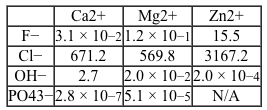
Passage Bone growth and remodeling during fracture healing are often slow and have potentially poor outcomes, including malunion or nonunion at the fracture site.  Magnesium bone implants can aid in bone formation and safely biodegrade in the body according to the following reaction:Mg(s) + 2H2O(l) → Mg(OH)2(s) + H2(g)Reaction 1  Corrosion of magnesium metal in aqueous mediumHowever, magnesium metal tends to degrade too quickly and forms hydrogen gas pockets in the body.  Corrosion is slowed as the metal naturally forms a protective layer of magnesium hydroxide in a process called passivation.  Magnesium hydroxide is less soluble than magnesium metal, and its dissolution is described by the endothermic reaction: Passage Bone growth and remodeling during fracture healing are often slow and have potentially poor outcomes, including malunion or nonunion at the fracture site.  Magnesium bone implants can aid in bone formation and safely biodegrade in the body according to the following reaction:Mg(s) + 2H<sub>2</sub>O(l) → Mg(OH)<sub>2</sub>(s) + H<sub>2</sub>(g)<strong>Reaction 1</strong>  Corrosion of magnesium metal in aqueous mediumHowever, magnesium metal tends to degrade too quickly and forms hydrogen gas pockets in the body.  Corrosion is slowed as the metal naturally forms a protective layer of magnesium hydroxide in a process called passivation.  Magnesium hydroxide is less soluble than magnesium metal, and its dissolution is described by the endothermic reaction:    <strong>Reaction 2</strong>  Solubility equilibrium of Mg(OH)<sub>2</sub> in water at 25°CAlthough passivation slows down the corrosion rate, it must be slowed even further to adequately facilitate bone reformation.Researchers are interested in the differences in the corrosion rates of magnesium metal protected by different biocompatible coatings.  They compared 10-mm magnesium disks coated with compounds of various cation and anion combinations, with solubility results shown in Table 1.  The coated disks were immersed in simulated body fluid (SBF) at room temperature for 50 hours.<strong>Table 1</strong>  Solubility for Biocompatible Inorganic Salts Given in mmol/100mL of Pure Water at 25°C    Adapted from Huan ZG, Leeflang MA, Zhou J, Fratila-apachitei LE, Duszczyk J. In vitro degradation behavior and cytocompatibility of Mg-Zn-Zr alloys. J Mater Sci Mater Med. 2010;21(9):2623-35. -The experiment was originally performed at physiological pH (7.4).  If the pH were raised to 12, how would the corrosion rate of the magnesium metal change? Reaction 2  Solubility equilibrium of Mg(OH)2 in water at 25°CAlthough passivation slows down the corrosion rate, it must be slowed even further to adequately facilitate bone reformation.Researchers are interested in the differences in the corrosion rates of magnesium metal protected by different biocompatible coatings.  They compared 10-mm magnesium disks coated with compounds of various cation and anion combinations, with solubility results shown in Table 1.  The coated disks were immersed in simulated body fluid (SBF) at room temperature for 50 hours.Table 1  Solubility for Biocompatible Inorganic Salts Given in mmol/100mL of Pure Water at 25°C Passage Bone growth and remodeling during fracture healing are often slow and have potentially poor outcomes, including malunion or nonunion at the fracture site.  Magnesium bone implants can aid in bone formation and safely biodegrade in the body according to the following reaction:Mg(s) + 2H<sub>2</sub>O(l) → Mg(OH)<sub>2</sub>(s) + H<sub>2</sub>(g)<strong>Reaction 1</strong>  Corrosion of magnesium metal in aqueous mediumHowever, magnesium metal tends to degrade too quickly and forms hydrogen gas pockets in the body.  Corrosion is slowed as the metal naturally forms a protective layer of magnesium hydroxide in a process called passivation.  Magnesium hydroxide is less soluble than magnesium metal, and its dissolution is described by the endothermic reaction:    <strong>Reaction 2</strong>  Solubility equilibrium of Mg(OH)<sub>2</sub> in water at 25°CAlthough passivation slows down the corrosion rate, it must be slowed even further to adequately facilitate bone reformation.Researchers are interested in the differences in the corrosion rates of magnesium metal protected by different biocompatible coatings.  They compared 10-mm magnesium disks coated with compounds of various cation and anion combinations, with solubility results shown in Table 1.  The coated disks were immersed in simulated body fluid (SBF) at room temperature for 50 hours.<strong>Table 1</strong>  Solubility for Biocompatible Inorganic Salts Given in mmol/100mL of Pure Water at 25°C    Adapted from Huan ZG, Leeflang MA, Zhou J, Fratila-apachitei LE, Duszczyk J. In vitro degradation behavior and cytocompatibility of Mg-Zn-Zr alloys. J Mater Sci Mater Med. 2010;21(9):2623-35. -The experiment was originally performed at physiological pH (7.4).  If the pH were raised to 12, how would the corrosion rate of the magnesium metal change? Adapted from Huan ZG, Leeflang MA, Zhou J, Fratila-apachitei LE, Duszczyk J. In vitro degradation behavior and cytocompatibility of Mg-Zn-Zr alloys. J Mater Sci Mater Med. 2010;21(9):2623-35. -The experiment was originally performed at physiological pH (7.4).  If the pH were raised to 12, how would the corrosion rate of the magnesium metal change?

(Multiple Choice)
4.8/5
(79)

Passage An automated external defibrillator (AED) is a medical device used to send an electric shock to the heart after cardiac arrest.  A key component of the AED is the power source, or battery.  Batteries used in AEDs need to have a good charge-to-weight ratio; they must be safe and reliable as well as rechargeable.Two types of rechargeable batteries used in early models of AEDs are the lead storage (also called lead-acid) battery and the nickel-cadmium (NiCd) battery.  These batteries consist of multiple electrochemical cells that are connected in series to deliver a potential between 9 V and 18 V.  A capacitor allows the AED to accumulate charge so that it can deliver between 300 V and 1,000 V.Some AEDs use a sealed lead storage battery.  Lead storage batteries are robust and hold a charge for a long time.  However, they have a low energy-to-weight ratio.  Each lead storage cell delivers approximately 2.0 V, and a battery of four cells weighing 1000 g can provide 30 W∙h of energy. Passage An automated external defibrillator (AED) is a medical device used to send an electric shock to the heart after cardiac arrest.  A key component of the AED is the power source, or battery.  Batteries used in AEDs need to have a good charge-to-weight ratio; they must be safe and reliable as well as rechargeable.Two types of rechargeable batteries used in early models of AEDs are the lead storage (also called lead-acid) battery and the nickel-cadmium (NiCd) battery.  These batteries consist of multiple electrochemical cells that are connected in series to deliver a potential between 9 V and 18 V.  A capacitor allows the AED to accumulate charge so that it can deliver between 300 V and 1,000 V.Some AEDs use a sealed lead storage battery.  Lead storage batteries are robust and hold a charge for a long time.  However, they have a low energy-to-weight ratio.  Each lead storage cell delivers approximately 2.0 V, and a battery of four cells weighing 1000 g can provide 30 W∙h of energy.    <strong>Figure 1</strong>  Electron flow in a lead storage battery when discharging and chargingThe half reactions for the anode and cathode of a lead storage battery in 4 M of sulfuric acid (H<sub>2</sub>SO<sub>4</sub>) are shown in Reactions 1 and 2:    <strong>Reaction 1</strong>    <strong>Reaction 2</strong> NiCd batteries have a higher energy-to-weight ratio than lead storage batteries but cannot hold as much charge.  Each NiCd cell delivers approximately 1.3 V, and a single-cell battery weighing 120 g can provide 7.2 W∙h of energy.The half reactions at the anode and cathode for a NiCd battery in KOH are shown in Reactions 3 and 4:    <strong>Reaction 3</strong>     <strong>Reaction 4</strong> -Assume that a NiCd battery charges for 30 minutes (t) with an applied current (I) of 5.0 A.  Which expression could be used to calculate the number of moles of Cd produced on the cathode from electrolytic plating? Figure 1  Electron flow in a lead storage battery when discharging and chargingThe half reactions for the anode and cathode of a lead storage battery in 4 M of sulfuric acid (H2SO4) are shown in Reactions 1 and 2: Passage An automated external defibrillator (AED) is a medical device used to send an electric shock to the heart after cardiac arrest.  A key component of the AED is the power source, or battery.  Batteries used in AEDs need to have a good charge-to-weight ratio; they must be safe and reliable as well as rechargeable.Two types of rechargeable batteries used in early models of AEDs are the lead storage (also called lead-acid) battery and the nickel-cadmium (NiCd) battery.  These batteries consist of multiple electrochemical cells that are connected in series to deliver a potential between 9 V and 18 V.  A capacitor allows the AED to accumulate charge so that it can deliver between 300 V and 1,000 V.Some AEDs use a sealed lead storage battery.  Lead storage batteries are robust and hold a charge for a long time.  However, they have a low energy-to-weight ratio.  Each lead storage cell delivers approximately 2.0 V, and a battery of four cells weighing 1000 g can provide 30 W∙h of energy.    <strong>Figure 1</strong>  Electron flow in a lead storage battery when discharging and chargingThe half reactions for the anode and cathode of a lead storage battery in 4 M of sulfuric acid (H<sub>2</sub>SO<sub>4</sub>) are shown in Reactions 1 and 2:    <strong>Reaction 1</strong>    <strong>Reaction 2</strong> NiCd batteries have a higher energy-to-weight ratio than lead storage batteries but cannot hold as much charge.  Each NiCd cell delivers approximately 1.3 V, and a single-cell battery weighing 120 g can provide 7.2 W∙h of energy.The half reactions at the anode and cathode for a NiCd battery in KOH are shown in Reactions 3 and 4:    <strong>Reaction 3</strong>     <strong>Reaction 4</strong> -Assume that a NiCd battery charges for 30 minutes (t) with an applied current (I) of 5.0 A.  Which expression could be used to calculate the number of moles of Cd produced on the cathode from electrolytic plating? Reaction 1 Passage An automated external defibrillator (AED) is a medical device used to send an electric shock to the heart after cardiac arrest.  A key component of the AED is the power source, or battery.  Batteries used in AEDs need to have a good charge-to-weight ratio; they must be safe and reliable as well as rechargeable.Two types of rechargeable batteries used in early models of AEDs are the lead storage (also called lead-acid) battery and the nickel-cadmium (NiCd) battery.  These batteries consist of multiple electrochemical cells that are connected in series to deliver a potential between 9 V and 18 V.  A capacitor allows the AED to accumulate charge so that it can deliver between 300 V and 1,000 V.Some AEDs use a sealed lead storage battery.  Lead storage batteries are robust and hold a charge for a long time.  However, they have a low energy-to-weight ratio.  Each lead storage cell delivers approximately 2.0 V, and a battery of four cells weighing 1000 g can provide 30 W∙h of energy.    <strong>Figure 1</strong>  Electron flow in a lead storage battery when discharging and chargingThe half reactions for the anode and cathode of a lead storage battery in 4 M of sulfuric acid (H<sub>2</sub>SO<sub>4</sub>) are shown in Reactions 1 and 2:    <strong>Reaction 1</strong>    <strong>Reaction 2</strong> NiCd batteries have a higher energy-to-weight ratio than lead storage batteries but cannot hold as much charge.  Each NiCd cell delivers approximately 1.3 V, and a single-cell battery weighing 120 g can provide 7.2 W∙h of energy.The half reactions at the anode and cathode for a NiCd battery in KOH are shown in Reactions 3 and 4:    <strong>Reaction 3</strong>     <strong>Reaction 4</strong> -Assume that a NiCd battery charges for 30 minutes (t) with an applied current (I) of 5.0 A.  Which expression could be used to calculate the number of moles of Cd produced on the cathode from electrolytic plating? Reaction 2 NiCd batteries have a higher energy-to-weight ratio than lead storage batteries but cannot hold as much charge.  Each NiCd cell delivers approximately 1.3 V, and a single-cell battery weighing 120 g can provide 7.2 W∙h of energy.The half reactions at the anode and cathode for a NiCd battery in KOH are shown in Reactions 3 and 4: Passage An automated external defibrillator (AED) is a medical device used to send an electric shock to the heart after cardiac arrest.  A key component of the AED is the power source, or battery.  Batteries used in AEDs need to have a good charge-to-weight ratio; they must be safe and reliable as well as rechargeable.Two types of rechargeable batteries used in early models of AEDs are the lead storage (also called lead-acid) battery and the nickel-cadmium (NiCd) battery.  These batteries consist of multiple electrochemical cells that are connected in series to deliver a potential between 9 V and 18 V.  A capacitor allows the AED to accumulate charge so that it can deliver between 300 V and 1,000 V.Some AEDs use a sealed lead storage battery.  Lead storage batteries are robust and hold a charge for a long time.  However, they have a low energy-to-weight ratio.  Each lead storage cell delivers approximately 2.0 V, and a battery of four cells weighing 1000 g can provide 30 W∙h of energy.    <strong>Figure 1</strong>  Electron flow in a lead storage battery when discharging and chargingThe half reactions for the anode and cathode of a lead storage battery in 4 M of sulfuric acid (H<sub>2</sub>SO<sub>4</sub>) are shown in Reactions 1 and 2:    <strong>Reaction 1</strong>    <strong>Reaction 2</strong> NiCd batteries have a higher energy-to-weight ratio than lead storage batteries but cannot hold as much charge.  Each NiCd cell delivers approximately 1.3 V, and a single-cell battery weighing 120 g can provide 7.2 W∙h of energy.The half reactions at the anode and cathode for a NiCd battery in KOH are shown in Reactions 3 and 4:    <strong>Reaction 3</strong>     <strong>Reaction 4</strong> -Assume that a NiCd battery charges for 30 minutes (t) with an applied current (I) of 5.0 A.  Which expression could be used to calculate the number of moles of Cd produced on the cathode from electrolytic plating? Reaction 3 Passage An automated external defibrillator (AED) is a medical device used to send an electric shock to the heart after cardiac arrest.  A key component of the AED is the power source, or battery.  Batteries used in AEDs need to have a good charge-to-weight ratio; they must be safe and reliable as well as rechargeable.Two types of rechargeable batteries used in early models of AEDs are the lead storage (also called lead-acid) battery and the nickel-cadmium (NiCd) battery.  These batteries consist of multiple electrochemical cells that are connected in series to deliver a potential between 9 V and 18 V.  A capacitor allows the AED to accumulate charge so that it can deliver between 300 V and 1,000 V.Some AEDs use a sealed lead storage battery.  Lead storage batteries are robust and hold a charge for a long time.  However, they have a low energy-to-weight ratio.  Each lead storage cell delivers approximately 2.0 V, and a battery of four cells weighing 1000 g can provide 30 W∙h of energy.    <strong>Figure 1</strong>  Electron flow in a lead storage battery when discharging and chargingThe half reactions for the anode and cathode of a lead storage battery in 4 M of sulfuric acid (H<sub>2</sub>SO<sub>4</sub>) are shown in Reactions 1 and 2:    <strong>Reaction 1</strong>    <strong>Reaction 2</strong> NiCd batteries have a higher energy-to-weight ratio than lead storage batteries but cannot hold as much charge.  Each NiCd cell delivers approximately 1.3 V, and a single-cell battery weighing 120 g can provide 7.2 W∙h of energy.The half reactions at the anode and cathode for a NiCd battery in KOH are shown in Reactions 3 and 4:    <strong>Reaction 3</strong>     <strong>Reaction 4</strong> -Assume that a NiCd battery charges for 30 minutes (t) with an applied current (I) of 5.0 A.  Which expression could be used to calculate the number of moles of Cd produced on the cathode from electrolytic plating? Reaction 4 -Assume that a NiCd battery charges for 30 minutes (t) with an applied current (I) of 5.0 A.  Which expression could be used to calculate the number of moles of Cd produced on the cathode from electrolytic plating?
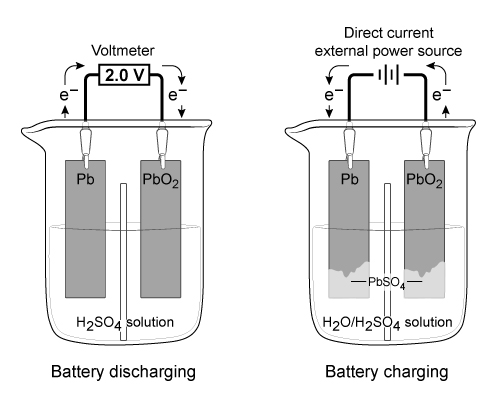


(Multiple Choice)
4.9/5
(70)

Which of the following element groups is NOT included in the representative elements?

(Multiple Choice)
4.9/5
(85)

Researchers wished to mimic the conditions of the medial Golgi (pH ≈ 6.3).  Which of the buffers shown in Table 1 would be best suited for this experiment?Table 1  Acid Dissociation Constants for Several Buffers Researchers wished to mimic the conditions of the medial Golgi (pH ≈ 6.3).  Which of the buffers shown in Table 1 would be best suited for this experiment?<strong>Table 1</strong>  Acid Dissociation Constants for Several Buffers
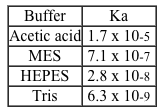
(Multiple Choice)
5.0/5
(87)
Showing 21 - 40 of 317
close modal

Filters

  • Essay(0)
  • Multiple Choice(0)
  • Short Answer(0)
  • True False(0)
  • Matching(0)

