Solved

Passage

Question 34

Multiple Choice

Passage
The alkaline-earth metals are a highly reactive family of metals occupying Group 2 (IIA) of the periodic table.  In their elemental form, the alkaline-earth metals have a shiny, silvery-white to slightly yellowish appearance.  The alkaline-earth metals exhibit some similarities to the chemistry of the alkali metals (Group 1) but are a little less reactive.Atoms of the alkaline-earth metals (M) have only two valence electrons and a low first and second ionization energy.  Consequently, these metals readily lose both electrons to produce cations with a +2 charge (M+2) during reactions with nonmetals.  As a result, the alkaline-earth metals do not exist in their elemental metallic form in nature.  Instead, the Group 2 elements are found primarily as metal oxides, which form by reacting oxygen (Reaction 1) .

Passage The alkaline-earth metals are a highly reactive family of metals occupying Group 2 (IIA)  of the periodic table.  In their elemental form, the alkaline-earth metals have a shiny, silvery-white to slightly yellowish appearance.  The alkaline-earth metals exhibit some similarities to the chemistry of the alkali metals (Group 1)  but are a little less reactive.Atoms of the alkaline-earth metals (M)  have only two valence electrons and a low first and second ionization energy.  Consequently, these metals readily lose both electrons to produce cations with a +2 charge (M<sup>+2</sup>)  during reactions with nonmetals.  As a result, the alkaline-earth metals do not exist in their elemental metallic form in nature.  Instead, the Group 2 elements are found primarily as metal oxides, which form by reacting oxygen (Reaction 1) .     Similarly, elemental samples of alkaline-earth metals will react with elemental halogens (X<sub>2</sub>)  to form metal halides (Reaction 2) , all of which are ionic except for BeCl<sub>2</sub>.     Except for beryllium, the alkaline-earth metals react with water to produce very basic metal hydroxide solutions and hydrogen gas (Reaction 3) .     The most difficult alkaline-earth metal to study is radium, because it is a rare radioactive element that is produced from the nuclear decay of uranium.  The most common natural isotope, radium-226, has a half-life of 1,600 years and decays by alpha emission into radon-222 (Reaction 4) .    -The rate-determining step for the overall reaction in Figure 1 is the conversion of: A) Compound <strong>1</strong> into the intermediate. B) Compound <strong>1</strong> into Compound <strong>3</strong>. C) the intermediate into Compound <strong>2</strong>. D) the intermediate into Compound <strong>3</strong>.
Similarly, elemental samples of alkaline-earth metals will react with elemental halogens (X2) to form metal halides (Reaction 2) , all of which are ionic except for BeCl2.

Passage The alkaline-earth metals are a highly reactive family of metals occupying Group 2 (IIA)  of the periodic table.  In their elemental form, the alkaline-earth metals have a shiny, silvery-white to slightly yellowish appearance.  The alkaline-earth metals exhibit some similarities to the chemistry of the alkali metals (Group 1)  but are a little less reactive.Atoms of the alkaline-earth metals (M)  have only two valence electrons and a low first and second ionization energy.  Consequently, these metals readily lose both electrons to produce cations with a +2 charge (M<sup>+2</sup>)  during reactions with nonmetals.  As a result, the alkaline-earth metals do not exist in their elemental metallic form in nature.  Instead, the Group 2 elements are found primarily as metal oxides, which form by reacting oxygen (Reaction 1) .     Similarly, elemental samples of alkaline-earth metals will react with elemental halogens (X<sub>2</sub>)  to form metal halides (Reaction 2) , all of which are ionic except for BeCl<sub>2</sub>.     Except for beryllium, the alkaline-earth metals react with water to produce very basic metal hydroxide solutions and hydrogen gas (Reaction 3) .     The most difficult alkaline-earth metal to study is radium, because it is a rare radioactive element that is produced from the nuclear decay of uranium.  The most common natural isotope, radium-226, has a half-life of 1,600 years and decays by alpha emission into radon-222 (Reaction 4) .    -The rate-determining step for the overall reaction in Figure 1 is the conversion of: A) Compound <strong>1</strong> into the intermediate. B) Compound <strong>1</strong> into Compound <strong>3</strong>. C) the intermediate into Compound <strong>2</strong>. D) the intermediate into Compound <strong>3</strong>.
Except for beryllium, the alkaline-earth metals react with water to produce very basic metal hydroxide solutions and hydrogen gas (Reaction 3) .

Passage The alkaline-earth metals are a highly reactive family of metals occupying Group 2 (IIA)  of the periodic table.  In their elemental form, the alkaline-earth metals have a shiny, silvery-white to slightly yellowish appearance.  The alkaline-earth metals exhibit some similarities to the chemistry of the alkali metals (Group 1)  but are a little less reactive.Atoms of the alkaline-earth metals (M)  have only two valence electrons and a low first and second ionization energy.  Consequently, these metals readily lose both electrons to produce cations with a +2 charge (M<sup>+2</sup>)  during reactions with nonmetals.  As a result, the alkaline-earth metals do not exist in their elemental metallic form in nature.  Instead, the Group 2 elements are found primarily as metal oxides, which form by reacting oxygen (Reaction 1) .     Similarly, elemental samples of alkaline-earth metals will react with elemental halogens (X<sub>2</sub>)  to form metal halides (Reaction 2) , all of which are ionic except for BeCl<sub>2</sub>.     Except for beryllium, the alkaline-earth metals react with water to produce very basic metal hydroxide solutions and hydrogen gas (Reaction 3) .     The most difficult alkaline-earth metal to study is radium, because it is a rare radioactive element that is produced from the nuclear decay of uranium.  The most common natural isotope, radium-226, has a half-life of 1,600 years and decays by alpha emission into radon-222 (Reaction 4) .    -The rate-determining step for the overall reaction in Figure 1 is the conversion of: A) Compound <strong>1</strong> into the intermediate. B) Compound <strong>1</strong> into Compound <strong>3</strong>. C) the intermediate into Compound <strong>2</strong>. D) the intermediate into Compound <strong>3</strong>.
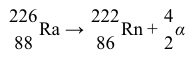
The most difficult alkaline-earth metal to study is radium, because it is a rare radioactive element that is produced from the nuclear decay of uranium.  The most common natural isotope, radium-226, has a half-life of 1,600 years and decays by alpha emission into radon-222 (Reaction 4) .
Passage The alkaline-earth metals are a highly reactive family of metals occupying Group 2 (IIA)  of the periodic table.  In their elemental form, the alkaline-earth metals have a shiny, silvery-white to slightly yellowish appearance.  The alkaline-earth metals exhibit some similarities to the chemistry of the alkali metals (Group 1)  but are a little less reactive.Atoms of the alkaline-earth metals (M)  have only two valence electrons and a low first and second ionization energy.  Consequently, these metals readily lose both electrons to produce cations with a +2 charge (M<sup>+2</sup>)  during reactions with nonmetals.  As a result, the alkaline-earth metals do not exist in their elemental metallic form in nature.  Instead, the Group 2 elements are found primarily as metal oxides, which form by reacting oxygen (Reaction 1) .     Similarly, elemental samples of alkaline-earth metals will react with elemental halogens (X<sub>2</sub>)  to form metal halides (Reaction 2) , all of which are ionic except for BeCl<sub>2</sub>.     Except for beryllium, the alkaline-earth metals react with water to produce very basic metal hydroxide solutions and hydrogen gas (Reaction 3) .     The most difficult alkaline-earth metal to study is radium, because it is a rare radioactive element that is produced from the nuclear decay of uranium.  The most common natural isotope, radium-226, has a half-life of 1,600 years and decays by alpha emission into radon-222 (Reaction 4) .    -The rate-determining step for the overall reaction in Figure 1 is the conversion of: A) Compound <strong>1</strong> into the intermediate. B) Compound <strong>1</strong> into Compound <strong>3</strong>. C) the intermediate into Compound <strong>2</strong>. D) the intermediate into Compound <strong>3</strong>.
-The rate-determining step for the overall reaction in Figure 1 is the conversion of:


A) Compound 1 into the intermediate.
B) Compound 1 into Compound 3.
C) the intermediate into Compound 2.
D) the intermediate into Compound 3.

Correct Answer:

verifed

Verified

Unlock this answer now
Get Access to more Verified Answers free of charge

Related Questions