Multiple Choice
Passage
An automated external defibrillator (AED) is a medical device used to send an electric shock to the heart after cardiac arrest. A key component of the AED is the power source, or battery. Batteries used in AEDs need to have a good charge-to-weight ratio; they must be safe and reliable as well as rechargeable.Two types of rechargeable batteries used in early models of AEDs are the lead storage (also called lead-acid) battery and the nickel-cadmium (NiCd) battery. These batteries consist of multiple electrochemical cells that are connected in series to deliver a potential between 9 V and 18 V. A capacitor allows the AED to accumulate charge so that it can deliver between 300 V and 1,000 V.Some AEDs use a sealed lead storage battery. Lead storage batteries are robust and hold a charge for a long time. However, they have a low energy-to-weight ratio. Each lead storage cell delivers approximately 2.0 V, and a battery of four cells weighing 1000 g can provide 30 W∙h of energy.
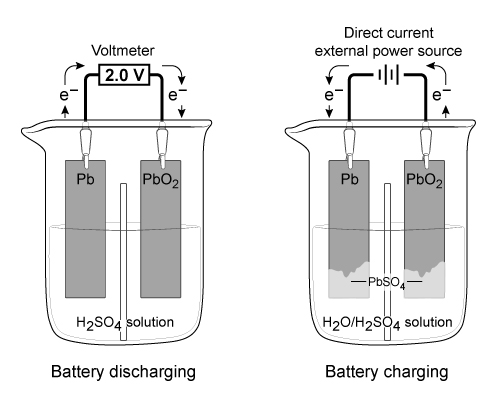 Figure 1 Electron flow in a lead storage battery when discharging and chargingThe half reactions for the anode and cathode of a lead storage battery in 4 M of sulfuric acid (H2SO4) are shown in Reactions 1 and 2:
 Reaction 1
 Reaction 2
NiCd batteries have a higher energy-to-weight ratio than lead storage batteries but cannot hold as much charge. Each NiCd cell delivers approximately 1.3 V, and a single-cell battery weighing 120 g can provide 7.2 W∙h of energy.The half reactions at the anode and cathode for a NiCd battery in KOH are shown in Reactions 3 and 4:
 Reaction 3
 Reaction 4
-To charge the NiCd cell, the applied external potential must be:
A) equal to 1.3 V.
B) greater than 1.3 V.
C) equal to −1.3 V.
D) less than −1.3 V.
Correct Answer:

Verified
Correct Answer:
Verified
Q177: Passage<br>Household cleaners commonly contain either ammonia (NH<sub>3</sub>)
Q178: Which of the following will occur during
Q179: If each of the following is an
Q180: Passage<br>Water is unique in that all three
Q181: Passage<br>Catabolism is an oxidative process in which
Q183: When ammonia burns in air, nitrogen dioxide
Q184: Passage<br>Oxytocin is a naturally occurring peptide hormone
Q185: Some test strips for blood glucose meters
Q186: Passage<br>Catabolism is an oxidative process in which
Q187: Consider the titration curve for aqueous ammonia