Multiple Choice
Passage
Dmitri Mendeleev is credited with grouping the elements by atomic mass and observing that similar properties emerge periodically. Henry Moseley then determined that a fundamental property, which Ernest Rutherford later called the atomic number, is more important than atomic mass for ordering the elements.As the periodic table took shape, scientists noted certain properties and trends. For example, Rayleigh and Ramsay observed that some elements are unreactive and gave them the name noble gases. But it was not until Niels Bohr described his model of the atom that scientists understood why noble gases are stable.Another important trend was discovered by Linus Pauling. He was the first to identify electronegativity as a way to describe bonds that are neither completely ionic nor completely covalent. Pauling assigned fluorine the highest electronegativity value of 4.0 because of its strong tendency to attract electrons when bonded to other atoms. All other atoms were assigned values relative to fluorine. This became known as the Pauling electronegativity scale.Scientists identified other trends based on x-ray crystallography and reactivity studies. Figure 1 shows the first ionization energy of the elements, and Figure 2 shows electron affinity.
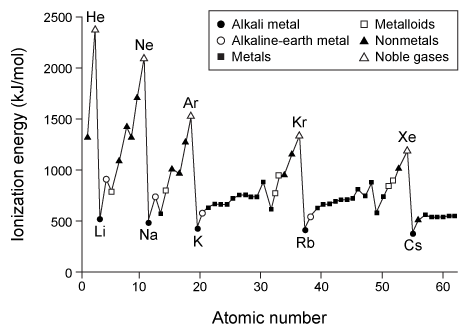 Figure 1 First ionization energy of elements
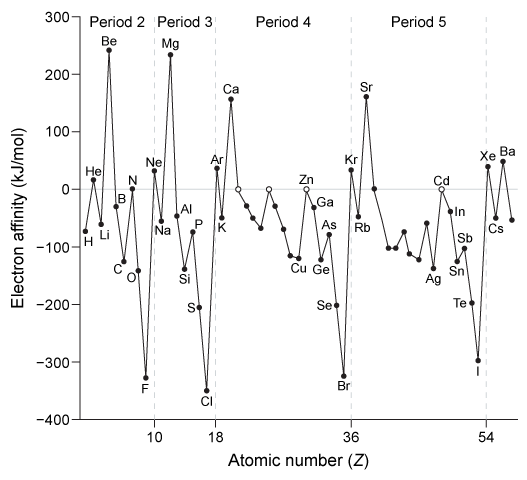 Figure 2 Electron affinity of several elements (larger negative values indicate greater electron affinity)
-According to trends in ionization energy, which metal would be the most reactive with Group 6A and 7A nonmetals?
A) Li
B) Na
C) K
D) Cs
Correct Answer:

Verified
Correct Answer:
Verified
Q277: Passage<br>Oxytocin is a naturally occurring peptide hormone
Q278: The overall reaction for the electrolysis of
Q279: Which of the following reactions requires the
Q280: Passage<br>Students conducted an experiment to determine the
Q281: Passage<br>Sulfur is the 10th most abundant element
Q283: Passage<br>Nuclear medicine uses radiopharmaceuticals for disease treatment
Q284: Passage<br>Although acetylsalicylic acid (aspirin) is a well-known
Q285: Passage<br>The bicarbonate (HCO<sub>3</sub><sup>−</sup>) buffer system (Reaction 1)
Q286: Passage<br>Kidney stones are a common ailment affecting
Q287: During beta decay, a radioactive atomic nucleus