Multiple Choice
Passage
Nuclear medicine uses radiopharmaceuticals for disease treatment and as tracers in medical imaging studies. Yttrium-90 (90Y) is a radiopharmaceutical agent used to treat overgrown joint lining known as pigmented villonodular synovitis, as well as some forms of liver cancer. It has a half-life of about 64 hours.Although the relatively short half-life of 90Y is optimal for use in medical applications, transportation and storage of the radiopharmaceutical are not feasible. As a result, strontium-90 (90Sr) , with a half-life of 28.8 years, is the most common source of 90Y. 90Sr is created by a nuclear fission process that begins with uranium-235 (235U) in a nuclear reactor as shown in Reaction 1.235U → 90Sr + ZReaction 1Fission of 235U produces 90Sr as well as additional fission products (Z) including, but not limited to, technetium-99 (99Tc) , iodine-129 (129I) , and zirconium-93 (93Zr) . Figure 1 shows the distribution of fission products.
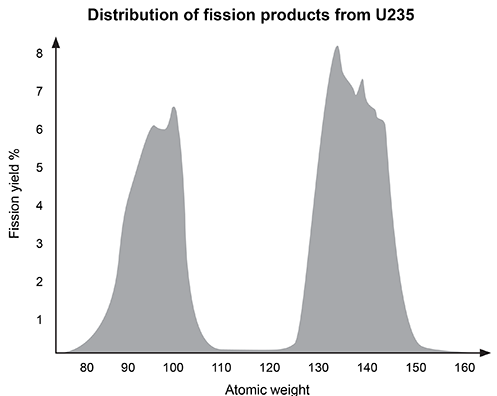 Figure 1 Distribution of 235U fission products by atomic weightTo create the final 90Y required for nuclear medicine studies, 90Sr decay is carried out in a controlled 90Y generator. 90Y is then separated from residual 90Sr for use in clinical applications.
Adapted from Wheeler CE. Comments on vaccines, August 1987. J Am Acad Dermatol. 1988;18(1 Pt 2) :232-4.
-Strontium is converted to yttrium by which of the following processes?
A) Electron capture
B) Positron emission
C) Gamma ray emission
D) Beta emission
Correct Answer:

Verified
Correct Answer:
Verified
Q278: The overall reaction for the electrolysis of
Q279: Which of the following reactions requires the
Q280: Passage<br>Students conducted an experiment to determine the
Q281: Passage<br>Sulfur is the 10th most abundant element
Q282: Passage<br>Dmitri Mendeleev is credited with grouping the
Q284: Passage<br>Although acetylsalicylic acid (aspirin) is a well-known
Q285: Passage<br>The bicarbonate (HCO<sub>3</sub><sup>−</sup>) buffer system (Reaction 1)
Q286: Passage<br>Kidney stones are a common ailment affecting
Q287: During beta decay, a radioactive atomic nucleus
Q288: Passage<br>Copper plays a vital role as a